An NFL preseason total looks like a forecast of a football game. It is really a forecast of a coaching decision, and that decision gets revealed to the market on a schedule you can actually read. The number posted on Tuesday is priced on a guess about who plays; the number at kickoff is priced on the answer. Everything about betting preseason over/unders well comes down to deciding which of those two numbers you want, and the answer is different for the over than it is for the under.
The Quick Answer
NFL preseason totals drift between the opener and kickoff because the market spends the week repricing playing time rather than talent, and that information leaks in a predictable order: joint-practice reports, then the head coach's press conference, then the game-day "our starters won't play" confirmation. Under bettors are generally trying to enter early, before the resting news is in the price; over bettors almost always need to wait for confirmation, because the news that helps them is the rarest kind. The full week-long timeline, the two entry windows, and the three traps that eat preseason totals bettors are below.
Why A Preseason Total Is A Playing-Time Bet
In the regular season, a total is a football question. You are pricing pace, efficiency, weather, and the two implied team totals that fall out of the spread. If you want that machinery in full, our NFL totals betting guide walks the whole thing, and this piece assumes it.
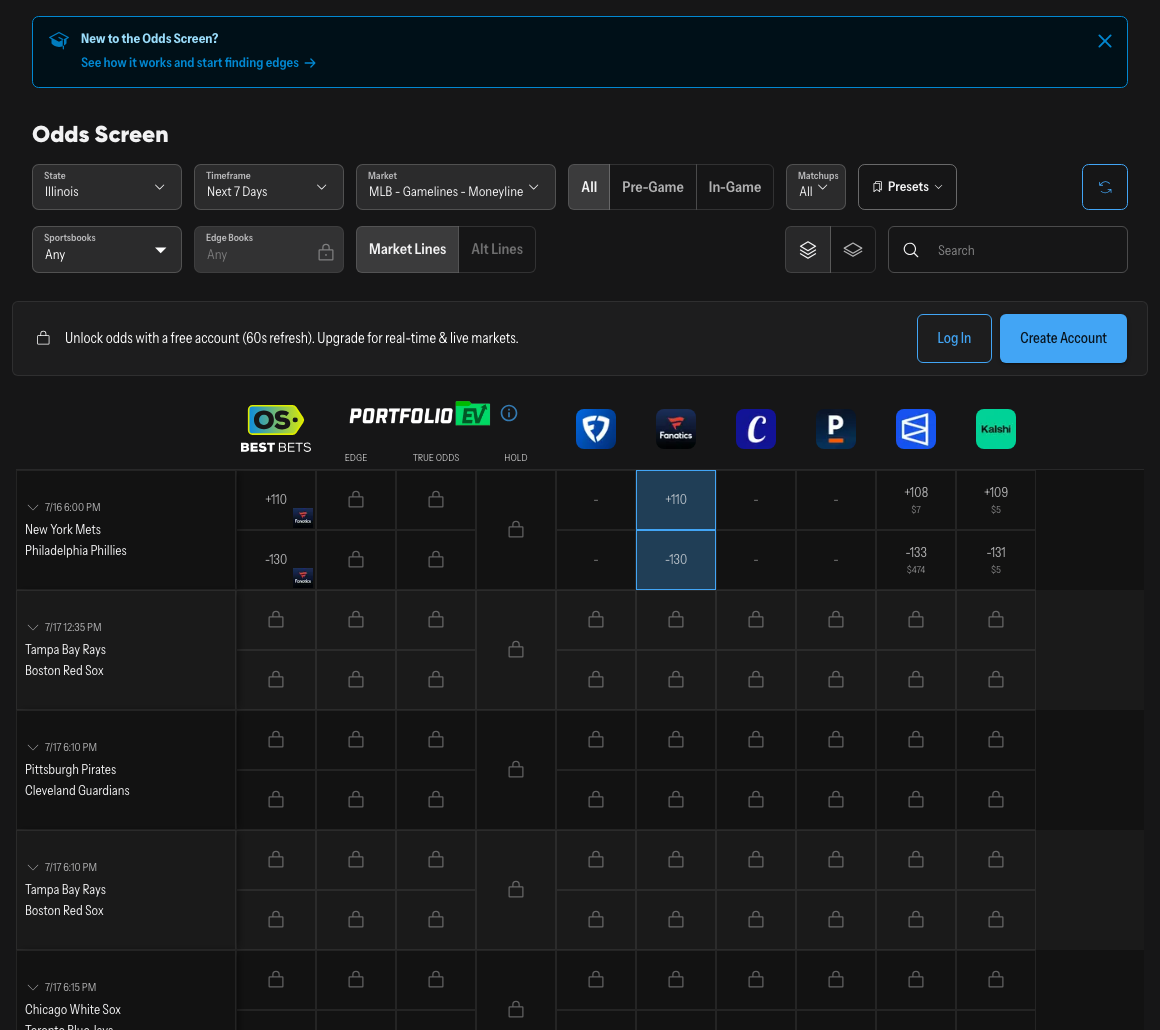
The odds screen with every book's number side by side: the gaps between them are the half-points you are shopping for.
August throws most of that out. The two rosters that will actually be on the field for much of the game are not the rosters on the depth chart, and the betting fundamentals that apply on a Sunday only get you to the starting line here. A starting quarterback might take six snaps. The player who decides whether a preseason game lands on 34 or 41 is a camp body fighting for the 53rd spot, and nobody has a stable projection for him. Not you, and not the book.
So the book does the only sensible thing: it posts a number built on an assumption about playing time and defends it with small limits. Every point of drift between the opener and kickoff is that assumption getting updated in public. Hold onto that idea. It explains the one asymmetry that makes preseason totals worth betting at all, and the timeline below is what exposes it.
The Drift: Why Saturday's Number Doesn't Sit Still
Preseason playing-time information arrives in stages, and the total moves as each stage lands. Count backwards from kickoff rather than from a weekday, because preseason games can run anywhere from Thursday to Sunday and an early kickoff compresses the whole cycle. The rough order:
| Time To Kickoff | What lands | Typical effect on the total |
|---|---|---|
| 4 Days Out | Opener posts | Priced off last year's coaching tendency and a generic playing-time assumption |
| 3–4 Days Out | Joint-practice reports (only when the two teams actually practised together) | Small moves; a team that scrimmaged its regulars all week often rests them on game day |
| 2–3 Days Out | Head coach's press conference | The biggest scheduled move of the cycle: "we'll see" versus a named plan |
| 1–2 Days Out | Beat-writer reporting, depth-chart leaks | Grinding, one-way drift as the resting picture firms up |
| Morning Of | Availability reports, announced sits, dress-status clues | The last real move; the number now is close to where it settles |
The row that matters most is the head coach's press conference. A head coach saying "our ones will get a series, maybe two" is a different total than "we're going to play a lot of guys," and unlike an injury report, that quote arrives at a scheduled time in front of cameras. It is the one moment in the cycle where you know in advance that information is coming. On a Thursday game the whole practice week compresses, so that presser can land barely a day before kickoff instead of two or three. Our coach-speak read on the preseason covers which staffs treat August as a real game and which treat it as practice in helmets, which is exactly the prior you should hold going into that presser.
Notice what almost never happens in that table: news that makes a coach play his starters more than expected. Playing-time news in the preseason is close to one-directional. Coaches announce rest; they rarely announce extra work. That one-way flow is the asymmetry I flagged earlier, and it is the reason the two entry windows are not mirror images.
Thin Limits Make Preseason Moves Loud — And Sometimes Fake
Preseason is a low-limit market, and the low limit is the defense. When public information beats the number, a book does not respond by pricing it sharper, it responds by refusing to take much of it. Books post preseason with limits a fraction of what they take on a regular-season game, because public reporting beats them here. It is the usual relationship in a concentrated form: main lines take the biggest bets and are the hardest to beat, and the markets you can actually beat take the smallest.
That has a consequence people misread constantly. When a regular-season total moves a full point across the market, real money did that. When a preseason total moves a full point, it might be one bettor with a four-figure wager clearing a book's overnight limit. The market is thinner, so the same move takes far less money to produce. Loudness and conviction are two different things here.
So the standard sharp-money reads need a discount here. Steam and reverse line movement still carry signal in August, but a single book moving alone is closer to noise than it would be in Week 8. The read I trust is a move that holds at three or more books for a couple of hours, and the mechanics of why that matters are in our line movement explainer. One book sitting at an outlier number in a thin market is usually just a shopping opportunity.
The Two Entry Windows
The rule I bet bythe under is a bet on news you expect, so take it early. The over is a bet you should only make after the news exists.
Here is where the asymmetry pays off. Because the news flow runs one way, toward less starter usage, the under and the over live in different windows.
Reading this on the morning of a game? The early window is already gone and one move is left: shop the current number across books, and check whether this week's drop actually held or bounced back. A number that slid and stayed is a different bet from one that slid and recovered.
If you want the under, early is usually your window. The information that is coming is information that helps you, and every hour that passes prices more of it in. If you have a real read on Tuesday that a staff is going to sit its regulars, the Tuesday number is the one that hasn't heard about it yet. Two separate forces are at work there and it is worth keeping them apart. Public bettors tend to prefer overs, which is part of why the opener sits high enough to be worth attacking in the first place; that is your edge at entry. What earns you the closing number is different: it is the resting news that lands after you bet, and that downward drift has to outrun whatever late over money arrives. In August the news usually wins that race, which is the whole bet. Beating the close is one of the better signals that a process is finding real value, and our CLV guide is the short version of why.
If you want the over, you almost always have to wait. The over needs starters on the field, a coach who wants live reps, or a game where both teams have real roster competition at the skill positions. Little of that is reliable at the opener unless a coach has already given a specific plan, and if you guess wrong you are holding a number that drifts against you for days. Waiting costs you price. It also removes the single biggest source of ruin on the bet, and on a market this soft, I would rather pay for certainty than get paid for a guess.
Which is why my Saturday-morning question is never "what will the score be" but "has the news landed yet, and does my side want it to have." Watch that play out across a single week and the cost of getting it backwards becomes obvious.
A Worked Example: One Saturday Total, Hour By Hour
Take an illustrative preseason game, using round numbers rather than a real market, where the total opens at 38.5 on Tuesday. Both staffs have a long history of pulling their regulars early, and neither has announced anything yet.
Wednesday afternoon, the home coach says his starters will "get a look" in the first quarter. Read against the opener's assumption that is a mild over signal, and the number ticks to 39. Thursday, the road team's beat writer reports that the road starters are done for the summer. Now the assumption flips the other way and the total slides to 37.5. By Friday night it is 37, and Saturday morning's beat reports and dress-status clues confirm what everyone already suspected.
The early under bettor got 38.5 and watched the market come to them. The one who waited for confirmation is taking 37 for the same outcome. The over bettor who chased 39 bought the single blip that ran against the week's direction and then spent two days watching their side get worse. Identical news, opposite results, decided entirely by when each of them entered.
Shop that whole sequence rather than watching one book. If a total is 37 in one place and 37.5 in another an hour before kickoff, that half-point costs nothing to capture on the live NFL totals odds screen, where you shop the number across every major book instead of taking whatever your one app shows. Books disagree on the same game, and there are structural reasons why.
Want to watch that sequence instead of reconstructing it?OddsShopper Pro shows every book's NFL total on one screen with the movement history attached, so you can see which drop held and which one bounced. It opens with a 7-day free trial, and code PRETOTALS20 takes 20% off your first payment after that.
Three Traps That Eat Preseason Totals Bettors
Chasing the move. Fighting a number that has already run is the most expensive habit in betting, and in a thin August market the run is often bigger than the information behind it. If a total dropped two points on a resting report, the resting report is in the price. Betting the under there is buying the news at retail.
Betting the over because it is more fun to sweat. Public bettors often prefer overs, so the shading tends to land in the number rather than the price. That shading is the mechanism behind the under lean, and it is why pulling the no-vig number out of the two prices comes before you call anything a value bet. Preseason concentrates the problem: casual August money piles onto overs in games where the starters are watching from the sideline in ball caps.
Teasing a preseason total. Teasers work on NFL point spreads because they move you through the key numbers of 3 and 7. Totals have key numbers too, but the clustering is far flatter, and preseason scoring is being produced by players whose distributions are far harder to model reliably. Most books will not tease a preseason game at all, and at the pricing the ones that will are offering, I do not.
How I Actually Play A Preseason Saturday
I do three things and skip everything else. I decide on Tuesday which side the week's news is likely to help — almost always the under — and I take a position then if the opener hasn't priced the staff's reputation. I hold the over back entirely until a coach has said something specific. And I check the number across the market twice: once when I place it, once about an hour before kickoff, because a stale outlier in a low-limit market is the cheapest half-point available all week.
Size it to the market, not to your conviction. The limit a book will take on a preseason total is telling you what the market thinks its own number is worth, and a bet you would happily fire in Week 8 is usually the wrong size in August. Partly because your edge is smaller than it feels, partly because hammering a thin overnight number moves the whole market against the rest of your week. Preseason rewards a small position taken at a good price across a few books. Pushing size through one is how you turn a small edge into a limited account.
If you would rather see where the market disagrees with itself than click through six apps, that comparison is what OddsShopper Pro is built to do: NFL totals from 20+ sportsbooks on one screen, with the movement history attached so you can see whether a drop held or bounced. Pro starts with a 7-day free trial, and code PRETOTALS20 takes 20% off your first payment after it.
And if you just want to see what our experts are on this weekend before committing to anything, the free expert picks today page is open to everyone.
NFL Preseason Totals FAQ
Why do NFL preseason totals move so much more than regular-season totals? Because I am not watching the same question get repriced. In November a total moves on injuries, weather and money. In August it moves on a coach announcing who plays, and that can change the identity of half the players on the field in one sentence. Add limits that are a fraction of a regular-season game's and every move looks bigger than the money behind it.
Is it better to bet a preseason total early or late? It depends which side you want, and I treat them differently. I will take an under early, because the news that is coming flows toward less starter usage and the opener has not heard it yet. I will not touch an over until a coach has confirmed real playing time, because guessing that a staff will play its regulars is the least reliable read available in August.
Do sharp bettors really bet preseason totals? Some do, and the reason is structural: preseason is thinly modelled and thinly traded, and public reporting favours the bettor there. The catch is that books know it too, so limits stay small. The realistic ceiling is a modest, well-shopped position, not a market you can push size into.
Should I bet first-half preseason totals instead of full-game? First-half markets isolate the window where your information is best, the stretch when starters and top backups are actually playing. There is a real argument for the segment bet there, though the pricing is often tighter and the limits smaller still, so shop it hard before assuming the derivative is the softer number.
How much does a half-point matter on a preseason total? Enough to be worth shopping for and not enough to pay a bad price for. Preseason scoring is noisy and there is no key-number cluster to cross the way there is on NFL spreads, so a half-point captured for free at a better book is worth taking, while paying steep juice to move a number half a point usually is not.
The Bottom Line
The reason a Saturday preseason total drifts all week is that it started life as a guess about a coach and ends life as a fact about a coach. That path is one-directional often enough to be tradeable, which is why the under wants the early number and the over wants the confirmed one. Get that sequencing right and preseason stops being the throwaway month between the draft and Week 1. It becomes one of the few windows all year where reading a press conference carefully is worth more than reading a box score.
If you want one rule to carry into Saturday: a coach who names a quarter is information, a coach who says "we'll see" is not, and a move I have not seen hold at three or more books for a couple of hours is not either. When an early under I already hold has been chased more than a point past my entry, I stop adding rather than double down on a number the market has now agreed with. The books have priced in your enthusiasm too, and they set the limits accordingly.
21+ and where legal. Never bet more than you can afford to lose.
More on this: NFL Preseason Props On Kalshi: Real Money, Fake Football · NFL Win Totals 2026: Kalshi Vs DraftKings Vs FanDuel · NFL Preseason Event Contracts, Explained In 60 Seconds · NFL Schedule This Week: All 16 Preseason Week 2 Games & Odds · Kalshi Gives The Cowboys And Patriots The Same Win Total