I've been staring at betting lines for years, and the thing that finally changed how I bet was realizing the number is a confession. Sharp money is hard to hide completely. When a betting syndicate or a respected professional gets down on a side, they move real money, and that money leaves a fingerprint on the line whether the book wants it to or not. Reverse line movement betting is the art of reading one of those fingerprints, and its louder cousin, the steam move, is the other. Learn to spot both and you stop guessing which way the smart money is leaning. The catch, and the part almost nobody gets right, is telling a real signal from market noise. We'll get to that, because it's where most of the money is won and lost.
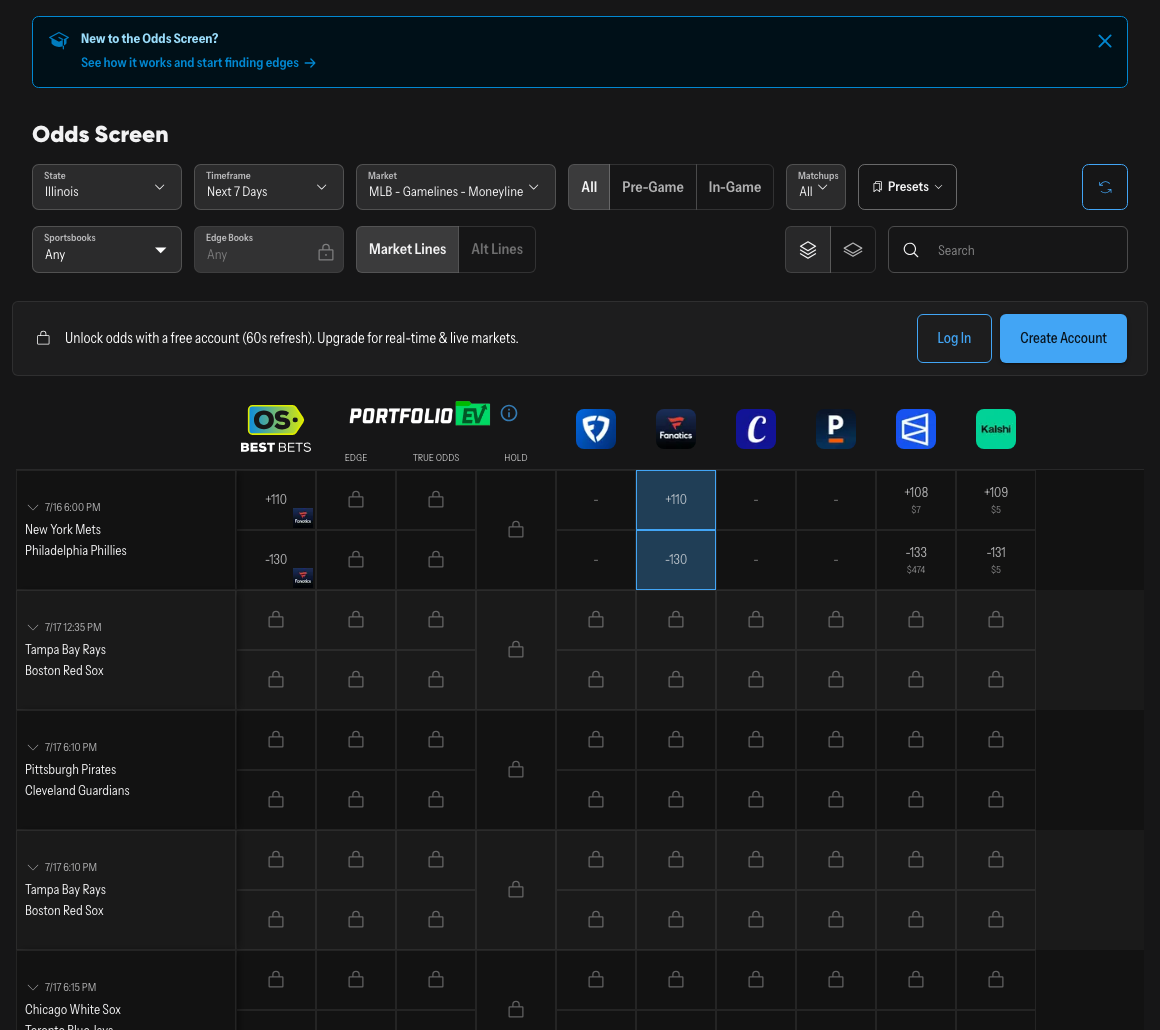 The OddsShopper live odds screen — every book's price on one board, refreshed in real time. Open the live board.
In Summary
Reverse line movement (RLM) is when a betting line moves against the side getting most of the bets. If 75% of tickets are on an NFL favorite but the number shrinks from -7 to -6 anyway, the public is on one side and the line is drifting the other way, which means the people with enough money and respect to move a market are on the other side. A steam move is the same signal turned up to 11: a sudden, uniform line shift across nearly every sportsbook at once, driven by heavy, coordinated syndicate action hitting many books in the same minute. Both can point to where the sharp money went, though they still need confirming against news and the rest of the market. To use them you have to see them, which means reading two things most bettors don't: how the line has actually moved over time, and where the professional money is landing. OddsShopper's line-movement history and Sharp Action tool are built to show exactly those two, and you weigh them against the public betting percentages (widely available for free) to spot the disagreement. The single hardest skill is separating a real move from a mirage, so most of this guide is about reading the signal correctly instead of chasing every wiggle on the board. If you're brand new to how odds work, start with how to read betting odds; this guide assumes you already know the difference between -110 and +130.
Watch The Video
The Sharp Action tool that makes these moves visible gets a full, hands-on walkthrough in our OddsShopper video, How to Copy Sharp Betting Action Before the Line Moves. Watch it to see the tool at work, then use this guide to apply that same sharp-money read to reverse line movement and steam.
What Reverse Line Movement Actually Tells You
Start with the ordinary case so the reverse case stands out. When enough money lands on one side, a book often adjusts the price toward that side, pricing its own risk and market position rather than simply trying to split the tickets evenly. Heavy money on the Chiefs? The Chiefs' price gets more expensive. That's normal line movement, and it tends to follow the crowd.
Reverse line movement is the exception that matters. Here the tickets say one thing and the number does the opposite. The public is loading up on a side, and instead of shading toward all that money, the book moves away from it. A number can drift against the tickets for boring reasons too, a key injury or a lineup scratch breaking midweek, so rule those out first. Once you have, the cleanest explanation left is the one worth acting on: a smaller pool of much larger, much sharper bets is landing on the unpopular side, and the book respects that money enough to move for it even while the ticket count screams the other way.
That's the whole insight in one line. Ticket count tells you where the bodies are; line movement tells you where the money is. When those two disagree, believe the money. Books don't move a number against 75% of the tickets to be charitable. They move it because the 25% they're moving for is sharp enough that ignoring it would cost them more than the crowd ever could.
Reverse Line Movement Vs. A Steam Move
RLM and steam get lumped together because both can point at sharp money, but they don't look the same on the board, and the distinction changes how you react.
| Signal | What it looks like | What's driving it | How fast you have to move |
|---|---|---|---|
| Reverse Line Movement | Line drifts opposite the public over minutes or hours | Sharp money quietly outweighing heavy public tickets | Deliberate; the edge lives in the gap between tickets and the number |
| Steam Move | Sudden, near-identical jump across most books at once | Syndicates firing large bets at many books in the same window | Immediate; the good number is gone in seconds to minutes |
The row I keep coming back to is the last one. RLM is a slow tell you can study, compare against ticket percentages, and act on with a clear head. A steam move is a stampede. By the time you've noticed a total rocket from 44.5 to 46 at every book simultaneously, the sharps have already gotten their number, and the price you can still get is the after price, not the one they beat you to. Both are sharp-money signals; only one of them waits for you.
That difference sets up the real problem. If the good number vanishes that fast, how are you supposed to catch these while they're still worth catching? You can't do it flipping between sportsbook apps by hand.
A Worked Example: Reading The Number Against The Public
Let me put illustrative numbers on it so the pattern is concrete. Say it's an NFL Sunday and an early line opens with the home favorite at -7. Through the week, the betting splits show something like 72% of spread tickets landing on that favorite. Ordinary logic says the line should climb toward -7.5 or -8 to keep pace with all that public money.
Instead the number does this:
Open: -7 (72% of tickets on the favorite) Midweek: -6.5 Kickoff: -6
The line fell a full point toward the underdog while nearly three-quarters of the tickets sat on the favorite. That's textbook reverse line movement. The public bet the popular team, and the market drifted the other way anyway, which tells you the heavier, sharper money was quietly backing the underdog while it was still getting +7. The signal isn't "bet the underdog blindly." It's that the number itself is disagreeing with the crowd, and that disagreement is information you can weigh before you decide.
Notice what made this legible: not the raw line, but the gap between where the tickets were (72% on the favorite) and where the number went (down toward the dog). A line moving is noise until you can see it against the money, and seeing that gap in real time is the entire job of the tools we're about to get into.
Where The Sharp Money Shows Up First
Here's the angle most explainers miss. Everyone tells you to watch "betting percentages," but ticket counts only show you the retail crowd. The sharp action often shows up first somewhere else entirely: on betting exchanges and prediction markets, where professionals get their real size down and the price is set by an order book rather than by a book manager shading for the public.
That's exactly the idea behind OddsShopper's Sharp Action tool. Instead of guessing from ticket splits, it reads the money on exchanges and prediction markets, pulling the order books from venues like Novig, ProphetX, Polymarket, and Kalshi, and shows you what that professional money believes is the true price. When the exchange money and the sportsbook line start to diverge, you're often looking at the earliest version of the same sharp signal that will show up as reverse line movement or a steam move on the retail books an hour later.
Pair that with the line-movement history on the odds screen, which timestamps how a side, total, or prop has moved and when, and the abstract idea of "sharp money" turns into something you can actually see: the exchange price leading, the retail line following. Suddenly the pro's read isn't a mystery, it's on your screen.
See the sharp money for yourself.OddsShopper Pro puts the Sharp Action tool and full line-movement history on one screen, so you can watch the exchange price lead and the retail line follow in real time. Use code RLM20 for 20% off.
How To Spot These Moves Without Guessing
So how do you catch a signal that can disappear in seconds? You stop watching one book and start watching the whole market at once. A few habits do most of the work:
- Compare The Line To The Tickets, Not To Itself. A number moving means nothing until you set it against the public betting percentages, which most odds sites and betting-splits pages publish for free. The RLM signal is the disagreement between the two, exactly like the example above.
- Watch Line-Movement History, Not Just The Current Price. The story is in the path the number took to get here and when it jumped, which is what the movement log preserves and a single screenshot can't.
- Read The Exchange And Prediction-Market Money. The Sharp Action tool surfaces where professional order flow is landing before the retail line fully adjusts, which is your earliest look at a move.
- Line-Shop The Moment You Spot One. When sharps move the number at one book, a slower book may still be hanging the old price. Getting the better number at that lagging book is often the entire edge, which is why serious bettors keep tracking line movement and shopping for the best number at the center of everything.
None of this requires you to be a syndicate. It requires you to see what they leave behind, fast enough to act, which is a tooling problem far more than a talent problem.
The Traps: When Line Movement Is Noise, Not Signal
Now the promise I made up top, because this is where discipline earns its keep. Not every wiggle is sharp money, and treating it that way is how you light money on fire.
The number already moved. This is the most expensive mistake. Go back to that NFL example: the sharp value lived at -7, when the dog was still hanging at the old number. Once the line has fallen to -6, there's little reason to think the professionals still love that side at the new price. They beat the number; you'd be taking the leftovers. Chasing a move after the value is gone is not following sharp money, it's paying full retail a step late.
Steam is rare. A true steam move is a coordinated market event, not a daily occurrence. If you think you're spotting "steam" on every game, you're almost certainly reading normal noise as signal. Real steam is uniform across the market and unmistakable; the fuzzy, one-book blips are usually just a book correcting its own mistake.
The discipline rulea move is only a signal if you can act while the value is still live and the same money shows up at more than one book. Everything else is a number wiggling, and wiggles are free to ignore.
Mirage moves happen. Sometimes a single book moves hard and the rest of the market never follows. That's not the sharps hitting everywhere at once; it's often one shop reacting to a lopsided position or a limit bettor, and it fizzles. This is the whole reason to watch the market, not a lone number. A move only counts as signal when the money behind it shows up in more than one place, which is exactly the cross-market picture the tools are built to give you.
The through-line from the very first paragraph holds up here: the number is a confession, but only if you can hear it clearly. Sharp money leaves fingerprints, and the difference between a winning read and a losing one isn't knowing the definitions of RLM and steam. It's the patience to weigh a move against the crowd, the speed to act while the value's still live, and the honesty to walk away when what you're staring at is just noise wearing a sharp costume.
Ready To Read The Market Like A Pro?
You don't need to guess where the money is. OddsShopper Pro puts the line-movement history and the Sharp Action tool on one screen, so you can see how a number moved and where the professional exchange money is landing side by side, then catch a move while the number's still worth taking.
Read the sharp side, not the crowd.Use code RLM20 for 20% off OddsShopper Pro and get the line-movement history + Sharp Action tool in one place.
More on this: Line Movement Explained: Steam & Reverse Line Moves · Sharp Money Tracker: How To Follow Sharp Betting Action Before The Line Moves · Seahawks Vs Patriots Spread: Kalshi Leans Toward 4. Pinnacle Toward 3. · NHL Puck Line Betting Explained: Hockey Terms To Know · MLB Run Line Explained
Frequently Asked Questions
What is reverse line movement in betting? Reverse line movement is when a betting line moves in the opposite direction of the public's bets, for example a favorite dropping from -7 to -6 while most tickets are still on the favorite. It signals that sharper, larger money is on the less-popular side, and the book is moving the number to respect that money rather than the crowd.
What is a steam move? A steam move is a sudden, uniform line shift that happens across nearly every sportsbook at almost the same time. It's usually caused by betting syndicates placing large bets at many books simultaneously, and it moves fast, so the best number is typically gone within seconds to minutes.
Does following reverse line movement or a steam move win on its own? No. These are sharp-money signals, nothing more. Their value depends heavily on timing: once the line has already moved to the new number, most of the edge the sharps captured is gone. They're information to weigh, not a system that prints money by itself.
How do I actually track reverse line movement and steam moves? You need to see line movement against betting percentages across the whole market, plus where professional money is landing. OddsShopper's line-movement history shows how and when a number moved, and the Sharp Action tool reads exchange and prediction-market money (Novig, ProphetX, Polymarket, Kalshi) so you can spot a move early instead of after the value's gone.
Why does the line move away from the side getting most of the bets? Because ticket count and money are different things. A book will move against 75% of the tickets when the other 25% is sharp enough that ignoring it would cost more than the public ever could. The number follows the money, not the crowd. For the mechanics of how books price and shade markets, see how sportsbooks make money.
Bet responsibly. If you or someone you know has a gambling problem, call 1-800-GAMBLER.