Betting on NFL football looks intimidating from the outside: a wall of numbers, plus and minus signs, and terms like "the vig" and "the hook" that nobody bothers to explain. It is simpler than it looks. Once you can read a set of NFL odds and you know the handful of bets that make up almost every wager, you can walk up to any sportsbook and place a smart pro football bet in under a minute. This guide takes you from zero to your first NFL bet: how to read the odds, the main bet types with real examples, the rhythm of the betting week, how to protect your bankroll, and the one habit that quietly saves you money on every bet before you ever get a pick right.
How To Read NFL Odds
Every NFL bet is priced in American odds, which use a plus or minus sign in front of a number. Learn to read these and the rest of betting falls into place.
- A minus number is the favorite and tells you how much you must risk to win $100. A team at -150 means you bet $150 to win $100.
- A plus number is the underdog and tells you how much you win on a $100 bet. A team at +150 means a $100 bet wins $150.
You do not have to bet in $100 units. The odds are just a ratio, so a $10 bet at +150 wins $15, and a $20 bet at -150 wins about $13. Every sportsbook app also shows your exact payout before you confirm, so you never have to do the math in your head.
Why Bigger Underdog Odds Are Better (And The Vig)
One beginner point pays off forever: a bigger positive number pays you more for the same win. A team at +220 returns $220 on a $100 bet; the same team at +150 returns only $150. If two sportsbooks list the same underdog, the one at +220 is flatly the better price. That is why serious bettors care about getting the best number, a habit we cover below.
You will also notice that most point-spread and totals bets are priced around -110 on both sides. That extra 10 cents is the vig (also called juice), the sportsbook's built-in commission. At -110 you risk $110 to win $100, which is why winning 50% of your bets is not enough to break even. You need to win about 52.4% of -110 bets to turn a profit, because the vig is baked into the price. Understanding that number is the whole reason line shopping matters.
Every price also maps to an implied probability, the win rate the odds are quoting. A few common NFL prices:
| American Odds | Implied win probability | Profit on a $100 win |
|---|---|---|
| -280 (Heavy Favorite) | ~73.7% | $35.70 |
| -150 (Favorite) | ~60.0% | $66.70 |
| -110 (Standard) | ~52.4% | $90.90 |
| +150 (Underdog) | ~40.0% | $150 |
| +220 (Bigger Dog) | ~31.3% | $220 |
If you think a team wins more often than its price implies, that is a bet worth making. Our implied probability guide breaks the conversion down, and the odds calculator does it for you in one click.
The Main NFL Bet Types
Almost every NFL wager is one of the types below. Here's the quick map before we walk through each one.
| Bet Type | What you're picking | Typical price | Best for |
|---|---|---|---|
| Moneyline | Which team wins outright | Favorite -280 / dog +230 | Beginners, live dogs |
| Point Spread | Winner after a handicap | Around -110 each side | The most popular NFL bet |
| Total (Over/Under) | Combined points over/under a number | Around -110 each side | Game-flow reads, weather |
| Player Prop | One player's stat line | Varies widely | Softer, less efficient markets |
| Parlay | Multiple bets that all must hit | Multiplied payout | Small stakes, big upside |
Moneyline: Just Pick The Winner
A moneyline bet is the simplest wager in football: pick which team wins the game, straight up. Say the Kansas City Chiefs are -280 at home against the Denver Broncos at +230. Bet $100 on the Chiefs and you profit about $36 if they win; bet $100 on the Broncos and you profit $230 if they pull the upset. The favorite costs more because it wins more often. Moneylines are a clean starting point, and they shine on live underdogs you think are being underrated.
Point Spread: The NFL's Signature Bet
The point spread is the bet most associated with pro football. Instead of just picking a winner, you are betting on the margin of victory. The sportsbook handicaps the favorite by a number of points:
- Chiefs -6.5 means Kansas City must win by 7 or more for your bet to cash.
- Broncos +6.5 means Denver can lose by 6 or fewer (or win outright) and you still win.
Both sides are usually priced around -110. The half-point (the "hook") exists so there is a clear winner with no tie. When you see a whole number like -7 with no hook, a final margin of exactly 7 is a push and your stake is refunded. Spreads are where NFL key numbers matter most, which we cover in a minute. For a deeper walkthrough, see our point spread betting guide.
Totals: Betting The Scoreboard, Not The Winner
A total (or over/under) has nothing to do with who wins. The sportsbook posts a combined-points number, say 45.5, and you bet whether the two teams combine to score more (over) or fewer (under) than that. If the Chiefs beat the Broncos 27-20, that is 47 total points, an over. Totals are where game environment does the work: a fast-paced dome matchup leans over, while wind above 15 mph grounds the passing game and often points to the under. Our over/under guide goes deeper on reading totals.
Player Props: The Beginner-Friendly Growth Market
A player prop is a bet on one player's individual stat line, not the game result: Patrick Mahomes over 274.5 passing yards, a running back to score an anytime touchdown, a receiver over 5.5 receptions. Props are a great lane for newer bettors because the markets are softer than spreads and totals, meaning the sportsbook spends less effort pricing them precisely. A useful beginner angle: dual-threat quarterbacks who both pass and run often have their rushing yards props posted lower than their real workload suggests, because the market tends to price them as passers first. Learn the format in our prop betting guide.
Parlays: More Bets, Bigger Payout, Lower Odds
A parlay ties multiple bets onto one ticket. Every leg must win or the whole ticket loses, and in exchange the payout multiplies. Here's the actual math on a two-team NFL parlay with both legs at -110:
Worked example.Each -110 leg is worth about 1.91 in decimal odds. Multiply them: 1.91 × 1.91 ≈ 3.64. A $100 two-leg parlay returns about $364 (a $264 profit), which is roughly +264 in American odds. Add a third leg at the same price and the potential payout approaches +600.
The tradeoff is real: the more legs you add, the lower your chance of hitting all of them. Parlays are fun for small stakes, but loading up on heavy favorites just to reach a bigger number, regardless of whether each leg is a good price, is a common beginner trap. The parlay calculator shows you the exact payout for any combination before you bet.
A teaser is a special NFL parlay that lets you move each spread or total in your favor by a set number of points (usually 6) for a smaller payout. It is a more advanced tool; our teaser bets guide explains when they are worth it.
NFL Key Numbers: Why 3 And 7 Matter
Because NFL scoring runs on field goals (3 points) and touchdowns plus the extra point (7), games are decided by certain margins far more often than others. The two most common margins of victory are 3 and 7, with 6 and 10 close behind. That is why a spread of -3 is worth much more than -2.5, and why getting a +7 underdog instead of +6.5 can be the difference between a win and a push.
As a beginner you don't need to master this, but keep one rule in mind: the number you bet at matters as much as the side you pick. A great read on the game at a bad number is still a bad bet. Our NFL betting strategy pillar covers key numbers, buying half-points, and timing in full once you are ready to level up.
The NFL Betting Week: When To Bet
Unlike daily sports, the NFL runs on a weekly rhythm, and knowing it helps you bet at the right time:
- Early Week (Sunday Night Through Tuesday): opening lines post and are at their softest. If you love a favorite, betting it early often gets you a better number before the public piles in.
- Midweek (Wednesday–Friday): injury reports come out. Practice participation and game-status designations move lines all week, so this is when the picture sharpens.
- Late Week / Game Day: lines have absorbed most of the information. If you want an underdog, waiting later in the week sometimes gets you a bigger number as favorite money pushes the line.
- 90 Minutes Before Kickoff: official inactives are released. A star being ruled out can swing a total or a prop instantly, so always check inactives before betting a specific player.
- Thursday Games come on a short week, which compresses prep and can inflate sloppiness and injury risk.
The takeaway: NFL lines are alive all week. Checking them more than once, and knowing when your side offers the best price, is a genuine edge.
Bankroll Basics: Bet Small And Bet Flat
The fastest way to blow up as a new bettor is betting too big. A simple, durable approach:
- Set A Bankroll you are comfortable losing entirely, separate from rent and bills.
- Bet A Flat 1–2% Of It Per Wager. On a $500 bankroll, that is $5–$10 a bet. Flat staking keeps one bad Sunday from wiping you out.
- Never Chase Losses. Doubling your bet size to "get it back" is how small losses become big ones.
Betting is entertainment with a cost of admission, not an income plan. If it ever stops being fun, step away, and if you need help, call 1-800-GAMBLER. You must be 21+ and in a state where betting is legal.
Line Shopping: The Easiest Edge In NFL Betting
This is the habit that separates winning bettors from everyone else, and it has nothing to do with picking games. Different sportsbooks post different prices on the same bet. One book might have the Chiefs at -6.5, another at -7; one might price a dog at +220 while another sits at +200. Over a season, always taking the better number adds up to real money, because you are lowering the vig you pay on every single ticket.
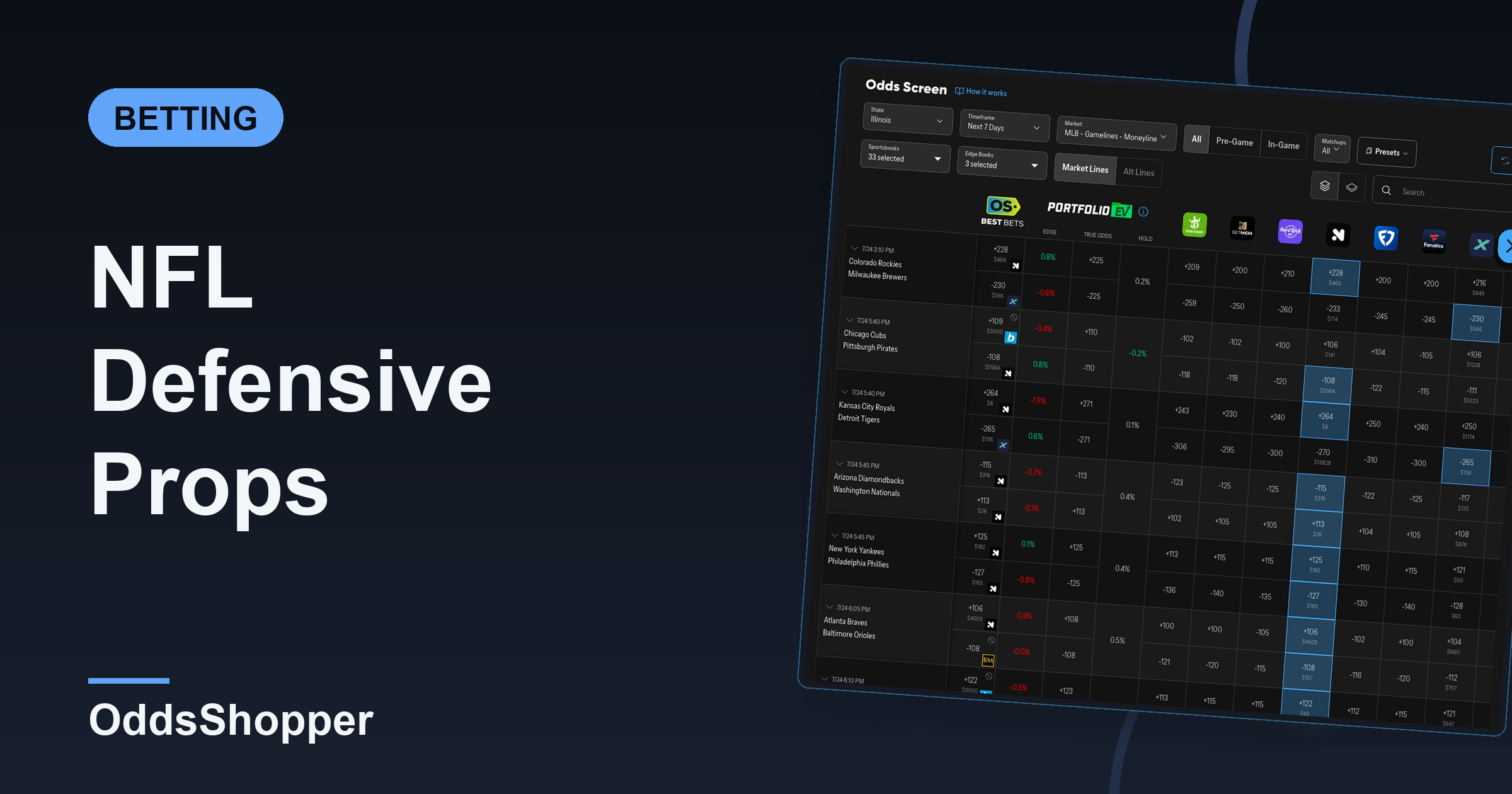
Doing this by hand across DraftKings 🎁, FanDuel 🎁, BetMGM 🎁, and Caesars is slow. This is exactly what OddsShopper was built for: it scans 100+ sportsbooks at once and shows you which book has the best number on any NFL game or prop, so you never leave value on the table. You can see it live on the OddsShopper NFL odds screen.
New to OddsShopper?It scans 100+ sportsbooks in seconds and flags the best NFL number and the bets priced in your favor, so you do the line shopping this guide just described automatically. You can try it free for 7 days, and code NFLBET20 takes 20% off OS Pro or OS Core if you subscribe. See today's edges free
How To Place Your First NFL Bet
Ready to actually do it? The walkthrough:
- Sign up at a licensed sportsbook available in your state and make a small deposit.
- Find your game in the NFL section. You will see moneyline, spread, and total for every matchup.
- Compare the price. Before you tap a bet, check the same line on OddsShopper to make sure your book has a competitive number.
- Tap the bet you want. It drops into your bet slip.
- Enter your stake (start small, 1–2% of your bankroll). The slip shows your exact payout.
- Confirm. That is a placed bet. Now you just watch the game.
Start with a single moneyline or spread bet on a game you already plan to watch. Skip the temptation to fire a big parlay on your first try. Get comfortable with the mechanics first, then branch out.
Where NFL Betting Is Legal
Online sports betting is legal and live in a large and growing number of regulated U.S. states, but it is not available everywhere, and the rules differ by jurisdiction. Only bet with a sportsbook licensed in your state, and confirm betting is legal where you are before you deposit. Never bet with an offshore or unlicensed book.
Find The Best NFL Number With OddsShopper
Everything in this guide points to one idea: in NFL betting, the price you get is as important as the team you pick. Reading odds, understanding the vig, and line shopping all come back to paying less to win more. OddsShopper does that work for you. It compares every major sportsbook in real time, surfaces the best available number on any NFL bet, and flags the wagers the market has priced in your favor, the same +EV bets a sharp bettor hunts for by hand.
Stop leaving the better number on the table. OddsShopper finds it for you across 100+ books. Try it free for 7 days, then keep it for 20% off OS Pro or OS Core with code NFLBET20 (less than a coffee a day). See today's edges free
Frequently Asked Questions
What is the easiest NFL bet for beginners? The moneyline is the simplest, since you only pick the winner. Point spreads and totals are close behind and are the most popular NFL bets once you understand handicapping.
How much should I bet on NFL games as a beginner? Bet a flat 1–2% of a bankroll you can afford to lose. On a $500 bankroll, that is $5–$10 per bet. Flat, small staking is the single best habit for lasting longer.
What does -110 mean in NFL betting? It is the standard price with the vig included: you risk $110 to win $100. Because of that built-in commission, you need to win about 52.4% of -110 bets to break even.
Why does one sportsbook have different odds than another? Each book prices independently, so the same NFL game can carry different spreads and payouts. Taking the best available number, called line shopping, lowers the vig you pay and is why tools like OddsShopper exist.
When is the best time to bet on NFL? Bet favorites early in the week when lines are softest, and consider waiting on underdogs until later as the number moves. Always check inactives, released about 90 minutes before kickoff.
More on this: How To Bet NFL On DraftKings: A Beginner's Guide · NFL 2026 on Kalshi: Every Board We Track · NFL Coach Of The Year Odds: Kalshi Fades A Two-Time Winner · NFL Picks Hub: Week 1 Odds, Win Totals, Props · NFL Win Totals 2026: Kalshi Vs DraftKings Vs FanDuel
The Bottom Line
You don't need to be a math whiz to bet the NFL well. Learn to read American odds, understand that the vig is why you need to win about 52.4% of standard bets, and start with simple moneyline or spread wagers at small, flat stakes. Then build the one habit that compounds all season: always get the best number. Line-shop every bet with the OddsShopper NFL odds screen, and when you are ready to go deeper on key numbers and timing, our NFL betting strategy guide is the next step.