Last updated: July 21, 2026
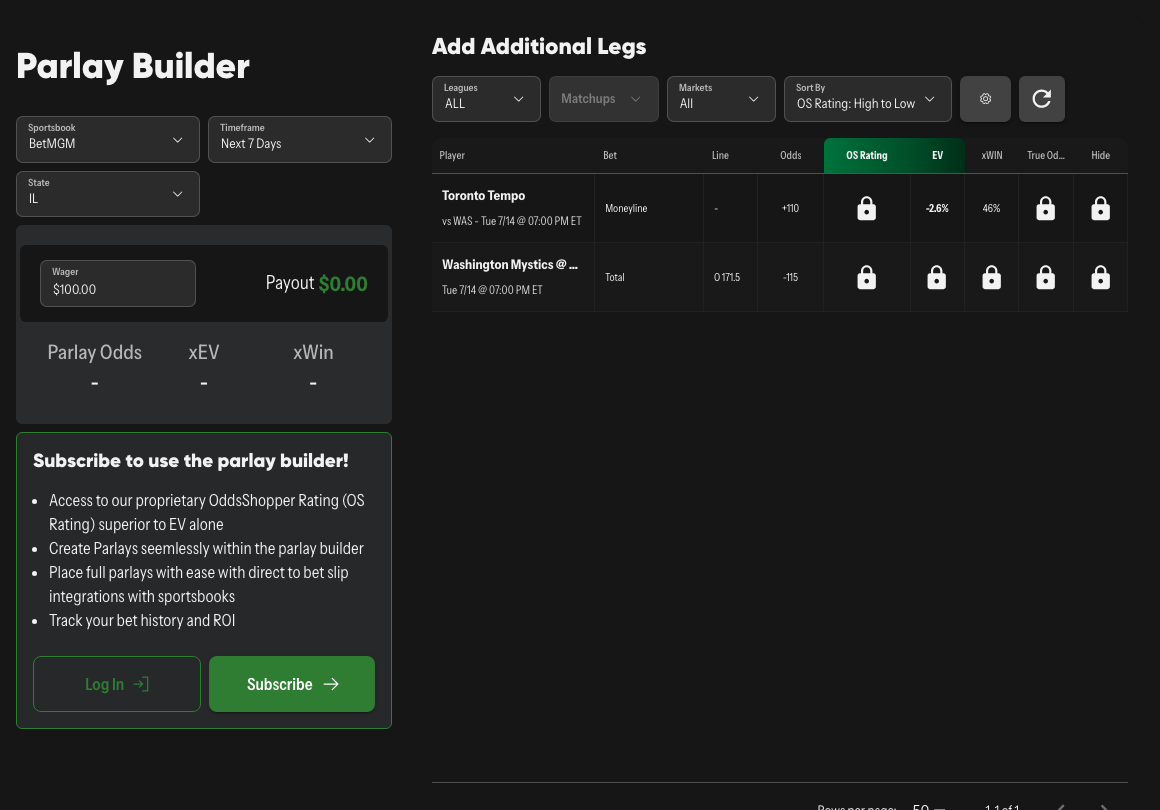
The OddsShopper Parlay Builder.
In Summary
A betting odds calculator does two jobs from one input. Give it your stake and the price, and it tells you the exact dollars coming back if the bet wins (the payout), how much of that is profit on top of your stake, and the implied probability the price is built on. That return answers "what does this pay?" The probability answers "is this worth betting?" Most calculators stop at the first question. This guide covers the payout and profit math for every odds format, the way parlay payouts multiply, and the part that actually grows a bankroll: reading the probability underneath the price so you only bet when the number tilts your way.
Payout Vs. Profit: The Distinction That Trips Everyone Up
Before any math, get one thing straight, because it is the most common mistake new bettors make.
- Profit is what you win on top of your stake.
- Payout (also called total return) is your profit plus your original stake handed back.
Put $100 on a +150 underdog and you win $150 in profit, and your $100 stake comes back too, so the payout is $250. The book did not pay you $250 of winnings; it paid $150 and returned your money. Decimal odds quote the payout, American odds quote the profit, and mixing them up is how people think a bet pays more than it does. An odds calculator keeps the two straight for you.
The Payout Formulas For Every Odds Format
Each format calculates the same payout a slightly different way. For negative American odds, drop the minus sign and use the bare number (so -150 goes in as 150).
American odds
- Positive odds profit:
stake × (odds / 100). A $100 bet at +150 returns100 × 1.50 = $150profit, $250 payout. - Negative odds profit:
stake × (100 / odds). A $100 bet at -150 returns100 × 0.667 = $66.67profit, $166.67 payout.
Decimal odds
- Total payout:
stake × decimal. At 2.50, a $100 stake returns100 × 2.50 = $250payout, $150 of it profit. Decimal already includes your stake, which is why it is the cleanest format for payout math.
Fractional odds
- Profit:
stake × (numerator / denominator). At 3/2, a $100 stake returns100 × 1.5 = $150profit, $250 payout.
All three describe the identical bet. Pick the format you read fastest; the payout comes out the same once you know whether the number already includes your stake.
The Payout Reference Table
This is the table a payout calculator fills in for you: what a flat $100 stake returns at common prices, profit and total payout side by side. Scale it to any stake: double the stake, double both columns.
| Odds (American) | Decimal | Profit on $100 | Total Payout |
|---|---|---|---|
| -200 | 1.50 | $50.00 | $150.00 |
| -150 | 1.67 | $66.67 | $166.67 |
| -110 | 1.91 | $90.91 | $190.91 |
| +100 (Even) | 2.00 | $100.00 | $200.00 |
| +150 | 2.50 | $150.00 | $250.00 |
| +200 | 3.00 | $200.00 | $300.00 |
| +250 | 3.50 | $250.00 | $350.00 |
| +400 | 5.00 | $400.00 | $500.00 |
Decimal odds are rounded to two places for readability; the profit and payout columns are computed from the exact decimal, so -110 shows 1.91 but pays the full $90.91.
Read down the profit column and the logic of pricing shows up: the longer the underdog, the more the same $100 returns, because the price is paying you for an outcome the book thinks is less likely. That trade-off is exactly what implied probability measures, which we get to below.
How Parlay Payouts Multiply
A parlay is where a parlay payout calculator earns its keep, because the math is not addition, it is multiplication. To get a parlay's payout you convert every leg to decimal, multiply them together, then multiply by your stake.
Take three legs each priced -110, which is decimal 1.9091. Multiply: 1.9091 × 1.9091 × 1.9091 ≈ 6.958. So a $100 three-leg parlay returns about 100 × 6.958 = $695.80 total, with roughly $595.80 of that as profit. In American terms that parlay prices out near +595, far longer than any single leg, because every leg has to hit.
There is a hidden cost buried in that number. The book's hold compounds with every leg you add, so a parlay carries more built-in margin than any single bet inside it. The bigger the price on the ticket, the bigger the cut baked into it, which is why parlays are the most profitable bet on the board for the sportsbook, not for you.
The parlay trapthat multiplication is the appeal and the danger at once. The total balloons fast, but so does the chance the whole ticket busts on a single miss. The math only rewards you when every leg is itself a good price, not when you bolt on extra legs to chase a bigger number.
Our parlay betting guide covers how to build them without giving the edge back, and our parlay calculator runs the leg-by-leg multiplication for you.
Implied Probability: The Number That Tells You Whether To Bet
A return figure tells you what a bet pays. It says nothing about whether you should make it. For that you convert the price into implied probability, the percentage chance the price is built on. That single number is the only thing an implied probability calculator exists to give you, and it is the most useful one on this page.
- From decimal:
1 / decimal. So 2.50 becomes1 / 2.50 = 40.0%. - From positive American odds:
100 / (odds + 100). So +150 becomes100 / 250 = 40.0%. - From negative American odds:
odds / (odds + 100). So -150 becomes150 / 250 = 60.0%.
Implied probability is the price restated as "how often this has to win for the book to break even." It is the one number in betting you can have an opinion about, because you can compare it to your own read of how likely the outcome really is.
The shortcutconvert any price to a percent, then ask one question. "Do I think this happens more often than that percent?" If yes, the bet is priced in your favor. If no, pass, no matter how much you like the side.
One Catch: The Vig Inflates Every Implied Probability
Add up both sides of a normal market and you get more than 100%. A game priced -110 on each side converts to 52.38% twice, which sums to 104.76%. That extra amount above 100% is the vig, also called the overround: 4.76% on this game, the book's built-in margin. It means the raw implied probability slightly overstates the book's true estimate. To judge a bet properly you strip that margin out to get the no-vig probability, which we cover in how to remove the vig. For a quick gut check the raw percent is fine; for a real value decision, de-vig first.
A Worked Example: From Price To Payout To Decision
Say you like a baseball team to win and your read is that it wins about 55% of the time. The best price you can find is -110.
First the payout: a $100 bet at -110 returns $90.91 profit, $190.91 total. Now the part that matters. Convert -110 to implied probability: 110 / (110 + 100) = 52.4%. Your estimate of 55% is higher than the 52.4% the price implies, so the book is paying you as if the team wins less often than you believe it does. That roughly 2.6-point gap is your edge, and that gap is positive expected value. Betting prices like this over and over is how an edge becomes profit across a season. Our guide on how to find +EV bets walks through it in full.
Flip the number and the bet diesat -150 the same team implies 60.0%, which is above your 55% read. Identical team, identical game, but now the price is against you, so the right move is to pass.
Computing the return was the easy half. The decision came from the probability.
Why The Best Number Matters: +150 Vs. +200
Look back at the payout table. A team at +150 pays $150 profit on $100 and implies 40.0%. The same team at +200 pays $200 profit and implies 33.3%. Nothing about the bet changed. Only the price did, and the better number pays $50 more on the same risk while requiring the outcome to be less likely.
That is the extreme version of a gap you can capture every day. In real life the spreads are smaller: DraftKings might post a team at +150 while FanDuel has +162 and BetMGM sits at +155 on the exact same wager. None of that requires you to be right about the game. You just take the highest number every time, and over a season those few extra points compound into real money. This is line shopping, comparing the same bet across sportsbooks and grabbing the best available price, and it is the most reliable edge in betting that needs no handicapping at all. It is also the habit behind beating the number the market settles on, which is what closing line value explained is about. The same math runs on any sport, so a football-specific version lives in our NFL betting calculator if that is your board. If you are still getting comfortable reading prices, start with how to read betting odds.
New to OddsShopper?It scans 100+ sportsbooks at once and flags the bets priced in your favor, running the same convert-and-compare math this guide just walked through, automatically across every book. You can try it free for 7 days, and code ODDS20 takes 20% off OS Pro or OS Core if you subscribe.
How OddsShopper Calculates It All For You
Running these formulas by hand is worth understanding, but you will not do it before every bet. OddsShopper's tools calculate each price for you and take the next step automatically:
- The odds screen shows the same bet across 100+ books so you can grab the best payout without checking each one yourself. Compare live prices on the OddsShopper odds screen.
- Portfolio EV converts every price to a true-odds probability, removes the vig, and the tool surfaces only the bets where the number tilts toward you, so the convert-and-compare loop runs in the background.
You learn the mechanics here; the tools handle the repetition. Knowing why a number is good and having something that finds it across every book in seconds is what keeps you on the right side of the price. None of it is a promise of profit; it is a way to make sure the math is working for you instead of against you.
Frequently Asked Questions
What does an odds calculator do? It turns your stake and the price into the exact payout (total money returned), the profit (winnings on top of your stake), and the implied probability (the percent chance the price is built on). Use the payout to see what the bet returns, and the implied probability to judge whether it is worth making.
What is the difference between payout and profit? Profit is what you win on top of your stake; payout is that profit plus your original stake returned. Stake $100 at +150 and you win $150 in profit, for a $250 total payout. Decimal odds quote the payout, American odds quote the profit.
How do you calculate a parlay payout? Convert every leg to decimal odds, multiply them together, then multiply by your stake. Three legs at -110 (decimal 1.9091) multiply to about 6.96, so a $100 parlay returns roughly $695.80 total. That total grows fast because every leg has to win.
How do you turn odds into implied probability?
Divide 1 by the decimal odds (1 / 2.50 = 40%). From positive American odds, use 100 / (odds + 100); from negative American odds, use odds / (odds + 100). The result is how often the bet must win for the book to break even.
Does a bigger payout mean a better bet? No. A bigger payout just means the outcome is less likely, so the price pays more. A bet is good only when its implied probability is lower than your honest estimate of how often it actually happens. That gap, not the size of the payout, is the edge.
The Bottom Line
Here is the whole page in one line: the payout is the easy half, and your edge is never in it. The money lives in the two or three points between the implied probability a price is built on and your honest read of the game. Bet only when that gap runs in your favor, then take the best available number on every one of those bets. The formulas above get you to the percentage; the part worth automating is running that convert, de-vig, and best-price loop across every book on every bet, which is exactly the repetition that quietly separates a bettor who beats the number from one who just admires the payout.
Want the math done for you? OddsShopper calculates every price across the books in real time and points you to the strongest number on the board. Start a free 7-day trial, then take 20% off OS Pro or OS Core with code ODDS20.
More on this: Devig Calculator: Find Fair No-Vig Odds From -110 Prices · Sportsbook Hold Calculator: Beat The Vig When You Bet · Free Bet Calculator: Turn Bonus Bets Into Cash · Hedge Bet Calculator: Lock In A Return On A Live Ticket · Free Parlay Calculator: Calculate Odds & Payouts