Sportsbook Hold Calculator: How To Measure The Vig And Bet The Lower Number
By OddsShopper Staff · Last updated: July 20, 2026
Every price a sportsbook posts has a tax buried inside it, and most bettors never see the number. That tax is the hold, and it quietly decides whether a winning-percentage bettor actually turns a profit. A hold calculator drags the figure into the open: feed it the two prices on a market and it tells you exactly how much margin the book is charging to take your action. Once you can read that number, picking where to bet stops being about brand loyalty and starts being about who charges the least to play.
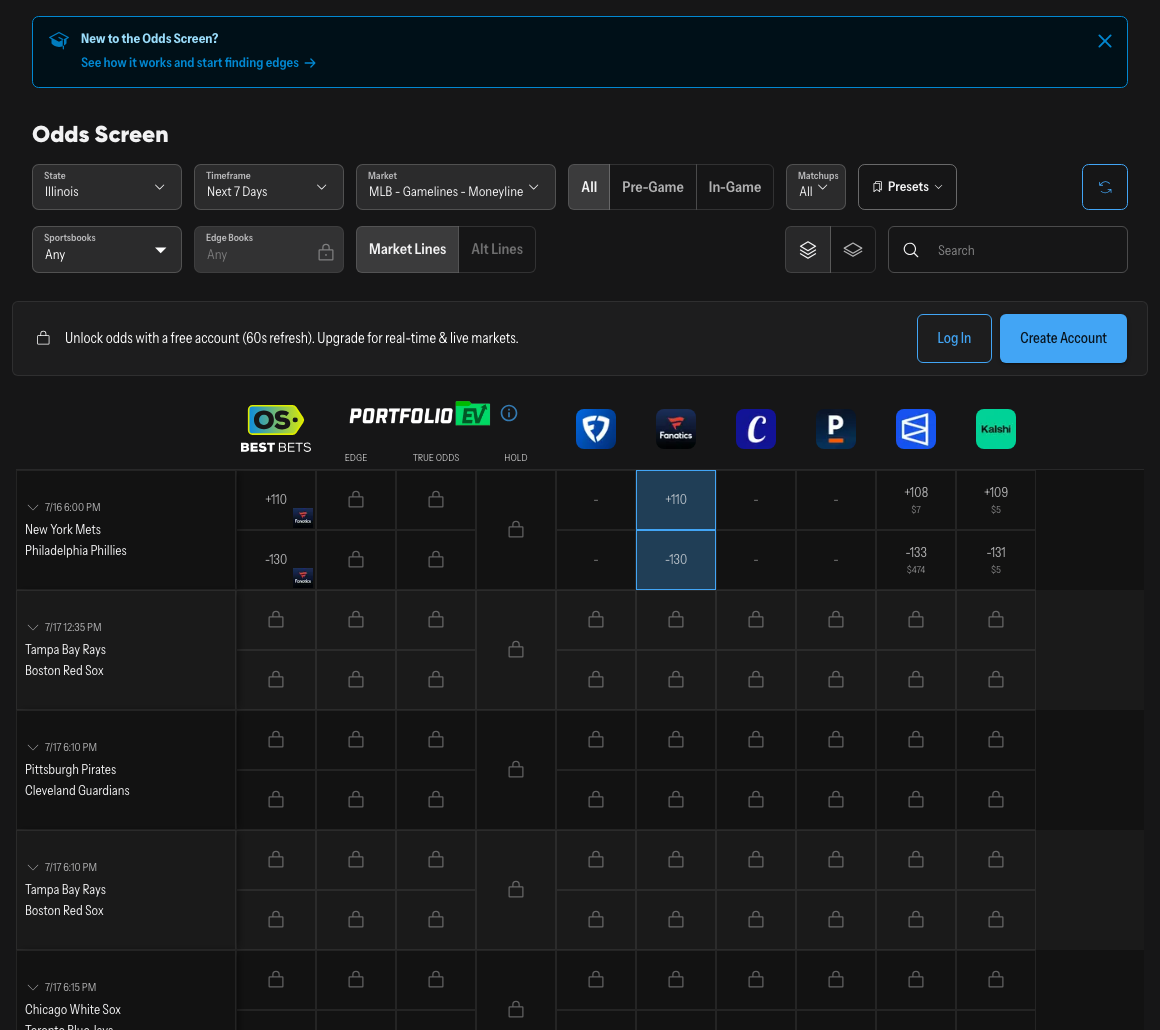
The OddsShopper Odds Screen.
TL;DR: What A Hold Calculator Tells You
- Hold (A.k.a. The Vig Or Juice) Is The Sportsbook's Built-In Margin — the slice of a two-way market priced above 100%, charged whether you win or lose.
- A standard -110 / -110 line carries a 4.55% hold; a reduced-juice -105 / -105 line on the same bet cuts that to 2.38%.
- Shopping the lower-hold book returns about $4.33 more on every winning $100 — free expected value that takes zero handicapping skill.
- We compute the hold on every market across 100+ books inside the OddsShopper odds screen, so you can skip the arithmetic and simply take the lowest number on the board.
What Hold And Vig Actually Are
When a book sets a market, it prices both sides so the implied chances add up to more than 100%. That extra slice above 100% is the overround, and the share of it the book expects to keep is the hold (you will also hear it called the vig, the juice, or the margin). It is the built-in commission on the bet, taken whether you win or lose.
The classic example is a point spread hung at -110 on both sides. A -110 price means you risk $110 to win $100. Convert it to an implied probability and each side sits at 52.38%. Add the two together and the market implies 104.76% of outcomes, which is impossible, because real probabilities can only sum to 100%. That extra 4.76 points is the book charging you for the convenience of a two-way market.
Hold is not a rip-off you can avoid entirely; it is how books stay in business. What you can do is measure it and refuse to pay more of it than you have to. Measuring the hold is only half the job — stripping it back out to see a market's true, no-vig price is the other half, and our guide to removing the vig walks through that step.
How To Calculate Hold On Any Market
The math is two short steps, and a calculator just runs them faster than you can.
Step 1 — convert each price to an implied probability. For an American favorite (a minus price), implied probability is odds / (odds + 100) using the price's unsigned number, so a -110 side is 110 / 210 = 0.5238, or 52.38%. For an underdog (a plus price), use 100 / (odds + 100) instead, so a +130 dog is 100 / 230 = 0.4348, or 43.48%. You will need both formulas the moment a market is not priced evenly on each side.
Step 2 — add the two implied probabilities, then find how much of that total is the overage. The hold is the amount above 100%, expressed as a share of the total:
Hold % = (implied A + implied B − 1) ÷ (implied A + implied B)
Run the standard -110/-110 spread through it: (0.5238 + 0.5238 − 1) ÷ 1.0476 = 0.0476 ÷ 1.0476 = 4.55%. So the industry-default line most books post carries a 4.55% hold. Treat that as the baseline every other market is worth measuring against, and it is the number a hold calculator returns the instant you type in two prices.
The Same Bet At Two Books: What A Lower Hold Saves You
Here is where the number stops being trivia. The same market rarely carries the same hold everywhere. Standard books such as DraftKings, FanDuel, and BetMGM commonly post a two-way market at -110 on each side. Reduced-juice books and exchanges such as Novig effectively price the same market tighter, often landing around -105 on both sides.
| Market (Representative Pricing) | Both sides | Two-way total | Hold |
|---|---|---|---|
| Standard Juice (E.g. DraftKings, FanDuel) | -110 / -110 | 104.76% | 4.55% |
| Reduced Juice (E.g. Novig) | -105 / -105 | 102.44% | 2.38% |
Read the reduced-juice row, because it is the one that pays you: moving from -110 to -105 on the same bet nearly halves the hold, from 4.55% down to 2.38%. In dollars, a -110 winner nets $90.91 profit on a $100 stake, while the -105 version nets $95.24. That is about $4.33 more back on every winning $100, for placing the identical bet at a book that charges less to take it. One bet, the gap is small. Across a season of volume, it is the difference between a break-even ledger and a losing one, because your real cost is the hold multiplied by how often you bet.
Prices drift, so treat the figures above as the standard structure rather than today's exact quote. The point is durable even when the pennies change: the lower-hold book keeps more of your money in your pocket, every single time.
New to OddsShopper?It scans 100+ sportsbooks in real time and shows the hold baked into every market, so you can instantly see which book is charging the least to take your bet, the exact thing this guide is teaching you to work out by hand. You can try it free for 7 days, and code HOLDEDGE20 takes 20% off OddsShopper Pro or Core if you subscribe: Start your free trial.
Hold Hides On Favorites And Underdogs, Too
Even markets like -110/-110 make the hold easy to spot, but it is present on lopsided prices as well, and it is easier to miss there. Take a moneyline posted at -150 for the favorite and +130 for the dog. The favorite's implied probability is 150 / 250 = 60.0%; the underdog's is 100 / 230 = 43.48%. They sum to 103.48%, so the hold works out to 3.48 ÷ 103.48 = 3.36%.
Nothing about the -150 or the +130 announces "3.36% margin" on its own. This is exactly why a calculator earns its place: it exposes the hold on a market where eyeballing the vig is hopeless, and it lets you compare that 3.36% against what the same game costs at the book down the street.
Where OddsShopper Surfaces The Hold For You
Doing this by hand for one market is quick. Doing it for every game on the board, at every book, before a line moves, is not. Handling that at scale is why we built the Hold Calculator and the odds screen.
Our OddsShopper odds screen lines up every sportsbook's price on a market side by side and displays the hold built into each one, the same figure the formula above produces, computed live across 100+ books. Instead of converting prices in your head, you scan a column and take the lowest-hold number on offer — the one we keep coming back to is simply whichever book is charging the smallest margin on the bet you already want. It turns line shopping from a chore into a glance, and it is where the manual math in this guide becomes a habit you can run on every game in seconds. For a column-by-column tour of the screen, our odds screen walkthrough shows exactly where the hold figure lives. If you would rather work a single bet, our free odds calculator converts American prices to implied probability in one click, the exact first step of the hold formula.
Why The Hold Decides Where You Bet
Line shopping to the lower hold is the most dependable edge that needs no handicapping skill at all. The -110 to -105 move above nearly halved the hold, from 4.55% to 2.38%, without changing the bet or the outcome. That saved cost is free expected value, and our odds screen finds the lower number for you across 100+ books in one scan instead of one market at a time. Stack promos and the occasional arbitrage finder opportunity on top — our arbitrage calculator guide shows how to size those when the gap between two books opens up — and the fractions keep adding up in your favor.
The lesson runs the other way, too. When a market's hold is unusually fat, that is the book protecting itself, and often a sign the price is one you should pass. Reading the hold tells you both where to bet and when to sit out. If you would rather see which plays sharp bettors are already backing while you build the habit, the free expert picks today page is a good place to start.
The one-line takeawaythe hold is a cost you pay on every bet, so treat it like one — measure it, then place the bet where that cost is lowest. Everything else in this guide is just the arithmetic behind that habit.
Frequently Asked Questions
What is hold in sports betting? Hold is the built-in margin a sportsbook keeps on a market, also called the vig or juice. It is the share of the two-way market sitting above 100%, expressed as a fraction of the total (the raw amount above 100% is the overround, and the hold is that overage divided by the total). A standard -110/-110 market carries a hold of about 4.55%.
How do you calculate the hold on a bet?
Convert each side to an implied probability, add them, and divide the amount over 100% by that total: (implied A + implied B − 1) ÷ (implied A + implied B). A hold calculator does the conversion and the division for you in one step once you enter both prices.
What is a good hold percentage to bet into? Lower is always better for the bettor. Standard two-way markets sit near 4.5%; reduced-juice books and exchanges can cut that in half. Whatever the lowest available hold on a market is, that is the book you want, because a smaller hold leaves more of every payout with you.
Does the hold calculator work on moneylines and totals? Yes. The same two-step math applies to any two-way market, whether it is a spread at -110/-110, a moneyline at -150/+130, or a total. For three-way markets you add a third implied probability before finding the overage.
Is the OddsShopper Hold Calculator free? The Hold Calculator and the core odds tools are free to use. OddsShopper Pro adds the deeper odds screen, live arbitrage, and additional leagues and markets, with a 7-day free trial to start.
Hold is the one edge you can capture without predicting a single game right. OddsShopper scans 100+ sportsbooks, shows the hold on every market, and points you to the lower number automatically, so you stop paying more vig than you have to. Try it free for 7 days, then code HOLDEDGE20 takes 20% off OddsShopper Pro or Core if you subscribe. Start your free trial and bet the better number today.
More on this: Devig Calculator: Find Fair No-Vig Odds From -110 Prices · Kalshi Vs A Sportsbook: Where The Money Actually Goes · Prediction Market Vs Sportsbook: An Exchange Is Not A Book · Kalshi Fees Vs. Sportsbook Vig: Which Costs You More? · Why Is My Sportsbook Withdrawal Pending? What It Means