Arbitrage Calculator: How to Split Your Stakes and Lock In a Return
By Greg Ehrenberg · Last updated: June 24, 2026
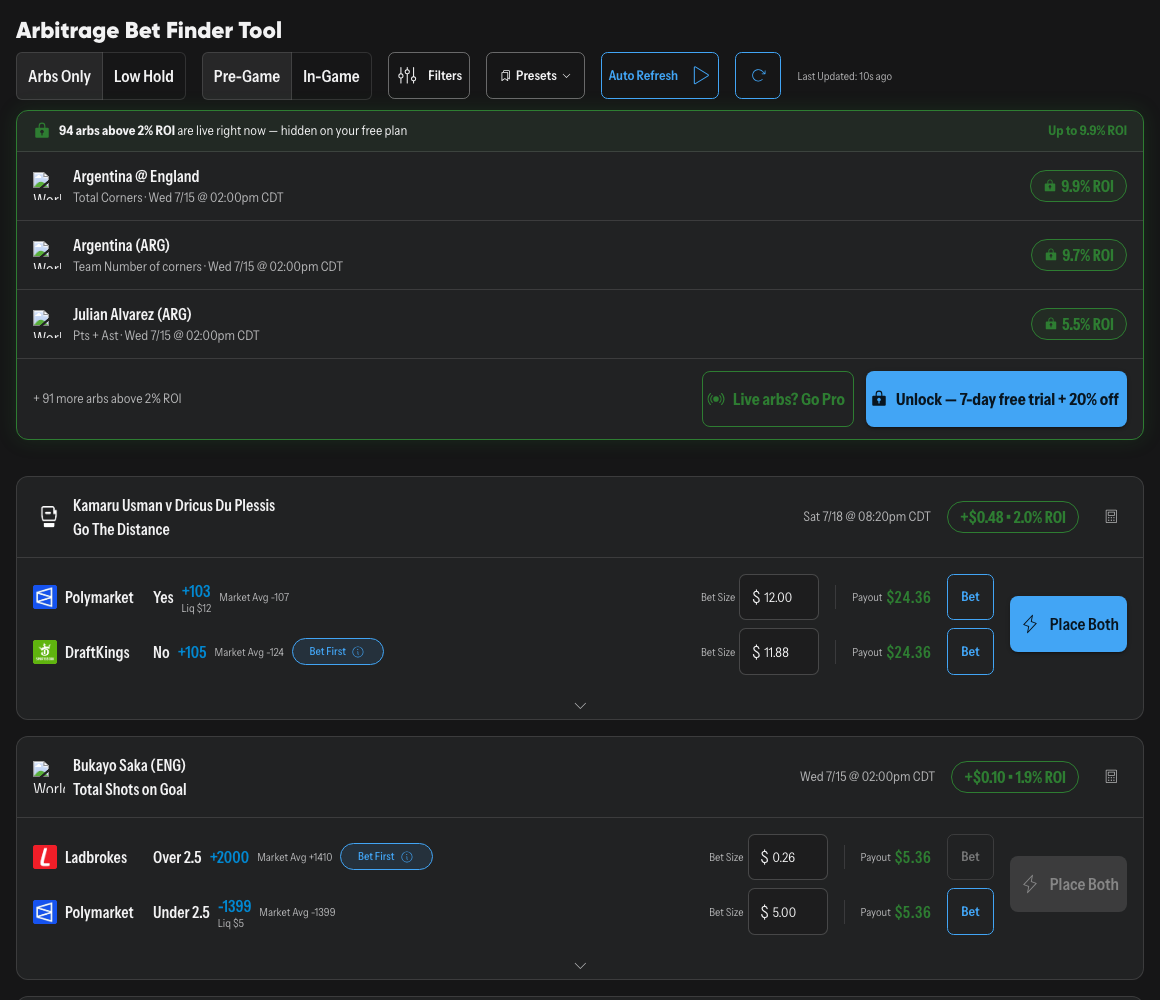 The OddsShopper Arbitrage Finder — live two-book locks with stakes and payouts. Open the live tool.
In Summary
An arbitrage calculator does one job: it takes the two prices you found, plus the amount you want to bet, and tells you exactly how much to put on each side so that every outcome pays you the same. That second part is where most people get tripped up. When the two prices are different, an even split leaves you with an uneven result, and you can accidentally turn a small edge into a loss on one side. A calculator handles the proportions for you in a second, which matters because arbs are usually small (often 0.5 to 2%) and they close fast. Below you'll see the formula, two worked examples (one easy, one realistic), and how to read what the tool spits back. OddsShopper's free Arbitrage tool has the calculator built in and pairs it with a live scan of 110+ sportsbooks, doing the line shopping across every book and sizing both legs in the same step.
Related reading: Will Sportsbooks Ban You for Arbitrage Betting?.
New to the concept itself? Start with Arbitrage Betting Explained for what an arb is and why these gaps exist. This guide assumes you've got the idea and just want to size the bets correctly.
What an Arbitrage Calculator Actually Does
You feed it three things and it gives you back two.
What you put in:
- The odds on side A (and which book has them)
- The odds on side B (and which book has them)
- Your total stake, the combined amount you want in play across both legs
What it returns:
- The exact stake for each side so both outcomes pay the same amount
- Your profit and return if the arb fills at those prices
The reason you need it is the sizing, not the detection. Confirming that an arb exists is one quick subtraction (more on that below). Splitting the money so the bet pays equally no matter who wins is the fiddly part, especially when one side is a favorite and the other is a dog. That's the arithmetic a calculator removes, along with the chance of fat-fingering it while a line is about to move.
The Two Numbers Behind the Calculator
Every calculator runs on the same two pieces of math. You don't have to memorize them, but seeing them makes the output make sense.
First, implied probability, which is just what each price says the chance of winning is. In decimal odds, it's 1 / decimal odds. A +150 underdog is 2.50 in decimal, so its implied probability is 1 / 2.50 = 0.40, or 40%.
Second, the arb check. Add the two implied probabilities together. If they total less than 1.00, the two prices don't add up to a full market, and that gap is your arbitrage:
Arb margin = 1 − (1 / decimal odds A + 1 / decimal odds B)
If that number is positive, you've got an arb, and the size of it is your edge. If it's zero or negative, there's no arb and the calculator will tell you so.
The stake split then follows from those same implied probabilities. You stake each side in proportion to its own implied probability, which puts more money on the shorter-priced (more likely) side:
- Stake on A = Total × (1 / odds A) ÷ (1 / odds A + 1 / odds B)
- Stake on B = Total × (1 / odds B) ÷ (1 / odds A + 1 / odds B)
That's the whole engine. Now let's run real numbers through it.
Worked Example 1: Even Odds, Even Split
Start with the easy case so the mechanic is clear. You spot the same market priced generously at two books:
- Side A at +110 (FanDuel) → 2.10 in decimal
- Side B at +110 (DraftKings) → 2.10 in decimal
Run the arb check: 1 / 2.10 + 1 / 2.10 = 0.476 + 0.476 = 0.952. That's under 1.00, so the margin is 1 − 0.952 = 0.048, about a 4.8% gap. With a $1,000 total stake and both prices identical, the split is even, $500 a side:
| Odds | Stake | If this side wins | |
|---|---|---|---|
| Side A | +110 (2.10) | $500 | $500 × 2.10 = $1,050 |
| Side B | +110 (2.10) | $500 | $500 × 2.10 = $1,050 |
| Total | $1,000 | $1,050 → $50 profit |
Either result returns $1,050 on $1,000 in play, a $50 profit regardless of which side wins, as long as both legs are placed at these prices. When both prices match, you don't really need a calculator. The next example is the one that does.
Worked Example 2: Different Odds, Proportional Split
This is the case where I actually reach for a calculator: a favorite at one book and a dog at the other. The way I think about it is fair odds versus the offered price. When two books each hang a number generous enough that their implied probabilities fall short of 100%, the gap is real, and the only thing left is sizing it right. An even split here would pay you differently depending on the result, so the stake sizing is the whole game. (The odds below are deliberately generous to make the split easy to read; real arbs usually run 0.5 to 2%, but the method is identical.)
- Side A at +150 (Book 1) → 2.50 in decimal, implied prob
1 / 2.50 = 0.400 - Side B at −120 (Book 2) → 1.833 in decimal, implied prob
1 / 1.833 = 0.545
Arb check: 0.400 + 0.545 = 0.945, under 1.00, so the margin is about 5.5%. Now split a $1,000 total stake in proportion to each side's implied probability:
- Stake on A =
1,000 × (0.400 ÷ 0.945) = $423 - Stake on B =
1,000 × (0.545 ÷ 0.945) = $577
| Odds | Stake | If this side wins | |
|---|---|---|---|
| Side A | +150 (2.50) | $423 | $423 × 2.50 = $1,057 |
| Side B | −120 (1.833) | $577 | $577 × 1.833 = $1,058 |
| Total | $1,000 | ≈ $1,058 → ~$58 profit |
Both outcomes land within a dollar of each other, around $1,058 back on $1,000, a roughly $58 profit (about 5.8% on your stake) whichever side hits. The penny-level difference is just rounding the stakes to whole dollars; the calculator carries the decimals and evens it out. Try to split that $1,000 evenly at $500 a side and Side B would pay less than your total outlay, turning a real edge into a one-sided gamble. That's the trap the calculator exists to prevent.
That stake split is the part you don't want to do by hand while a line is ticking. OddsShopper's free Arbitrage tool scans 110+ sportsbooks in real time, surfaces the gap, and shows the exact stake for each side automatically. OS Pro unlocks the full Live Arbs feed, the real-time stream plus the higher-margin arbs free users don't see. Try it free for 7 days, then code ARBCALC20 takes 20% off OS Pro or OS Core if you stay.
How to Read the Calculator's Output
Once you enter the two prices and your total stake, a good arbitrage calculator hands you four things. Here's what each one means and what to do with it:
- Per-side stake. The exact dollar amount for each leg. Place these, not a round number you eyeballed.
- Total return / profit. What you get back if both legs fill at the prices shown. If the profit is tiny relative to the stake, decide whether it clears your time and limit risk.
- Margin (or ROI) %. The size of the edge. Most live arbs sit in the 0.5 to 2% range; anything much larger usually means a stale line or a price that's about to vanish, so double-check it's real.
- A no-arb flag. If the implied probabilities add up to 1.00 or more, there's no arb, and the tool will say so rather than handing you a losing split.
A quick sanity habit: glance at whether the bigger stake landed on the shorter-priced side. It always should. If the calculator wants more money on the longer underdog, you've entered an odds value backward.
Three-Way Markets Work the Same Way
The two-way formula extends straight to three-way markets like soccer (home / draw / away) or any market with three outcomes. You just sum three implied probabilities instead of two:
Arb margin = 1 − (1 / odds A + 1 / odds B + 1 / odds C)
If that total is under 1.00, the arb is live, and each side is staked in proportion to its own implied probability, exactly as before. The math gets more tedious by hand with every extra leg, which is precisely why three-way arbs are where a calculator earns its keep.
Common Mistakes the Calculator Won't Catch
The tool nails the math. These are the human errors around it that still cost people money:
- Splitting evenly when the odds differ. The whole point of Example 2. Always size by implied probability, not by gut.
- Entering the wrong odds format. Mixing American and decimal, or typing −120 as +120, produces a confident, wrong answer. Confirm the format before you trust the split.
- Stale prices. A calculator sizes the arb you typed in. If the line moved between finding it and placing it, recalculate, because a half-second-old price can erase the margin.
- Leaving a leg unfilled. Place the side most likely to move first, then the other immediately. A one-sided "arb" is just a regular bet you didn't mean to make. Track which legs you've already placed so you don't double up one side.
- Ignoring book limits. If a book caps your stake below what the split calls for, scale the other side down to match, or the proportions break. Books differ widely on how hard they cap winners, and the best sportsbooks for arbitrage betting rundown covers what to look for before you fund an account.
For the conceptual side of all this, why these gaps open, why books limit pure arbers, and how arbing compares to positive expected value betting inside a broader Portfolio EV approach, the arbitrage betting guide covers it in full. If you want to double-check a single price's payout or implied probability on its own, the odds calculator does that piece.
More on this: Devig Calculator: Find Fair No-Vig Odds From -110 Prices · Arbitrage Betting Mistakes: Why Your Arb Doesn't Fill · Sportsbook Hold Calculator: Beat The Vig When You Bet · Best Sportsbooks For Arbitrage Betting: What To Look For · Free Bet Calculator: Turn Bonus Bets Into Cash
Frequently Asked Questions
How does an arbitrage calculator work? It converts your two prices into implied probabilities, checks whether they add up to less than 100% (the condition for an arb), and then splits your total stake in proportion to each side's implied probability so both outcomes pay the same. You enter the odds and your stake; it returns the per-side amounts, your profit, and the margin.
How do you calculate stakes for an arbitrage bet?
Stake each side in proportion to its own implied probability (1 ÷ its decimal odds). For a total stake T, Side A gets T × (1/odds A) ÷ (1/odds A + 1/odds B) and Side B gets the rest by the same formula. That weighting puts more money on the shorter-priced side so the payouts match.
What odds format should I enter? Whatever the calculator asks for, just be consistent. Most use decimal odds internally because the math is cleaner (implied probability is simply 1 ÷ the decimal price). If you only have American odds, convert both first, or use a tool like OddsShopper's that accepts the format the book displays.
Is an arbitrage calculator free? The calculator inside OddsShopper's Arbitrage tool is free to use, and the free tier also surfaces live arbs up to 2% ROI. OS Pro adds the full real-time Live Arbs feed and the higher-margin opportunities free users don't see.
Can a calculator lock in a profit? It sizes the bet so every outcome pays the same if both legs fill at the prices you entered, which is why arbing is low-risk rather than risk-free. Lines move, books void or limit bets, and a missed second leg leaves you one-sided. The math is handled for you; placing both legs fast and accurately is on you.
Hunting arbs by hand and sizing them on a napkin is slow, and the gaps close in seconds. OddsShopper scans 110+ sportsbooks in real time, flags live arbitrage opportunities, and hands you the exact stake for each side, no manual math. Try it free for 7 days, then code ARBCALC20 takes 20% off OS Pro or OS Core if you subscribe. Start your free trial and put the Live Arbs feed to work today.