Picture the scene the way our video puts it: you are at the bar with your buddies in Week 1, football is on every screen, and the conversation turns to the bets. Somebody laments losing by the hook. Somebody else swears the line moved because of steam. You nod along, chime in with a term you half-remember, use it out of context, and now everyone at the table knows you are the beginner. This NFL betting glossary fixes that for good, and it does it with one organizing idea we will carry all the way down the page: nearly every one of these 20 football betting terms is really about the price, and whether you are on the smart side of it or the crowd's side. By the end you will be able to run the same half-point check sharp bettors run before every NFL spread bet, and we will do one together.
The Quick Answer
NFL betting terms break into four families: the core markets (moneyline, point spread, total), the pricing concepts (American odds, the vig, key numbers, the hook, the push), the bet structures (straight bets, parlays, same game parlays, teasers, round robins, buying points), and the market-reading terms (handle, sharps and squares, steam, reverse line movement, closing line value), plus one outlier that belongs to no family: the bad beat, which is just the word for the pain. If you only remember one thing, make it key numbers: NFL games land on margins of exactly 3 and 7 more often than any others, so a half point around those numbers changes everything. All 20 terms are defined below, with a worked example showing exactly how much that half point is worth.
Watch The Video
Prefer to learn these terms on screen? The full breakdown, from the basics through the sharpest market concepts, is in the video below, and everything in this guide follows its structure. Watch on YouTube.
The Core NFL Markets: Odds, Moneyline, Spread, And Total
Start where the video starts, with the three bets that cover most NFL money and the odds format that prices all of them.
| Market | What You Are Betting | Typical Shape |
|---|---|---|
| Moneyline | Which team wins the game | Favorite -155 / underdog +130 |
| Point Spread | The margin of victory | -10.5 / +10.5, both near -110 |
| Total (Over/Under) | Combined points by both teams | e.g. Over/Under 47.5 |
The spread row is the one to sit with, because it exists to solve the moneyline's problem, and that connection is the fastest way to understand both.
- American Odds show the likelihood of each outcome using a minus and a plus number. The minus side is the favorite, and the number is how much you would need to bet to win $100. The plus side is the underdog, and the number is how much a $100 bet would win. In the video's example, the Chiefs at -155 against the Chargers means $155 to win $100, while the Chargers at +130 means a $100 bet returns $130 in winnings. You never have to bet $100; the numbers just scale.
- Moneyline is the simplest wager on the board: pick the team that wins the game. The catch is that some NFL teams are so much better than their opponent that the moneyline stops being attractive. On a heavy favorite you risk a lot to win a little, and on a big underdog you get a big payout attached to a team with a small chance of actually winning.
- Point Spread is the market's answer to lopsided matchups: it evens the two teams out by handicapping the favorite, typically with both sides priced near -110. If the Eagles are -10.5 against the Cardinals, the Eagles must win by 11 or more to cover, and the Cardinals at +10.5 cash if they lose by 10 or fewer, or win outright.
- Total, also called the Over/Under, is a bet on the combined points scored by both teams, no matter who scores them. At a total of 47.5, the Over needs 48 or more combined points and the Under needs 47 or fewer.
The Vig: What Every Bet Actually Costs
Notice that -110 attached to both sides of a spread. Two even sides should logically pay even money, and the gap between what should happen and what does is our next term.
- Vig, also called the juice, is the cut the sportsbook charges to take your bet. At -110 you are not betting $100 to win $100; you are betting $100 to win $90.91. That missing $9-and-change is the vig, and it is how sportsbooks make money no matter which side wins. It is also why picking winners is not enough: at -110 you need to win about 52.4% of your spread bets just to break even, so every fraction of a point of price you save matters.
The vig is the toll on a single bet. The next family of terms is about NFL-specific pricing, where half points stop being fractions and start being the whole game.
Key Numbers, The Hook, And The Push
Football scoring is lumpy. Field goals are worth 3 and touchdowns with the extra point are worth 7, so final margins bunch on those numbers. That one fact powers three of the most-used NFL betting terms you will hear.
- Key Numbers are the most common margins of victory in the NFL, and 3 and 7 are the big ones. A spread sitting on, or just across, a key number behaves very differently from one sitting in dead space like 5.
- The Hook is the half point attached to a line. Lose a bet by that half point and you lost by the hook: your buddy who took the Falcons -3.5 watched them win by exactly 3 and lost his bet on the hook.
- A Push is a tie between you and the book. If that same buddy had bet the Falcons at -3 instead of -3.5, their 3-point win would have pushed instead of losing: nobody wins, and his stake comes back. A line with a hook can never push, which is exactly what makes the hook so important around key numbers.
Worked Example: The Half-Point Check
Here is the check we promised in the intro, straight from the video. Say you like the Panthers as underdogs, and five of the books on your screen post them at +7. A sixth hangs +7.5. That half point is enormous: at +7.5 the Panthers can lose by exactly a touchdown and extra point, one of the two most common margins in football, and your bet still cashes. Flip it to the favorite and the same logic holds: the Falcons at -2.5 are a meaningfully better bet than the Falcons at -3, because at -2.5 a field-goal win still cashes your ticket instead of pushing. Neither version of the bet costs you anything extra; you just have to see the better number before you bet, which means comparing DraftKings, FanDuel, BetMGM, and Caesars at a minimum before you lock anything in. That is the entire case for line shopping in one example, and it is exactly what the OddsShopper NFL odds screen is built for: it lines up every covered sportsbook's price on each game side by side, so the book hanging +7.5 while the market sits at +7 jumps out in one glance instead of requiring six open tabs.
New to OddsShopper?It scans 20-plus sportsbooks and lines up every NFL price in one place, so the best number, and the half point everyone else misses, is always in front of you. New subscribers can try OS Pro free for 7 days, and code NFLTERMS20 takes 20% off your first payment of OS Pro or OS Core if you subscribe.
Bet Structures: From Straight Bets To Round Robins
Once you can read a price, the next set of terms describes the different shapes a wager can take. They run from the simplest bet on the board to combinations of combinations.
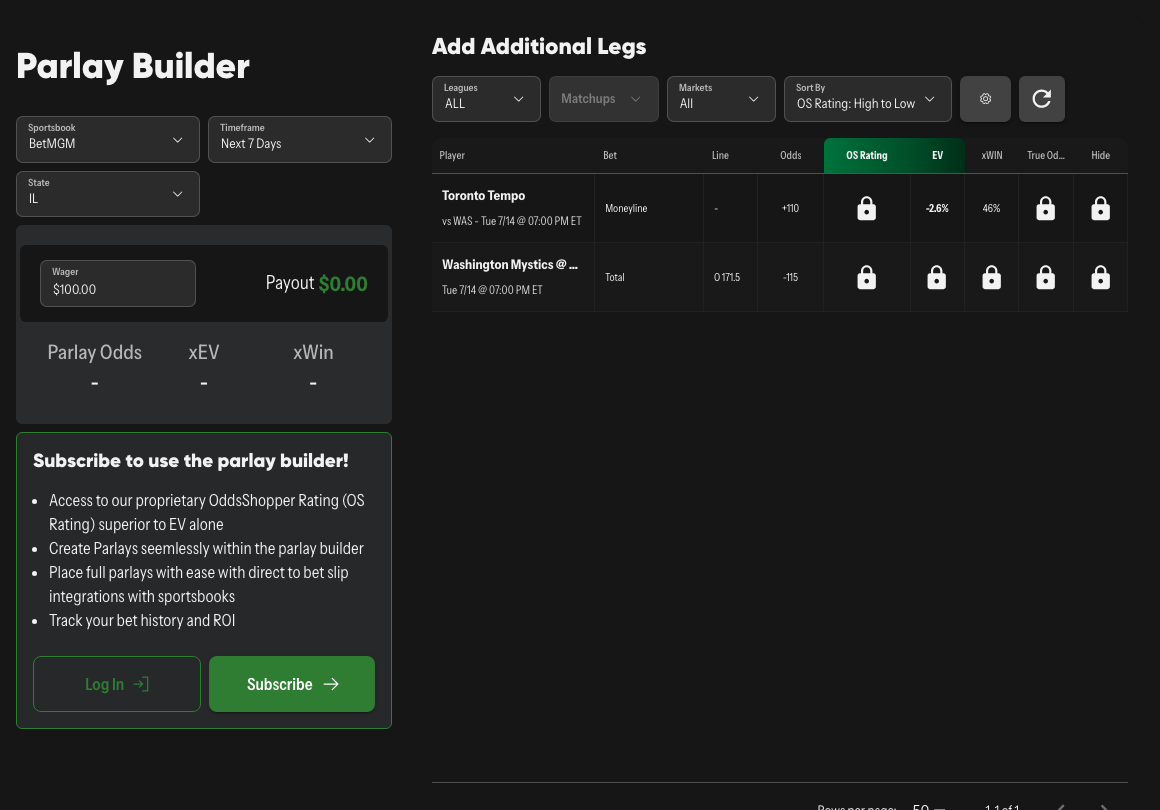
The OddsShopper Parlay Builder.
- Straight Bet: a single wager on a single outcome. One bet, one result, and the natural home of the half-point check from the worked example above, because when your whole ticket is one number, getting the best version of that number is the whole job. If you are choosing between formats, our guide to parlays vs. straight bets makes the case for keeping it simple.
- Parlay: multiple bets combined into one ticket for a bigger payout. Each bet in the parlay is called a leg, and every leg must win for the ticket to cash. Remember the vig from earlier? A parlay pays it on every leg at once, which is the quiet cost inside that bigger payout. The math and the pitfalls get their own treatment in our parlay betting guide.
- Same Game Parlay (SGP): exactly what it sounds like, a parlay where all the legs come from one game. Same all-or-nothing structure, with a pricing wrinkle: because legs from one game are related outcomes, books price that correlation into the payout, so the price you see is rarely the generous one it looks like. More in our separate NFL same game parlay guide.
- Teaser: a parlay variation where you move every leg's line by a set number of points in exchange for a smaller payout. Take three 9-point favorites, tease them 7 points, and you are now betting all three at -2. The video's tip is the right one, and it is a callback to the section above: always try to tease through the key numbers of 3 and 7, and avoid teasing through zero. Our NFL teaser betting guide covers when the math actually works.
- Round Robin: a series of smaller parlays generated from your list of picks. Take three underdogs, the video uses the Eagles, Raiders, and Steelers moneylines, in a three-team round robin and you get three two-leg parlays: Eagles/Raiders, Eagles/Steelers, and Raiders/Steelers. The payout ceiling is lower than a straight three-leg parlay, but at underdog prices you can still profit without going three for three. Full breakdown in how to bet round robins.
- Buying Or Selling Points: paying extra vig to move a spread or total in your favor, or moving it against you in exchange for a better price. The video calls this a square move to generally stay away from, and that is the honest default: books price alternate lines aggressively. The narrow exception follows directly from the key-number logic above: a half point that crosses 3 or 7, bought at a cheap price, is the one purchase sharps will actually consider.
- Bad Beat: the term for the loss you never saw coming. The video's version: your 7-point underdog is down six in the final seconds, still covering, and all they have to do is let the game end. Instead the last kickoff turns into a chaos of desperate laterals, a fumble gets scooped up and returned 50 yards for a touchdown, and a covered bet becomes a lost one on the final play. No strategy content here, just the word for the pain.
Reading The Market: Handle, Sharps, Steam, And CLV
Every term so far describes your bet. The last family describes everybody else's, and this is where the sharp-versus-square thread we opened with pays off, because these are the terms that tell you which side of the market you are actually standing on.
- Handle is the total amount of money wagered on something: one side of a game, a whole sportsbook, even an entire state. It measures dollars, not ticket count, and that distinction is about to matter.
- A Sharp And A Square are the market's two archetypes, and one term in the video's count. A sharp is a professional bettor with a history of profit: shops the best odds across many sportsbooks, and does not place a bet without a definitive edge. Books take sharp action seriously and move lines because of it. A square is a recreational bettor: bets at one book, does not shop prices, loves favorites and Overs, and has no real sense of value or edge. Bet size does not make you sharp; process does.
- Steam is a line moving rapidly toward one side, usually a sign that respected money just hit the number across the market.
- Reverse Line Movement is the sharpest signal on this list: the line moves against the side taking the majority of bets. When most of the tickets are on one team but the line moves the other way, sharp or heavy money is on the less popular side. Here is the callback to handle: you can often spot which side the sharps are on by comparing where the money (handle) sits against where the tickets sit.
- Closing Line Value (CLV) is the price you bet compared to the price when the market closed. Bet the Patriots at +4 and watch the line close at +2.5 and you beat the market: positive CLV. Bet them at +4 and watch it close at +5.5 and the market beat you. Sharps grade themselves on closing line value over full seasons, not on any single night's results, because consistently beating the close is the clearest evidence a betting process actually works.
The tell to remembertickets count bets, handle counts dollars. When most of the tickets are on one side but the line moves toward the other, the money disagrees with the crowd, and the money is usually the side worth studying.
Want to watch these concepts operate on a live board instead of in definitions? Our free expert picks page shows real plays each day with the reasoning attached, which is a faster education than any glossary once the vocabulary clicks. And when you are ready to bet live games, the in-game market has a vocabulary of its own, covered in our live NFL betting guide.
FAQ
What is the hook in NFL betting? The hook is the half point attached to a spread or total, like -3.5 instead of -3. Losing by the hook means that half point decided your bet: a team that wins by exactly 3 covers at -2.5, pushes at -3, and loses at -3.5.
What are key numbers in NFL betting? Key numbers are the most common margins of victory in NFL games, and 3 and 7 matter most because field goals are worth 3 points and touchdowns with the extra point are worth 7. A half point that crosses 3 or 7 changes a bet's chances far more than a half point anywhere else.
What is the difference between a sharp and a square? A sharp is a professional bettor with a profitable track record who shops odds across many sportsbooks and only bets with a definitive edge. A square is a recreational bettor who uses one book, takes whatever price is posted, and leans on favorites and Overs. The difference is process, not bet size.
What is reverse line movement? Reverse line movement is when a line moves against the side receiving the majority of bets. It usually means sharp or heavy money is on the less popular side, which you can often confirm by checking whether the handle and the ticket count point in different directions.
What does the vig mean in betting? The vig, or juice, is the sportsbook's built-in charge for taking your bet. It is why spreads are usually priced at -110 on both sides instead of +100: you risk $110 to win $100, and that gap is the book's cut on every wager.
How do I find the best NFL odds? Compare prices across sportsbooks before every bet, especially around the key numbers of 3 and 7 where a half point matters most. Five books can sit at +7 while a sixth hangs +7.5, and that extra half point costs you nothing if you see it in time. The OddsShopper NFL odds screen puts every covered book's price on one screen so that gap shows up in one glance.
Bottom Line
Twenty terms, one lesson: the price is the bet. The moneyline, spread, and total tell you what you are betting; the vig tells you what it costs; key numbers and the hook tell you when a half point is worth fighting for; and handle, steam, reverse line movement, and CLV tell you what the smartest money in the market thinks of your number. So make the half-point check from the worked example your standing habit: before any NFL spread bet, look at where the line sits against 3 and 7, then check whether any book on the board will hand you the extra half point for the same stake. It takes seconds, it is the single most concrete thing on this page, and it is the difference between paying for your vocabulary and getting paid for it. If you also bet baseball, the same pricing logic runs through our MLB betting terms glossary, and when you want the shopping done for you, OddsShopper lines up 20-plus sportsbooks on one screen and surfaces the bets where the price is actually in your favor. New subscribers can try OS Pro free for 7 days, and code NFLTERMS20 takes 20% off your first payment of OS Pro or OS Core.
More on this: NFL 2026 on Kalshi: Every Board We Track · NFL Coach Of The Year Odds: Kalshi Fades A Two-Time Winner · NFL Picks Hub: Week 1 Odds, Win Totals, Props · NFL Win Totals 2026: Kalshi Vs DraftKings Vs FanDuel · Kalshi Vs Polymarket NFL: Why The Cheaper Fee Loses