Every NFL bet is a math problem before it is a rooting interest. What does this three-leg parlay actually pay? Is +150 on a home dog a better price than the -110 you're staring at on the spread? How much cash can you pull out of that $50 bonus bet the app just dropped? An NFL betting calculator answers all three in seconds, and once you let the arithmetic do the work, you stop guessing and start pricing.
This guide walks through the core NFL betting calculators: parlay, odds/payout, expected value (EV), and the bonus-bet (free bet) converter, plus how that same math powers the biggest bets of the year on the Super Bowl, with a worked example for each. The one most bettors skip is the EV calculator, and it's the only one that tells you whether a bet is actually worth making. Hold that thought; we'll get there, because the parlay math right below is where NFL bettors quietly light the most money on fire.
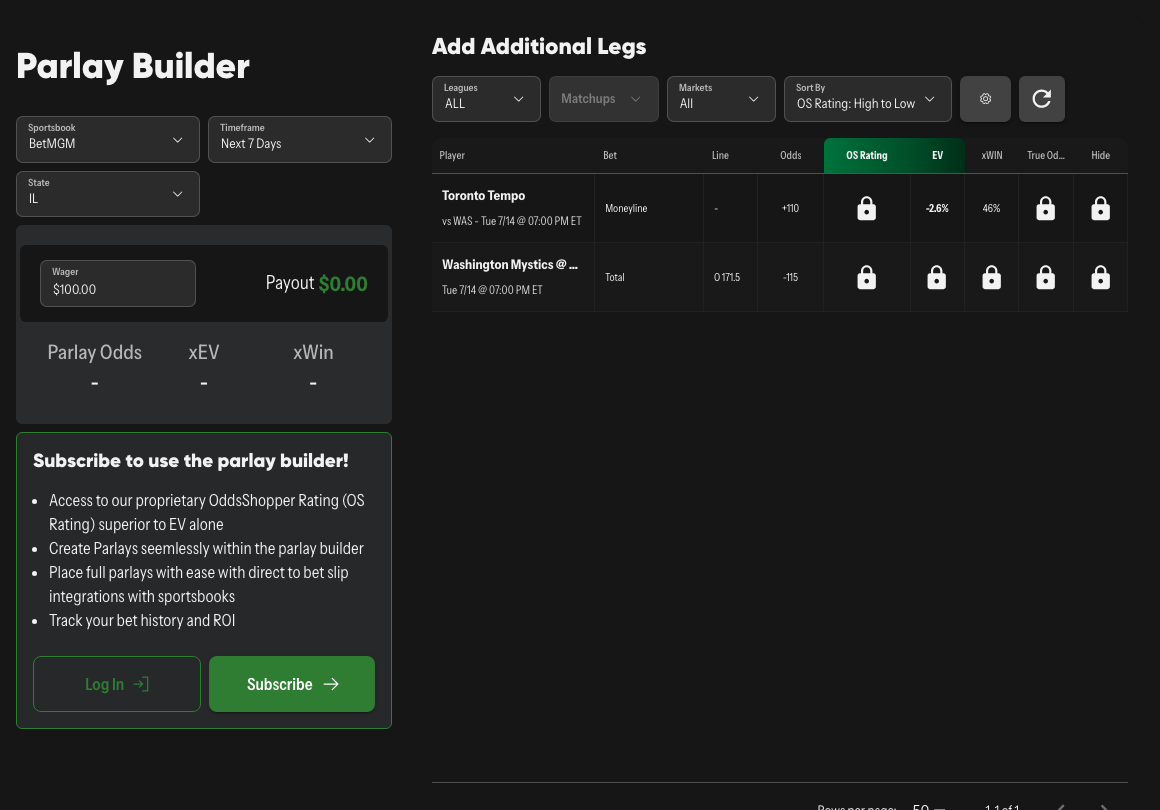
The OddsShopper Parlay Builder.
The Five NFL Calculators At A Glance (TL;DR)
- Parlay Calculator: combines every leg's odds into one payout and one implied probability. The tool that flatters you the most and says the least about the vig it hides.
- Odds & Payout Calculator: turns any stake and price into exact payout, profit, and implied probability, so you can compare a moneyline to a spread to a teaser on the same scale.
- EV Calculator: strips the sportsbook's built-in margin out of a price (the "no-vig" fair number), then compares that fair price to the best price you can actually bet to estimate whether an NFL bet is +EV. This is the one that actually finds the edge.
- Free Bet / Bonus Bet Calculator: sizes the hedge that converts most of a sportsbook bonus into withdrawable cash (usually worth about 60-80 cents on the dollar).
- Super Bowl Bet Calculator: the same odds and parlay math, applied to futures and prop parlays on the one game everyone bets.
The thread running through all of them: a calculator only does arithmetic. The edge comes from feeding it the best number, which is why every example below ends at the same place: line shopping across books. Let's build up to it.
Which NFL Betting Calculator Do You Need?
Different NFL bets need different math. Here's the map from bet type to the tool that answers your question:
| Your NFL Bet | The calculator you need | What it tells you |
|---|---|---|
| 3-Team Spread Parlay | Parlay calculator | Combined payout + implied win probability |
| Single Moneyline Or Spread | Odds & payout calculator | Payout, profit, implied probability |
| "Is This Price Actually Good?" | EV calculator | +EV, -EV, or a push after the vig |
| A $50 Bonus Bet From The App | Free bet / bonus bet calculator | The hedge that turns it into cash |
| Super Bowl Future Or Prop Parlay | Super Bowl bet calculator | Futures payout + parlay math |
The row people ignore is the third one. The first two tell you what a bet pays; the EV calculator tells you whether to make it at all — and a bet can pay beautifully while still being a long-term loser. That distinction is the difference between a bettor who churns and one who compounds, so we'll spend the most time there. First, the parlay, because it's the bet you're most likely to place on any given NFL Sunday.
The NFL Parlay Calculator: A Worked Example
A parlay ties multiple bets into one ticket. Every leg has to win, and in exchange the payout multiplies. The math is simple once you convert each American price into decimal odds, multiply them together, and convert back.
Worked example (illustrative). Say you like a three-team NFL spread parlay, each leg priced at the standard -110:
- Convert -110 to decimal: (100 / 110) + 1 = 1.9091 per leg
- Multiply all three: 1.9091 x 1.9091 x 1.9091 = 6.958
- A $20 stake pays 20 x 6.958 = $139.16 total, a profit of $119.16
- Combined odds in American terms: about +596
Now the part the parlay calculator quietly shows you and most bettors never look at: the implied probability. Each -110 leg implies a 52.4% chance. Multiply those (0.524 x 0.524 x 0.524) and the odds imply this parlay hits about 14.4% of the time. But that 14.4% is the vig-inflated number: the fair no-vig probability of each leg is closer to 50%, so the true parlay chance is about 12.5%, and an honest payout at 12.5% would be near +700. The gap between the +700 you deserve and the +596 you're offered is the sportsbook's edge, compounded three times over. That's why "it only takes one" losing leg stings so much: you were overpaying on every leg before the games even kicked off.
Here's how a $20 NFL parlay of standard -110 legs scales. The last column is the probability the odds imply, which is the vig-inflated number, so your real chance of cashing is a bit lower still:
| Legs (All -110) | Combined odds | $20 pays (total) | Implied win probability |
|---|---|---|---|
| 2 | +264 | $72.89 | 27.4% |
| 3 | +596 | $139.16 | 14.4% |
| 4 | +1,228 | $265.67 | 7.5% |
| 5 | +2,436 | $507.18 | 3.9% |
| 6 | +4,741 | $968.25 | 2.1% |
Look at the six-leg row: it dangles a $968 payout, but the odds already imply it hits only about one time in 50, and six genuine coin-flip legs would cash even less often than the number shown. That's the trap of the big-number parlay in one line of a table. The more legs you add, the further your real chance falls behind the shiny payout, because the vig compounds on every leg.
Two rules follow directly. First, a parlay is only worth building if each leg is a bet you'd make on its own. Piling bad bets onto one ticket doesn't fix them, it multiplies the vig. Second, shop each leg for the best number, because a half-point or a -105 instead of -110 changes that final payout more than you'd think. For the full breakdown of parlay odds and a payout chart, see our parlay calculator guide, and for why most football parlays lose and how to build the rare +EV ones, read NFL parlay betting.
The NFL Odds & Payout Calculator
Before you can judge a parlay, you have to read a single price. An odds and payout calculator turns any American price and stake into three numbers: total payout, profit, and implied probability.
Worked example (illustrative). You're weighing a home underdog at +150 on the moneyline against the same team at -110 on the spread:
- +150, $20 Stake: profit = 20 x (150 / 100) = $30, total payout $50. Implied probability = 100 / (150 + 100) = 40%.
- -110, $20 Stake: profit = 20 x (100 / 110) = $18.18, total payout $38.18. Implied probability = 110 / (110 + 100) = 52.4%.
That +150 pays far more than -110, and here's the beginner insight worth burning in: a longer-shot bet at +220 is worth more than a shorter-priced one at +150 only if the extra payout outruns its lower win probability. Price and probability are two sides of the same coin, and the payout calculator shows both at once so you're never seduced by a big number alone. Run any NFL price through the math in our odds calculator, and if converting American, decimal, and fractional odds still trips you up, start with how to read betting odds.
Everything so far tells you what a bet pays. Neither the parlay nor the payout calculator has said a word about whether you should make it. That's the next tool, and it's the one that separates bettors who win from bettors who just have fun.
The NFL EV Calculator (The One That Finds The Edge)
Expected value (EV) is the long-run profit or loss of a bet if you could place it thousands of times. A positive EV (+EV) bet is priced better than the no-vig fair probability says it should be; a -EV bet is priced worse. The whole game is finding +EV and skipping the rest.
The trick is that the odds on your screen already include the sportsbook's margin: the vig. An EV calculator's first job is to remove it and reveal the no-vig fair odds: the market-implied fair price once the house's cut is stripped out. Compare that fair price to the price you're offered, and the gap is your edge.
Worked example (illustrative). A book posts an NFL total at Over -110 / Under -110. Each side's -110 implies a 52.4% chance, but they can't both be true: together they add up to 104.8%. That extra 4.8% is the vig. Strip it out and the market's fair price on each side is 50/50, or +100 either way. Now suppose a different book, say DraftKings or FanDuel, is pricing that same Over at +105. You're getting a plus-money price on what the market itself calls a 50% shot. Your calculator does the EV math:
- Win 50% of the time for +$105 profit per $100: 0.50 x $105 = +$52.50
- Lose 50% of the time for -$100: 0.50 x -$100 = -$50
- Expected value per $100 bet = +$2.50, a +2.5% EV play
That 2.5% edge doesn't sound like much on one bet. But if your fair price is accurate and you keep betting edges like it, that small advantage is what +EV bettors try to compound over a big sample, even though variance means plenty of those individual bets still lose. The EV calculator found the edge by doing two things a human can't do fast enough on a Sunday: devigging a multi-book consensus into a fair price, then scanning every book for the outlier that beats it. OddsShopper's EV Calculator and +EV screen do this continuously across 20+ books, ranking bets from the biggest edge down, while the no-vig / fair-odds display shows the fair price behind any line. For the formula in full, see the expected value calculator guide, and remember the NFL key numbers, 3 and 7, because a half-point bought across those numbers changes the fair probability more than a half-point anywhere else, which feeds straight back into this EV math.
Skip the manual math.OddsShopper's odds screen prices every NFL line across 20+ books, devigs it, and flags the +EV bets and best number for you: the parlay, payout, and EV math above, done automatically. Try it free for 7 days, then keep it for 20% off OS Pro or OS Core with code NFLCALC20. See today's edges free
The NFL Free Bet & Bonus Bet Calculator
Sportsbooks hand out bonus bets constantly during football season, and they're worth less than their face value because you don't get the stake back, only the winnings. A free bet calculator solves the one question that matters: how do you turn a $50 bonus into cash you can actually withdraw instead of a coin flip?
The most reliable way to convert it is a hedge. You place the bonus bet on one side at a long price, then bet real money on the other side at another book, sized so you pocket roughly the same amount whichever way the game breaks. (If you're chasing raw expected value instead of a locked conversion, you might let the bonus ride on a single +EV spot, but the hedge is what turns it into predictable cash.)
Worked example (illustrative). You have a $50 NFL bonus bet and put it on an underdog at +300:
- If it wins: 50 x 3 = $150 profit (you don't get the $50 stake back, since it was a bonus)
- To hedge, you bet the other side (typically around -320 to -360 once the book's vig is baked in) at a second book like BetMGM or Caesars, staking roughly $112
- Either outcome nets you around $37-38 in real, withdrawable cash
That's about a 75% conversion, turning a $50 bonus into roughly $37 you can withdraw, no matter which way it lands. Longer odds on the bonus-bet side usually improve the conversion, but only when the other side is priced efficiently: bad hold or a thin market can erase the benefit, which is why the calculator (and the tool behind it) hunts for the longest price with a clean hedge to place the free bet on. OddsShopper's Promo Converter finds those spots and sizes the hedge automatically. Walk through the formula in our free bet calculator guide, and for a step-by-step on the whole move, see how to convert a free bet.
The Super Bowl Bet Calculator
The Super Bowl is the one game where casual bettors place futures, props, and giant prop parlays, and all of them run on the same math we've already covered. A Super Bowl bet calculator is really just the odds, parlay, and payout tools pointed at the big game.
Worked example (illustrative). You put $50 on a team to win the Super Bowl at +700 in the fall:
- Profit if it hits: 50 x (700 / 100) = $350, total payout $400
- Implied probability: 100 / (700 + 100) = 12.5%
For a Super Bowl prop parlay (say the game's Over, the favorite -3.5, and a star to score a touchdown), you'd run each leg through the parlay math from earlier: convert to decimal, multiply, convert back. The same warning applies, only louder. Super Bowl prop parlays carry some of the widest margins of the year, and it's not an accident: the game draws a flood of casual money, so books widen the vig on props precisely because they know most of that action isn't price-sensitive. The two-week gap between the conference championships and kickoff also moves the number a lot, so the line you calculate in week one may not be the line at kickoff. The calculator keeps you honest by putting the real combined probability next to that headline payout, so you can decide whether the number is fair before you get swept up in the hype. When totals are posted, shop the Super Bowl number across books on the live NFL odds screen.
How I Actually Use These On An NFL Sunday
Here's the workflow these calculators add up to, in order. I start at the odds screen to see the whole board (spreads, moneylines, totals) priced across every book at once (spreads, moneylines, totals). I let the EV calculator compare each no-vig fair price against the best number available across those books and flag the handful where the best price beats the fair one, and that shortlist is where I start. A few rules keep me honest from there:
- Every Parlay Leg Has To Already Be On The +EV Shortlist before it earns a spot. The parlay calculator confirms a payout; it doesn't rescue bad bets.
- I Weight Spreads Sitting On A Key Number (3 and 7) differently from a half-point in the dead zone, because those are the numbers that actually move win probability. That's why the NFL key numbers feed straight into the EV math.
- I Skip A Stale Line. If the number I calculated has already moved at the sharp books, the edge is gone, and I re-check injuries and weather before I fire. Concretely: if a spread I liked at -110 has moved through 3, I'll often pass, or take the moneyline instead when the no-vig price says the hook is no longer worth the juice.
- Any Bonus Bet The App Drops Goes Into The Promo Converter to be hedged, not blown on a hero parlay, and the stake stays sized to my bankroll rather than the size of the payout.
Notice what ties the whole thing together: back at the very top I promised the math was the easy part and the real edge was the best number. This is where that pays off. Every one of these tools is only as good as the price you feed it, and the price you feed it is only the best one if you've shopped all 20+ books. The math is the easy part; the shopping is the edge. Do both, and NFL betting stops being a guess and becomes a repeatable process.
Do all four calculations at once.OS Pro runs the odds, parlay, EV, and bonus-bet math on every NFL line across 20+ books, so you shop the best number and price every bet before you place it. Try it free for 7 days, then keep it for 20% off OS Pro or OS Core with code NFLCALC20, less than a coffee a day. See today's edges free
NFL Betting Calculator FAQ
How do you calculate an NFL parlay payout? Convert each leg's American odds to decimal, multiply them all together, then multiply by your stake. Three -110 legs come out to 1.9091 x 1.9091 x 1.9091 = 6.958, so a $20 parlay pays about $139 total (roughly +596). A parlay calculator does it instantly and also shows the combined implied probability.
What is a good EV for an NFL bet? A positive number is a bet worth considering, as long as you trust the fair price you devigged and the stake fits your bankroll. Many sharp bettors hunt for small edges in the low single digits and place a lot of them. EV is the gap between a bet's no-vig fair price and the price you're actually offered, so the edge comes from finding the book that's out of line, not from one huge score.
How much is an NFL bonus bet worth? Usually about 60-80 cents on the dollar once you hedge it, because you keep the winnings but not the stake. Placing the bonus on a longer-priced side and hedging the other side at a second book pushes the conversion higher: a $50 bonus on a +300 dog can net roughly $37 in withdrawable cash (about 75%).
Can you calculate a Super Bowl bet payout? Yes. It's the same math as any other bet. A $50 future at +700 pays $350 profit ($400 total) and implies a 12.5% chance. Super Bowl prop parlays use the standard parlay formula, just with wider margins, so check the combined probability the odds imply before you place one.
Is there a free NFL betting calculator? Yes. OddsShopper's core odds tools are free to sign up for, and OS Pro adds the deeper EV screen, no-vig fair odds, Parlay Builder, and Promo Converter, plus a 7-day free trial. The advantage over a plain calculator is that these price every NFL bet across 20+ books, so the number you're calculating with is already the best available.
Do sportsbooks have their own betting calculator? Most show a bet slip that calculates the payout for the price they offer, but that's not the same as a shopping tool. A standalone NFL betting calculator compares prices across books and strips out the vig, which is exactly the information a single sportsbook's slip will never show you.
More on this: NFL 2026 on Kalshi: Every Board We Track · NFL Coach Of The Year Odds: Kalshi Fades A Two-Time Winner · NFL Picks Hub: Week 1 Odds, Win Totals, Props · Devig Calculator: Find Fair No-Vig Odds From -110 Prices · NFL Win Totals 2026: Kalshi Vs DraftKings Vs FanDuel