Free Bet Conversion: How to Turn a Free Bet Into Cash
In Summary
A "free bet" (sportsbooks also call it a bonus bet) is not the same as cash, and the difference is the whole reason free bet conversion exists: if a free bet wins, the book keeps your stake and pays you only the profit. So a $100 free bet at +200 doesn't return $300. It returns $200. Free bet conversion is the process of turning that stake-not-returned promo into withdrawable cash by placing the free bet on one side of a market and backing the other side with real money at a different sportsbook. Done right, you secure the bulk of the free bet's value, typically 60–80 cents on the dollar, regardless of which side wins. This guide covers what a free bet actually is, the conversion (hedge) play step by step, the odds that maximize your conversion rate, the rollover and playthrough traps that quietly void the value, and how OddsShopper's Free Bet Converter finds the best conversion for you automatically.
What a Free Bet Actually Is (Stake-Not-Returned)
When you place a normal cash bet, a win returns your stake plus your profit. A $100 cash bet at +200 (decimal 3.00) pays $300 total: your $100 back, plus $200 in winnings.
A free bet is different: the stake is not returned. Same $100 at +200, but as a free bet, a win pays only the $200 profit. The book keeps the $100 "stake" because you never actually risked your own money. This is sometimes called a stake-not-returned (SNR) free bet, and almost every U.S. sportsbook promo ("Bet $5, get $150 in bonus bets," refer-a-friend credits, win-and-get offers) works this way.
That single mechanic is why I never just bet a free bet straight on a -150 favorite. If it loses, you get nothing. If it wins, you collect a small profit and the book has paid out the least it possibly could. A free bet sitting unused, or fired on a short favorite, is the worst-case outcome: you're leaving most of its value on the table. The first time I treated a free bet like cash and slapped it on a -200 favorite, I got back about $50 of value on a $100 credit and didn't even realize how badly I'd shortchanged myself until I ran the conversion math afterward.
Why You Can't Withdraw a Free Bet Directly
You can't cash out a free bet and you can't bet both sides of the same game with it at the same book. Sportsbooks block that, because it would let you trivially extract the credit. The value only becomes real money once a free-bet wager actually wins and pays profit into your withdrawable balance.
So the goal of conversion is simple: wherever the free bet lands, make sure most of its value ends up in your real cash balance. Not stranded as a promo credit that expires, and not blown on a -EV longshot that probably loses. The cleanest way to do that is the hedge play below.
The Conversion Play: Hedge the Free Bet at a Second Book
Here's the mechanic. You place the free bet on one side of a two-way market at Book A, then back the opposite side with real cash at Book B. Because one side of the market has to win, you collect either way, and you size the cash hedge so the two outcomes pay out close to the same amount. The net result: you convert the bulk of the free bet into withdrawable cash, regardless of which side wins.
Compliance note, said plainlythis is low-risk, not risk-free. Lines move between the time you place leg one and leg two, books can void or limit bets, and a single-game market can settle in ways like a push or void that break the hedge. Treat the numbers below as the math when both bets are placed at the listed prices, not as a promise.
A few rules that make the play work:
- Use two different sportsbooks. Most books prohibit betting both sides of the same event, and hedging your own promo on the same book is treated as bonus abuse that can get the bonus voided or the account limited. Free bet at Book A, cash hedge at Book B.
- Pick a two-way market (moneyline, spread, a two-outcome total). Simpler markets are easier to hedge cleanly than three-way or heavily juiced ones.
- Bet the free bet on the longer odds side. This is the single biggest lever on your conversion rate (see the next section).
- Place both legs close together so the lines don't drift apart on you.
If you'd rather skip the hand-math entirely, the Free Bet Converter runs this exact play for you, but it's worth understanding the why first, which is what the rest of this guide covers.
A Worked Example (Real Math, Example Books/Odds)
Say DraftKings 🎁 drops a $100 free bet in your account, and you're looking at a Lakers–Nuggets game. (The books, sides, and prices below are an illustrative example to show the math, not a live line; your converter will surface the actual best pairing.)
- Place the free bet on the underdog at long odds. You take the Lakers moneyline at +400 (decimal 5.00) on DraftKings. A cash bet at +400 would pay $500 total; as a free bet, a $100 winner pays only the $400 profit (stake not returned).
- Hedge the favorite with real cash at a second book. The Nuggets (the other side) are -450 (decimal ≈ 1.222) at FanDuel 🎁. You want both outcomes to land near the same payout, so you bet a cash hedge of about $327 on the Nuggets.
- If the Lakers (+400) win: the free bet pays +$400, you lose the $327 cash hedge → net ≈ +$73.
- If the Nuggets (-450) win: the hedge pays ≈ $73 profit ($327 × 0.222), the free bet loses (no cash risked) → net ≈ +$73.
- Either way you net ≈ $73 in withdrawable cash from a $100 free bet, about a 73% conversion rate.
The exact hedge stake comes from a simple formula: hedge = (free-bet profit) ÷ (decimal odds of the hedge side). Here that's $400 ÷ 1.222 + a bit of rounding, landing near where the two outcomes pay the same. You don't have to do this by hand. That's exactly what a free bet calculator (or the Free Bet Converter) is for: enter the free-bet amount and the two prices, and it returns the precise hedge stake and your conversion rate instantly.
Two honest caveats this example surfaces, the parts most "convert your free bet" guides skip:
- Converting a long-odds free bet ties up real cash. To convert this $100 free bet you had to lay ~$327 of your own money on the hedge. The longer the odds you chase for a higher conversion rate, the more cash you need on hand, and the more exposed you are if the hedge book voids or limits the bet, or the line moves before you get leg two down. Size the play to cash you actually have, and remember the hedge leg is real risk capital, not the free credit.
- This example converts at ~73%, a touch under the ~78–80% the +400 row shows below. That gap is the juice on the -450 hedge. The table assumes a cleanly-priced hedge; the more vig the book bakes into the side you're laying cash on, the more conversion you bleed. Line-shopping a better number on the cash side is exactly what closes that gap and pushes a real conversion back toward the top of the band, which is the whole point of pricing the hedge against the full board instead of one book.
Skip the by-hand hedge math.OddsShopper's Free Bet Converter scans every major book live, surfaces the highest-converting pairing, and sizes the cash hedge to the penny so you bank the most of your free bet. Curious what it flags as +EV on today's board? See for yourself free for 7 days, with code FREEBET20 for 20% off OS Pro or OS Core after.
Conversion Rates: Why the Odds You Pick Decide Everything
Your conversion rate is how much of the free bet's face value you keep as cash. The lever is the odds you bet the free bet on: longer odds convert more, because a stake-not-returned bet only earns profit, and longer odds pay more profit per dollar. Roughly how it scales (illustrative, before line shopping; exact figures depend on the hedge price you find):
Related reading: Sports Betting Strategy: How to Bet Smarter.
| Free bet placed at | Approx. conversion rate |
|---|---|
| -110 (≈1.91) | ~45–50% |
| +100 (2.00) | ~50% |
| +200 (3.00) | ~65–67% |
| +300 (4.00) | ~73–75% |
| +400 (5.00) | ~78–80% |
That's the math behind the 60–80% rule of thumb you'll see everywhere: a healthy free bet conversion lands in that band, and anything over ~70% is strong. The takeaway is the opposite of how most people use a free bet. Instead of firing it on a "safe" favorite, you want a longer-odds side (commonly in the +300 to +500 sweet spot) with a tight, well-priced hedge on the other side. Below roughly +150 you're leaving real money on the table.
Two things move you toward the top of the band:
- Line shopping the hedge. The other side of your hedge is a cash bet, so getting the best price on it directly raises your conversion rate, the same line-shopping discipline that drives all of OddsShopper. A half-point or a few cents of juice on the hedge is free conversion %.
- Low-hold pairs. When the two books' prices barely overlap in the book's favor (a "low-hold" market), more of the free bet's value survives the hedge. Finding those pairings by hand across a dozen books is the tedious part, and the part worth automating.
Rollover, Playthrough, and the Traps That Quietly Eat the Value
This is where most "convert your free bet" guides go quiet, and where the value actually leaks. Read the promo's terms before you place anything:
- Playthrough / rollover requirements. Some bonuses aren't free bets at all. They're deposit or bonus-cash offers that require you to wager the amount some number of times (e.g., "1x rollover") before any of it is withdrawable. A pure free bet usually has no rollover on the credit itself, but the winnings can. Hedging math assumes the profit is immediately withdrawable; if it isn't, factor the extra turnover in.
- Minimum-odds restrictions. Many free bets require a minimum price (often around -200 or longer). That's usually fine for conversion (you want long odds anyway), but it can block the exact line you wanted.
- Expiration. Free bets expire, frequently in 7 days. An unused free bet converts at exactly 0%. Set a reminder.
- One-and-done stake return. Re-confirm it's stake-not-returned (almost all are). If a rare promo does return the stake, your math (and the right hedge size) changes.
- Taxes. Converted free-bet winnings are still betting income. In the U.S., net gambling winnings are taxable, and books may issue a W-2G on larger payouts, so your post-tax conversion is a bit lower than the headline rate. This isn't tax advice; if you're converting volume, track your wins and losses.
- Promo-ban / limiting risk. Books dislike bettors who only ever touch promos. Hedging on a separate book avoids the obvious same-book abuse flag, but if every wager you place is promo-driven, you may get "promo banned" or limited. Mixing in normal recreational bets keeps a lower profile. This is the same dynamic sharp bettors hit with arbitrage: the edge is real, but books push back, so spread your action.
None of these void the strategy. They're the difference between a claimed 75% conversion and a realized one.
Where This Sits in a +EV Approach
Free bet conversion is a clean, low-variance way to bank promotional value, but it's a promo edge, not a long-term betting strategy by itself. Once the promos dry up, your edge has to come from betting positive expected value (+EV): getting prices better than the true odds, over and over. A free bet is a +EV tool, not a reason to make a bad bet. Just because you have a boost or a credit doesn't mean you have to use it on a given play. A 25% profit boost can't rescue a minus-EV bet, so don't let the promo talk you into one.
In other words: convert the free bet for cash, or deploy it on a play that's +EV, but never burn it on a -EV favorite just because it "feels safe." The hedge-to-cash play above is the most reliable use when you just want the money in your balance.
How OddsShopper's Free Bet Converter Does This For You
The hard part of free bet conversion isn't the formula. It's scanning every book at once to find the pairing that converts the most, then sizing the hedge to the penny. That's what the Free Bet Converter automates:
- You pick your state, the sportsbook holding your free bet, and the free bet amount. The tool reads live odds across the major U.S. books (DraftKings, FanDuel, BetMGM, and more) and surfaces the two most advantageous bets to pair: which side to put the free bet on and where to place the cash hedge.
- It returns the exact hedge stake and your conversion rate so you can see your cash before you bet. OddsShopper's tool page targets a conversion of 75+ cents per dollar on the free bet.
- It's part of the broader OddsShopper line-shopping toolset, so the hedge side is priced against the full board, not one book.
Personally, the workflow I'd run: the moment a free bet hits my account, open the converter, take the highest conversion pairing in the +300 to +500 range, place the free bet, then immediately place the recommended cash hedge at the second book. Money in the balance, no math by hand.
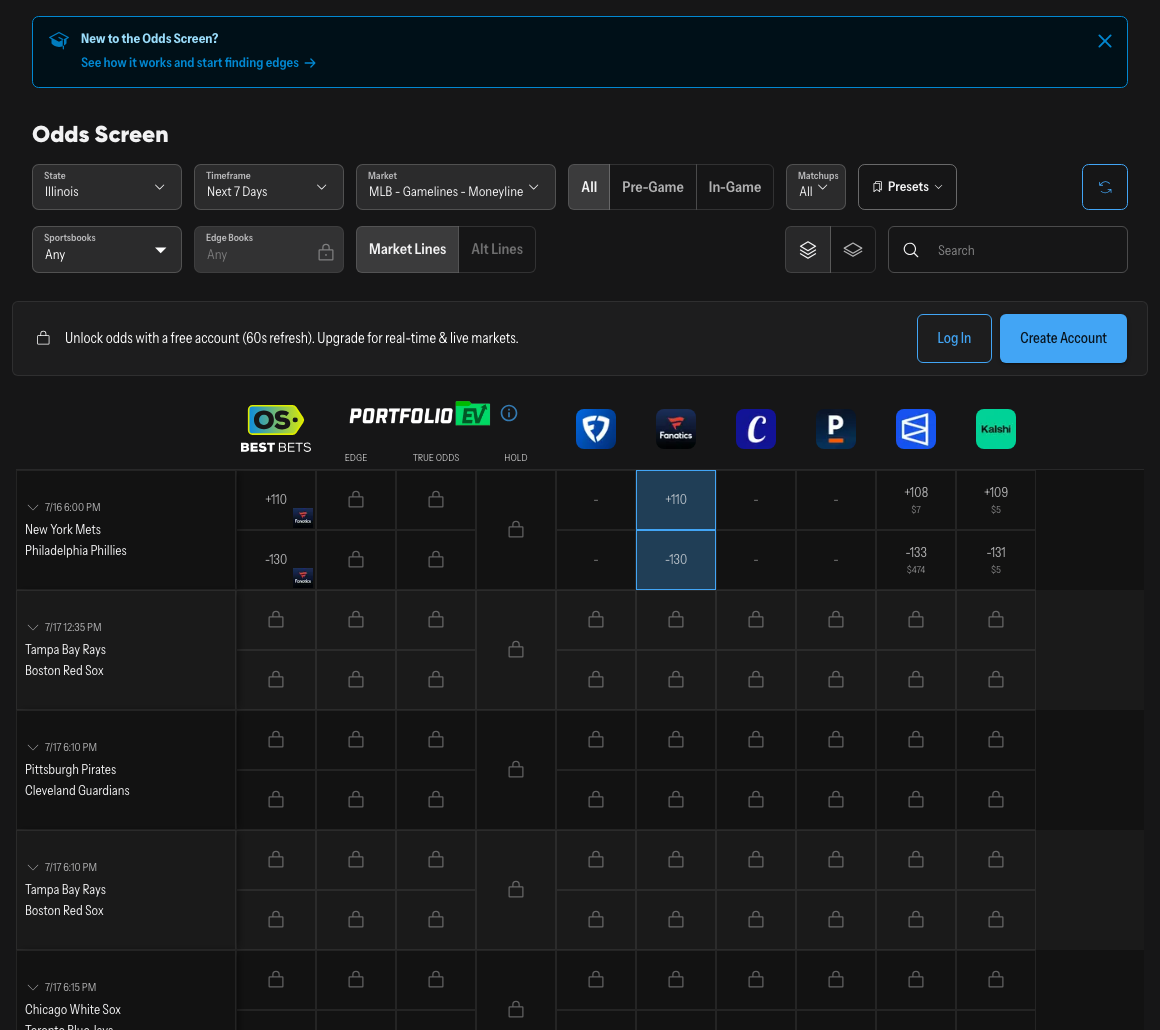 The OddsShopper live odds screen — every book's price on one board, refreshed in real time. Open the live board.
Frequently Asked Questions
What is free bet conversion? It's turning a stake-not-returned free bet (a promo wager where a win pays only the profit, not your stake back) into withdrawable cash. You place the free bet on one side of a market and a real-money hedge on the other side at a different sportsbook, so you collect regardless of which side wins and keep the bulk of the free bet's value as cash.
What is a good free bet conversion rate? A healthy conversion lands around 60–80% of the free bet's face value, and anything over ~70% is strong, so a $100 free bet converts to roughly $60–$80 in cash. The rate depends mostly on the odds you place the free bet at (longer odds convert more) and how well you price the hedge.
How do you convert a free bet into cash? Place the free bet on the longer-odds side at one book (the +300 to +500 range is the sweet spot), then back the opposite side with real cash at a second book, sizing the hedge so both outcomes pay about the same. A free bet calculator returns the exact hedge stake and your conversion rate.
Why can't I just bet the free bet on a favorite? Because a free bet's stake isn't returned, betting it on a short favorite earns little profit even when it wins, and nothing when it loses. Longer odds pay more profit per dollar, which is why you convert at a far higher rate placing the free bet on an underdog and hedging the favorite for cash.
Is free bet conversion legal / is it allowed? The hedging math itself is just placing bets at two sportsbooks, which is legal in regulated U.S. markets where sports betting is available (21+). Individual sportsbooks set their own promo terms, though. Hedging on the same book is usually treated as bonus abuse, and books can limit accounts that only ever bet promos, so use separate books and mix in normal wagers.
Do free bets have rollover or playthrough requirements? A pure free bet usually has no rollover on the credit itself, but the winnings sometimes do, and some "bonus" offers are really deposit/bonus-cash promos with a playthrough requirement. Always read the terms; playthrough, minimum odds, and expiration (often 7 days) all affect what you actually keep.
Stop letting free bets expire or burning them on favorites. The OddsShopper Free Bet Converter scans every major book, finds the highest-converting pairing, and tells you the exact hedge stake to secure most of the free bet's value as cash. Upgrade to OS Pro with code FREEBET20 for 20% off your first payment and turn every promo into withdrawable cash.
More on this: Odds Boosts Strategy: Which Ones Are Actually +EV · Bankroll Management Sports Betting: Unit & Kelly Sizing · Closing Line Value (CLV) Explained: Beat the Close · How to Find +EV Bets: A Practical Workflow · How to Hedge a Bet: When to Hedge & How Much