An assist is the only line on the box score you cannot complete by yourself. A scorer can go get his own points, a rebounder can chase his own boards, but an assist only exists if a teammate catches the pass and buries the shot. That single fact is the whole reason NBA assists props behave differently from every other prop on the board, and it is the reason a patient bettor can still beat them.
Here is the thesis I want you to carry through this guide: an assist prop is a bet on a chain of events. A creator has to have the ball, he has to make the pass, and someone else has to finish it, and because that chain runs through other people, the number swings on inputs the market is slow to fully price. The books sharpen points lines all day because points draw the most action; assists draw less, so the numbers sit looser and the reads live longer. Below is how I actually handicap an assist line, in the order the inputs matter, from the on-ball role that anchors the volume all the way to the one spot I keep coming back to (a co-creator sitting), and then how to turn a good read into a bet that is priced in your favor.
The Quick Answer
To bet NBA assists props, confirm the player actually runs the offense (on-ball role and assist rate), judge the environment that has to finish his passes (pace, shooting, and the opponent's scheme), and pounce on the biggest edge in the market: the night the team's other playmaker sits and one hub inherits the whole offense. Then de-vig the line to its fair price and shop every major sportsbook for a better number, because assists draw less action than points and the loose prices last longer. The full driver-by-driver read, the co-creator injury spot, and a worked +EV example with real book prices are all below.
Why NBA Assists Props Are Softer Than Points
Sportsbooks put their sharpest pricing where the money goes, and no player prop takes more money than points. The scoring line for a star is bet all day by squares and sharps alike, so the book has every incentive to sharpen it to the penny. Assists are the opposite corner of the board. They draw meaningfully less action, which means the books spend less effort sharpening them, and a looser number can sit unattended longer than a scoring line ever would. The books tell you this themselves with their limits: the same shop that will happily take a big bet on the side or total caps a player's assist prop at a small fraction of that, and a market a book caps that tightly is a market where it does not fully trust its own number.
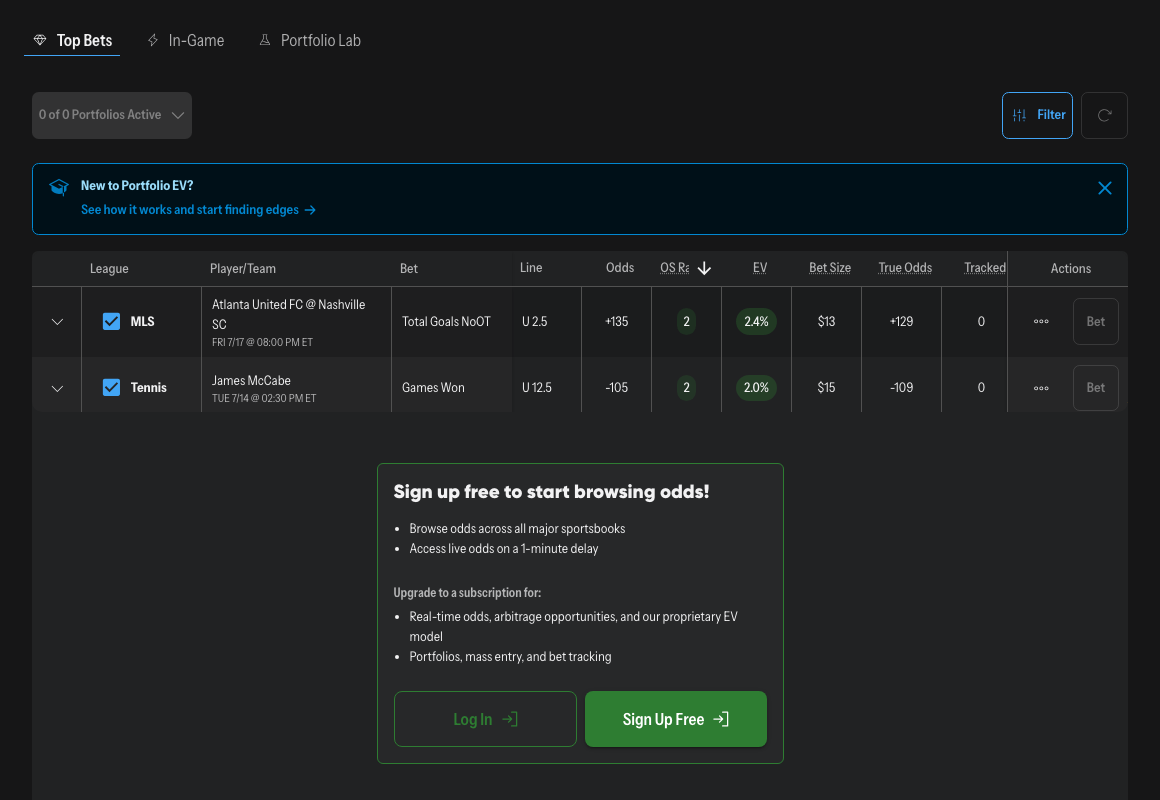
The OddsShopper +EV Screen.
That gap is the opportunity. It does not make assists easy; an inefficient number is still a number, and you still have to be right about the read. But your edge survives longer here than it does on points. On a scoring line, the moment real information hits, the price snaps to it. On an assist line, the same information often takes a beat longer to move the number, and that beat is where a disciplined bettor lives.
So the question becomes: where does the read come from? It comes from understanding what an assist actually is, a shared event and not a solo one, and handicapping every input that decides whether that shared event happens tonight. Everything below works down that list, in order.
See which NBA assists props are priced above fair value.OddsShopper scans the major sportsbooks, de-vigs each assist prop to its true number, and flags the ones offering you the best of it. You can try OddsShopper Pro free for 7 days, and code NBAASSISTS20 takes 20% off OS Pro or OS Core if you subscribe: Start your free trial.
What Actually Drives An NBA Assist Prop
When I handicap an assist line, I work down a short hierarchy. Reputation is not on it, and neither is a passer's season average in a vacuum.
- On-Ball Role And Assist Rate Come First; They Are The Volume Base. Assists flow to whoever runs the offense and holds the ball. A player's assist rate — the share of his teammates' made field goals he sets up while he is on the floor — tells you whether the offense actually runs through him or merely near him.
- The Finishing Environment Is Second, And It Is Unique To This Prop. An assist needs a teammate to make the shot, so the quality of his finishers, the shooting matchup, and the pace of the game all decide how many of his passes convert into assists.
- Then The Situation That Redistributes The Ball. A co-creator sitting, the opponent's coverage scheme, and the game script all change how much initiation lands on your player tonight.
Get those in order and you have a real read. Lead with a passer's reputation instead, and you are betting a name the book has already accounted for.
On-Ball Role And Assist Rate: The Volume Base
Start with the input that anchors everything: does this player actually run the offense?
Assists are a role stat before they are a skill stat. The ball has to be in a player's hands for him to create for others, so the primary initiator — the guy who brings it up, runs the pick-and-roll, and makes the reads — carries an assist number that a secondary, off-ball teammate simply cannot, no matter how willing a passer he is. Assist rate is the cleanest single measure of this: it captures how large a share of his teammates' baskets a player sets up while on the floor, and it survives the pace-and-minutes noise that a raw assist total is buried under.
Minutes are the multiplier on top of role. A lead guard locked into 34 minutes has a completely different assist floor than the same guard in a minutes cap, even when the season line looks identical. So confirm two things before anything else: is this player the on-ball hub, and is he going to be out there long enough for the role to pay off? Role tells you the rate; minutes tell you how long the meter runs. You need both pointing up before an assist over is worth pricing.
Finishers, Shooting, And Pace: The Environment That Completes The Pass
Here is where assists split from every other prop, and it is the part most bettors skip. A points prop is finished the moment the ball leaves the scorer's hand. An assist is not finished until a teammate's shot goes in. That means an assist number is only half about the passer; the other half is the four teammates he is passing to and the game they are playing in.
Three inputs decide whether his passes actually convert:
- The Quality Of His Finishers. A creator surrounded by knockdown shooters and rim-runners banks assists that a creator surrounded by bricklayers never gets credit for. The same ten great passes produce eight assists on a good shooting night and four on a cold one. Nothing changed about the passer — his teammates just missed.
- The Shooting Matchup (Expected Made Field Goals). Because an assist requires a made shot, a game where a team projects to shoot well and score efficiently lifts every assist line on that side. A favorable matchup for the finishers is, indirectly, a favorable matchup for the passer's assist prop.
- Pace. Every game plays at a tempo, measured in possessions per 48 minutes, and it is the multiplier under every counting stat. Around 100 possessions is roughly league average; a game projected into the mid-100s is a track meet, and a grind-it-out, half-court game can sit a half-dozen possessions lower, down in the mid-90s. More possessions mean more trips down the floor, more shots taken, and more chances for the hub's passes to turn into made baskets.
The trap is reading an assist line as if it lives only on the passer. It does not. A brilliant playmaker on a cold-shooting team in a slow game is a worse assist bet than a good playmaker surrounded by shooters in a track meet. Judge the environment, not just the name.
The Co-Creator Lever: When The Other Playmaker Sits
This is the spot I keep coming back to, and the payoff I promised at the top. The single most actionable edge in the NBA assist market is an injury, but not the same injury that moves a points prop, and that distinction is the entire edge.
On a points prop, the money spot is a scorer sitting so a teammate inherits the shots. On an assist prop, the money spot is a co-creator sitting so a teammate inherits the ball. When a team's second ball-handler is ruled out, all of that initiation has to go somewhere, and it funnels to the remaining lead guard. His assist rate does not tick up slightly; it can jump hard, because he is now running every possession instead of sharing them. This is the canonical assist spot every sharp bettor hunts: the other playmaker is out, one hub inherits the whole offense, and for a window the book still has his assist line set for the shared role he played yesterday, not the solo role he is playing tonight.
And here is the nuance that makes assists their own discipline, straight from how the sharpest prop bettors think. If a star sits, the vacated production does not always show up as points for the guy who inherits the ball. Sometimes the teammate who takes over is a distributor, and what spikes is his assists, not his shot attempts — his scoring usage barely moves while his playmaking explodes. If you only ever bet the points over when a star goes down, you miss half the edge. The disciplined read is to ask which stat actually moves: if the ball goes to a scorer, bet points; if it goes to a passer, bet assists. The "different stat" spot, a lead guard whose scoring holds steady but whose assists climb because he is now the sole creator, is one of the most underpriced tickets on the board, precisely because most bettors reflexively bump the points line and leave the assist line alone.
The highest-value assist spot on the boarda confirmed injury to the other ball-handler, all the initiation funneled to one remaining hub, and his assist line still set for the shared role he played last game. This is the read I trust most in the entire assist market.
Always read tonight's injury report, never the depth chart. An assist over that was a mild lean an hour ago becomes the strongest play on the board the moment the co-creator is ruled out.
Opponent Scheme: How Defenses Give Up Kickout Assists
Pace and finishers decide how many made shots are available. The opponent's scheme decides how easy the passes to those shots are.
Assists are manufactured by defensive breakdowns, so the coverage a team plays matters as much as how good it is overall. Two scheme tendencies inflate an assist number:
- Drop Coverage In The Pick-And-Roll. A defense that sits its big man back in the paint on ball screens concedes the pass, either to the roller diving to the rim or, more often, to the shooter spotting up as help rotates. A hub facing a heavy-drop defense gets a steady diet of clean kickout and pocket-pass reads, and clean reads become assists.
- Weak Point-Of-Attack Defense. When the on-ball defender cannot contain penetration, the hub gets into the paint at will, the defense collapses to stop the drive, and the ball sprays out to open teammates. A soft point of attack is an assist factory: every blown containment is a help rotation, and every help rotation is an open shooter one pass away.
The sharp version of the matchup read is not "is this a good or bad defense," it is "does this defense hand out the kind of passes my player makes." A primary initiator walking into a drop-heavy, leaky-point-of-attack defense is the assist-over case that a simple defensive-rating glance will completely miss.
Game Script And Blowout Risk
One more filter before you bet, and it is the one that quietly sinks assist overs: game script.
An assist over is built on minutes, and minutes evaporate in a blowout. In a game that carries a double-digit spread, the starters, including your hub, may sit the entire fourth quarter, and a playmaker who needed 34 minutes of run to clear his number only sees 27. That is the silent killer of an over that looked perfect on role and matchup: the ball movement was there, the floor time was not. Remember the volume base from earlier: it assumed a full workload, and a blowout revokes it.
The flip side is a real edge. A close, competitive game keeps the hub on the floor to the final buzzer, protecting every assist over built on full minutes. There is even a second-order effect unique to assists: garbage time, when starters sit and benches trade isolation buckets, produces very few assists, so a game that stays tight keeps the offense running through your creator when the passes matter most. Before you lock an assist over, glance at the spread and the total and ask whether the game script actually lets your player finish the night. A likely blowout is a reason to pass on the favorite's hub — or to look at the under on a starter whose evening ends in the third quarter.
The Alt-Line Trap
Books know bettors love a big payout, so alongside the main NBA assists over under number they hang alt lines — a much higher assist total at plus money, a "12-plus assists" ticket that pays like a small parlay. The number looks generous, the payout looks fun, and the vig hidden inside it is often steep. An alt line that pays, say, +260 can carry an implied probability well above the player's real chance of hitting it once you account for the book's cut, which means you are being offered a lottery ticket with the vig quietly stacked against you.
The discipline is the same one that governs every bet in this guide: de-vig the alt line and compare it to the player's true probability before the payout seduces you. A big assist number at plus money is only a good bet if the price beats the real odds of it hitting, and on alt lines it usually does not. Treat the tempting payout as a reason to run the math, not a reason to skip it.
How To Find A +EV NBA Assist Prop
A great read is only half the bet. The other half is price, and this is where you turn "I like this over" into a bet that is mathematically in your favor.
Start with fair value. Every posted price has the book's cut, the vig, baked in. To strip it out, take both sides of the same prop at a sharp book and de-vig them. Say the sharpest book posts a guard's assists at Over 8.5 (-110) and Under 8.5 (-110). Each side implies about 52.4%, which adds up to 104.8%. That extra 4.8% is the hold. Remove it and the true, fair chance of the over lands right at 50%, an even-money +100.
Now shop that number across every major book. If the fair price is +100 and one book is posting the same Over 8.5 at +115 while another sits at -120, the gap is your edge:
| Sportsbook | Posted price on Over 8.5 assists | Your result vs. a fair +100 |
|---|---|---|
| Sharp Book (Used To Set Fair Value) | -110 / -110 both sides | Fair line is +100 (a 50% true chance) |
| FanDuel 🎁 | +115 | +EV: paid +115 on a 50% shot, about +7.5% |
| Caesars | -120 | -EV: laying -120 on the same 50% shot, about -8% |
Illustrative prices to show the math, not a live line. Always check the current number before betting.
The row that matters is the FanDuel +115. You are being paid +115 for an outcome the market itself prices at even money, so every dollar there returns roughly seven and a half cents of expected value on a true coin flip. The same exact bet at -120 is a losing proposition. Nothing changed about the passer, the pace, or the matchup between those two books — the only difference is the number, and the number is the whole edge. Take the +115 at one book instead of the -120 at another, and over a season of hundreds of assist props, that shopping is worth more than any single great read.
Stop laying a bad number on a bet you like.OddsShopper de-vigs every NBA assists prop to its true price and lines up all the major sportsbooks so you can grab the best of it in one click. Try it free for 7 days, then code NBAASSISTS20 takes 20% off OS Pro or OS Core: Start your free trial.
The Tools That Do The Work For You
You could open ten sportsbook apps and de-vig each assist prop by hand. Or you could let a screen do it. Three OddsShopper tools cover the exact workflow this guide walked through:
- The Odds Comparison Screen lines up FanDuel, DraftKings, BetMGM, Caesars, and the rest for a given market side by side, so shopping an assist line takes a glance instead of ten tabs. Start on the live NBA odds screen and switch to the player-prop market.
- The Sharp Sportsbook Algorithm does the de-vig math for you, stripping the vig out of each market to its no-vig true price — so the fair +100 in the example above is calculated for you, and an alt line's real implied probability is exposed instead of hidden behind the payout.
- Portfolio EV then ranks every bet by expected win percentage and expected return. The tool surfaces the props where a book is paying above that fair price, so the +115 over is the kind of number that rises to the top automatically. Filter it to the player-prop markets and it points you straight at the spot this guide taught you to hunt: the co-creator-out assist over still priced for last night's shared role, now sitting above its fair number.
If you are still shaky on the fundamentals, our guide to player props betting explained covers how props work and why the popular ones run tight in the first place. For the sharpest corner of the board, see how the same volume-and-matchup logic plays out on NBA points props, and see how the softer NBA rebounds props market rewards the same patient approach. The discipline is not basketball-specific, either: our guides to NFL rushing yards props and NFL receiving yards props run the identical volume-then-price read on football numbers.
Frequently Asked Questions
What are NBA assists props? NBA assists props are bets on how many assists a single player records in a game, posted as an over/under number such as 8.5. You bet whether he clears that line (the over) or falls short of it (the under), independent of who wins the game. An assist is only credited when a teammate makes the shot off his pass.
What is the most important factor in an NBA assists prop? On-ball role and assist rate. Assists flow to the player who runs the offense and controls the ball, so a primary initiator's share of possessions — and his projected minutes — set the ceiling for the number well before reputation or a single matchup enters the picture. The gap is not subtle: a true lead guard typically sets up 30 percent or more of his teammates' baskets while he is on the floor, while an off-ball wing often sits under 15 percent, and no matchup or hot streak closes a gap that wide.
Why are NBA assists props softer than points props? Assists draw less betting action than points, so books price them looser and sharpen them less aggressively. That leaves more beatable numbers and lets a good read survive longer before the line moves — unlike the scoring market, which snaps to new information almost immediately.
How does an injury affect an NBA assists prop? When a team's other primary ball-handler is ruled out, the remaining lead guard inherits the initiation, and his assist rate can spike as he runs every possession. That vacated playmaking role can push his assist prop into strong over territory before the book fully adjusts — and it can move his assists even on nights his scoring stays flat.
How do you find the best NBA assists props? De-vig the prop at a sharp book to find its fair price, then shop every major sportsbook for a better number than that fair value. The best NBA assists props are the ones where a book pays more than the true odds of the outcome hitting; that prop is priced in your favor.
More on this: NBA Championship 2027 Odds: Live Title Prices By Team · NBA Next Team Odds: Every Star's Landing-Spot Market, Scored · How To Bet NBA Points Props: A Strategy Guide · How To Make Your Own NBA Projections For Player Props · How To Bet NBA On DraftKings: A Beginner's Guide
The Bottom Line On NBA Assists Props
Assists props reward the bettor who remembers what an assist really is: a shared event, not a solo one. The number lives on a chain — a hub with the ball, a pass to the right spot, a teammate who finishes — and because that chain runs through other people and draws less action than the scoring market, the price sits looser and the reads last longer. You beat it by handicapping the whole chain: confirm the on-ball role and the minutes, judge the finishers and the pace that turn passes into made baskets, read the opponent's scheme for the kind of breakdowns your player exploits, respect the game script so a blowout does not steal his floor time, and above all hunt the spot where a co-creator sits and one hub inherits the entire offense. Then, once you like a side, win the last few cents at the counter by betting the best available number. Read the whole chain and shop the price, and the softest corner of the NBA prop board becomes a place where a patient bettor holds a real edge.
Find the mispriced NBA assists props on any night's board.OddsShopper finds the assist lines priced in your favor across the major sportsbooks and shows you the true odds on every one. Try it free for 7 days, then code NBAASSISTS20 takes 20% off OS Pro or OS Core: Start your free trial.
Betting involves risk. Bet only what you can afford to lose, and only where it's legal in regulated U.S. markets. No profit is promised. 21+. If you or someone you know has a gambling problem, call 1-800-GAMBLER.