Ask a room of new bettors what they wager on and most will say the moneyline or the spread. Ask them where some of the softest numbers on the board hide, and you get blank stares. The answer, most nights, is player props, and by the time you finish this guide you'll know how to spot the ones the books have mispriced.
Player props are one of the fastest-growing corners of sports betting for a reason: they are simple to understand, and on a busy sports night there can be hundreds or thousands of them posted. That volume is exactly why they run soft, and softness is the whole opportunity. Let's start with what a player prop actually is, then work toward how you turn "which prop do I like?" into "which prop is actually worth betting?"
In Summary
- A Player Prop Is A Bet On One Player's Stat Line — a hitter's hits, a quarterback's passing yards, a guard's rebounds — not on which team wins.
- Props Are One Of The Softest Corners Of The Board because a single game posts hundreds of them, and no book can sharpen every number the way it sharpens the spread.
- The Edge Is +EV Plus Line Shopping: de-vig the sharp market to a prop's fair price, then shop every book for a number that beats it.
- A Real Example Below shows a hitter's under priced at +190 against a +162 fair line — a 10.7% edge for taking the same bet at a better number.
- OddsShopper's Positive EV And Prop Tools do the de-vig and the shopping for you, so the tool surfaces the props already priced in your favor.
What Is A Player Prop Bet?
A player prop (short for "proposition") is a bet on an individual player's stat line rather than the result of the game. You are not betting on who wins. You are betting on what one player does inside the game: a hitter's total hits, a pitcher's strikeouts, a quarterback's passing yards, a guard's rebounds.
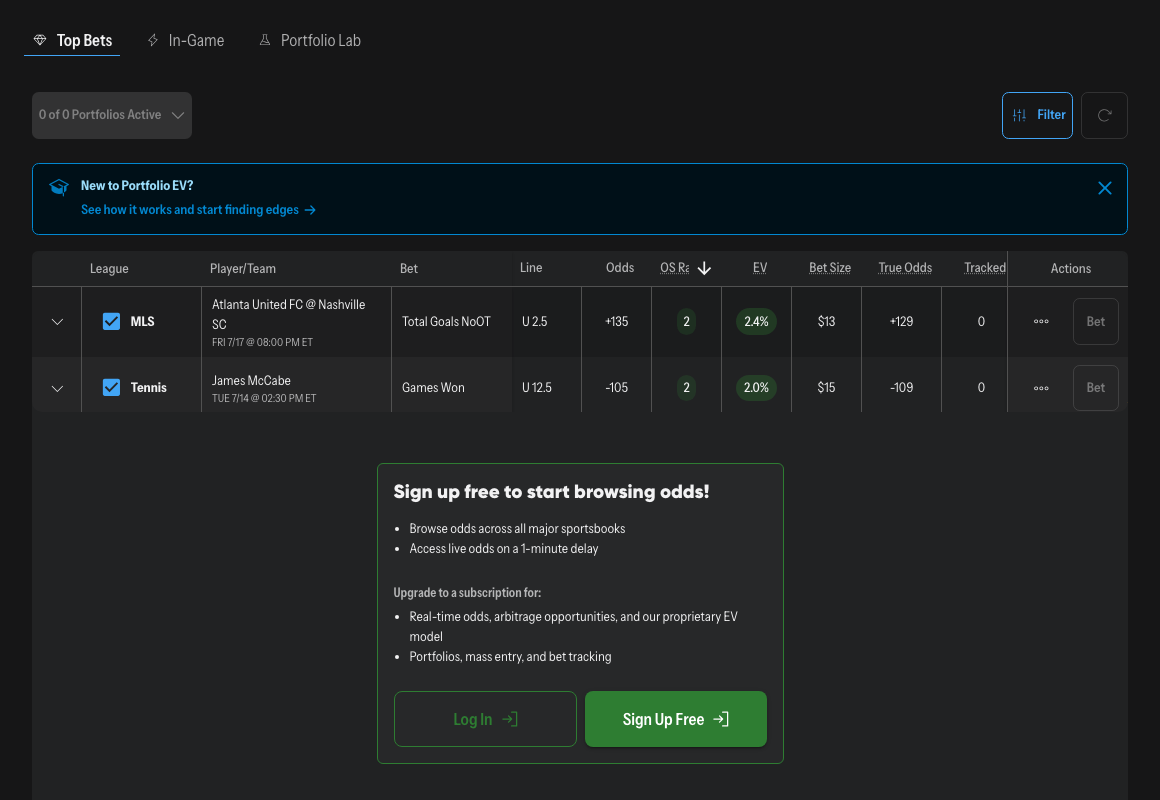
The OddsShopper +EV Screen.
Most player props are set on a half-number line with an over and an under. A sportsbook might post a Major League Baseball hitter at 0.5 total hits, and you decide whether he gets at least one (the over) or is held hitless (the under). A half-number line means there is no tie to sweat: he clears it or he does not. That makes a player prop one of the easiest bet types for a beginner to reason about, because you are answering a single, concrete question about a single player.
The Main Types Of Player Props By Sport
Props follow the sport. What a stat sheet tracks, a sportsbook will usually price. The most common markets across the major U.S. leagues look like this:
| League | Popular player props |
|---|---|
| MLB (Baseball) | Total hits, home runs, total bases, strikeouts (pitcher), RBIs, pitching outs |
| NFL (Football) | Passing yards, rushing yards, receiving yards, receptions, anytime touchdown |
| NBA (Basketball) | Points, rebounds, assists, threes made, points + rebounds + assists (PRA) |
| NHL (Hockey) | Shots on goal, points, goals, goalie saves |
Baseball is one of the most prop-heavy sports because so much of it is one-on-one: a single batter against a single pitcher, dozens of times a night. That is why a beginner often starts with something like an MLB total hits or a pitcher strikeout prop, where the matchup is easy to picture. The point holds across every sport, though. If a box score counts it, you can usually find a prop for it. Football bettors, for example, can dig into a whole board of NFL player props, and basketball bettors can work a single market end to end with our guide to nba assists props. Golf runs on the same logic through finishing-position markets like top 5s, top 10s and top 20s, the US answer to each-way golf betting.
Props are no longer sportsbook-only territory either: CFTC-regulated exchanges now list them as event contracts. Here is how Kalshi player props work.
Why Player Props Are Often The Softest Bets On The Board
Here is the part that makes props worth learning. A sportsbook pours its sharpest pricing into the markets that take the most money: the big game lines, the spread, the total. Those numbers get shaped by professional bettors and adjusted constantly, so the edges are thin.
Prop markets are different. A single game can carry hundreds of individual prop numbers, and the book simply cannot sharpen every one of them the way it sharpens the moneyline. Some props get less attention, lower betting limits, and slower updates. A mispriced number hides in exactly that gap. The same prop can also sit at wildly different prices from one book to the next, because each book sets and manages its own number, and they do not all land in the same place.
That combination, high volume plus uneven pricing, is why one of the softest bets on the board is frequently a player prop and not a game line. Now let's turn that idea into an actual method.
How To Find +EV Player Props
Finding a good prop comes down to two habits: research and price. Do both and you are betting with an edge; skip either and you are guessing.
Research the number. Before you look at odds, look at the player's situation. For a hitter, who is the pitcher and what does he give up? For a receiver, how many targets does his role earn him? The core inputs are the same across sports: a player's usage or role, the matchup, and the game's expected pace. A pitcher with a strikeout prop facing a lineup that whiffs a lot is a very different bet than the same pitcher facing a contact-heavy lineup. The most systematic version of this habit is a projection: a season-long number for what the player should do in this exact spot. Our guide to betting NFL props with projections shows how to turn projections into prop bets, leg by leg.
Then check the price against fair value. This is where +EV, or positive expected value, comes in. A bet is +EV when the price you can get is better than the true odds of it happening. You find the true odds by taking the vig out of the sharpest markets (called de-vigging), and then you shop for a book offering a better number than that fair price. If the fair price on a prop is +162 and one book is posting +190, that gap is your edge.
None of this is abstract. Here are three real Major League Baseball player-prop lines from a single OddsShopper board snapshot, each showing the de-vigged fair price next to the best number actually available across the books at the time:
| Player Prop | Fair odds | Best takeable price | Edge |
|---|---|---|---|
| Carson Benge Under 0.5 Hits | +162 | +190 (Bet365) | +10.7% |
| Tyler Tolbert Under 0.5 Hits | +110 | +132 (Bet365) | +10.5% |
| Jared Young Under 0.5 Hits | +114 | +130 (Bet365) | +7.5% |
Lines captured from one OddsShopper board on July 9, 2026 — a fixed illustration, not live pricing. Prices move; always check the current number before betting.
An under 0.5 hits prop is a bet that the hitter is held hitless that day. In that snapshot, the one I keep coming back to is the Carson Benge under. The market's fair price on him going hitless was +162, already a plus-money number, yet Bet365 was posting +190 on the same outcome. That gap is a 10.7% edge, and it shows up whenever one book prices a prop better than the fair number the rest of the market implies. There is nothing exotic to predict there: you are simply getting paid +190 for something the market prices at +162.
See which props are +EV right now.OddsShopper scans the major sportsbooks, de-vigs each prop to its true price, and flags the ones priced in your favor, so you are not doing that math by hand. New here? You can try OddsShopper Pro free for 7 days, and code PLAYERPROP20 takes 20% off OS Pro or OS Core if you subscribe.
Line Shopping: Why The Best Available Price Matters Most
If you take one habit from this guide, make it line shopping. The prices in that table are the best numbers available, and the only way to know a number is the best is to compare every book at once. Betting the same prop at a better number costs you nothing extra, and it is the easiest edge a beginner can claim.
Think about what a price actually pays. Picture the same prop at two books: at +190 it returns $190 on a $100 win, but at +140 the same outcome returns only $140 — a $50 difference for no extra risk. That is why the +190 you could actually take on the Carson Benge under mattered so much: it sat well above his +162 fair price, and that gap is the whole edge. Settle for a lower number at the first book you open, and over a season of hundreds of bets you hand most of that edge back.
Line shopping only works if you can see every book at once, which is exactly the problem the tools below solve.
The Tools That Do The Work For You
You could open ten sportsbook apps and compare each prop by hand. Or you could let a screen do it. A few OddsShopper tools cover the exact workflow this guide just walked through:
- The Odds Comparison Screen lines up the major sportsbooks — FanDuel, DraftKings, Bet365, Caesars and the rest — for a given market side by side, so line shopping takes a glance instead of ten tabs. Start on the live odds screen and switch to the prop market you want.
- The Positive EV Tool does the de-vig math for you: it calculates each prop's true price and surfaces the ones where a book is offering better than fair, ranked by edge. That Carson Benge +190 line is the kind of thing it flags automatically.
- The Prop Tool applies the same true-odds logic to the player-prop markets specifically, so you can go straight to the mispriced props instead of scrolling a full board.
If you play props on PrizePicks instead of a sportsbook, the same fair-price logic applies to pick'em entries — our free PrizePicks optimizer guide shows how to build entries from projections rather than gut feel.
The point of all three is the same: turn the two habits, research and price, into something you can act on in seconds instead of spreadsheets. If you want to understand the math underneath, our guide to positive expected value betting breaks down where the fair number comes from, how sportsbooks make money explains the vig you are removing when you de-vig a prop, and how to use the OddsShopper EV tool shows the workflow above running on a live board.
Frequently Asked Questions
What are player props in betting? Player props are bets on an individual player's stat line, such as a hitter's total hits or a quarterback's passing yards, rather than on which team wins the game. Each one is posted as a number with an over and an under.
Why are player props considered softer than game lines? Because a single game carries hundreds of individual prop numbers and a sportsbook cannot sharpen every one the way it sharpens the moneyline or spread. Lower attention and lower limits leave more mispriced props for bettors to find.
How do you find a +EV player prop? Research the player's role, matchup, and the game's pace, then compare the best available price to the prop's de-vigged fair price. When a book offers a better number than fair value, that prop is +EV — OddsShopper's Positive EV tool runs that de-vig-and-compare across the major books for you, the same way it flagged the Carson Benge under at +190 against a +162 fair line.
Are player props worth betting for beginners? Yes, because each prop is a simple two-outcome question about one player, which makes it easy to reason about. Pair that with line shopping across books and props are one of the more beginner-friendly ways to bet with an edge. Bet within your budget, and only where it is legal in regulated U.S. markets.
More on this: What Is A Prop Bet? Proposition Betting Explained · NFL Comeback Player Odds: Kalshi Sleeps on Daniel Jones · PFA Player Of The Year 2026 Odds: Kalshi's Big Fernandes Bet · NFL Comeback Player Of The Year Odds: The Missing Favorite · NFL Preseason Event Contracts, Explained In 60 Seconds
The Bottom Line On Player Props
Props grew into one of the biggest and softest corners of the market, by sheer volume of numbers posted, precisely because books put up so many of them and can't price every one to the same standard as the game lines. For a bettor willing to do a little research and always take the best available number, that softness is a standing invitation. Start with a market you understand, hold out for a price better than fair value, and shop every prop before you place it. Mispriced numbers show up often enough that, over a season of hundreds of bets, shopping every prop steadily improves your expected value — though your results still depend on the prices you take and the bets you pick. The bettors who do best at props are the ones who keep looking for mispriced numbers, shop every price, and let a tool do the searching.
Stop leaving the better number on the table.OddsShopper finds the props priced in your favor across the major sportsbooks and shows you the true odds on each one. Try it free for 7 days, then code PLAYERPROP20 takes 20% off OS Pro or OS Core.
Betting involves risk. Bet only what you can afford to lose, and only where it's legal in regulated U.S. markets. No profit is promised. 21+. If you or someone you know has a gambling problem, call 1-800-GAMBLER.