Most people bet an NBA points prop the lazy way: they pull up a scorer they like, glance at his season average, see the number sitting a shade under it, and fire the over. The problem is that everyone else is doing the same thing, which is exactly why NBA points props are the tightest, sharpest-priced player-prop market in basketball. The book already knows the season average. If that were the edge, there would be no edge.
So here is the thesis I want you to carry through this whole guide: a points prop is a bet on opportunity, not on talent, and because the scoring market is priced so efficiently, the only reliable way to beat it is to catch a change in that opportunity before the number catches up. Nine times out of ten that change is an injury. Below is how I actually handicap a scoring line, in the order the inputs matter, from the volume base to the one lever I keep coming back to, and how to turn a good read into a bet that is truly priced in your favor instead of a coin flip you are paying too much for.
The Quick Answer
To bet NBA points props well, handicap the player's opportunity first: usage rate and projected minutes, then scoring efficiency, then pace and the opponent's defense at his position, and only bet when the price beats the prop's de-vigged fair value. The single biggest edge is an injury, because a star ruled out spikes a specific teammate's usage before the book fully moves his number.
- Points Props Are The Sharpest Prop On The Board. They take the most action, so the book prices them tightly. You will not beat a scoring line by knowing a player's average; the market already has it.
- The Edge Is A Change In Opportunity, And The Biggest One Is An Injury. With a primary scorer sitting, a specific teammate's usage rate spikes, and the book is often a step slow to move his points number far enough.
- Handicap In Order: usage and projected minutes (the volume base), then scoring efficiency (how well those shots convert), then pace (more possessions, more scoring chances), then the matchup (opponent defensive rating and how they guard that position), then game script (blowout risk to minutes).
- Watch The Alt-Line Juice Trap. A tempting "30+ points" ticket at plus money often carries far more vig than it looks — de-vig it before you fall for the payout.
- Then Win On Price. De-vig the prop to its fair number and shop every book. Over a season, betting the best available number is worth more than any single great read.
Below, we break down each input in the order it matters, the alt-line juice trap, and a worked de-vig example that shows exactly where the edge on a scoring line hides.
Why NBA Points Props Are The Sharpest Prop On The Board
Sportsbooks concentrate their best pricing where the money goes, and no player prop takes more money than points. The scoring line for a star is bet all day by squares and sharps alike, so the book has every incentive to sharpen it to the penny. That is the opposite of the rebounds market, where a looser number can sit unattended. Points is the market that fights back.
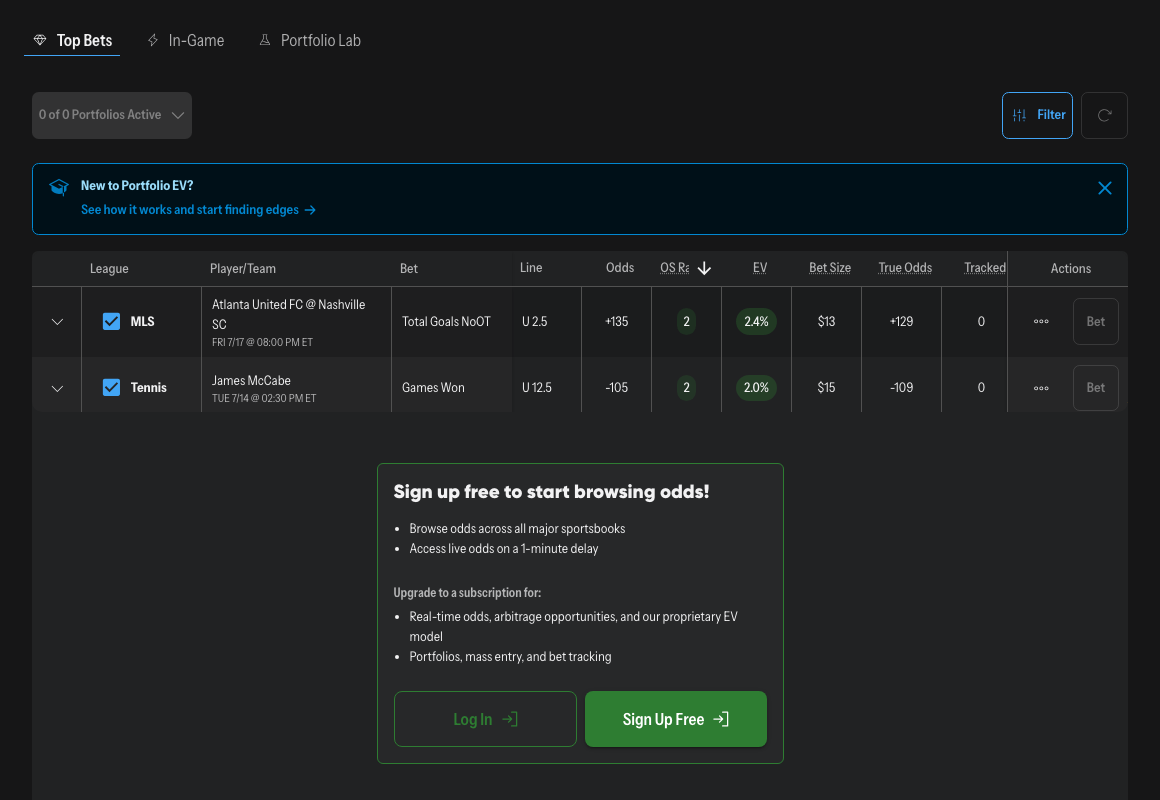
The OddsShopper +EV Screen.
Which means the "find a name you like and bet the over" approach is dead on arrival here. The season average is public information the line already reflects. If a player scores 24 a game, the book is not going to hang 21.5 and wait for you to notice. It is going to hang 24.5 and shade the juice.
So where does the edge live? In the one thing the market is always a beat slow to fully price: a change in a player's opportunity. When something shifts how many shots a player is going to take tonight — a teammate ruled out, a role change, a pace mismatch — the true scoring number moves immediately, but the posted line often lags for a window. That lag is the entire game. Everything below is about finding it before it closes, and then not giving the edge back at the counter by laying a bad price.
See which NBA points props are priced above fair value.OddsShopper scans the major sportsbooks, de-vigs each scoring prop to its true number, and flags the ones offering you the best of it. You can try OddsShopper Pro free for 7 days, and code NBAPOINTS20 takes 20% off OS Pro or OS Core if you subscribe.
What Actually Drives An NBA Points Prop
When I handicap a scoring line, I work down a short hierarchy. Reputation is not on it, and neither is last night's box score.
- Usage And Minutes Come First; They Are The Volume Base. Points are just shots that go in, and shots come from usage: the share of a team's possessions a player finishes while he is on the floor. Pair a high usage rate with a realistic minutes projection and you have the raw volume a scoring number is built on. No usage and no minutes, no points.
- Efficiency Is Second. Once you know a player will get the touches, you ask how well he converts them — his true shooting, how many of his shots are threes, whether he gets to the line. A high-usage player who scores efficiently is the engine; volume is the multiplier.
- Then The Environment And The Matchup. How fast the game plays decides how many possessions exist to score on, and the opponent decides how hard those points are to get.
Get those in order and you have a real read. Lead with the 24-a-game average instead and you are betting a name the book has already priced.
Usage And Minutes: The Volume Base
Start with the two inputs that never lie: is he going to have the ball, and is he going to be on the floor?
Usage rate is the engine because points are a volume stat before they are an efficiency stat. A player who ends a huge share of his team's possessions gets the shot attempts, the free throws, and the scoring chances that a low-usage role player simply never sees, no matter how good a shooter he is. Roughly 17 to 18 field-goal attempts a night, or six-plus three-point attempts, is the shape of a real points-over profile: a player the offense is actually running through.
Minutes are the multiplier on all of it. A scorer locked into 34 minutes is a completely different bet than the same scorer in a minutes cap coming off an injury, even when the season line looks identical. Confirm tonight's projected minutes before you do anything else, because a scoring number that assumes 34 minutes is dead the moment the coach says 28. Usage tells you the rate; minutes tell you how long the meter runs. You need both pointing up before a points over is even worth pricing.
Efficiency: Turning Those Shots Into Points
Volume gets a player the shots. Efficiency decides how many of them become points: the step most bettors skip.
Two high-usage guards can take the same 18 shots and land in very different places, because one converts at a far better clip than the other. True shooting percentage is the number to watch: it folds twos, threes, and free throws into one figure and tells you how much scoring a player squeezes out of every possession he uses. The shape of the shots matters too. A guard who fires six or more threes a night has a higher scoring ceiling on any given evening than a same-usage player living on mid-range twos, because three points beat two, and a player who gets to the free-throw line adds cheap, defense-proof points that do not depend on a shot falling. So once the volume checks out, ask the follow-up: does this player turn his shots into points efficiently, or is he a high-volume, low-conversion scorer whose over needs a hot night to cash? A high-usage, high-efficiency scorer is the cleanest points-over profile there is; a high-usage, cold-shooting one is where an over quietly dies even when the minutes and touches were all there.
The Injury Lever: A Star Sitting Spikes A Teammate's Usage
This is the lever I keep coming back to, and the payoff I promised at the top. The single most actionable edge in the entire NBA prop market is an injury, and for points props it is not close.
Rule a team's primary scorer out and the possessions he used to end do not vanish. They get redistributed, and a large share of them flow to one specific teammate — the next man up in the offense's pecking order. His usage rate does not tick up a point or two; it can jump five or more, and a usage jump of that size is flatly bettable. This is the canonical spot every sharp bettor hunts: a star sits, the number-two option inherits the touches, and for a window the book has his points line set for the role he played yesterday, not the one he is playing tonight. Always read tonight's injury report, never the depth chart, because a scoring over that was a mild lean an hour ago becomes the strongest play on the board the moment the news drops.
The highest-value points spot on the boarda confirmed injury to the primary scorer, a vacated shot diet, and the number-two option inheriting the touches at a line still set for last night's role. This is the read I trust most in the entire scoring market.
One critical nuance, and it is the mistake that separates a disciplined bettor from someone chasing headlines: the usage has to actually land on scoring. A star sitting does not always turn the vacated role into points for the same guy. Sometimes the teammate who inherits the ball is a distributor, and what spikes is his assists, not his shot attempts — his scoring usage barely moves while his playmaking explodes. If the injury redistributes playmaking rather than shots, the points prop is the wrong ticket and the assist prop is the bet. Over-bumping a scoring line on an injury that did not actually change who shoots is one of the most common ways bettors hand the edge back. Confirm the vacated touches are shot attempts before you buy the points over.
Pace: More Possessions, More Scoring Chances
So far everything has been about the player. Now zoom out to the game around him, because usage only tells you a player's share of the possessions — pace tells you how many possessions there are to share.
Every game plays at a tempo, measured in possessions per 48 minutes, and it is the multiplier under every scoring line on the floor. Around 100 possessions is roughly league average; a game projected into the mid-100s is a track meet, and a grind-it-out, half-court game can sit a dozen possessions lower. That gap is enormous for a points prop: a dozen extra possessions is a dozen more trips down the floor for a high-usage scorer to take shots on. The same player, same usage, same minutes, scores meaningfully more in a 105-possession game than in a 93-possession one, and the difference has nothing to do with him.
| Game Environment | Possessions per 48 (rough benchmark) | What it means for a points prop |
|---|---|---|
| Grind-It-Out, Half-Court Game | Low 90s | Fewer trips, fewer shots; overs need everything else to go right |
| League-Average Tempo | Around 100 | Neutral; the line already assumes this |
| Track Meet | Mid-100s | Extra possessions lift every scorer's chances; overs get a tailwind |
Benchmarks, not live figures; always check how tonight's specific matchup projects.
The row that decides bets is the track meet: a dozen extra possessions over a grind-it-out game is a dozen more chances for a high-usage scorer to add to his total, before talent enters the conversation at all. The trap here is reading a scoring line in a vacuum. A points total that looks a touch high against a slow, defensive opponent can be a clear over once you see the game projects to a fast, up-and-down environment. Check the pace of both teams before you judge the number, because a fast opponent lifts everyone's scoring chances, and a fast opponent facing a team that also likes to run turns a normal scoring night into a shootout.
The Matchup: Defensive Rating And Position Defense
Pace decides how many scoring chances exist. The opponent decides how hard those chances are to convert.
Start broad with defensive rating (points allowed per 100 possessions) for the simple good-defense-or-bad-defense read. A leaky defense hands out points to everyone; an elite one makes every bucket work. But the sharper lever is position defense: how a team defends the specific spot your player plays. A defense can be stout overall and still bleed points to shooting guards because its own guard defenders are a weakness. A scorer walking into the team that gives up the most points to his position is the points-over case that the broad defensive rating alone will hide.
Layer it onto the volume read and the picture sharpens fast. A high-usage guard, locked into starter minutes, in a fast game, against the defense that surrenders the most points to guards — that is four inputs all pointing the same direction, and it is a far better bet than the biggest name on the board playing a slow team that smothers his position. When the matchup and the volume agree, you are holding a real edge. When they fight each other, pass.
The core points overa high-usage scorer, locked into starter minutes, in a fast game, against the defense that gives up the most points to his position. Everything else is a tiebreaker.
Game Script And Blowout Risk
One last filter quietly sinks more scoring overs than any of the inputs above: game script.
A points over is built on minutes, and minutes evaporate in a blowout. In a game that carries a double-digit point spread, the favorite's starters may sit the entire fourth quarter, and a scorer who needed 34 minutes to clear his number only sees 27. That is the silent killer of an over that looked perfect on usage and matchup — the volume was there, the floor time was not. Remember the volume base from earlier: it assumed a full workload, and a blowout revokes it. The flip side matters too, and it is a real edge: a close, competitive game keeps the stars out there to the final buzzer, protecting every over built on full minutes, and a tight game can even spike a closer's scoring in crunch time. Before you lock a points over, glance at the spread and the total and ask whether the game script actually lets your player finish. A likely blowout is a reason to pass on the favorite's scorer — or to look at the under on a starter whose night ends in the third quarter.
The Alt-Line Juice Trap
Here is a trap the scoring market sets more aggressively than any other prop market, precisely because points props draw so much action: the alternate line.
Books know bettors love a big payout, so alongside the main scoring number they hang alt lines — a much higher points total at plus money, a "30-plus points" or "35-plus points" ticket that pays like a small parlay. The number looks generous, the payout looks fun, and the vig hidden inside it is often brutal. An alt line that pays +250 can carry an implied probability well above what the player's real chance of hitting it is once you account for the book's cut: a lottery ticket priced as if it hits far more often than it actually does. The discipline is the same one that governs every other bet in this guide: de-vig the alt line and compare it to the player's true probability before the payout seduces you. A big number at plus money is only a good bet if the price beats the real odds of it hitting, and on alt scoring lines it usually does not. Treat the tempting payout as a reason to run the math, not a reason to skip it.
How To Find A +EV NBA Points Prop
A great read is only half the bet. The other half is price, and this is where you turn "I like this over" into a bet that is mathematically in your favor.
Start with fair value. Every posted price has the book's cut, the vig, baked in. To strip it out, take both sides of the same prop at a sharp book and de-vig them. Say the sharpest book posts a guard's points at Over 24.5 (-110) and Under 24.5 (-110). Each side implies about 52.4%, which adds up to 104.8%. That extra 4.8% is the hold. Remove it and the true, fair chance of the over lands right at 50%, an even-money +100.
Now shop that number across every book. If the fair price is +100 and one book is posting the same Over 24.5 at +112 while another sits at -118, the gap is your edge:
| Sportsbook | Posted price on Over 24.5 points | Your result vs. a fair +100 |
|---|---|---|
| Sharp Book (Used To Set Fair Value) | -110 / -110 both sides | Fair line is +100 (a 50% true chance) |
| BetMGM 🎁 | +112 | +EV: paid +112 on a 50% shot, about +6% |
| DraftKings | -118 | -EV: laying -118 on the same 50% shot, about -7.6% |
Illustrative prices to show the math, not a live line. Always check the current number before betting.
The row that matters is the BetMGM +112. You are being paid +112 for an outcome the market itself prices at even money, so every dollar there returns about six cents of expected value on a true coin flip. The same exact bet at -118 is a losing proposition. Nothing changed about the player, the pace, or the matchup between those two books — the only difference is the number, and the number is the whole edge. Take the +112 at one book instead of the -118 at another, and over a season of hundreds of scoring props, that shopping is worth more than any single great read. One more confirmation signal once you have your number: if the line then moves toward your side, the sharpest money in the market likely agrees with you. Our guide to following sharp money covers how to read that movement.
Stop laying a bad number on a bet you like.OddsShopper de-vigs every NBA points prop to its true price and lines up all the major sportsbooks so you can grab the best of it in one click. Try it free for 7 days, then code NBAPOINTS20 takes 20% off OS Pro or OS Core.
The Tools That Do The Work For You
You could open ten sportsbook apps and de-vig each scoring prop by hand. Or you could let a screen do it. Three OddsShopper tools cover the exact workflow this guide walked through:
- The Odds Comparison Screen lines up FanDuel, DraftKings, BetMGM, Caesars, and the rest for a given market side by side, so shopping a points line takes a glance instead of ten tabs. Start on the live NBA odds screen and switch to the player-prop market.
- The +EV Betting Screen does the de-vig math for you, stripping the vig out of each market to its no-vig true price, so the fair +100 in the example above is calculated for you, and an alt line's real implied probability is exposed instead of hidden behind the payout.
- Portfolio EV then ranks every bet by expected ROI and expected win percentage; the tool surfaces the props where a book is paying above that fair price, so the +112 over is the kind of number that rises to the top automatically. Filter it to the player-prop markets and you go straight to the mispriced scoring lines instead of scrolling an entire board.
If you are still shaky on the fundamentals, our guide to player props betting explained covers how props work and why the popular ones run tight in the first place. For the softer corner of the board, read how the same volume-and-matchup logic beats NBA rebounds props and how to hunt value in NBA Summer League, where the pricing is looser than the regular season. And the framework travels: the opportunity-first, price-second process in this guide is the same one that beats NFL player props, where target share and snap counts play the role usage and minutes play here.
Frequently Asked Questions
What are NBA points props? NBA points props are bets on how many total points a single player scores in a game, posted as an over/under number such as 24.5. You bet whether he clears that line (the over) or falls short of it (the under), independent of who wins the game.
Why are NBA points props harder to beat than rebounds or assists props? Points props take the most betting action of any player prop, so books price them tightly and sharpen them all day. Rebounds and assists draw less sharp money, which leaves their numbers looser and often more beatable. On points, the edge comes from catching a change in opportunity before the line moves, not from knowing the average.
How big does a usage jump need to be before it is worth betting? A spike of five or more points of usage rate is the bettable threshold, and it is the size of jump that typically follows a primary scorer being ruled out. If the vacated role lands on a distributor and his scoring usage barely moves, skip the points prop and look at his assists instead; betting the stat that actually changed is the whole discipline.
How do you find a +EV NBA points prop? De-vig the prop at a sharp book to find its fair price, then shop every sportsbook for a better number than that fair value. When a book pays more than the true odds of the over hitting, that scoring prop is priced in your favor.
More on this: NBA Championship 2027 Odds: Live Title Prices By Team · NBA Next Team Odds: Every Star's Landing-Spot Market, Scored · How To Bet NBA Assists Props: A Strategy Guide · How To Make Your Own NBA Projections For Player Props · How To Bet NBA On DraftKings: A Beginner's Guide
The Bottom Line On NBA Points Props
Points props reward the bettor who treats a scoring line as a question about opportunity, not a referendum on a name. Because it is the sharpest prop market in basketball, you do not beat it by knowing what a player averages — the book knows that too. You beat it by catching the moment his opportunity changes: a star ruled out that hands him the touches, a pace mismatch that inflates every possession, a soft position defense that makes those touches count. Work the hierarchy you now have, and once you like a side, win the last few cents at the counter by betting the best available number. Read the opportunity and shop the price, and the tightest corner of the NBA prop board becomes a place where a patient bettor can still find an edge.
See tonight's mispriced NBA points props.OddsShopper finds the scoring lines priced in your favor across the major sportsbooks and shows you the true odds on every one. Try it free for 7 days, then code NBAPOINTS20 takes 20% off OS Pro or OS Core.
Betting involves risk. Bet only what you can afford to lose, and only where it's legal in regulated U.S. markets. No profit is promised. 21+. If you or someone you know has a gambling problem, call 1-800-GAMBLER.