Every July, a basketball league appears on the board that looks familiar and prices like nothing else on it. The NBA logo is there. The team names are there. The odds screen shows moneylines, spreads and totals exactly the way it does in February. And then a rookie you have never heard of plays 34 minutes, a lottery pick plays six, and the number you bet turns out to have been about a game that never happened.
That is NBA Summer League, and it is the reason this guide exists. Betting it well has almost nothing to do with knowing which roster has more talent. It has everything to do with knowing who is going to be on the floor, for how long, and whether anyone in that building still cares about the result.
The most useful question in Summer League is not which team is better. It is which team's two best players have already been told they are done. We will walk you through the night that question was the entire bet.
Summer League Is Not NBA Basketball With Worse Players
Start with the rulebook, because most bettors never do. The game you are pricing is structurally different from the NBA game your instincts were trained on.
| Rule | NBA regular season | NBA Summer League |
|---|---|---|
| Game Length | Four 12-minute quarters (48 minutes) | Four 10-minute quarters (40 minutes) |
| Personal Fouls | Six and you are disqualified | Ten (six in the semifinals and championship) |
| Free Throws | Every awarded shot is taken | One shot worth the full value, except in the last two minutes of the fourth and in overtime |
| Overtime | Five minutes | Two minutes, then sudden death: first basket wins |
| Timeouts | Seven per team | Two per half |
The free-throw row is the one worth slowing down for, because it is new and almost nobody has priced it. For the 2026 Summer League, any foul that would normally send a player to the line for two shots sends him for one shot worth two points. A three-shot foul becomes one shot worth three. Traditional free throws return only in the final two minutes of the fourth quarter and in overtime. The G League has run this rule since 2019-20.
Notice what that does and does not do. It should not lower expected free-throw points, assuming a shooter converts a single high-value attempt at his usual rate: 75% of one two-point shot is the same 1.5 points as 75% of two one-pointers. It does not add possessions either. The game clock never ran during free throws in the first place, and pace math counts a trip to the line as one possession either way. What the rule removes is real time, not clock time.
What it changes is the shape of the outcome. Every trip to the line is now a single all-or-nothing swing, which widens the spread of plausible totals around the same average. A game that finishes near the posted number is now more likely to be settled by one miss than it used to be. That is a distribution effect rather than a mean effect, it is the half of this rule nobody has confidently priced, and it matters most to anyone betting a total close to the number.
Now hold the 40-minute number in your head, because it invalidates the reflex most bettors bring to a game total. Summer League is roughly 83% of an NBA game by clock. A team that would score 115 in an NBA game does not score 115 here, no matter how bad the defense looks. When a Summer League total sits near 180 and your gut says "that's low for two teams playing no defense," your gut is reading a 48-minute number.
Roster Intent: What You Are Actually Handicapping
Ben Rasa put the framework in a few words on the July 10, 2023 edition of his OddsShopper daily pick show, Ben's Sharp Bet: "A large part of how I'm handicapping this is pretty simple. Who's there and motivated? Who brought … players with some serious experience?"
That is the whole game. Thirty organizations show up to Las Vegas with wildly different reasons for being there. Some bring second-year players with a rotation spot to win, a coaching staff that wants to see them win games, and a nine-man rotation. Others bring a roster of camp invitees, sit their lottery pick entirely, and treat the week as a fourteen-player audition where everyone gets minutes and nobody plays a fourth quarter.
The tell is rotation depth, and it is visible in the box score of the previous game. On that same July 2023 broadcast, breaking down an Indiana team he thought might be the best in Las Vegas if it kept deploying the same rotation, Ben's evidence was not only a scoring line. It was this:
"They only played nine guys and two of them were sub-ten minutes. This was a legitimate tight rotation."
A short rotation with two token appearances is a coaching staff playing to win. A rotation that runs deep into the bench with nobody carrying a starter's workload is a front office running an evaluation. Those two teams should not be priced the same way even if the talent on paper is identical, and inside a single Summer League week the second team will usually be the one that quietly stops covering.
So before you look at a number, look at who showed up and how the coach used them last time. Then ask the harder question.
Shutdown Risk: The Thing That Actually Moves A Summer League Line
An NBA injury report tells you who cannot play. Summer League's equivalent is thin, late and often wrong, and the players who matter most are not injured anyway. They are finished.
Once a prospect has shown the organization what it needed to see, there is no upside left in playing him and a real downside in a rolled ankle. So teams shut players down. It happens midweek, it is announced by a beat writer rather than a league report, and it happens to exactly the players a spread was built around. Losing your usage leader moves a line in the NBA. In Summer League, losing two of them is the difference between a team that is favored and a team that is not.
This is the information that moves Summer League lines fastest, and it is also the most dangerous to act on, because you are usually acting before it is official. Ben was explicit about that on the July 11, 2023 edition of Ben's Sharp Bet: "Dangerous game. We're inferring what's gonna happen tonight."
The compensating advantage is that the market tells you when your inference is right. If you read a beat report at noon, bet the number at 12:05, and the spread has moved two points by tip-off, the market has confirmed you. That is closing line value, and in a market this thin it arrives fast and it arrives visibly.
The Markets Books Actually Post For Summer League
Books hang a thin menu here. Knowing which markets exist before you go looking saves you from building a bet around a line that was never posted.
| Market | Posted for Summer League? | What to know |
|---|---|---|
| Moneyline | Yes, on every game | The most liquid Summer League market and the first to move on shutdown news |
| Point spread | Yes, on every game | Where the roster-intent edge shows up; books disagree with each other more than they do in the NBA |
| Game Total | Yes, on every game | Priced off a 40-minute game, not a 48-minute one |
| First Half And Quarter Lines | Varies by book | Thin and low-limit where they exist, and often the last place a stale number survives |
| Player Props | Thin, late, low-limit | Frequently absent for future dates. Never assume a prop line will be there |
That last row deserves emphasis, because it is the single most common way a Summer League bettor wastes an afternoon. Prop coverage here is nothing like a regular-season NBA game. Lines show up late, they are frequently missing for future dates entirely, and where they do exist the limits are small. That is not the books being lazy. A prospect's minutes are unknowable 48 hours out, so there is very little for a trader to price. Build your card off game lines, and treat any prop that appears as a bonus rather than a plan.
Pricing The Total: A 40-Minute Game With No Defense
Pace is where every good totals read starts, and Summer League scrambles the usual benchmarks. In the NBA, roughly 70 possessions per game is average and 75 or more is a track meet. Summer League teams push tempo, turn the ball over constantly, and take early shot-clock threes, all of which raise possessions per minute. Then the 40-minute clock takes 17% of the minutes away.
The result is a total that looks low against your NBA intuition and is usually correct. Rather than reaching for a number, work in ratios. Ask what these two teams would score across 48 minutes at this tempo, take roughly five-sixths of it, and only then compare to the posted number. If the answer still says over, you have a read. If it only said over because 180 felt low, you had a reflex.
Two other structural facts belong in every totals read here:
- Overtime Barely Adds Points. A Summer League overtime is two minutes, and if it is still tied after that, the first basket ends the game. An NBA overtime is five full minutes and adds a meaningful chunk of scoring to a total. If you are pricing the chance of a push, an SL overtime is worth a fraction of what you are used to.
- Foul-Outs Almost Never Happen. A ten-foul limit means the rotation you saw in the first quarter is the rotation you get in the fourth, unless the coach chooses otherwise. The whistle no longer decides who finishes the game; the coach does. Note the exception the table already flags: the semifinals and championship revert to six fouls, so late-window elimination games behave more like NBA games than the round-robin ones do.
Blowout Risk And The Motivation Cliff
Blowout risk is the silent killer of an NBA over, and Summer League has a version of it that is worse and also, usefully, on a schedule.
The Las Vegas format is published before the event, and it has held the same shape in recent years: all 30 teams play at least five games, the top four after four games advance to a semifinal round, and the other 26 teams play a fifth game that decides nothing at all.
This year's calendar.The 2026 Las Vegas Summer League runs July 9 through 19. Semifinals are July 18 and the championship is July 19. (Refresh this box each July.)
Read that last sentence again as a bettor. There is a point, roughly two-thirds through the window, where 26 of the 30 rosters in the building have nothing left to win. That is a motivation cliff you can see coming days out, and it lands on the same games that a book's model, trained on the first four days, is still pricing as though the teams care. Late-window consolation games are where minutes get spread thinnest, where the tight nine-man rotations dissolve, and where an over built on "these guys will play" is most likely to die in a fourth quarter played entirely by two-way contracts.
The corollary matters for spreads too. Laying a big number in a consolation game asks a team with no incentive to keep its foot down. Taking points in one asks nothing at all.
What "Soft Lines" Actually Means
You will read everywhere that Summer League lines are soft. Half of that is true, and the half that is true is not the half people bet on.
- What Is True: books put far less modeling effort into a July exhibition than into a February NBA game, and they protect themselves by posting low limits. A market that only lets you bet a few hundred dollars does not need a sharp number, so it does not get one. Books also disagree with each other far more than they do on an NBA game, and that disagreement is the actual product.
- What Is Not True: that soft means beatable at will. A low limit is a book telling you it knows the number might be wrong and it does not intend to lose much either way.
The edge is real, it is small, and it lives between books rather than inside any one of them. When DraftKings 🎁 has a game at 3.5 and BetMGM 🎁 has it at 2.5, one of those is a materially better ticket, and neither one is a mistake anybody will let you bet $5,000 into.
This is precisely the shape of problem OddsShopper is built for. Pull up every book's number on one screen, remove the vig from both sides to get a fair price, and let the Sharp Sportsbook Algorithm weight the books that actually set the market rather than the ones that copy it. Then compare the best available price to that fair price. If the best number is not better than fair, there is no bet, and you have spent 30 seconds learning that instead of an hour rationalizing it. Line shopping matters more here than in any NBA market precisely because the disagreement is wider.
One practical warning before you go looking. Summer League is not offered in every regulated state, and coverage varies book to book. Ben flagged it in 2023 and it remains true: "First things first, your state may not have Summer League available. It's definitely hit or miss."
Shop the number before you bet it.OddsShopper compares every book's NBA Summer League moneylines, spreads and totals on one screen and shows you the de-vigged fair price next to them. Use code SLGUIDE20 for 20% off OddsShopper Pro
Bankroll Sizing For Exhibition Basketball
Everything above describes a market with a modest, genuine edge and enormous outcome variance. A single coach's decision to rest a prospect at halftime can turn a correctly-priced bet into a loss, and you will never see it coming. That combination has one correct response, and it is not conviction.
Size Summer League smaller than you size an NBA game. If a full unit is what you fire on a regular-season spread you have modeled all week, a Summer League play is a fraction of that. The bankroll math is the same math you already use; only the inputs changed. A thinner edge and a fatter variance distribution both argue for a smaller stake, and they compound.
There is a small mercy built in: the books will do some of the sizing for you. Limits this low make it hard to over-bet a Summer League card even if you want to. Treat that constraint as information rather than an obstacle. The book is telling you how confident it is, which is a reasonable ceiling for how confident you should be.
Live Betting Summer League
Live markets are where a Summer League edge is most available, because the in-game price reacts to the scoreboard while you are reacting to the rotation.
Return to the rotation tell. If a team's coach is nine deep with two token appearances, you learn that in the first quarter, and the live total and live spread have not learned it yet. If a coach empties the bench at the first sign of a lead, you learn that too, and a live over is now a bad bet regardless of what the pace says.
Three specific angles worth watching for:
- The rotation reveal. By the end of the first quarter you know whether tonight's coach is playing to win or evaluating. The pre-game market did not.
- The final-two-minute rule flip. Traditional free throws return for the last two minutes of the fourth. A close Summer League game gets slower and more stoppage-heavy exactly when it is closest, which matters if you are live-betting a total near the number.
- The garbage-time floor. With no veteran starters on max contracts to rest, blowouts here do not automatically empty out the way NBA blowouts do. A coach can leave his rotation in. Whether he does is a read on the team, not a rule.
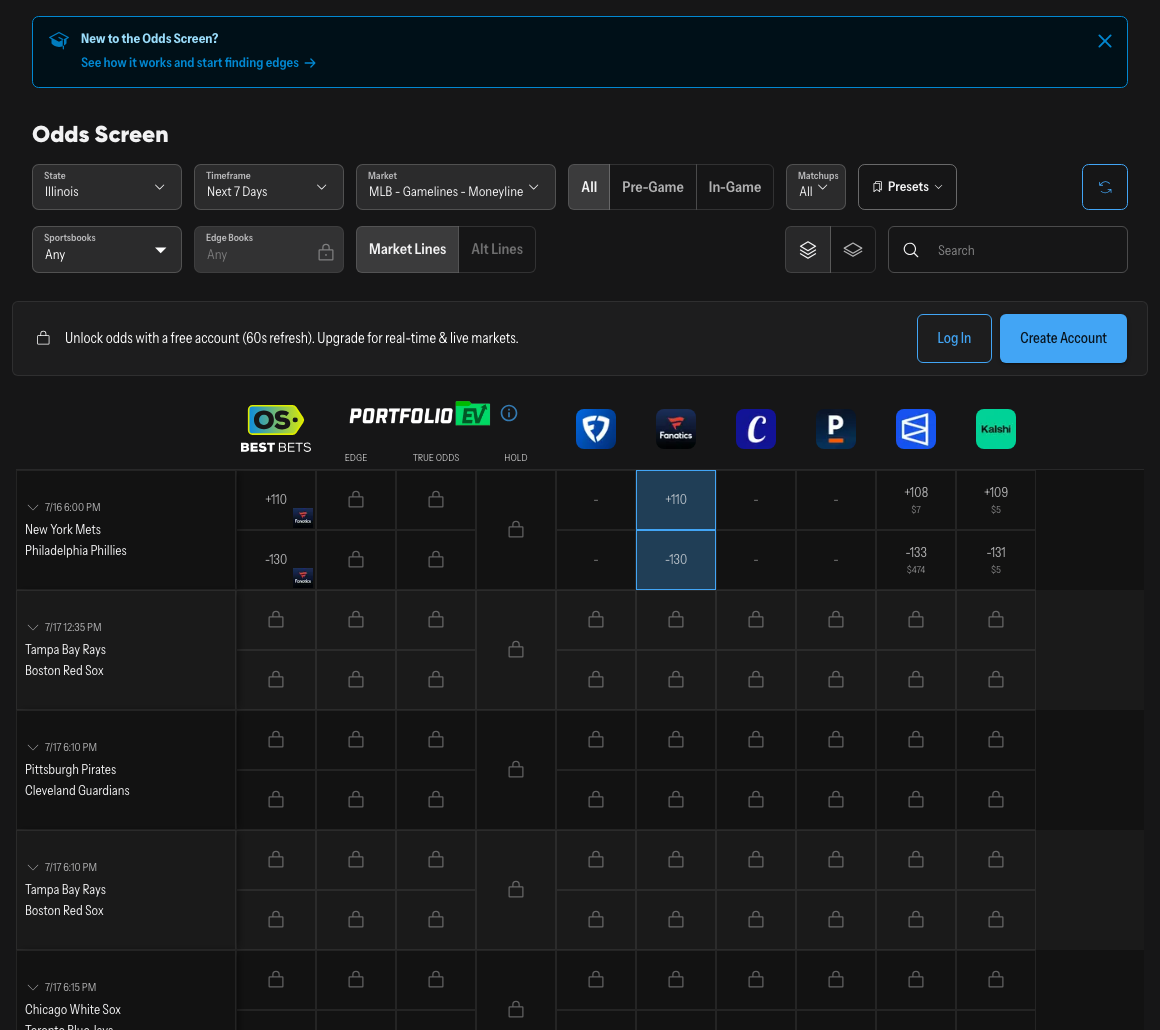 The OddsShopper live odds screen — every book's price on one board, refreshed in real time. Open the live board.
A Worked Example: How Ben Rasa Bet A Summer League Shutdown
Here is the night we promised you.
On July 11, 2023, the Houston Rockets were the best story in Las Vegas. Jabari Smith Jr. and Tari Eason had been dominant across two games, combining for close to 60 points per game (35.5 and 23.0 respectively). Houston had beaten Portland on a buzzer-beater and blown out Detroit. Ben had bet the Rockets in both.
Then a beat report landed suggesting the Rockets were likely shutting Smith and Eason down for the rest of the event. Amen Thompson was already out with an ankle injury. Nothing was official.
Ben's read on the July 11 show was to lay 5.5 points with Oklahoma City. His reasoning had three parts, and every one of them was about availability rather than the talent on paper:
- Oklahoma City's rotation was real. "They had four guys in their first Summer League game in Vegas off the bench play double-digit minutes. They're a pretty deep team." A deep team is a team that survives its own attrition.
- Houston's floor had collapsed, not shifted. Take two of the five best players in the event, by Ben's own read at the time, off a roster that had already lost a rookie guard, and you do not have a slightly worse team. In Ben's words: "You couldn't have a more drastic drop-off."
- The market was already agreeing. "The line is indicating that it may very well be true." He expected the number to move further toward Oklahoma City once the news was confirmed, which is the whole point of betting before confirmation.
He also stated the risk plainly, which is the part most people skip: "If we're wrong and it's not true, obviously we're not taking an ideal line. … I wouldn't make this bet without them, but I am willing to take that risk."
That is the complete Summer League process in one bet. Roster intent, then shutdown risk, then a number bet before the market finished digesting it, then an honest statement of the risk on a play whose central premise was a beat report. Houston did shut both players down. The prices in that example are from July 2023 and are useful only as an illustration of the process, never as a current line.
In Summary: The Summer League Betting Checklist
Before you place a Summer League bet, work down this list.
- Check The Rules, Not Your NBA Reflexes. Forty minutes, ten fouls, one free throw worth two, a two-minute overtime.
- Read Last Game's Box Score For Rotation Depth. Nine men with two cameos is a team playing to win. Twelve men and nobody over 22 minutes is an audition.
- Hunt Shutdown News Before It Is Official. Beat writers, not injury reports. It is the shortest-shelf-life edge on the board.
- Price The Total Off 40 Minutes. Then adjust for tempo, not the other way round.
- Know Where You Are In The Format. Once the top four are set, 26 teams are playing for nothing.
- Shop Every Number. The books disagree with each other more here than anywhere on the board, and that disagreement is the edge.
- Bet Small. Thin edge, fat variance, low limits. All three say the same thing.
Of those seven, the one we keep coming back to is rotation depth, because it is the only item on the list you can verify yourself from a box score rather than infer from a tweet.
Frequently Asked Questions
How Long Is An NBA Summer League Game?
Forty minutes, played as four 10-minute quarters with an eight-minute halftime. Overtime is a single two-minute period, and if the game is still tied after that, the next basket wins.
Why Are NBA Summer League Lines Softer Than Regular-Season NBA Lines?
Books invest far less modeling into a July exhibition, and they protect themselves with low betting limits instead of sharp numbers. The practical effect is that different sportsbooks post noticeably different lines on the same game, which is where the value sits.
Can You Bet Player Props On NBA Summer League?
Usually only on or near the day of the game. Books rarely hang Summer League props for future dates, because a prospect's minutes are unpredictable that far out, and the limits are small where they do exist. Build your card off moneylines, spreads and totals.
What Is The Biggest Mistake Bettors Make On Summer League?
Handicapping talent instead of attendance. The roster that looks better on paper frequently sits its best players midweek, and a spread built on those players becomes a bet on a team that is no longer playing.
How Much Should You Bet On A Summer League Game?
Less than you would bet on a regular-season NBA game. The edge is thinner and the variance is much wider, and sportsbook limits on these markets are low for exactly that reason.
Is NBA Summer League Available At Every Sportsbook?
No. Availability varies by state and by book, and some sportsbooks skip the market entirely. Check your book before you build a card around it.
Where To Bet NBA Summer League
Come back to where we started. You are not handicapping basketball talent in July. You are handicapping who is in the building, who still wants the game, and which sportsbook has not yet noticed that one of those two things changed this morning.
Every part of that is an information race, and the finish line is a number. Once you have the read, the only thing left is refusing to bet a worse price than the one available. OddsShopper puts every book's Summer League game lines on one screen with a de-vigged fair price beside them, so the last step takes seconds instead of tabs. When you have a specific game in mind, our NBA Summer League best bets run the same process against the day's board, and live betting strategy covers the in-game angles above in more depth.
Get 20% off OddsShopper Pro with code SLGUIDE20 and start shopping the number
Betting involves risk. Bet responsibly and only what you can afford to lose. If you or someone you know has a gambling problem, call 1-800-GAMBLER. Must be 21+ and physically located in a state where sports betting is legal.
More on this: Soft Betting Lines: Finding +EV In NBA Summer League · NBA Summer League Best Bets Today: July 10 Picks · NBA Championship 2027 Odds: Live Title Prices By Team · NBA Next Team Odds: Every Star's Landing-Spot Market, Scored · League Of Legends Betting Odds: What The Exchange Lists