How To Win At NBA Betting: A Beginner's Guide
Last updated: July 13, 2026
In Summary
One of the most common questions new bettors ask is how to actually win at NBA betting, and it usually starts with the same hurdle: the terminology. The NBA offers a huge menu of bets, and if you don't know what a point spread, a moneyline, or a "PRA" prop is, the whole board is overwhelming. This guide walks through every major NBA bet type in plain English, then gets to the part that actually wins money: finding value. Winning at NBA betting is not about predicting who wins each game. It's about spotting prices that are better than the true odds, then acting before that edge disappears. OddsShopper organizes every NBA market in one place and shows fair prices and projections right in the feed, so you can see which numbers are worth betting instead of guessing.
Watch The Video
Here's the full walkthrough that this guide is based on, covering each NBA bet type on the OddsShopper board.
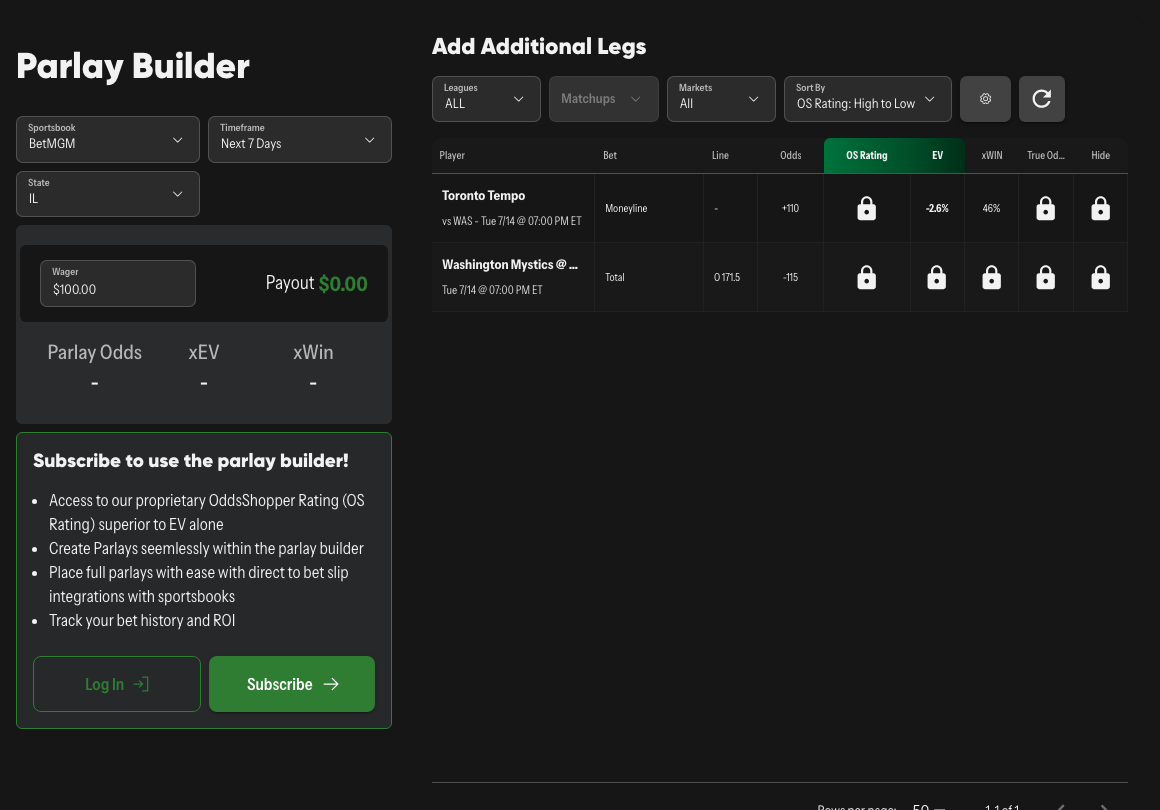
The OddsShopper Parlay Builder.
NBA Betting For Beginners: Start With The Terms
The NBA has, in the host's words, a million different types of bets. The board looks intimidating only because the language is unfamiliar, so the first step is learning what each market actually means. Once the terms click, the menu stops being overwhelming and starts being a list of opportunities.
The bets break down into two big buckets:
- Game Bets ride on the team and the final result: point spreads, totals, and moneylines.
- Player Props ignore the result entirely and ride on what one player does: points, rebounds, assists, and combinations of them.
We'll take them in that order, the same way you'd run down the markets on the OddsShopper NBA tab, then cover same game parlays, which stitch several of these together.
A note on the examplesevery team, player, and price in this guide is lifted straight from the video walkthrough. They're teaching numbers, not tonight's lines or a current roster, so don't read "Bucks -5.5" or a named player as a live bet. The point is the mechanic each one illustrates, and those never go stale.
Point Spreads
A point spread is the sportsbook's way of leveling an uneven matchup. The book sets a margin one team has to cover, so a lopsided game becomes close to a coin flip on paper.
Say the Milwaukee Bucks are a 5.5-point favorite over the Atlanta Hawks. That's written as Bucks -5.5. The Bucks have to win by 6 or more for that bet to cash. The Hawks at +5.5 cash if they win outright or simply lose by 5 or fewer. The favorite carries the minus, the underdog carries the plus, and the half-point exists so there's never a tie.
Totals (Over/Under)
A total, also called the over/under, has nothing to do with who wins. Instead, the book posts a single number for the combined points both teams score, and you bet whether the real total lands over or under it.
If the Bucks–Hawks total is 232.5, you're betting on whether the two teams together score 233 or more (over) or 232 or fewer (under). It doesn't matter how the points are split between the two teams. One team could score 200 and the other 40, and the only thing that matters is the combined total versus the line.
Moneylines (And How To Read The Odds)
A moneyline strips it down to the simplest question: who wins? Margin of victory doesn't matter, so you don't worry about spreads at all. The catch is the price. Backing the favorite costs you more, and backing the underdog pays you more.
This is where the plus and minus signs matter, and reading them correctly is the single most important habit for a beginner:
| Moneyline | What the sign means | The math |
|---|---|---|
| Bucks -195 (Favorite) | Minus = how much you must bet to win $100 | Risk $195 to win $100 |
| Hawks +175 (Underdog) | Plus = how much you win on a $100 bet | Risk $100 to win $175 |
That gap is also your first lesson in value, and it's the one I hammer with every new bettor I talk to. An underdog at +175 pays far more than a shorter price would for the exact same outcome, so the number you get matters as much as the side you pick. Two bettors can both take the Hawks to win, and the one who got the better price keeps more money over a season. (If you're still shaky on the plus/minus math, my how to read NBA odds walkthrough breaks it down number by number, and our guide on positive expected value explains why the price, not the pick, is what makes a bet good.)
Player Props: Betting On The Box Score
Game bets are all on the team. Player props let you drill down to an individual. Instead of the Bucks or the Hawks, you bet on what a single player does in the game, and the book sets a line for each stat.
The simplest is points. A book might post John Collins at 16.5 points, and you take the over (17+) or the under (16 or fewer). His team can win or lose in a blowout and it doesn't change your bet. Only his point total does. From there the menu widens to rebounds, assists, threes, and just about any box-score number the NBA tracks, each with its own line.
Points, Rebounds, And Assists (PRA)
The prop worth understanding early is the combo line, usually written as PRA (points + rebounds + assists). Beginners see the abbreviation and freeze, but it's the simplest idea on the board: every point, every rebound, and every assist the player records counts as one toward the line.
Because a player can pile up the number three different ways, PRA lines sit higher than the points line alone. If John Collins is 16.5 on points but 26.5 on PRA, the book is effectively saying he'll add about 10 rebounds and assists on top of his scoring. The distribution doesn't matter. A 27-point night with zero rebounds and zero assists grades exactly the same as a 15-point, 6-rebound, 6-assist night. All three categories count equally, and that's the whole appeal: more ways to get there. Props are one of the richest parts of the NBA board, and if you want the deeper strategy on them, our how to bet NBA player props guide picks up where this leaves off.
Alternate Spreads: Adjusting The Line Yourself
Once you're comfortable with the standard markets, the books let you move the numbers. An alternate spread lets you manually adjust the point spread in exchange for different odds. If you have a strong read that a favorite wins big, you can buy a bigger spread for a bigger payout.
The standard Bucks line might be -5.5 at roughly even money. Push it to Bucks -14.5 and the price jumps to something like +310, because now they have to win by 15 or more. That's a more aggressive bet with a far larger payoff, and the same idea works in reverse if you want a safer, lower-paying number.
Same Game Parlays: Combining Bets For A Bigger Payout
The same game parlay (SGP) is one of the newer and more exciting bet types the video highlights. A parlay combines multiple bets into one ticket, and you have to win every leg or the whole thing loses. The trade-off is the payout: instead of roughly doubling your money like a single bet, a winning parlay pays a multiplier.
A single bet on its own is called a straight bet. Here's how a same game parlay builds up from one, using the kind of legs the video walks through:
| Step | Legs on the ticket | Approx. payout on $100 |
|---|---|---|
| Straight Bet | Bucks -4.5 | single bet (no multiplier) |
| Add A 2Nd Leg | Bucks -4.5 + Bobby Portis over 15.5 points | +200 ($100 wins $200) |
| Add A 3Rd Leg | + Khris Middleton over 4.5 assists | +280 ($100 wins $280) |
Each leg you add lengthens the price. Be more conservative with fewer, safer legs and the payout is smaller. Get more aggressive with longer shots and the odds climb fast, with some same game parlays paying north of 10 or 12 to 1. The trick I use when I build one is to tell a story: if Bobby Portis is scoring, who's feeding him the ball? That logic points me toward a Khris Middleton assist leg that fits the same game flow.
But the payout is also the trap, which brings us to the part that actually decides whether you win.
How To Actually Win: It's About Value
Here's the line that matters most: value, value, value. A big multiplier looks exciting, but a parlay only wins money over time if every leg is priced in your favor. Combine legs just because the payout is fun and parlays will quietly bleed your bankroll. Combine legs that each carry a real edge and the multiplier works for you. If I could hand a beginner one habit, it would be that one.
And that gap is the difference between betting the NBA and winning at it. Winning isn't picking more games right. It's consistently getting prices that are better than the true odds, whether that's a moneyline, a prop, or a single leg of a parlay. The bettor who only fires plays where the number is in their favor gives themselves the best long-term chance, even with plenty of losing nights mixed in.
Value isn't tied to one market. It shows up all over the board:
- A moneyline where the underdog's price is longer than its true chance of winning.
- A total or spread sitting a step off the number it should be.
- A prop where the line is soft on a player you have a read on.
- A parlay leg that would be worth betting on its own, before you ever stack it onto a ticket.
The hard part is that an edge is invisible if you can't measure the price against the true odds, and it's gone in minutes once the market corrects. As the host puts it, the edges in the NBA are great, but if you can't locate them in time, a lot of that edge disappears very quickly. That's the problem OddsShopper is built to solve.
New to OddsShopper?It pulls live NBA odds from every major sportsbook into one screen and shows fair prices and projections right in the feed, so you can tell at a glance which spread, total, prop, or parlay leg is actually worth betting instead of eyeballing it. You can try it free for 7 days, and code NBABET20 takes 20% off OS Pro or OS Core if you subscribe.
Finding The Bets On The Board
Knowing the terms is only half of it. You also have to find each market on your sportsbook and line it up against a fair price. On a book like DraftKings 🎁 or FanDuel 🎁, you click into a game and the bets run across the top: standard spreads and totals, alternate spreads, and player props under their own tab. The same John Collins 16.5 points you studied on the OddsShopper screen is sitting there to bet over or under. (If you want the click-by-click version, our how to bet NBA on DraftKings guide walks the whole slip.)
This is where OddsShopper saves you the legwork. The NBA odds screen shows the same markets with projections built into the feed, so you're not flipping between an analysis tool and your book trying to remember which number was the value. The tool surfaces the spread, total, prop, or parlay leg where the posted price is off the fair price, so you see the bet, the fair number, and the books offering it in one place, which is exactly the speed you need before an edge moves. OddsShopper also has a Parlay Builder, which the video points to as another tool for putting together same game parlays and seeing the options in one place.
More on this: NFL Win Totals 2026: Kalshi Vs DraftKings Vs FanDuel · NBA Championship 2027 Odds: Live Title Prices By Team · Why Byron Donalds (R) Will Win The Florida Governor Primary · Kalshi Steelers Over 8.5 Settlement: Refunded, Not Paid · Why Ben Ray Lujan (D) Will Win The New Mexico Senate Race
Frequently Asked Questions
How do you win at NBA betting? By betting value, not winners. Over the long run, the bettor who profits is the one who consistently gets prices better than the true odds, across moneylines, spreads, totals, and props. Picking the right side matters far less than getting the right number, which is why comparing the offered price to a fair price is the core skill.
What is the easiest NBA bet for beginners? The moneyline is the simplest to understand, since you're only picking the winner. But "simple" and "profitable" aren't the same thing. Whatever market you start with, the goal is the same: take it only when the price is in your favor, and the OddsShopper feed makes that call easier by putting the projection next to the posted moneyline so you can see whether an underdog's price is longer than its real chance to win.
What does PRA mean in NBA betting? PRA stands for points, rebounds, and assists. It's a combo prop where all three stats are added together toward one line, so any point, rebound, or assist the player records counts equally. The lines are higher than a points-only prop because there are three ways to add to the total.
How do you read NBA moneyline odds? A minus number is how much you must bet to win $100, so -195 means risking $195 to win $100. A plus number is how much you win on a $100 bet, so +175 means a $100 bet wins $175. Minus is the favorite, plus is the underdog.
Are same game parlays a good bet? They can be, but only if every leg carries real value. A parlay multiplies the edge of its legs, so adding legs that are priced against you just compounds the disadvantage no matter how big the payout looks. Build them from legs that are each worth betting on their own, and treat the multiplier as a bonus, not the goal.
What is an alternate spread? An alternate spread is a point spread you adjust yourself in exchange for different odds. Buying a bigger spread on a favorite (say -14.5 instead of -5.5) pays more because it's harder to hit. Buying a smaller spread pays less but hits more often.
Ready to actually find the value instead of guessing at it? OddsShopper pulls every NBA market and fair price into one feed, so you can spot the spreads, props, and parlay legs that are priced in your favor before the edge moves. Try it free for 7 days, then upgrade to OS Pro with code NBABET20 for 20% off your first payment of OS Pro or OS Core and put real NBA projections to work.