ProphetX NFL Betting: How To Name Your Own Price On The Exchange
Every NFL bettor learns the same lesson eventually, usually the expensive way. You can be right about the side and still lose money over a season, because the price you paid was worse than the price you deserved. ProphetX NFL betting inverts that problem. Instead of accepting the price a bookmaker prints, you post the price you are willing to take and wait for another trader to meet it. This guide covers what the exchange actually is, why federal regulation is the reason it reaches states with no sportsbook at all, how making and taking odds works on an NFL market, and the workflow that tells you which price is worth posting. One market, a team laid at -3, will carry the whole argument by the time we finish with it.
What ProphetX Is, And Why It Reaches 49 States
ProphetX is a peer-to-peer sports prediction exchange that operates under federal commodities regulation rather than state gambling licenses. That sounds like a paperwork distinction. Treat it instead as the most consequential fact on this page, because it decides both where you can trade and what the numbers on your screen actually mean.
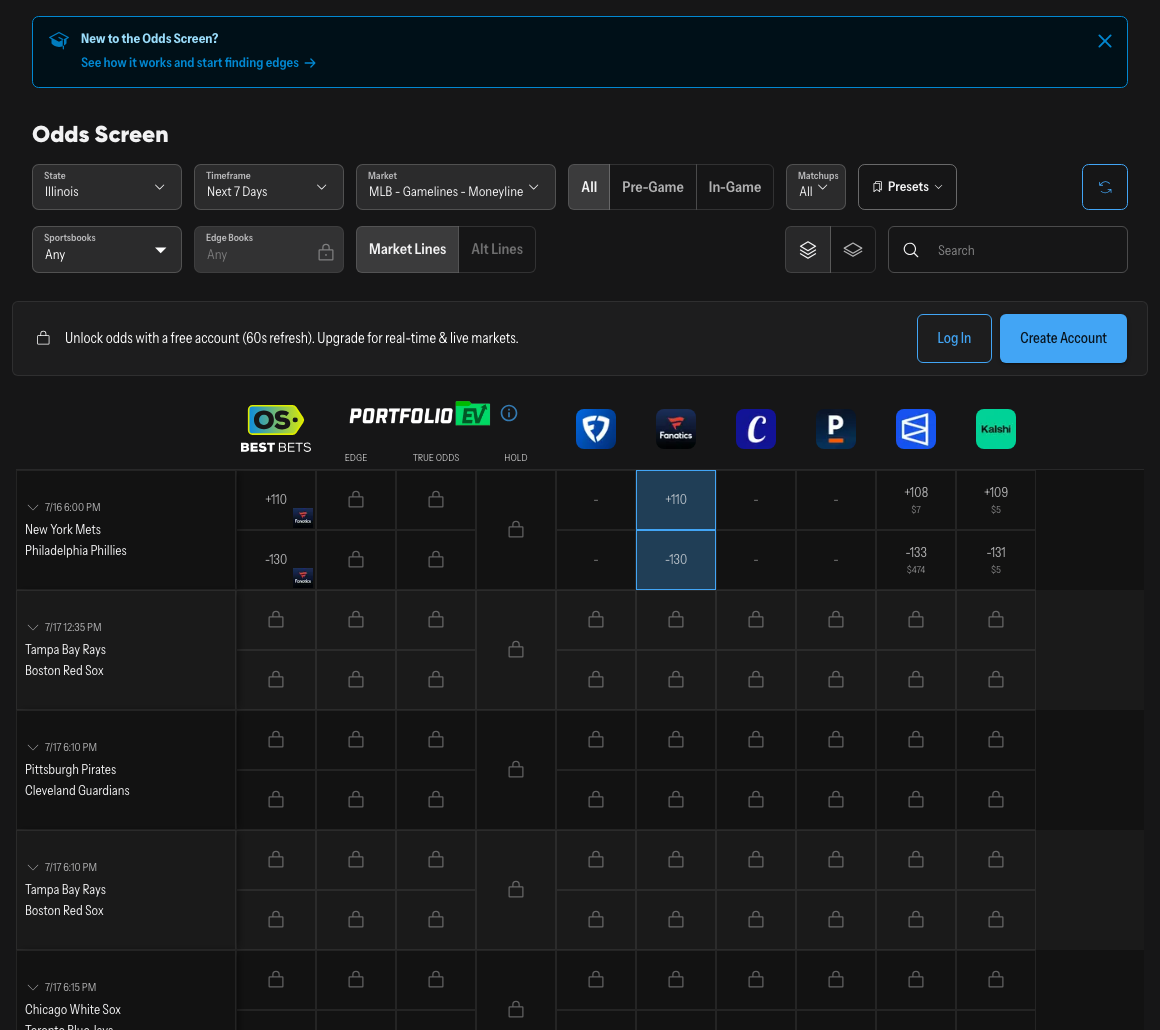
The OddsShopper Odds Screen.
A sportsbook prints a number, folds its margin into it, and takes the other side of your action. ProphetX runs an order book instead, matching you against a trader who disagrees with you, and earning a commission rather than profiting when you lose. The company has been public about the design. Co-founder Jake Benzaquen put it plainly to Sportico in June 2026: "We won't be trading against our customers. We never have." ProphetX is not the counterparty to your trades.
Be precise about who is actually across the table, though. Peer-to-peer does not mean every fill comes from a fellow bettor. On any order book, professional liquidity providers sit alongside retail traders, and that is what keeps prices tight enough to be worth shopping in the first place. The part that matters survives the nuance: the house itself is not your counterparty.
If the structure sounds familiar, it should. ProphetX runs the same federally regulated event-contract model Kalshi and Polymarket US built their sports markets on, and it now sits in that family rather than alongside state-licensed books. One distinction matters for an NFL bettor, though: Kalshi and Polymarket are general-purpose exchanges that happen to list sports alongside elections, weather, and economic data. ProphetX is sports-only, built sports-native from the start. Our Kalshi vs. sportsbooks breakdown for NFL runs that same comparison on the exchange that got here first, and it is worth reading beside this one before you pick a platform.
ProphetX's federal-registration model, rather than a state-by-state sportsbook licensing rollout, is the basis for its nationwide access. ProphetX announced CFTC approval on June 11, 2026, after a Derivatives Clearing Organization registration dated June 10 and a Designated Contract Market designation dated June 11, and launched across the country on June 18, 2026. The result, as of this writing in July 2026, is coverage no book can match: 49 states, with Nevada the only holdout, including California and Texas. That reach is not settled law. State and court treatment of sports-event contracts remains actively contested, several states have moved against exchange-style sports contracts generally, and our state-by-state guide to prediction market legality tracks where the fight stands.
Check before you fund. Coverage and eligibility rules move, and prediction markets are an actively contested space. Confirm ProphetX operates where you live and that you meet its age and eligibility requirements before you deposit. None of this is legal advice, just a nudge to verify rather than assume.
Why The NFL Is The Market Where The Price Wins
Now the promise from the top comes due, because the NFL is not an arbitrary sport to run this experiment on. Nothing else in American betting trades this heavily, which means nothing else is priced this efficiently. Whatever clever read you have on a Week 3 game, the market has almost certainly already absorbed it. The side is rarely where your edge lives.
The number is. NFL scoring clusters on key numbers in a way no other major sport does, because of how touchdowns and field goals stack: 3 is the most common margin of victory by a wide margin, 7 is second, and 10, 6 and 4 cluster behind them. A spread of -3 is not just one point worse than -2. It sits on the fattest part of the distribution, and moving across it is worth far more than moving between two numbers that decide almost nothing.
Books know this, which is why they charge for it. Buying a half-point off 3 costs you real juice, and the standing advice among sharp NFL bettors is to buy only when the half-point actually crosses 3 or 7 and only at cheap prices, because the alternate lines are raked aggressively. A typical two-way NFL market carries roughly a 4% to 5% hold, and that margin is invisible: it is baked into the -110 on both sides before you ever click.
The NFL read in one line: on the most efficiently priced board in sports, the side is a coin you can't weight much. The price is. Everything below is about who gets to set it.
Here is the pivot the entire article rests on. A sportsbook lets you say yes or no to its price. It will sell you a better one, at a markup it sets. An exchange lets you name the price you are willing to pay on the markets it lists. Those are structurally different relationships with the most price-sensitive board in sports, and the gap between them is why a bettor who already shops lines should care about ProphetX at all.
One clarification before the example, because it is the thing most people get wrong about exchanges. Naming your price does not mean inventing your own spread. If ProphetX lists a team at -3, you are not conjuring a -2.5 contract out of nothing; you are setting the odds you will accept on a contract the exchange actually lists. Where an alternate number like -2.5 is listed, you can name your price on that too, instead of paying a book's markup for the same half-point. The lever is the price. The menu is still the menu.
Making Vs. Taking An NFL Price
Every play on an order book is either a take or a make, and ProphetX supports both.
- Taking means you trade at the current market price: you accept a number already posted and the system fills you at the best available price. Of everything on the exchange, this comes closest to placing a normal bet.
- Making means you set your own price and wait for another participant to match it. Your order sits on the book until a trader decides your number is worth taking against them.
| Take the current price | Set your own price |
|---|
| What You Do | Accept a number already on the book | Post the number you want |
| Speed | Matched right away, if liquidity is there | Waits until a counterparty takes it |
| The Price | Whatever the market is offering | The exact price you name |
| Best When | The posted price already beats your fair number | Your read says fair is better than what is posted |
| NFL Fit | Fine when the board has already come to you | The reason to be here at all |
That last row is the one I keep coming back to. Taking a price is convenient, and when the posted number already beats your fair estimate, convenience is the correct answer. Making a price is what converts a read into a position at a number you chose, without paying a book's markup to get there.
Your economics change too, though not as cleanly as the marketing suggests. On a sportsbook you always pay someone's margin, hidden in the line. On an exchange the platform's cut is at least visible: ProphetX currently advertises 2% on winnings only, so a losing position costs nothing beyond the stake. Be honest about the rest of it, though. Commission is the visible cost, not the whole cost. A taker still pays the bid/ask spread, and a market maker's edge can sit inside the price you just accepted. Compare the full effective price, not the fee line. Fee schedules change, so confirm the current one before you lean on it.
A Worked Example: Naming Your Price On A -3 NFL Market
Make it concrete, and keep the two questions separate: which side you want, and what price makes it worth taking. The exchange only helps with the second.
Say ProphetX lists a team at -3 and the best available price to back it is -110. You do the de-vig work below and your no-vig read says the fair price on that side is about -102. That gap is the entire opportunity. Paying -110 for something worth -102 is how a season quietly bleeds out: you are right about the side and still behind, because you overpaid for it eight times a week.
So you do not take -110. You post -102, or you get greedy and post +100, and you wait. If another trader takes the other side, your play is matched and live at the price you named. If nobody does, no trade executes, though your collateral can stay reserved until the order is cancelled or expires. (Every figure here is illustrative, not a live price.)
| Your Choice | What happens | The honest read |
|---|
| Take -110 Now | Matched right away, position live | Certain, and you have paid 8 cents over fair |
| Post +100 And Wait | Matched only if a counterparty accepts +100 | The price you want. May never fill, precisely because it is good for you |
| Post +100, Never Filled | Order expires, no play | No P&L, no edge captured, and your stake was tied up the whole time |
The middle row carries the tension nobody warns you about. Nothing is at risk, which sounds purely good, but your stake still sits as collateral against an order nobody has taken. Call that capital doing no work, and call it the real cost of making your own market. Worse, the better your price, the less anyone wants it: an order that is a bargain for you is a donation for them. A number that fills instantly is often a number you should have questioned.
Now flip the read and watch the honest version of this. If your no-vig work says fair on that -3 side is closer to -140, the posted -110 is already a gift, and the right move is to take the current price right now before it moves. And if your read says the favorite is weaker than the board, the value was never on this side at all: it is on the dog at +3, and the play is to post your price over there instead of getting clever about laying a number you do not believe in.
That is the discipline the whole article is really about. Once you know fair, the exchange stops being a place to name a number you like the look of, and becomes a place to hold out for the only number worth having.
Cancel stale orders. A resting order carries no live position, but it does not go away when the world changes. If an injury drops or the line moves, your unmatched order can still get picked off at yesterday's price by a trader who saw the news first. Pull your open orders before injury waves, big line moves, and kickoff.
What You Can Trade Before Week 1
Because this is July, the honest answer is that the NFL board is thin right now compared to what it becomes in September. ProphetX's markets span the ones you already bet: NFL moneylines, spreads and totals, with player props also reported across industry coverage as of July 2026. What is actually posted in the offseason is a narrower menu than that, so check the app rather than planning around a market that may not be up yet.
The thin board cuts both ways, and the tradeoff is sharper than it first looks. A season win total or a division-winner contract, if one is listed, is priced off a roster nobody has watched play a snap since January, which makes it far less efficient than a Week 10 spread. Inefficiency is exactly where naming your own price has room to work. The catch is on the other side of the same coin: fewer traders are watching in July, so the counterparty who would take your number may simply not be there. Your good price and an unfilled order are the same event.
Say a win total is posted at 9.5 and the price to back the over is -115. In September that number has been chewed on by the whole market. In July it has not, so your read is likelier to be different from the board's, and likelier to sit unmatched for days. Post it anyway on a stake you would not miss, and treat the fill itself as information. (Illustrative, not a live price.)
The practical read: use the quiet weeks to build three specific habits on stakes you would not miss. Post an order away from the current price and watch how far off it actually fills, because that tells you what the real spread on this book is better than any fee page will. Cancel orders you no longer want, until pulling them is muscle memory. And practise pulling everything before news lands, because the NFL calendar is a series of scheduled ambushes: depth-chart moves in August, injury reports on Wednesday through Friday, inactives ninety minutes before kickoff. Each one repriced the market while your stale order sat there looking generous. Nobody wants to learn what "matched" means at 12:58 on a Sunday.
The Workflow: De-Vig First, Then Name Your Price
An exchange only rewards you if you bring a real opinion to it, and this is where our side of the workflow earns its place. Naming your price means nothing unless the price you name is smarter than the one already on the board. Which means the work happens before you open the order ticket, and it happens somewhere else.
Think of it as line shopping, taken one step further, with each step feeding the next decision directly. Start on the OddsShopper live NFL odds screen — shop the number across every major book to see where a game is priced across DraftKings, FanDuel, BetMGM, Caesars and 20-plus other books, rather than trusting whichever one you happen to have open. That screen's spread of prices is your raw material: it tells you the range the market thinks is defensible, which is the range your posted price has to beat. Our live NFL odds hub covers how to read each market on it.
Next, strip the vig out of the line. This is the step that produces the actual number you post as your own price, because a price with a 4% to 5% hold baked into it is not an estimate of anything, it is a book's ask. The no-vig figure that falls out the other side is your fair price, and the whole make-or-take decision reduces to comparing it to what ProphetX has posted. Run that comparison through the EV Calculator and it will tell you which of the two moves to make: if the posted price already beats fair, take it; if it does not, the calculator's fair price is the number you post and wait on.
Return to that -110 and watch the math do the work. The odds screen shows how much margin each book is charging on the game. Pull it out, and you learn whether fair on that side is -102, in which case -110 is an overpay and you post your own price, or -140, in which case -110 is the bargain and hesitating costs you the fill. Same market, same side, opposite actions, and the only thing that changed is that you did the de-vig first. Traders who work several platforms at once run this comparison across the gaps between them, which is the idea behind prediction market arbitrage, and the reasoning is identical whether you are reading Kalshi, ProphetX, or a book. Our step-by-step Kalshi guide walks the same loop on the other major exchange, and our prediction markets vs. sports betting breakdown covers the fuller contrast.
One more input worth pricing properly. If you have bonus credit from a sign-up offer, the free bet converter tells you what that bonus is actually worth in real, withdrawable cash, which matters here because a bonus is worth less than its face value. Knowing the real number tells you whether to burn it on a straightforward take or hold your cash for the price you are waiting on. None of this is new thinking for anyone who already shops lines. The exchange just lets you act on the gap at your own price instead of the house's.
The ProphetX New-User Offer: Trade $10, Get $20
Signing up through our link attaches the current new-user offer. Here it is at a glance.
| Detail | What to know |
|---|
| Headline Offer | Trade $10, Get $20 for new users |
| What Activates It | Sign up through our link with code ODDS5, then make a first qualifying trade of $10 or more |
| Timing | Credited within 24 hours of that first qualifying trade, subject to the offer's terms |
| Who Qualifies | New accounts only, of eligible age, in a state where ProphetX operates |
| The Honest Read | A welcome offer, not a guaranteed return. Confirm live terms on ProphetX, since offers change |
The last row is the one worth sitting with. This is a welcome offer with its own terms attached, not free money, so treat it as a cheap reason to learn the mechanic rather than a reason to force plays you would otherwise skip. ProphetX updates its offers periodically, and the terms on their site are always the final word.
Frequently Asked Questions
How does ProphetX NFL betting work?
You either trade at the current market price on an NFL contract, or set your own price on a listed market and wait for another participant to match it. Your play goes live only once it is matched.
Is ProphetX legit?
ProphetX announced CFTC approval on June 11, 2026 to operate as both a Designated Contract Market and a Derivatives Clearing Organization, and launched nationwide on June 18, 2026. That places it under federal commodities regulation, in the same family as Kalshi and Polymarket US, and it clears its own trades. It has also stated it runs no affiliated trading arm, so the platform does not take positions against its users.
Is ProphetX a sportsbook?
No. ProphetX is a CFTC-regulated prediction market exchange. You trade against other users on an order book at prices the market sets, and ProphetX charges a commission rather than building a margin into the line.
Is ProphetX legal in my state?
It is live in 49 states, with Nevada the sole exception, including California and Texas where no legal online sportsbook operates. Availability can change, so confirm it operates where you live and that you meet the age and eligibility requirements before signing up.
What is the ProphetX promo code?
Use code ODDS5. Signing up through our ProphetX link applies it, and it attaches the current new-user offer: Trade $10, Get $20, subject to terms and credited within 24 hours. Confirm the live terms on ProphetX before you sign up.
What does "matched" mean on ProphetX?
A play is matched when another trader takes the other side of it at your price. Until then it is an open order, not a live position, and nothing is at risk.
What does ProphetX charge on a winning NFL play?
Commission rather than vig. ProphetX currently advertises a 2% fee on winnings only, with no fee on losing positions. That is the visible cost, not the only one: as a taker you also pay the bid/ask spread, so judge the all-in effective price. Fee schedules change, so confirm the current one on ProphetX.
Can I set my own spread number on ProphetX?
No. You set your own price on the markets ProphetX lists. If the exchange posts a team at -3, you name the odds you will accept on that contract rather than inventing a -2.5 line. Where an alternate number is listed, you can name your price on that market too.
Can I bet NFL player props on ProphetX?
ProphetX lists NFL moneylines, spreads, totals, and player props among its markets. Depth varies by market and by how close you are to kickoff, so check what is actually posted in the app.
Why This Matters More In The NFL Than Anywhere Else
The reason to learn an exchange is not novelty. The NFL punishes bad prices more ruthlessly than any other board in sports, because it is the one market where everybody already knows which team is better and the only thing left to argue about is what that costs. A sportsbook lets you say yes or no to the price it printed, and sells you a better one at its own markup. Everything above comes back to those eight cents between -110 and -102: a book keeps them, and an exchange lets you ask for them, on the days someone is willing to give them up. Find the fair price first. Then go name yours.
Ready to try it? Sign up for ProphetX with code ODDS5 then make a first qualifying trade of $10 or more to get the Trade $10, Get $20 new-user offer. Subject to terms; credited within 24 hours.
Eligibility and location requirements apply. Not available in every state. Trading on an exchange involves risk, including the possible loss of the funds you put up. The new-user offer is subject to ProphetX's terms and is not a guaranteed return. Confirm the current offer and full terms on ProphetX before you sign up. Regulatory details reflect ProphetX's announced CFTC approval as of July 2026 and are not legal advice.