Most bettors pick an NBA rebounds prop the same way they pick a fantasy player: they find a name they trust, glance at his season average, and fire the over. That instinct is exactly why the rebounding market stays soft. Rebounds are one of the more model-beatable player prop markets in basketball, and the edge almost never comes from who the player is. It comes from the volume of missed shots waiting to be grabbed and the frontcourt he is grabbing them against.
That is the whole idea I want you to walk away with: an NBA rebound is an opportunity stat before it is a talent stat. Get the opportunity right and the number takes care of itself. Below is how I actually handicap a rebounds prop, from the two inputs that matter most to the one lever I keep coming back to when I need a tiebreaker, and how to turn that read into a bet that is actually priced in your favor.
In Summary
- Rebounds Are An Opportunity Market, Not A Talent Contest. The over cashes on volume and matchup far more often than on the biggest name, which is why the market stays soft.
- Confirm Minutes First, Then Rebound Rate (REB%). A board can't be grabbed by a player who isn't on the floor; the rate tells you how many of the available rebounds he pulls down while he is out there.
- Pace And Shot Volume Set The Ceiling. More possessions and more missed shots mean more boards for everyone — a fast, cold-shooting opponent is a rebounder's best friend.
- A Frontcourt Injury Is The Single Strongest Spot. When a rebounding partner is ruled out, most of his vacated boards flow to the remaining big before the book fully moves the number.
- Respect Game Script, Then Shop The Number. A blowout steals the minutes an over needs; once you like a side, de-vig it and take the book paying above fair value. Code NBABOARDS20 takes 20% off OddsShopper Pro.
Why NBA Rebounds Props Are One Of The More Beatable Markets
Sportsbooks put their sharpest pricing where the money is: the NBA game lines, the spread, the total, and the popular points props. Those numbers get shaped by professional bettors all day, so the edges there are thin.
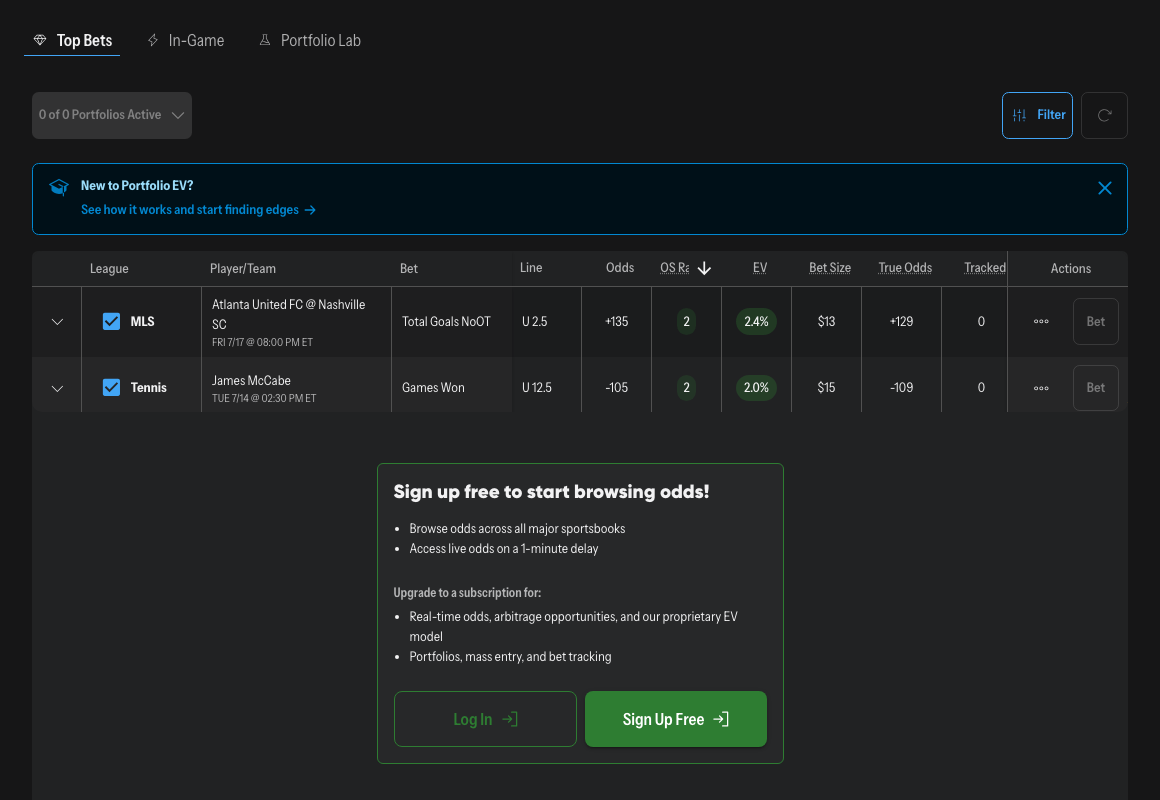
The OddsShopper +EV Screen.
Rebounds sit on the other end of that spectrum. Points props take the most action of any player prop, which means they are also the most efficiently priced. Rebounds and assists draw far less sharp money, so the book has less incentive to sharpen every one of them to the same standard. That is the opening. You can even see it in how the market reacts to news: when a starting big is ruled out an hour before tip, the points line for his replacement often moves fast, while the rebound line is frequently a step slow to catch up. On top of that, rebounding is one of the most predictable stats in the sport, because it leans on two things that are stable and easy to project: a player's size and his baseline rebound rate. Minutes are the one input that does swing night to night, which is exactly why you confirm them first.
None of that means every rebounds prop is a gift. It means the mispriced ones show up often enough to be worth hunting, as long as you know what actually moves a rebound total.
See which NBA rebounds props are priced above fair value.OddsShopper scans the major sportsbooks, de-vigs each prop to its true number, and flags the ones offering you the best of it. Code NBABOARDS20 takes 20% off OS Pro or OS Core.
What Actually Drives An NBA Rebound Prop
When I handicap a rebounds prop, I work down a short hierarchy. Name recognition is not on it.
- Minutes And Role Come First. A player cannot grab a board he is not on the floor for. A center locked into 34 minutes is a completely different bet than the same center in a minutes-cap game or a bench role, even though the season average looks identical. Confirm tonight's projected minutes before anything else.
- Individual Rebound Rate Is Second. Rebound percentage (REB%) is the share of the available rebounds — every missed shot either team leaves on the floor — that a player pulls down while he is on the court. It is a rate, so it survives the pace and minutes noise that a raw per-game average hides. A player with a high REB% is the engine; minutes are the multiplier.
- Then The Matchup And The Environment. Once you know a player will be out there and that he cleans the glass at a high rate, you ask what he is rebounding into: how many shots the two teams miss, and how well the opponent competes for those misses.
Get those three in order and you have a real read. Lead with a season average instead and you are just betting a name.
Opponent Pace And Shot Volume: More Missed Shots, More Boards
Here is the lever I keep coming back to. A rebound only exists when a shot is missed, so the single biggest driver of raw rebound volume is how many missed shots the game produces.
Two things inflate that number. The first is pace: the more possessions a game plays, the more shots go up, and the more misses hit the rim for everyone. A fast opponent lifts every counting stat on the floor, rebounds included. The second is shot volume and shooting quality: a team that jacks up a high number of shots, or a poor-shooting team that misses a lot of them, quietly hands out extra boards. A cold-shooting, high-tempo opponent is a rebounder's best friend, because every brick is a chance.
This is why the season average lies so often. A center who averages 10 boards against a slow, efficient half-court team is a different player against a fast team that chucks and misses. Same guy, far more available rebounds. When I find a strong rebounder whose team is facing a high-pace, shot-happy opponent, that is usually the over I trust most, and it is the read that has nothing to do with the player's reputation.
The core rebounds overa high-rate rebounder, locked into starter minutes, in a fast game against a poor-rebounding opponent. Everything else is a tiebreaker.
Matchup And Size: Reading The Opposing Frontcourt
Pace tells you how many boards are available. The opposing frontcourt tells you how many your player actually gets to keep.
The question is simple: does the opponent compete on the glass, or leave rebounds on the floor? A team that rebounds poorly, or that runs a smaller lineup with no true center, cedes boards to a big man who wants them. Put a high-REB% center, a legitimate seven-footer, against a switch-heavy, small-ball opponent whose tallest rotation player stands about 6-foot-8, and the defensive rebounds pile up almost by default, because nobody is boxing him out at his size. Flip it around and a great rebounder swallowed up by two seven-footers can fall short of a number he usually clears in his sleep.
So pair the two reads: pace decides how many boards exist, and the opposing frontcourt decides how many your player gets to keep. When both point the same way, you are holding a matchup worth far more than the biggest name on the board.
The Injury Lever: A Frontcourt Injury Frees Up Boards
The highest-value spota confirmed frontcourt injury, a vacated rebounding role, and a big man who suddenly has the paint to himself. This is the read I trust most in the entire market.
The most actionable edge in the entire NBA prop market is an injury, and rebounds are no exception. When a team's other big man is ruled out, the boards he used to grab do not disappear. They get redistributed, and most of them flow to the remaining big.
This is the rebounding version of a usage spike. A center who splits the glass with a rebounding power forward has a natural ceiling on his own number; take that partner out of the lineup and suddenly there is no one competing with him for defensive rebounds. His rate can hold while his opportunity jumps, and the book is often slow to move the prop far enough to account for it. Always check tonight's injury report, not the depth chart, because a rebounds over that looked like a mild lean before the news often becomes the strongest play on the board once a rebounding partner is ruled out.
Game Script And Blowout Risk
One more filter before you bet, and it is the one that quietly sinks overs: game script.
A rebounds over is built on minutes, and minutes evaporate in a blowout. In a game that carries a double-digit spread, the starters may sit the entire fourth quarter, and a center who needed 34 minutes to reach his number only sees 26. That is the silent killer of an over that looked great on the matchup. The flip side matters too: a close, competitive game keeps the starters out there to the final buzzer, protecting every over built on full minutes. Before you lock a rebounds over, glance at the spread and the total and ask whether the game script actually lets your player finish. A blowout risk is a reason to pass, or to look at the under on a starter whose night ends early.
How To Find A +EV NBA Rebounds Prop
A great read is only half the bet. The other half is price, and this is where you turn "I like this over" into a bet that is mathematically in your favor.
Start with fair value. Every posted price has the book's cut, the vig, baked in. To strip it out, take both sides of the same prop at a sharp book and de-vig them. Say the sharpest book posts a center's rebounds at Over 10.5 (-110) and Under 10.5 (-110). Each side implies about 52.4%, which adds up to 104.8%. That extra 4.8% is the hold. Remove it and the true, fair chance of the over lands right at 50%, or an even-money +100.
Now shop that number across every book. If the fair price is +100 and one book is posting the same Over 10.5 at +115 while another sits at -120, the gap is your edge:
| Sportsbook | Posted price on Over 10.5 rebounds | Your result vs. a fair +100 |
|---|---|---|
| Sharp Book (Used To Set Fair Value) | -110 / -110 both sides | Fair line is +100 (a 50% true chance) |
| BetMGM 🎁 | +115 | +EV: paid +115 on a 50% shot, about +7.5% |
| DraftKings | -120 | -EV: laying -120 on the same 50% shot, about -8.3% |
Illustrative prices to show the math, not a live line. Always check the current number before betting.
The row that matters is the BetMGM +115. You are being paid +115 for an outcome the market itself prices at even money, so every dollar there returns about seven and a half cents of expected value on a true coin flip. The exact same bet at -120 is a losing proposition. Nothing changed about the player or the matchup between those two books. The only difference is the number, and the number is the whole edge. Take the +115 at one book instead of the -120 at another and, over a season of hundreds of rebounds props, that shopping is worth more than any single great read.
Stop laying a bad number on a bet you like.OddsShopper de-vigs every NBA rebounds prop to its true price and lines up all the major sportsbooks so you can grab the best of it in one click. Code NBABOARDS20 takes 20% off OS Pro or OS Core.
The Tools That Do The Work For You
You could open ten sportsbook apps and de-vig each rebounds prop by hand. Or you could let a screen do it. Three OddsShopper tools cover the exact workflow this guide walked through:
- The Odds Comparison Screen lines up FanDuel, DraftKings, BetMGM, Caesars, and the rest for a given market side by side, so shopping a rebounds line takes a glance instead of ten tabs. Start on the live NBA odds screen and switch to the player-prop market.
- The Sharp Sportsbook Algorithm does the de-vig math for you, stripping the vig out of each market to its no-vig true price, so the fair +100 in the example above is calculated for you instead of by hand.
- Portfolio EV then ranks every bet by expected ROI and expected win percentage. The tool surfaces the props where a book is paying above that fair price, so the +115 over is the kind of number that rises to the top automatically. Filter it to the player-prop markets and you go straight to the mispriced rebounds and assists lines instead of scrolling an entire board.
If you are still shaky on the fundamentals, our guide to player props betting explained covers how props work and why they run soft in the first place. The same opportunity-first logic drives the neighboring prop markets: the minutes-and-volume read carries straight over to how to bet NBA points props, and the usage-redistribution angle behind a frontcourt injury is even sharper for how to bet NBA assists props. For more basketball reads, see how the same volume-and-matchup logic applies to betting NBA Summer League and where to hunt for soft betting lines in NBA Summer League, since a loosely-priced market is a loosely-priced market whatever the level.
Frequently Asked Questions
What are NBA rebounds props? NBA rebounds props are bets on how many total rebounds a single player grabs in a game, posted as an over/under number such as 10.5. You bet whether he clears that line (the over) or falls short of it (the under), independent of who wins the game.
What is the most important factor in an NBA rebounds prop? Minutes and opportunity. A player cannot grab a board he is not on the floor for, so projected minutes come first, followed by his individual rebound rate and then the volume of missed shots the game is likely to produce.
Why are NBA rebounds props easier to beat than points props? Points props take the most betting action, so books price them tightly. Rebounds draw less sharp money and correlate strongly with size and minutes, which makes them both loosely priced and more predictable, and that combination is where value hides.
How does a frontcourt injury affect a rebounds prop? When a team's other big man is ruled out, his rebounds get redistributed, and most flow to the remaining big. That vacated role can spike a player's rebound opportunity before the book fully adjusts the number, which is one of the strongest over spots in the market.
How do you find a +EV NBA rebounds prop? De-vig the prop at a sharp book to find its fair price, then shop every sportsbook for a better number than that fair value. When a book pays more than the true odds of the over hitting, that rebounds prop is priced in your favor.
More on this: NBA Championship 2027 Odds: Live Title Prices By Team · NBA Next Team Odds: Every Star's Landing-Spot Market, Scored · How To Bet NBA Assists Props: A Strategy Guide · How To Bet NBA Points Props: A Strategy Guide · How To Make Your Own NBA Projections For Player Props
The Bottom Line On NBA Rebounds Props
Rebounds reward the bettor who treats them as an opportunity market instead of a talent contest. The players who go over are usually not the biggest names, they are the ones with locked-in minutes and a high rebound rate walking into a fast, shot-happy game against a frontcourt that will not box them out, ideally with a rebounding partner already ruled out. Read the opportunity first, respect the game script so a blowout does not steal the minutes your over needs, and then, once you like a side, refuse to bet it at a bad price. Do the read and shop the number, and the softest corner of the NBA prop board turns into one of the more dependable places to find value.
See tonight's mispriced NBA rebounds props.OddsShopper finds the boards priced in your favor across the major sportsbooks and shows you the true odds on every one. Code NBABOARDS20 takes 20% off OS Pro or OS Core.
Betting involves risk. Bet only what you can afford to lose, and only where it's legal in regulated U.S. markets. No profit is promised. 21+. If you or someone you know has a gambling problem, call 1-800-GAMBLER.