What Is A Prop Bet? Proposition Betting Explained
When I started betting, the spread and the moneyline were easy enough to follow, but the longest part of every sportsbook menu was a wall of bets on one player doing one thing: passing yards, strikeouts, points, made threes. So what is a prop bet? It's any wager on one of those inside-the-game events, and once I understood how they're priced, props became the part of the board where I find the most value. Let me break the whole idea down in plain terms.
In Summary
A proposition bet (a "prop bet," or just a "prop") is a wager on something that happens inside a game rather than on the final score. Instead of betting which team wins or covers, you're betting on a specific event: how many yards a quarterback throws for, whether a pitcher records over 6.5 strikeouts, which team scores first. Most props are an over/under on a number or a yes/no, and they're usually priced with the standard -110 juice you see on a point spread. Props matter for one big reason: sportsbooks have to price thousands of them with far less attention than the main game line, so the numbers are often softer and books disagree more. That's where an edge tends to live, and it's why I shop every prop across multiple books before I bet it.
What Is A Prop Bet?
A prop bet is a wager on a specific outcome within a game that isn't tied to the final result. The main markets on any game, the moneyline, point spread, and total, all settle on who wins and by how much. A prop steps off that and lets you bet a narrower question: Will Patrick Mahomes throw for over 274.5 yards? Will there be a goal in the first 10 minutes? Which team scores first?
The name comes from "proposition" — the book proposes an outcome, and you take the over or the under, or the yes or the no. You'll also hear them called player props, game props, novelty bets, or side bets. The common thread is that the bet rides on an event inside the game, not the scoreboard at the end.
Props started as a Super Bowl novelty (the coin toss, the length of the national anthem) and have grown into a year-round, every-game market. On a single NBA night a book might hang points, rebounds, assists, threes, and steals lines on every player in the rotation. That volume is the whole story, and we'll come back to why it works in your favor.
Player Props Vs. Team And Game Props
Props split into a few clean buckets. Knowing which is which makes the whole menu readable.
| Prop Type | What you're betting on | Example |
|---|---|---|
| Player Prop | One player's individual stat line | Nikola Jokic over 11.5 rebounds; Aaron Judge to hit a home run |
| Team Prop | One team's outcome or stat | Cowboys over 24.5 team total points; first team to score |
| Game Prop | Something about the game as a whole | Total combined threes over 21.5; will the game go to overtime |
Player props are the biggest and softest group, which is why most bettors live there. You're betting one athlete's box-score line: points, yards, strikeouts, shots on goal, receptions. Each one is usually an over/under on a number.
Team props narrow the focus to a single side, like a team's own point total or whether they score first, without you having to call the full game result.
Game props zoom out to the contest itself: total combined stats across both teams, whether there's overtime, or whether a specific event happens at all.
Most props are framed two ways. An over/under asks you to bet above or below a posted number (Mahomes over 274.5 passing yards). A yes/no asks whether a one-off event happens (Judge to homer: yes or no). Both are just two-way markets with a price on each side.
How To Read Prop Odds And The -110 Juice
Prop odds work exactly like the rest of the board, so if you already know how to read betting odds, you're set. Most over/under props are priced around -110 on both sides, the same juice you see on a spread.
A price of -110 means you risk $110 to win $100 (or $11 to win $10, or $55 to win $50, and it scales). The minus sign is what you lay to win 100; a plus number is what you'd win on a $100 stake. That -110 also tells you the book's implied probability: each side priced at -110 needs to hit about 52.4% of the time just to break even, even though a true coin-flip is 50%. That extra 2.4 points on each side is the book's cut, the vig (or "juice").
Look at how that plays out on a real-shaped example. Say a book posts:
Patrick Mahomes Passing Yards — Over/Under 274.5
- Over 274.5 at -110
- Under 274.5 at -110
If you bet $110 on the Over and Mahomes throws for 280, you win $100 (you get back $210). If he throws for 270, you lose the $110. Simple. Now look at both prices together: -110 on each side implies 52.4% + 52.4% = 104.8%. A fair, no-juice market would add up to 100%, so that extra 4.8% is the book's built-in margin (the overround) baked into the price. Every straight prop you bet is fighting that margin, which is the first reason the price you get matters so much.
The fastest way to beat the juice is to never accept a bad number. The same Mahomes Over might be -110 at one book and -102 at another. Same bet, less risk, more profit when it hits. OddsShopper scans every major sportsbook at once and flags which one has the best price on the prop you want. You can try it free for 7 days, and code PROPBET20 takes 20% off OS Pro if you subscribe.
Why Player Props Are Softer, Less-Efficient Markets
This is the part that turned props from a fun side bet into my favorite market. A sportsbook pours its sharpest pricing into the main game lines, the moneyline, spread, and total, because those take the most money and the smartest action. Props get a fraction of that attention. A book might post 200-plus player props on a single night's card, and it simply can't sharpen and defend every one the way it defends the game total.
Three things follow from that:
- Lines Move Slower. A late scratch or a usage change can take longer to show up in a prop number than in the game line.
- Books Disagree More. Because each book prices independently and props are lower-priority, you'll see the same strikeout or points total hung at different numbers on DraftKings, FanDuel, and Bet365 far more often than you see it on a spread.
- Limits Are Lower. Books cap prop bets smaller precisely because they know the prices are softer, which is itself a tell that the market is beatable.
The takeawaythe main game line is usually the book's sharpest number, and player props are where book-to-book disagreement is easiest to find. That's why I do most of my hunting in the prop market, not on the spread.
That disagreement between books is the opportunity. When one book is slow to move a strikeout total or hangs a generous price on an Over, that price can be better than the prop's true probability — a positive expected value (+EV) bet. You won't win every one; +EV is about being priced in your favor so you profit over a large sample, not on any single night. But softer markets are where those edges show up most, and props are the softest big market on the board. (For the full workflow on de-vigging a prop and sizing it, see our player prop betting strategy guide.)
Combining Props Into A Same-Game Parlay
You can also stack multiple props from one game into a same-game parlay (SGP) — say Jokic over points and over rebounds in the same matchup. The appeal is a bigger payout from a few correlated legs; the catch is that books know those legs are related and shade the price to tax that correlation, so an SGP is often priced worse than the legs would be on their own.
The rule that keeps you out of trouble is simple: a parlay multiplies the value of its legs, so every leg has to be a good price on its own. Adding a leg you don't love just to fatten the payout drags the whole ticket down. Build an SGP only when each prop in it is one you'd bet straight. OddsShopper's parlay builder prices a same-game parlay leg by leg across books, so you can see whether that correlation tax is worth paying before you lock the ticket. (Sizing matters too — parlays are higher variance, so they get a smaller stake.)
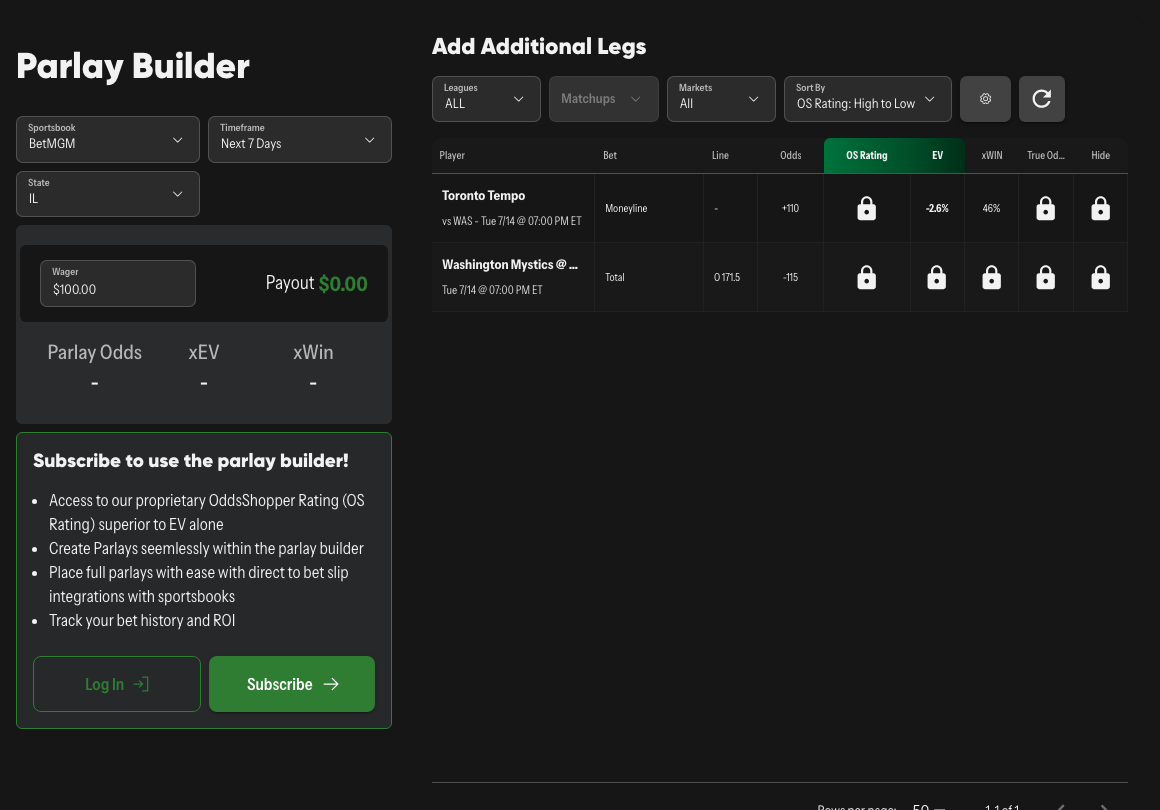
The OddsShopper Parlay Builder prices a same-game parlay leg by leg across books.
How To Find +EV Props By Line Shopping Across Books
Everything above points to one habit: line shopping. Because props are priced independently at every book, the exact same bet is regularly available at different numbers, and taking the best one is free expected value. Betting Mahomes Over 274.5 at -102 instead of -110 doesn't feel like much on one bet, but it's the difference between winning long-term and grinding to a slow loss across hundreds of them.
The problem is that no one can eyeball every book by hand in the seconds before a line moves, and you shouldn't have to. That's the job I hand to a tool. OddsShopper pulls live prices from every major sportsbook, de-vigs each market to estimate a no-vig fair price, then flags the books offering a number better than that fair price (the +EV props) with the exact book to bet it at. Instead of opening eight apps, you see the edge and where to take it in one screen.
Here's a real example from an OddsShopper de-vig snapshot dated July 22, 2026. The prop was Dominic Canzone Under 0.5 total hits. De-vigged across the market, the fair price came out to +154, but Bet365 was still hanging +185 on that exact same Under:
| The Prop (July 22, 2026 Snapshot) | De-vigged fair price | Best takeable price | Your edge |
|---|---|---|---|
| Dominic Canzone Under 0.5 Hits | +154 | +185 (Bet365) | +12.2% |
Two different numbers live in that row, and they measure two different things. The $31 is the raw payout gap: a $100 bet pays $154 at the fair number but $185 at Bet365, so shopping puts an extra $31 in your pocket on a win. The +12.2% is the real prize: a 12.2% edge on every dollar you stake, weighing how often the Under actually cashes (its de-vigged win probability), not just the win-only payout difference. The point isn't Canzone, it's the gap: you're not projecting his hits any better than the market, you're just refusing to take +154 when +185 is sitting one tab over.
Do that on every prop and you stop overpaying the book; when the price clears fair value, that's where the edge starts. My rule keeps it disciplined: I want the takeable price clearly better than fair — a fraction of a percent isn't worth chasing once you factor in limits and void rules, and on a player prop I wait for confirmed lineups before I fire, because a late scratch voids the bet on some books and only refunds it on others. Beat the number the market closes at often enough (what sharp bettors call closing line value, or CLV) and you put yourself in a stronger long-term position, though results still swing with sample size, limits, and variance. Want to run the edge yourself? The EV calculator turns any fair price and takeable price into an exact number in seconds, and the free expert picks today feed shows the props our analysts are already on.
More on this: Player Props Betting Explained: Find the +EV Ones · Best +EV Bet Tracker: What To Look For (And What Most Skip) · Closing Line Value Vs. Variance: Your P&L Is Lying To You · Devig Calculator: Find Fair No-Vig Odds From -110 Prices · How To Bet On Horses: 6 Horse Racing Bet Types Explained
Frequently Asked Questions
What is a prop bet in simple terms? It's a bet on something that happens inside a game rather than on the final score, like how many points a player scores or which team scores first. You're usually betting the over or under on a number, or a straight yes/no.
What is the difference between a player prop and a game prop? A player prop rides on one athlete's stat line (Nikola Jokic over 27.5 points). A game prop rides on the contest as a whole (total combined threes, or whether the game goes to overtime). A team prop sits in between, on a single team's outcome or stat.
Why are most prop bets priced at -110? Because -110 is the standard juice on a two-way market: you risk $110 to win $100. With -110 on both the over and the under, the market adds up to about 104.8%, and that extra 4.8% is the book's built-in margin for booking the bet.
Are prop bets easier to win than regular bets? Not easier to win, but often better priced. Sportsbooks set thousands of props with less attention than the main game lines, so the numbers are softer and disagree more between books. That makes it more likely you can find a price better than the bet's true probability — the edge is in the price, not in any single result.
What is a same-game parlay prop? It's two or more props from the same game combined into one ticket for a larger payout. Books shade the price to account for the props being correlated, so only build one when every leg is a price you'd happily bet on its own.
How do I find the best odds on a prop bet? Compare the same prop across multiple sportsbooks and take the best number, a habit called line shopping. A tool like OddsShopper scans every major sportsbook at once, strips the vig to show fair value, and flags which book has the best price — the exact gap that turned Canzone's Under from +154 fair into a +185 takeable number above — so you don't have to check each app by hand.
Can you bet props on any sport? Yes. Player and team props are offered across the NFL, NBA, MLB, NHL, soccer, and more, plus one-off novelty props on big events. The mechanics, an over/under or yes/no priced with juice, are the same in every sport. For a sport-specific walkthrough, start with how to bet NBA player props.
New to OddsShopper? It scans every major sportsbook in real time and flags the player and team props priced in your favor, doing automatically the line-shopping this guide just walked through. You can try it free for 7 days, and code PROPBET20 takes 20% off OS Pro if you subscribe. Start your free trial and stop leaving the better number on the table.