It is a Sunday in the fall, one wide receiver has an over/under of 62.5 receiving yards, and five different sportsbooks have five different prices on it. One has the over at -140. One has it at even money. The bet is identical at every book: same player, same number, same afternoon. Only the price changes.
That gap is the entire game. NFL player props are not a contest to guess whether a receiver clears 62.5 yards. They are a contest to find the book whose price is wrong, and the good news for a new bettor is that the books are wrong constantly. A sportsbook posts hundreds of props every week and cannot sharpen all of them, so the soft numbers sit in plain sight. By the end of this guide you will know every prop market, how a book builds the number, and how to spot the one that is mispriced. That 62.5-yard receiver comes back later, because the gap between the worst of those five prices and the best one is often the difference between a bet worth making and one that quietly bleeds your bankroll.
The Quick Answer: NFL Player Props In 30 Seconds
- Player Props Are Bets On One Player's Stat Line (passing yards, rushing yards, receiving yards, receptions, anytime touchdowns), not on the final score.
- They Are The Softest Market On The Board. Books post too many to price them all perfectly, and recreational money piles onto overs and favorites, which can leave value on the other side.
- The Edge Is In The Price, Not The Pick. The same prop is priced differently at every book. Getting the best number, and knowing the true (de-vigged) probability behind it, is what makes props beatable.
- Two Skills Win: Line Shopping And De-Vig. Shop every book for the best number, then strip out the vig to see the fair price. This guide teaches both, with a worked example.
- The Fast Way To Do All Of It: OddsShopper compares every NFL prop across 100+ sportsbooks and shows the de-vigged fair odds on each one. New users get a free 7-day OS Pro trial, and code NFLPROPS20 takes 20% off your first payment when you subscribe.
Every market below has its own live board, and the whole de-vig method is worked end to end on a two-way price further down.
New to OddsShopper? It scans 100+ sportsbooks and flags the NFL props priced in your favor, so you are not opening five apps by hand. The first seven days of OS Pro are free, and code NFLPROPS20 takes 20% off your first payment if you decide to stay.
Why Player Props Are The Best Market For New Bettors
Start where the money is easiest. The main lines (the point spread and the game total) are the hardest markets to beat because they are the most bet, the most watched, and the fastest to correct. A sharp bettor moving the Chiefs spread is fighting every other sharp in the country for a half-point. That is hard mode.
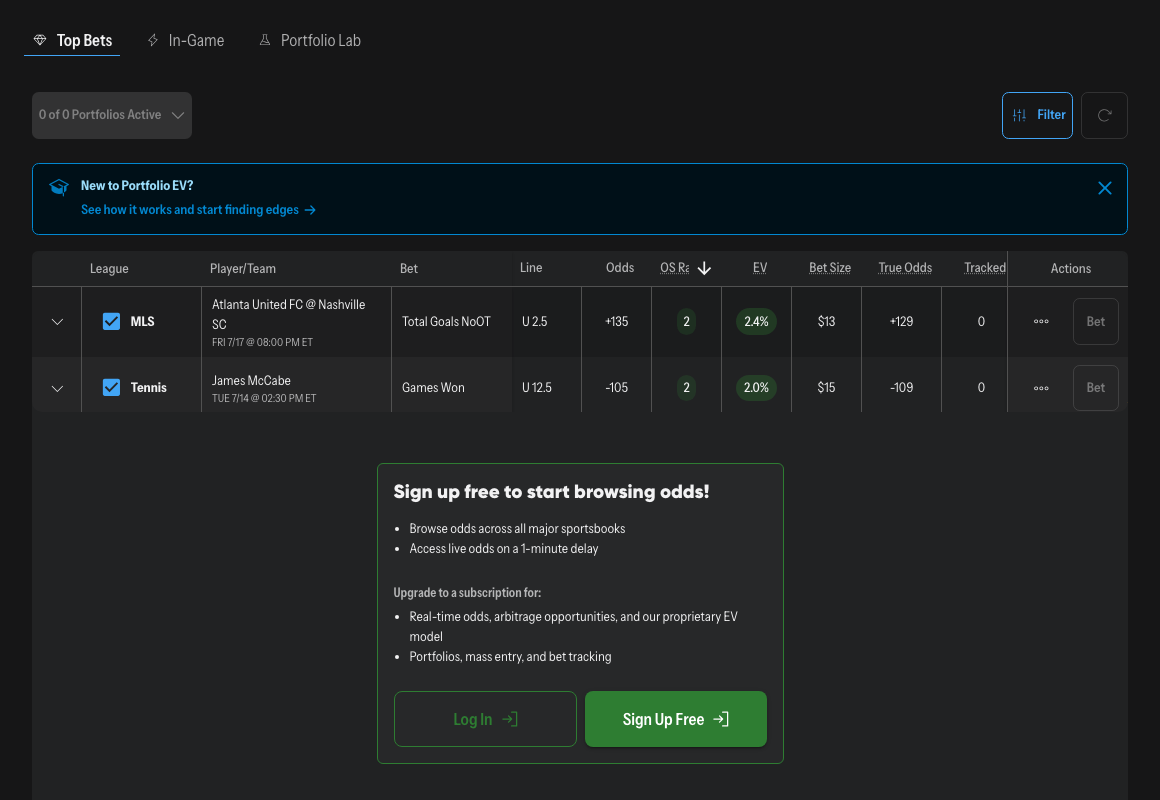
The OddsShopper +EV Screen.
Player props are the opposite. A single game might have two hundred separate prop numbers across every skill-position player, and no book has the staff to price all two hundred as carefully as it prices the spread. On top of that, recreational money floods the popular side (the star quarterback's passing over, the household-name running back's anytime touchdown), which pushes those prices past fair and can leave the quieter side soft. The props board is where the softest numbers live, which is exactly why it is the natural place for a newer bettor to start: the market is less efficient, so the price mistakes are bigger and last longer.
You can measure that. When I pulled the OddsShopper NFL board on September 14, 2026, the receiving-yards market was carrying prices from 40 separate sources. The tackles market had 8. Both are bets on one player's afternoon; one of them has five times as many prices arguing the number into shape, and the other is left to drift. That gap is the inefficiency, in a single comparison, and it is the reason the advice in this guide lands differently market to market.
Football also posts more of these than any other major league we track. The same catalog count, league by league, from that morning's pull:
| League | Distinct player-prop market types (September 14, 2026) |
|---|---|
| NFL | 141 |
| NBA | 53 |
| NHL | 39 |
| MLB | 27 |
The NFL is not a little ahead of the field; it is more than two and a half times the next-busiest catalog. The logic in this guide works in every sport (our player props betting explained guide runs the cross-sport version), but that top row is why football is where a book runs out of attention first.
This is the thesis of the whole guide. You are not being asked to out-scout an NFL scouting department. You are being asked to notice when a number is priced wrong, and to take the right side at the best number when it is. Everything below is designed to make that one skill second nature.
The NFL Player Prop Markets, One By One
Every prop is a bet on whether one player's number finishes over or under the line the book posts. Here is the whole board at a glance before we take each market in turn.
| Market | What drives the number | Where the value usually hides |
|---|---|---|
| Passing Yards | Team total, opponent pass defense, weather | The under on a QB nobody is talking about |
| Rushing Yards | Volume plus game script (read the spread) | Dual-threat QB rushing overs |
| Receiving Yards | Target share and average depth of target | Longest-reception on a boom-bust receiver |
| Receptions | Target volume and short-route role | A player whose role just changed |
| Anytime TD | Touches inside the 10-yard line | The goal-line back, not the big name |
The row I keep coming back to is the last one. Anytime touchdown is the market where the public most reliably overpays for a name, and where a no-name goal-line back is the sharper price, so it is worth understanding exactly what each of these markets is really measuring.
Passing Yards (And Passing TDs, Completions, Attempts)
The quarterback markets carry the highest volume on the board. A passing-yards number is built off how many points the offense is expected to score and how good the defense across from it is against the pass. A quarterback on a team favored to put up 27 points against a leaky secondary gets a high number; that same quarterback in a low-total, windy game gets a low one. Passing touchdowns, completions, and attempts run on the same math, and attempts in particular spike when a team is expected to trail and throw to catch up.
Because these are the most-bet quarterback props, the popular side gets shaded hardest exactly when the most money is on it: a star's passing over in a Sunday or Monday night game moves further past fair than the same quarterback's number in a quiet 1 p.m. window, because that is where the recreational money concentrates. The under on a quarterback nobody is discussing, in a game nobody is watching, is where the soft number usually sits. Working out which quarterback that is, week to week, is the whole job of our NFL passing yards props guide.
Rushing Yards (And The Dual-Threat QB Angle)
Rushing-yards props live and die on volume and game script. A running back on a big favorite is expected to carry the ball in the fourth quarter while his team runs out the clock, which is why the volume-plus-script combination matters more than last year's yards-per-carry. The rushing angle I go back to most, though, is the quarterback rushing over on a dual-threat passer. Books tend to post those numbers conservatively, and the yardage is volume-driven and repeatable rather than dependent on one broken tackle.
One caution: a favored back's number assumes he plays four quarters. If the spread says his team blows the opponent out, he may sit late, so read the number against the game script before you take the over. Reading a spread into a carry count is the spine of our NFL rushing yards props guide.
Receiving Yards (And Longest Reception For Boom-Bust WRs)
A receiving-yards number is driven by target share and average depth of target, meaning how often the ball goes his way and how far downfield. A possession receiver who catches eight short passes and a field-stretcher who catches two deep ones can carry the same yardage number for completely different reasons, and that changes which side you want.
For a boom-or-bust deep threat (the guy who posts 12 yards or 112 with nothing in between), the smarter market is often his longest reception rather than his total receiving yards. One long catch cashes a longest-reception over even on an otherwise quiet day, which fits a volatile player's profile far better than a cumulative-yards line does. Both sides of that choice get the full treatment in our NFL receiving yards props guide.
Receptions
Receptions are the high-floor market. They are driven by target volume and route participation, and a low average depth of target actually helps, because a checkdown back or a slot receiver who catches six short passes is a reception machine even when his yardage is nothing. Underneath, zone-coverage matchups boost this market by funneling the ball to short, high-percentage throws.
Receptions props are quietly efficient near the number because they are so volume-stable, so the value tends to show up on players whose role just changed, like a receiver promoted by an injury ahead of him. Catching those role changes before the number moves is what our NFL receptions props guide is built around.
Anytime Touchdown Scorer
The anytime-touchdown market is not about season totals; it is about touches near the goal line. A back who gets the carries inside the 10 has real touchdown equity even if he is not a star, while a big-name receiver who never sees a red-zone target is priced higher than his actual chances. We break the touchdown market down in full in our NFL anytime touchdown props guide; the short version is that goal-line role beats reputation every time.
One thing worth knowing before you go looking for it: on an odds screen this bet is usually filed as total touchdowns, and "anytime" is the over on the 0.5 rung. The 1.5 rung on the same board is the two-touchdown bet, which is why the same player can show up at +140 and +1100 on what looks like one market. Anytime-TD prices also swing hard between books because touchdown probability is hard to model, which makes it the market where line shopping pays the most. More on that below.
Sacks, Tackles And The Thin End Of The Board
The skill-position markets are the loud half of the board. The quiet half is defensive: total sacks, total tackles, combined tackles including assisted stops, and interceptions caught by a defender. (Interceptions thrown is a separate board and an offensive market, a bet on the quarterback rather than on the defense.) These are driven by snap count and role first: an every-down linebacker facing a run-heavy offense gets the tackle chances, an edge rusher lined up across from a struggling offensive tackle gets the sack chances.
Thin is the point, and it is a sliding scale rather than two buckets. On that same September 14 pull, sacks carried 18 separate prices and tackles just 8, against receiving yards' 40. A market eight prices deep has almost nothing forcing its number into line, which is the inefficiency argument from the top of this guide with the volume turned up. It cuts both ways, though: fewer places pricing a market means smaller limits and a real chance nobody has a number at all. Our NFL defensive props guide covers how to read sacks, tackles and interceptions without overpaying for the thinness.
How Sportsbooks Price A Prop
Here is the part that turns a fan into a bettor. Every two-way prop is priced with a built-in margin called the vig (also called juice or hold). The vig is how the book makes money whether you win or lose, which is why you cannot just bet the side you like and expect to profit.
Take a receiving-yards prop posted at Over 62.5 (-110) / Under 62.5 (-110). A -110 price means you risk $110 to win $100, which implies a 52.4% chance (the formula for a minus price is |odds| / (|odds| + 100), where |odds| is the absolute value of the odds, here 110 / 210). Add both sides together, 52.4% over plus 52.4% under, and you get 104.8%. Probabilities cannot really sum past 100%, so that extra 4.8% is not real: it is the book's vig, the hold you have to beat before you win a single dollar.
That is also why the same prop is -110 at one book and -120 at another. Every book bakes in its own margin and shades its own number based on which way its customers are betting. Two books looking at the identical receiver will post two different prices, and one of them is closer to the truth than the other. Finding that one is the job. (For the version where you build your own number first and compare the board against it, betting NFL props with projections walks that route.)
The one-sentence versiona prop is only a bet when the price you can get is better than the true probability behind it. Everything else in this guide is just how to measure those two numbers.
The De-Vig: Turning A Price Into A True Probability
To know whether a price is a bet, you have to strip the vig back out and find the fair (no-vig) probability. It sounds technical, but it is three steps of arithmetic, and it is the single most valuable habit in prop betting. This one skill separates people who wager on props from people who beat them.
Worked Example: De-Vigging A Receiving Yards Prop
Back to our 62.5-yard receiver. (Every number here is illustrative, chosen to show the method, not a live line.)
At the sharpest book on the market, the two-way price looks like this:
| Side | Price | Implied probability |
|---|---|---|
| Over 62.5 | -130 | 56.5% |
| Under 62.5 | +110 | 47.6% |
Those add to 104.1%, and that 4.1% is the vig. To de-vig, you divide each side by that total to force the two back to 100%:
- Fair over = 56.5% ÷ 104.1% = 54.3%
- Fair under = 47.6% ÷ 104.1% = 45.7%
(The percentages are rounded to one decimal place; the two fair sides add back to 100%, which is the whole point of de-vigging.)
So the true probability of the over is 54.3%, which as a fair price is about -119. That number, not any single book's posted price, is your yardstick. Now you go shopping, and this is where the price gap I promised at the top finally pays off. Of those five books, here are the two that decide the bet:
- Book X has the over at -140 (58.3% implied). You would be paying for a 58.3% outcome that is really 54.3%, a worse price than fair and a long-term loser.
- Book Y has the same over at +100 (50.0% implied). You are getting a 54.3% outcome at a 50% price. The number is in your favor, which makes it a +EV bet.
Same receiver, same 62.5 line, same over, and one book is a mistake while the other is a bet worth making. Nothing about the football changed. Only the price did, which is the point of this entire guide. If you want the full walkthrough of the math, our how to find +EV bets guide covers it step by step, and how to read betting odds has the implied-probability conversions in a table.
Do this in one click instead of by hand.Three steps of arithmetic per prop is fine for one bet and impossible for a Sunday. OddsShopper de-vigs every NFL prop for you and shows the fair odds next to every book's price, so the +EV side is already flagged before you do any of it.
Line Shopping: Why The Best Number Is The Whole Edge
The worked example just proved the most important habit in betting: always take the best number. The over that lost money at one book won it at another, and the only thing that changed was which book you clicked.
Plus-money props make it even clearer. The same anytime-touchdown bet might be +150 at one book and +180 at another. That is the identical wager you were making anyway, and the second book pays you $30 more on every $100. Over a full season of props, taking +180 instead of +150, or +100 instead of -140, moves your break-even by more than most bettors' edge is worth, without changing a single opinion about the games. A bigger positive number always pays more, and a smaller negative number always costs less. Getting the best price is also one of the most reliable ways to beat the closing line, and closing-line value is the honest scorecard that a bet was priced in your favor. That whole edge is money left on the table if you skip it.
Those 40 price sources on the receiving-yards board are worth something specific to you here. A board that deep gives you dozens of chances that the number you want is stale somewhere, and the spread between the best and the worst price on a given prop is routinely the whole difference between clearing the de-vigged fair price and missing it. Two caveats before you go counting: those 40 sources include prediction markets and pick'em apps alongside sportsbooks, and which of them you can actually bet depends on your state. You only capture a spread you can reach across. On any given prop the best number might be at DraftKings 🎁, FanDuel 🎁, BetMGM 🎁, or Caesars, which is exactly why you want an account at more than one. The book with the best price is different on every prop, and you only capture the edge if you can actually bet it.
Compare Every NFL Prop In One Place
Doing all of this by hand, opening five apps, converting every price to a probability, de-vigging each market, is realistic for one prop, not for a full Sunday. This is what the tools are for.
The OddsShopper live NFL player-props screen lays out every quarterback and skill-player prop across 100+ books on one page, with the best number on each prop highlighted, so line shopping is a glance instead of a chore. It opens on passing yards, and the Market selector at the top switches to any of the others: all 141 of the market types counted at the top of this guide are listed behind it, from passing yards down to kicking points.
You do not have to use the selector, though. Every market has its own address, so you can bookmark the board you actually bet and skip straight to it:
| Market | Go straight to the live board | Our guide to that market |
|---|---|---|
| Passing Yards | Total Passing Yards | NFL passing yards props |
| Rushing Yards | Total Rushing Yards | NFL rushing yards props |
| Receiving Yards | Total Receiving Yards | NFL receiving yards props |
| Receptions | Total Receptions | NFL receptions props |
| Longest Reception | Longest Reception | Covered in the receiving-yards guide |
| Anytime Touchdown (The 0.5 Rung Of Total Touchdowns) | Total Touchdowns | NFL anytime touchdown props |
| First Touchdown | First Touchdown Scorer | A separate board from anytime TD |
| Sacks And Tackles | Total Sacks · Total Tackles | NFL defensive props |
Do not skip past the first-touchdown row. Anytime touchdown and first touchdown are separate boards, priced separately, and they are not the same bet: anytime pays on a score at any point, first pays only on the game's opening score, which is why the prices on the same player look nothing alike. If the goal-line back from earlier is the one you like, it is worth pricing both before you fire, because the market that overpays for a name overpays hardest on the one everybody clicks.
The paid layer goes further. OS Pro adds the de-vigged fair odds and a +EV screen where the tool surfaces the props priced in your favor automatically, plus an EV Calculator if you want to check a specific price yourself. It is the de-vig math from the worked example, run on live numbers across every book at once. If you want to see how the free screen works first, our odds screen walkthrough shows it in action.
Common NFL Player Prop Mistakes
Even bettors who understand the price make these. Avoiding them is most of the battle.
- Taking The First Number You See. The single most expensive habit. Our 62.5-yard receiver was a losing bet at one book and a winning one at the next, and the app you happened to open first has no idea which you got. Always shop before you fire.
- Chasing Alt-Line Rungs. Betting that same receiver's over at 62.5, then again at 72.5, then 82.5 feels like piling on upside, but each rung is a separate bet paying its own vig, and books rake alts aggressively. Take the one number you have an edge on, not a ladder of them.
- Ignoring The Hold. That -130-both-sides prop is carrying the same kind of margin you just stripped out of the 62.5-yard example, only fatter. De-vig it first: the heavier the hold, the bigger your real edge has to be before the bet clears, and the number that looks fine on the screen may be quietly unbeatable.
- Betting The Name, Not The Price. The star's anytime-touchdown over is the most-bet, most-shaded number on the board. The goal-line grinder nobody mentions is usually the better price.
- Ignoring Game Script And Inactives. A favored back's rushing over assumes four quarters of carries, but a big spread says he may sit late. And a number means nothing if the target ahead of him just got ruled out, so check the inactive report before you fire.
For the bigger-picture NFL approach these props fit into, our NFL betting strategy guide ties the prop edge to sides, totals, and bankroll, and how to bet on NFL covers the fundamentals if you are brand new.
Frequently Asked Questions
What are NFL player props? NFL player props are bets on an individual player's performance, such as passing, rushing, or receiving yards, receptions, or whether he scores a touchdown, rather than on the final score or the point spread. You bet the over or under on a number the sportsbook posts.
Which NFL prop is easiest to bet? There is no single easiest market, but props as a category are softer than the spread and total because books post so many of them. The best value tends to sit on the less-popular side, like fading the over on a well-known player, or backing the goal-line back nobody is talking about in the anytime-touchdown market.
How do I find the best price on a prop? Compare the same prop across multiple books and take the best number, then check it against the de-vigged fair price. A tool like the OddsShopper NFL props screen shows every book's price side by side and flags the best one, so you are not checking each book one by one.
Are NFL player props +EV? A prop is +EV when the price you get is better than the true probability. In the worked example above, the same over was +EV at one book and -EV at another. Props are beatable precisely because the price varies so much from book to book, and the de-vig is how you tell which side of fair you are on.
What does it mean to de-vig a prop? De-vigging strips the sportsbook's built-in margin out of a two-way price so you can see the true probability. You convert both sides to implied percentages, add them (they will total more than 100%, and that extra is the vig), then divide each by that total to force them back to 100%. The result is the fair, no-vig probability you compare every book's price against.
The Bottom Line
Go back to that Sunday: one receiver, one 62.5-yard line, five books, five prices. When we started, that was just noise. Now it is a map. You know the price is the game, not the pick; you know the star's over is usually the shaded number and the quiet side is where value hides; and you know how to de-vig a two-way price and shop the over until a trap at -140 becomes a profit at +100.
That discipline is the whole game with NFL player props, and it explains why they are the right market to learn on. The books cannot price hundreds of them perfectly, so the mistakes are there every week for anyone willing to check the number. The only thing left is to make the checking fast. OddsShopper scans 100+ sportsbooks, de-vigs every NFL prop, and puts the +EV side in front of you, so the work in this guide happens in seconds instead of by hand across a stack of betting apps. New users get a free 7-day OS Pro trial, and code NFLPROPS20 takes 20% off your first payment of OS Pro when you subscribe.
Find the best NFL prop numbers
Betting is for adults 21+ in regulated markets where legal. Bet within your means; the goal is a long-term edge, never a sure thing.
More on this: NFL Training Camp Betting: What August News Moves Lines · NFL Week 1 Player Props: The Money Is All On Longshots · Patrick Mahomes NFL Comeback Player: Kalshi Odds · NFL Comeback Player Of The Year Odds: The Missing Favorite · Offensive Player of the Year Odds: Kalshi's Saquon Discount