Most NFL rushing yards props are shaped before the ball is ever snapped. Sportsbooks post these numbers early and adjust them slowly, and the sharpest approach to them isn't chasing last year's yardage total. It's answering four questions in order: who actually carries the ball, whether the game flow keeps it in his hands, who he's running into, and what the weather does to the whole plan. Work through those and you can spot rushing lines the market hasn't fully caught up to yet. There's also one rushing prop our sharpest voices come back to almost every week, and it isn't a running back at all. The full four-step read, a worked line-shopping example, and that quarterback rushing number are all below.
If you're already comfortable with the fundamentals of prop pricing, this guide skips the basics and goes straight to the read. If you want a refresher on how these markets are built and settled first, start with player props betting explained, then come back here for the rushing-specific angles.
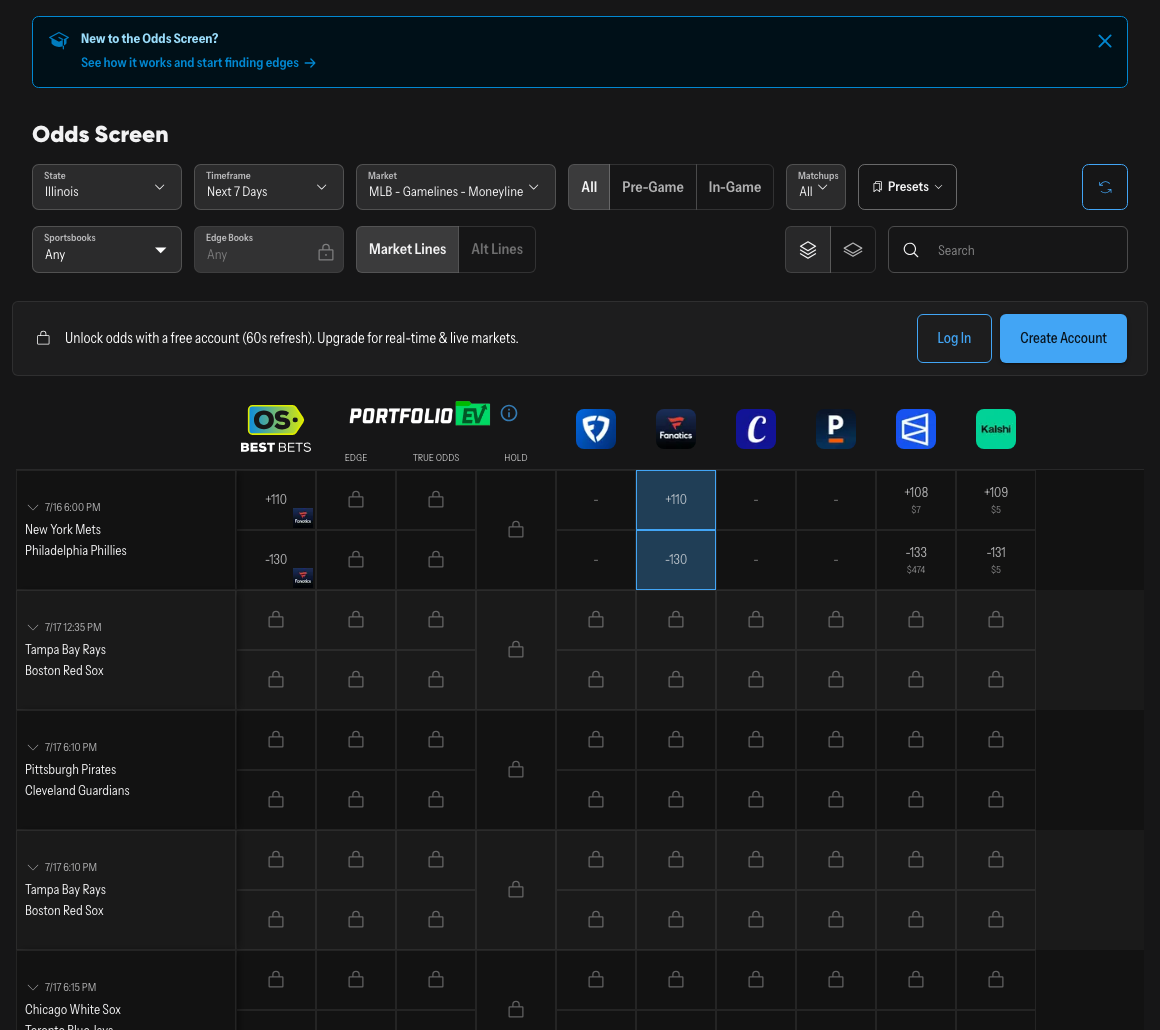 The OddsShopper live odds screen — every book's price on one board, refreshed in real time. Open the live board.
Why Rushing Yards Props Are A Softer Market
Main lines, the sides and totals, are the hardest markets to beat because the sharpest money hammers them into shape early. Player props are the opposite end of the spectrum. Books hang rushing yardage numbers with lower limits, correct them more slowly, and often copy them across the market instead of pricing each one from scratch. That's the whole reason props are a good starting lane for a bettor hunting an edge, and rushing yards is one of the cleanest props to model, because it hinges mostly on one input: workload. A receiving line depends on target share, the quarterback's accuracy, and the coverage a receiver draws all at once, but a rushing line tracks tightly to how many times a back touches the ball. That makes rushing yards prop betting one of the most modelable, and most frequently mispriced, corners of the board.
The mistake bettors make that funds the books is leading with a season total. A back who ran for 1,100 yards last year is a name, not a bet. If his backfield got crowded, his team is a road underdog this week, or the coordinator changed, that number is worthless. The edge is in projecting this game's carries, not reciting last year's box score. If you want the deeper theory on turning a projection into a priced bet, how to find EV bets covers the math; here we'll focus on the football that feeds it.
New to this?OddsShopper scans 100+ sportsbooks and flags the rushing props priced in your favor, and you can try the whole thing free for 7 days, cancel anytime.
Volume Comes First: Rush Attempts And Snap Share
In football, volume beats efficiency for props. A mediocre back who gets 22 touches will out-rush an efficient one who gets 8, almost every time. So the first number we build any rushing prop around is projected rush attempts, backed by snap share and route participation. A back on the field for 70% of snaps in a clear lead role is a different animal than a committee piece who sits on passing downs.
| Volume Signal | What it tells you | Why it matters for the prop |
|---|---|---|
| Rush Attempts | The raw workload | The single biggest driver of rushing yards |
| Snap Share | Is he a workhorse or a rotation piece | Separates a bankable floor from a boom-or-bust guess |
| Route Participation | Does he stay on for passing downs | A three-down back holds a role even when his team trails |
| Inside-10 Carries | Goal-line role | Where the touchdown equity, and a chunk of the yardage, lives |
The row that most often separates a hit from a miss is snap share. A quick runner can average a healthy yards-per-carry and still fall short of a modest rushing line if he only sees ten touches, while a plodding workhorse clears the same number on volume alone. Bet the workload, not the highlight reel. For how to turn a workload read into a full number of your own, our guide to betting NFL props with projections picks up where this step ends.
The flip side of vacated touches is the best volume-driven angle on the board: the elevated backup. When a starter sits and the next man up inherits a lead role, books often post the backup's first line before the market has fully priced his new workload, and a runner stepping into 18-plus touches at a number built for a rotational role is exactly the kind of lag this whole approach hunts. No names required; the read is the role, not the résumé.
Game Script: Let The Spread Tell You Who Runs
Volume isn't fixed. It bends to the score, and the score is something the market already forecasts for you in the spread. Leading teams run to bleed clock; trailing teams throw to catch up. So a big favorite's early-down back is a rushing-over profile, and a big underdog's back is a rushing-under profile, because the second his team falls behind, those carries turn into pass attempts to somebody else.
The trap hiding inside that logic is the blowout. Bet a favored back for a full game of carries and you can get burned when the spread was right and the starters sit in the fourth quarter. A 10-point favorite's back might be up 21 by the middle of the third and give way to a backup, so his 22 projected touches quietly become 15. This is the same volume-over-efficiency point from the last section, running in reverse: the yardage follows the carries, and game script decides how many carries actually show up. Read the spread as a carry forecast, not just a pick.
The Matchup: Opponent Run Defense
Once you know the who and the how-many, weigh the against-whom. Not all run defenses are equal, and the ones that get gashed on the ground are worth leaning into. Look at opponent run-defense quality by EPA or DVOA for the headline, then check how a defense funnels: a team that's stout against the pass but soft up front invites carries and rushing volume, which is exactly the environment a rushing over wants.
Two splits sharpen that headline number. First, weigh early-down run defense over the all-downs figure, because that's where a lead back's carries actually live; a unit that holds up on obvious passing downs can still be soft on the first-and-10 runs that fill his line. Second, split the yardage a defense allows into before and after contact: a team bleeding yards before contact is losing at the line of scrimmage, which any volume back exploits, while a team giving it up after contact is missing tackles, which rewards the back who breaks them. Same headline ranking, two different overs.
A rushing prop lives at the intersection of a heavy workload and a leaky front. A three-down back on a favorite, facing a bottom-tier run defense, in a game his team is expected to control, is the rushing-over profile you're hunting. Flip any one of those and the edge thins. For the broader framework on how these NFL matchup reads fit together across markets, our NFL betting strategy guide zooms out to the full picture.
The one-line read.Rushing-over value shows up when a heavy workload, a favorable game script, and a soft run defense all point the same way. If only one or two line up, pass and wait for a cleaner number.
Weather: Wind Grounds The Passing Game
Weather is the quiet multiplier on the whole read. Wind above roughly 15 mph wrecks the passing and kicking game, and offenses respond the only way they can: they run. A gusty forecast pushes both teams toward the ground, which inflates carries and pulls totals down. You end up in a natural rushing-over environment, and it's one the props market is often slow to fully price because the number was set days earlier under a calmer forecast.
Rain hurts efficiency and ball security but still nudges play-calling toward the run. So when you see a true wind game on the board, your rushing-yards read and your read on the total point the same direction: fewer pass attempts, more handoffs, live rushing overs. Check the forecast before you lock a passing yards prop against it and a rushing prop for it.
Our Favorite Rushing Prop: Dual-Threat QB Rushing Yards
Here's the prop we promised up top, and it's the one our betting voices come back to almost every week: quarterback rushing yards on a dual-threat QB. The QB rushing yards prop is volume-driven and the books tend to post it low, because a designed-run and scramble profile is harder for their models to pin than a running back's. When a QB is a real part of the ground game, that low number is where a lot of weekly value sits, and it dodges the committee risk that muddies a lot of NFL running back props.
The read is the same sequence, applied to the quarterback:
- Design Volume: is he actually running by design, or only scrambling when a play breaks down?
- Game Script: does the spread project a competitive game that keeps him upright and moving the chains?
- Contain: is the defense one that loses the edge and gives up scramble lanes?
A dual-threat QB in a competitive game against a front that loses contain is the cleanest version of this bet. Because the posted line so often sits under a fair projection of his designed-run volume, it's one of the best-priced rushing numbers on the board relative to its true probability, which is why it stays on our card.
One settlement wrinkle matters more here than anywhere else on the board. Scrambles count as rushing yards and sacks don't (in the NFL, sack yardage comes off team passing, not the quarterback's rushing line), but kneel-downs count as negative rushing yards. A dual-threat QB over that's sitting a yard or two clear late can bleed back under while his team closes the game out in victory formation, so bake a small cushion into the number you're willing to take.
A Worked Example: Reading A Rushing Prop The Right Way
Put the sequence together on one number. For illustration, say a workhorse back is a 7-point home favorite against a bottom-five run defense, and his rushing yards line is posted at 74.5. The volume is there (he's a back who never leaves the field), the game script favors him (a touchdown favorite runs late), the matchup is soft, and there's no weather flag. That's three green lights and no weather red flag, so the over is the side. From here the work shifts from handicapping to finding the best price.
This is where line shopping does real work. The same over won't carry the same price everywhere. Using illustrative numbers:
| Sportsbook | Line | Over price |
|---|---|---|
| DraftKings 🎁 | 74.5 | -115 |
| FanDuel 🎁 | 74.5 | -108 |
| BetMGM 🎁 | 73.5 | -110 |
FanDuel is offering the best price on the same 74.5 number, so at -108 it's the clear play over the -115 elsewhere. The BetMGM line is a different bet entirely: a full point lower at 73.5, which is worth a look if you'd rather have the cushion than the price. To know which is actually the better value, you strip the vig out of each and compare the no-vig price to your own estimate, a process our remove the vig guide walks through step by step. Take the best number and you give yourself the best shot at positive closing line value, or CLV, the truest long-run scoreboard for whether you're beating the market or just getting lucky. Grabbing -108 instead of -115 looks tiny on one bet and adds up to meaningful value across a season.
Do this automatically.OddsShopper's +EV screen prices NFL rushing props across 100+ books, and the tool surfaces the no-vig fair odds and the exact side and book where the number is in your favor. Try it free for 7 days, then use code NFLRUSH20 for 20% off your first payment of OddsShopper Pro or Core.
Shop The Number And Bet The Best Price
Even a perfect read gets wasted at a bad price. Rushing props scatter across the market. DraftKings might hang 74.5 while another book sits at 73.5, and the gap between prices is often bigger than the edge you handicapped. Watching line movement helps too: if a rushing number drifts up through the week, sharper money is on the over and you want to be ahead of it, not chasing it. The OddsShopper NFL odds screen lets you compare every book's NFL numbers in one place instead of tabbing between apps.
The discipline is simple. Find the side, then take the best available number, every time. That's the same habit that separates long-term winners in every market, and it's covered more broadly in our NFL betting strategy piece.
Common Rushing-Prop Traps
- Leading With A Season Total. Books know recreational bettors anchor to name recognition and last year's yardage, so they can shade a familiar name's line and still take action on it. Last year's 1,100 yards means nothing if this week's carries just got vacated or the team is a two-score dog. Project this game.
- Ignoring Game Script. Betting a favored back's full workload without accounting for a possible blowout, or fading a trailing back who'll still get his early carries, both leave value on the table because the number was set for an average outcome, not the specific one the spread predicts.
- Buying Alt Rungs Blindly. Climbing to a higher rushing-yards milestone for a fatter payout is a separate bet each time: each rung is its own separately priced market, and books bake a fatter hold into the alt ladder than the main line. They rake those aggressively for a reason.
- Fading The Weather Read. The line was set days earlier, often before the forecast firmed up, so a late-week wind spike is exactly the kind of lag that opens a rushing-over edge. Pushing a rushing under into a 20 mph wind game fights the condition that inflates carries.
- Confusing Value With The Favorite. The best rushing bet is the one offered at a better price than your own estimate of its true probability, not the biggest name or the shortest number.
Frequently Asked Questions
What is the most important stat for NFL rushing yards props? Projected rush attempts. Volume drives rushing yardage more than efficiency does, so a back's expected workload, backed by snap share, is the number to build the bet around.
How does the point spread affect a rushing prop? The spread is a carry forecast. Favorites run late to protect a lead, which supports rushing overs, while a big favorite also carries blowout risk that can pull a starter's fourth-quarter carries. Underdogs throw to catch up, which cuts their backs' rushing volume.
Are quarterback rushing yards props worth betting? On dual-threat quarterbacks, yes. Books tend to post those lines low because a running QB's volume is harder to model, so they're one of the more consistently soft rushing markets week to week.
How do NFL rushing yards props settle? On official NFL rushing yards. Scrambles count, sacks don't (sack yardage counts against team passing), and kneel-downs count as negative rushing yards, which matters most on a dual-threat quarterback over late in a game his team is closing out.
Does weather really matter for rushing props? It does. Wind above roughly 15 mph pushes teams away from the pass and toward the run, inflating carries and making rushing overs live, so always check the forecast before betting.
Where can I find the best rushing prop odds? Compare every book, because the same line is often priced differently across the market. The OddsShopper odds screen puts every book's NFL numbers in one place, and the +EV tools flag the rushing props priced in your favor with the no-vig fair price alongside.
In Summary: Win The Rushing Prop Before Kickoff
The rushing-props edge isn't a hidden stat. It's a sequence you run before the game starts: volume first, then game script off the spread, then the run-defense matchup, then the weather. Do that and the yardage line stops looking like a mystery and starts looking like a number you can price. Season totals are the noise; carries are the signal, and the quarterback run market is the softest corner of all.
The last step is the one that turns a good read into a profitable one: take the best available number, every time, and measure yourself against the closing line. That's what a market-based tool is built to do for you, so you spend your time on the read and none of it tabbing between sportsbooks.
Bet rushing props the sharp way.OddsShopper compares 100+ books, strips the vig to show the true price, and flags the rushing numbers posted in your favor. Start your free 7-day trial, then take 20% off OddsShopper Pro or Core with code NFLRUSH20.
For the touchdown side of the ground game, read our guide to NFL anytime touchdown props. And if you want the full map of every market like this one, our NFL player props hub covers the passing, receiving, and touchdown families the same way this guide covers the ground game.
More on this: NFL Passing Yards Leader Odds: The Champion Nobody Is Buying · NFL Receiving Yards Leader Odds: Chase's Knee And A Board With No Favorite · NFL Receiving Yards Props: Where The Value Hides · NFL Passing Yards Props: How The Line Hides Value · NFL Preseason Event Contracts, Explained In 60 Seconds