A strikeout is one of the few things in baseball that two people fight over on every pitch: the guy trying to miss the bat, and the guy trying not to swing through it. That tug-of-war is why I keep coming back to MLB strikeout props. Unlike a home run, which needs one perfect swing and a little luck, a starter's strikeout total is a slow accumulation you can actually forecast, because it rides on skills that hold up over a full season rather than one at-bat. The trap for casual bettors is backing the name (the ace, the strikeout reputation) instead of asking whether the matchup and the price support the posted total. Get good at that question and you will find yourself taking the under on big names more than you would ever guess, and I will show you why by the end.
The Quick Answer
To bet MLB strikeout props well, forecast the pitcher's true strikeout total from three drivers, in order: his swing-and-miss skill (whiff rate, CSW%), the opposing lineup's strikeout rate against his handedness, and the innings he will actually throw. Then de-vig the posted price, compare the fair line to your read, and only bet, over or under, when the number beats it; park and umpire tendencies are context the books already price, never your edge. Below: each driver in depth, the over/under/alt-line decision table, a full worked de-vig example, and the spots where the under quietly beats a big-name arm.
New to props entirely? Start with what player props are and how they work, then come back. This guide assumes you already know the basics and goes straight at the strikeout market.
What An MLB Strikeout Prop Actually Is
A pitcher strikeout prop is a wager on how many batters a pitcher, usually the listed starter, will strike out in a game, offered as an Over/Under. The main line sits at the sportsbook's projection, often something like 6.5, and both sides carry a price. Books also post alternate lines: you can buy down to Over 4.5 at a shorter price for lower variance, or reach up to Over 7.5 or 8.5 at a longer price for upside. Same pitcher, same night, a whole ladder of numbers. One housekeeping note that separates pitcher strikeout props from most other markets: books differ on what happens if the listed starter is scratched or exits early, so confirm the posted pitcher and each book's house rules before you bet.
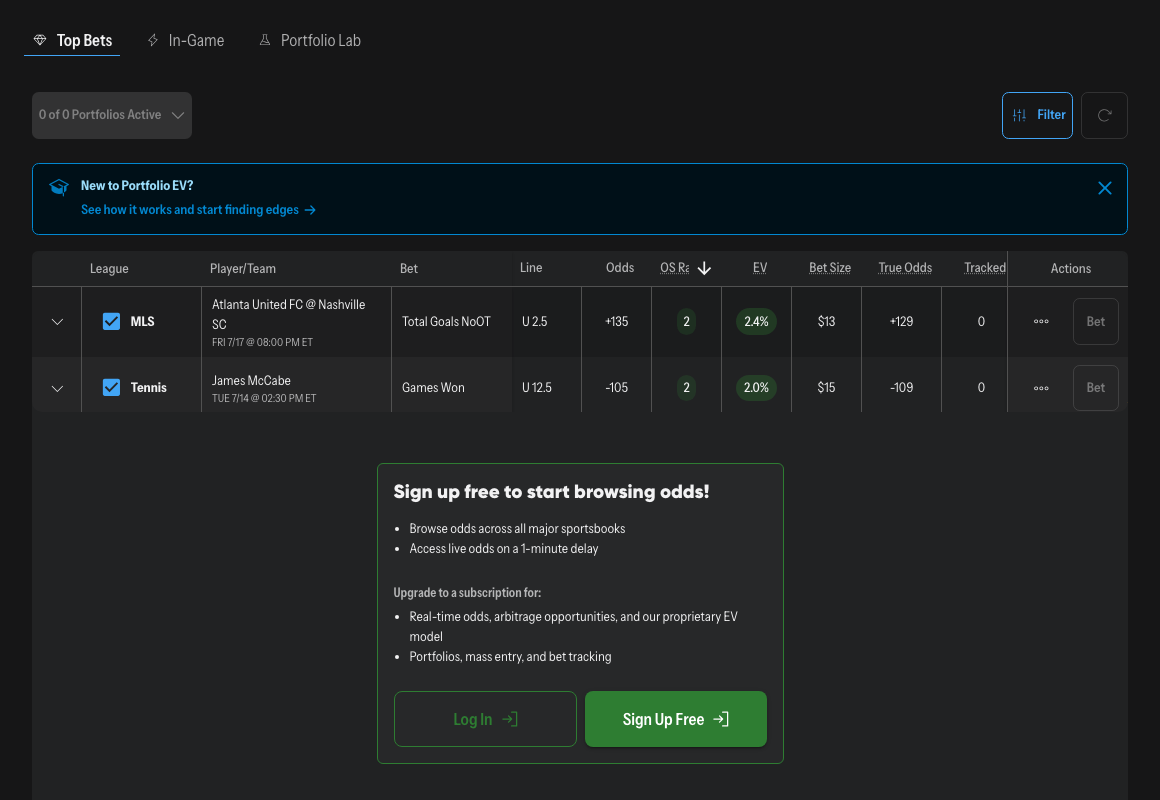
The OddsShopper +EV Screen.
The key mental shift is that you are not betting on whether a pitcher is good. You are betting on whether the specific total in front of you is too high or too low. A Cy Young arm can be a great under and a back-end starter can be a great over, entirely depending on the number and the matchup. Once that clicks, the rest of this guide is just learning what moves the true total off the posted one.
Driver 1: The Pitcher's Swing-and-Miss Skill
Everything starts with the arm's ability to miss bats, but raw strikeout totals lie in small samples, so I anchor on the underlying rate stats instead:
- K% And K/9: how often he strikes hitters out per plate appearance and per nine innings. The headline skill number.
- Swinging-Strike Rate (SwStr%): the share of all pitches thrown that hitters swing through. This is the stickiest, most predictive whiff signal, and it stabilizes faster than the strikeout total itself.
- CSW% (Called Plus Swinging Strikes): called strikes and whiffs together, as a share of total pitches. It captures a pitcher who steals strikes in the zone and gets chases, which is the full picture of how he racks up two-strike counts.
I start with these rate stats because they describe the skill before the box score does. A pitcher running north of a 30% strikeout rate is in elite, hard-to-fade territory, and when the market prices that reputation you need a real matchup argument to sell the over cheaply. A high price like that is usually high for a reason.
The forward-looking version of this: a pitcher's whiff rate is a skill, but his strikeout total is that skill multiplied by opportunity. Hold that thought, because opportunity is where most overs quietly die.
Driver 2: The Lineup's Strikeout Rate Vs That Hand
A strikeout takes two, so half the bet is the nine hitters standing in the box. The number that matters most here is the opposing team's strikeout rate, and specifically their strikeout and whiff rate against the hand the starter throws. A lineup can be a free-swinging mess against right-handers and disciplined against lefties; the split is the read, not the season-long team number.
This is the same whiff lens from Driver 1, just pointed at the hitters instead of the pitcher, and it is where the under earns its keep. An elite strikeout arm gets neutralized when he draws a contact-first lineup that puts the ball in play, works counts, and refuses to chase. The stuff is still filthy; the strikeouts just do not show up, because you cannot strike out a bat that keeps making contact. That combination, high-strikeout pitcher against a low-strikeout lineup, is one of the cleaner under cases in the sport, and it is often available because the pitcher's name keeps the over price elevated.
Flip it and the over lives on the other extreme: a good-not-great arm drawing a strikeout-prone lineup, especially one stacked with the handedness he punishes. The bat-missing does not have to be elite when the hitters are handing out empty swings.
Driver 3: Innings And Leash, Where Overs Go To Die
You can be dead right about the whiff skill and the matchup and still lose the over, because strikeouts need pitches, and pitches need innings. This is the single most underrated part of the market.
Before you bet an over, ask how deep this start actually goes:
- Expected Innings And Pitch Count. A starter on a strict count, or one just back from the injured list building up, might be capped at four or five innings by design. A dominant four-and-a-third-inning outing can still whiff just five and leave an Over 6.5 dead, while the under cashes without the pitcher ever looking bad.
- The Third-Time-Through Penalty. Modern managers are quicker to pull starters before or during the third trip through the order. Fewer trips means fewer plate appearances to accumulate strikeouts, though a true workhorse will still face a lineup a third time.
- Game Script And The Bullpen. A blowout, a rain threat, or a shaky night gets a starter yanked early. Game script can erase two innings of strikeout opportunity with no warning.
So I treat the over as a two-part bet, the rate and the volume, which is why I'll pass on a nasty arm's over the second I see a short leash. Recall Driver 1: whiff skill times opportunity. When the opportunity is throttled, even the best rate in the league cannot get there.
The workload rulenever bet a strikeout over until you have an answer on innings. Pitch count, IL build-up, third-time-through habits, and bullpen game risk all cap the total before the first pitch. If you cannot make a confident case for six innings, the over needs to be mispriced badly to be worth it.
Park, Umpire, And The Rest Of The Context
Two smaller factors round out the picture, and both come with a warning label.
Park matters at the margins. Some environments and elevations quietly nudge strikeout totals, but the effect on Ks is far softer than on home runs: a big, offense-friendly park might swing home run totals hard while barely moving a strikeout number, because a swing-and-miss does not care how far the ball would have carried. Treat park as a rounding error next to the whiff-skill and workload reads.
The home-plate umpire is the sneakier one. Umpires have measurable, repeatable strike-zone tendencies; a pitcher-friendly zone hands both starters extra called strikes and lifts strikeout totals, while a tight zone drags them down. This is checkable, not folklore: public trackers like Umpire Scorecards grade every umpire's called zone game by game, so once the assignment posts you can see whether tonight's ump runs generous or tight. Assignments can post late, so check it, but keep it in proportion.
Both of these are tie-breakers, not the case. I would not flip a bet I otherwise loved just because of the umpire, but I might pass a thin over when a tight-zone assignment and a pitch-count risk both point the same way. The sportsbook can account for park, and often adjusts once the umpire is known, so do not treat either as an automatic edge. Use them to understand why a total is set where it is. The clearest edge usually comes when one shop is hanging a price that is meaningfully off your fair line.
Over, Under, And Alt Lines
Strikeout props are a two-sided market, which is what makes them fun to bet. The over is the popular side, because casual bettors love backing a strikeout artist to go off, and that public demand can push the over price a little rich, leaving room on the under when the matchup or the leash says so. That is the reveal I promised: a large slice of disciplined strikeout prop betting is being willing to take the under on a name everyone wants over.
Before you pick a side, it helps to have the setups sorted. It's the quick-reference I run through on every start:
| Factor | Leans Over | Leans Under |
|---|---|---|
| Pitcher Whiff Skill | High SwStr% / CSW%, elite K-rate | Pitch-to-contact, average whiffs |
| Opposing Lineup | High strikeout rate vs his hand | Contact-first, low strikeout rate |
| Expected Volume | Full workload, 6+ innings likely | Short leash, pitch count, IL build-up |
| Public Lean | Little public attention on the game | Over is the crowd's default, so its price runs rich |
The last row is the one bettors overlook most: because the over is the crowd's reflex on any name-brand strikeout arm, its price runs a touch rich, which means a matchup that only modestly favors the under can become bettable at the right number. That is the setup I hunt for.
Alternate lines are your tool for expressing conviction at the right price. If you love an arm's spot but worry about a short outing, buying down to a lower alt over trades payout for safety. If you think a total is badly low, reaching up an alt line captures more when you are right. The habit that matters is checking the whole ladder across books, because the same pitcher's Over 6.5 at DraftKings can be materially better priced than the identical number at FanDuel or BetMGM, and which book is the outlier changes night to night.
A Worked Example: De-Vigging A Strikeout Market
Numbers here are illustrative, a math demonstration rather than today's board, so you can run the same process on any live market.
Suppose a starter's Over 6.5 strikeouts is priced around -120 and the Under 6.5 around +100. Convert both to implied probability: -120 implies about 54.5%, +100 implies 50%. They add to roughly 104.5%, and that extra slice is the sportsbook's hold, the built-in margin that pays the book. The 4.5% here is on the friendly end; real strikeout prop markets often hold more than that, which is exactly why shopping them matters. Strip it out proportionally and the fair, no-vig picture is roughly 52% over and 48% under.
Now compare that fair line to your own read. If your matchup work (elite whiff skill, a strikeout-prone lineup, a normal workload) has this pitcher closer to 57% to clear 6.5, the over is priced in your favor and you have real value. If instead you have a short leash and a contact lineup pulling him toward 45%, the under is the better bet even though the over is the obvious side. Then shop it: an over you like at -120 at one book might be -108 at another, and over a full season those saved cents compound into real money. They also show up in your closing line value, the cleanest long-run scoreboard for whether your strikeout prop reads are actually beating the market.
That three-step loop, de-vig the price, compare it to your read, and take the best number, is the entire game.
Ready to skip the manual math?OS Pro de-vigs and line-shops every strikeout prop for you, and code STRIKEOUT20 takes 20% off.
How To Find The +EV Strikeout Props
Running that loop by hand for every pitcher on the day's card is a lot of work, which is exactly what OddsShopper is built to remove. My actual workflow is short: I filter to strikeout props only, sort by projected edge, throw out anything with real workload or lineup risk, and then compare the best available price against the rest of the market before I decide the edge is still there.
The Positive EV tool does the heavy lifting on step one. The tool surfaces which strikeout props are priced above their de-vigged fair-value baseline across every major sportsbook, so you are only weighing numbers that already beat the market; the full method behind that screen is in our guide to how to find +EV bets. The prop tool lets you scan the full ladder of alternate strikeout lines at once and shows which book has the best price on the exact number you want. And the odds screen puts every book's price on every MLB market side by side, which is the line-shopping habit from the worked example, automated.
A useful confirmation signal is when a prop's projected return clears a sharp reference price such as Pinnacle's, used here as a market benchmark rather than a book most U.S. readers can bet, because that points to a number the market has left soft rather than just long odds. You still bring the matchup read (the whiff skill, the lineup, the leash); the tools handle the pricing math that turns a good read into a good bet.
If you'd rather tail the work than do it, our experts post their own MLB strikeout leans in today's strikeout props. And the same de-vig-and-shop process runs on every prop market, so see how it plays out for MLB total bases props, MLB home run picks, and MLB hits props, and when football season arrives, on NFL player props too.
The Read I Keep Coming Back To
Strip it all away and betting MLB strikeout props is a forecasting problem with a pricing answer. You forecast the true total from three inputs (how well the pitcher misses bats, how easily the lineup gets missed, and how many innings he'll actually throw), and then you let the price tell you which side, if either, is worth the bet. The name on the jersey is the least useful thing on the screen. The most useful is a fair number in your head and a book somewhere posting one that is off it. Find that gap often enough, stay willing to take the under when everyone else wants the over, and you give yourself a far better process than betting reputations.
Frequently Asked Questions
What is an MLB strikeout prop? It is an Over/Under bet on how many batters a starting pitcher will strike out in a game. Sportsbooks post a main line (say 6.5) with a price on each side, plus alternate lines above and below it.
Should I bet the over or the under on strikeout props? Neither by default; it depends entirely on the number versus the matchup. High-strikeout arms against contact-heavy lineups, or starters on a short leash, make strong unders. Bat-missers facing strikeout-prone lineups with a full workload make strong overs. The under is live more often than casual bettors assume.
What stats matter most for pitcher strikeout props? The pitcher's whiff rate (swinging-strike% and CSW%) and strikeout rate, the opposing lineup's strikeout rate against that pitcher's handedness, and his expected innings and pitch count. Park and umpire zone tendencies are secondary context.
Why do expected innings matter so much? Strikeouts require pitches, and pitches require innings. A pitch count, the third-time-through-the-order penalty, or a bad game script can pull a starter early and cap his total no matter how good his stuff is, which is how overs on dominant arms lose.
How do I find value in strikeout props? De-vig the two sides to get the fair line, compare it to your own read, and shop every book for the best price on the side you want. A small price gap matters: an over at -120 at one shop versus -108 at another is real money over a full season. OddsShopper's Positive EV and prop tools automate the de-vigging and line-shopping across every major sportsbook.
Ready to bet smarter? Use code STRIKEOUT20 for 20% off OS Pro and let the tools surface the strikeout props priced in your favor.
More on this: MLB Strikeout Props Today · MLB Hit Props Today · MLB Home Run Picks Today (8/19): Shohei Ohtani & More · MLB Picks Hub: Today's Live Boards and Series · MLB Total Bases Props Today