Every PrizePicks cheat sheet today looks roughly the same: a table of players, a hit rate, a green arrow. What almost none of them tell you is the one thing that decides whether an entry is worth submitting — what the rest of the betting market thinks that same line is worth. PrizePicks pays a fixed multiplier. The sportsbooks price the same players every night with real money behind the number. When those two disagree, that gap is the entire edge, and a free PrizePicks optimizer earns its keep by finding it.
So this guide is about the price, not the picks. There is one number buried in the payout ladder that surprises nearly everyone the first time they run the arithmetic, and it quietly changes which entry type you should be defaulting to. I will get to it in a minute, because it only lands once you understand what a cheat sheet is actually claiming.
The Quick Answer
A free PrizePicks optimizer is only worth using if it reads live sportsbook odds, strips out the vig, and compares that fair probability to the payout rung you're trying to clear — hit rates and green arrows alone won't get you there. The full payout-ladder math, the de-vig walkthrough you can run yourself, and the stats that move each sport's lines are all below.
- A cheat sheet is a shortlist of pick'em lines, not a betting slip. It only becomes a decision once you know the fair probability of the line.
- The Payout Ladder Sets The Bar. On the standard Power Play ladder, a two-pick entry needs roughly 57.7% per leg just to break even, and hitting break-even means exactly that: breaking even, not profiting.
- The Bar Doesn't Fall In A Straight Line. The per-leg bar dips to 55.0% at three picks, bounces up to 56.2% at four, then drifts to its 54.7% floor at six. The four-pick is the trap rung.
- De-Vig The Sportsbook Price on the same player prop to get the fair probability. If that number sits below your rung, the pick is a pass regardless of how pretty the hit rate looks.
- Hit Rate Is A Rear-View Mirror. "Nine of the last ten" is a sample of ten. The market's price folds in every piece of information the books and their sharpest customers have.
- Free Optimizers Are Everywhere; Market-Priced Ones Are Not. Use one that reads live sportsbook odds across as many books as you can, de-vigs each book on its own, and compares the consensus to the PrizePicks line.
- Size The Entry, Then Leave It Alone. 1% to 1.5% of your bankroll per entry, tracked every time.
- Works the same across MLB, NFL, and NBA, though the stats that move each line are completely different.
What A PrizePicks Cheat Sheet Actually Is
PrizePicks is a pick'em game. You choose two to six player projections, call each one More or Less, and every selection has to land for a Power Play to pay; a tie or a player who never takes the floor is discarded, and the entry reverts to the next ladder down rather than losing outright. There is no moneyline, no spread, no odds attached to the individual pick. Just a number, a direction, and a multiplier at the end.
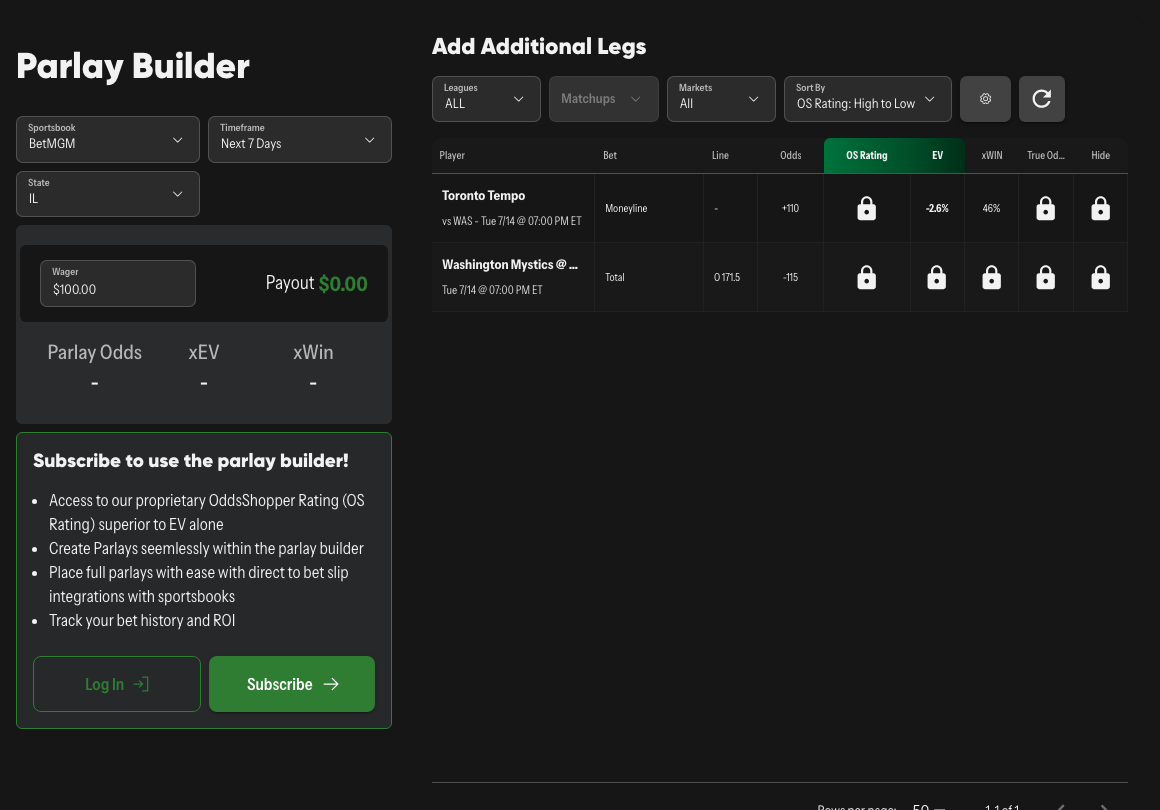
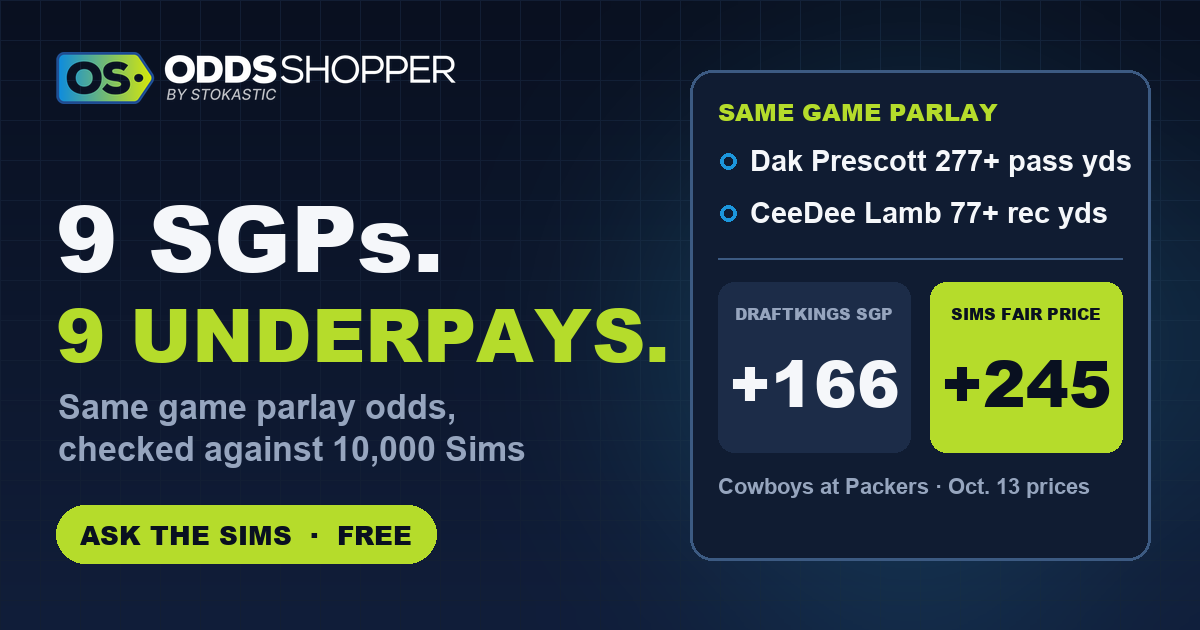
The OddsShopper Parlay Builder.
That screenshot is the sportsbook-parlay side of the same engine — the de-vig you'll watch below is exactly what its pick'em sibling, the Entry Builder, runs against the PrizePicks board.
That simplicity is the trap. As we broke down on How to Win At NBA Betting, "there are a million different types of bets," and the terminology overwhelms people long before the edges do. Pick'em strips all of that away and leaves a reader feeling like the hard part is over. It isn't. It has been hidden. A sportsbook shows you that a prop is priced at -115, which tells you immediately that the book thinks it hits a bit more often than not and that you are paying a fee to take it. PrizePicks shows you 24.5 and a button. The price is still there. You just can't see it.
A cheat sheet, done properly, puts the price back. It answers one question per line: what probability does the market assign to this number, and is that probability high enough to clear my payout rung? Everything else on the sheet is decoration.
If any of that vocabulary is new, our player props betting explainer covers the ground floor before you go further.
The Payout Ladder Is The Real Cheat Sheet
Start with the multiplier, because it is the one number PrizePicks publishes openly and, once you've submitted, never changes on you. On the standard Power Play ladder, a two-pick entry pays 3x, a three-pick pays 6x, a four-pick pays 10x, a five-pick pays 20x, and a six-pick pays 37.5x. Check the app before you play, since multipliers shift by sport and by promo, and on entries where PrizePicks varies the payout — promos, special projections, certain pick combinations, or the peer-to-peer Arena format — the displayed payout can differ from this ladder, so read the entry screen before applying the table.
Now ask what each rung demands. If every leg is independent and each hits with probability p, a Power Play returns your stake when p raised to the number of legs, multiplied by the payout, equals 1. Solve it and you get the bar you have to clear on every single pick:
| Entry | Payout | Break-even per leg |
|---|---|---|
| 2-Pick Power Play | 3x | 57.7% |
| 3-Pick Power Play | 6x | 55.0% |
| 4-Pick Power Play | 10x | 56.2% |
| 5-Pick Power Play | 20x | 54.9% |
| 6-Pick Power Play | 37.5x | 54.7% |
Read down that middle column and two things jump out.
The first is the two-pick. It's the entry that feels safest, the one every beginner defaults to because two coin flips sound so much easier than six, and it carries the steepest per-leg requirement on the entire board. Add a third leg and the bar drops nearly three full points, from 57.7% to 55.0%. The math is not rewarding you for playing it safe. It is charging you a premium for the comfort.
The second is stranger, and almost nobody talks about it: the bar does not fall in a straight line. It drops to 55.0% at three picks, climbs back up to 56.2% at four, then drifts down to its floor of 54.7% at six. The four-pick is the trap rung: it asks more of every single leg than the three-pick on either side of it, in exchange for the privilege of adding a leg. If you have been defaulting to four picks because 10x reads better than 6x, that bounce has been quietly costing you. And while the six-pick technically carries the lowest bar on the board, once you skip the four-pick the bar barely moves from three legs up — 55.0, 54.9, 54.7 — so what a bigger entry is really buying you is variance, not a friendlier requirement.
The ladder in one linethe two-pick charges you a premium for feeling safe, the four-pick asks more of every leg than the three-pick on either side of it, and past the four-pick bump the bar barely moves — a bigger multiplier is buying variance, not a friendlier bar.
Those are the numbers I promised, and together they reframe what a PrizePicks strategy actually is: your job is not to find picks you like, it's to find picks the market prices above your rung. A coin flip never gets there. Two 50/50 legs on a 3x payout return 75 cents on the dollar, which is a 25% loss on every dollar you put through it, forever, no matter how the individual nights go.
One caveat the table hides. All of this assumes your legs are independent. Pair a pitcher's strikeouts with the opposing team's run total, or a quarterback with his own receiver, and they aren't. The outcomes move together, which fattens both tails, and the true probability of the whole entry is no longer your per-leg number raised to the number of legs. Correlation isn't automatically bad, but it means the break-even column has stopped describing your entry. If you want the ladder's math to apply as written, build from legs in different games.
Which entry type suits which situation is a longer conversation, and we ran it in full in our Power Play vs Flex Play breakdown.
Worked Example: Turning A Sportsbook Price Into A PrizePicks Decision
Here is the mechanic, start to finish. The prices below are illustrative, chosen because they're the most common shape you'll meet, and the arithmetic is what matters.
Say a book has an MLB starter's strikeout prop at the same number PrizePicks posted, with the Over at -115 and the Under at -105.
Step one, convert each side to implied probability. For a negative American price, that's the odds divided by the odds plus 100.
- Over: 115 / 215 = 53.49%
- Under: 105 / 205 = 51.22%
Step two, notice they add to more than 100%. 53.49 + 51.22 = 104.71%. Those extra 4.71 points are the overround, the book's margin baked into both sides. (As a share of money wagered, the book's hold is 4.71 / 104.71, or about 4.5%.) The overround is not a probability. It's a fee.
Step three, remove it. Divide each side by the total:
- Fair Over: 53.49 / 104.71 = 51.1%
- Fair Under: 48.9%
So the market's honest read is that this line is a near coin flip, tilted a hair to the Over. Now walk it back to the ladder. A two-pick needs 57.7%. This leg offers 51.1%. It is 6.6 points short, and even the friendliest rung on the whole ladder, the six-pick at 54.7%, is still 3.6 points out of reach.
A prop the market prices near a coin flip cannot clear any rung on that ladder. And near the coin flip is precisely where PrizePicks sets its projections, close to the true median outcome, which parks most legs right around 50%. That's the design. A prop whose fair probability really is 60% clears every rung on the board, easily. Those exist. They just don't exist at the number PrizePicks posted unless something has come loose.
The edge, then, lives entirely in the lines that aren't fairly priced against the pick'em number: a PrizePicks projection sitting at 5.5 strikeouts while the book market is pricing the same starter as if the true number were closer to 6.5. That's where the fair probability climbs well clear of the rung. Finding those, across hundreds of lines, every night, by hand, is not a thing a person does. It's a thing a tool does.
New to OddsShopper?It scans every major sportsbook available in your state in real time, strips the hold out of every price, and flags the props where the market disagrees with the pick'em number, which is the exact de-vig you just watched us do by hand, run across the whole board in seconds. You can try it free for 7 days, and code SHOP15 takes 15% off your first payment of OS Pro if you subscribe.
The full de-vig method lives in our guide on how to remove the vig, and the conversion step is broken out in implied probability.
How To Use A Free PrizePicks Optimizer In Six Steps
The OddsShopper Pick'Em Entry Builder runs this loop for you: the tool surfaces the pick'em lines where the de-vigged market price and the PrizePicks number have come apart, which is the only part of this that doesn't scale by hand. We walked through the tool itself, screen by screen, in our PrizePicks entry builder guide. Whichever free optimizer you use, the sequence should look like this.
- Set your bankroll first, before you look at a single line. Deciding stake size after you fall for a pick is how discipline dies.
- Select your leagues. If you only play MLB, filter the rest out. Fifty NBA props you'll never touch are noise, not coverage.
- Select your books. Most people skip this step, and it's the one that decides whether the fair probabilities are any good.
- Read the edge column, not the hit-rate column. Edge is the market's fair probability minus what your rung demands. Hit rate is just history.
- Layer in the promos. Discounted projections and boosts change the line or the payout, which moves the bar you have to clear. More on that below.
- Size it and submit it. Then stop. Do not add another leg because the entry "feels light."
Steps two and three come straight from how we use these tools ourselves. As we walked through on The Easiest Way To Beat Live Sports Betting Markets, you narrow the tool down to the leagues you actually bet, then select only the books you hold accounts at. That show was about in-game markets rather than pick'em, but the same shopping discipline carries over intact: use as many books as possible.
Line Shopping: Why We Pull From As Many Books As Possible
That last instruction isn't a preference. It's the input quality of every number downstream.
Go back to that 4.71% overround. It came from one book's pair of prices, which means the fair probability it produced still carries that one book's lean. Pull the same prop from DraftKings 🎁, FanDuel 🎁, and BetMGM 🎁 at once, de-vig each book's own two-sided pair separately, and you end up with three separate estimates of the same fair probability. Take a consensus of those, leaning on the books posting the tightest overrounds, and it will usually beat any single book's read.
Now the mistake, because it's the one that quietly wrecks a lot of homemade sheets. Do not take the best Over from one book and the best Under from another and de-vig that pair. Those two prices never coexisted anywhere. Together they can sum to less than 100%, and normalizing that composite tilts the answer toward whichever side happened to post the outlier. Shopping for the best price tells you where to place a bet. It cannot tell you what a line is worth. Those are two different jobs, and only the second one is what a cheat sheet is for.
This is also why a free optimizer that reads two books is usually worth less than one reading 20, no matter how slick the interface is. Each additional book is another market signal — correlated, since books watch each other, but worth more when it comes from a fresh, liquid market with a tight overround. The tool is only ever as good as the market it can see. Our live MLB strikeout odds are the raw, book-by-book version of the comparison we just ran, and that page is where I go first when a pick'em number looks too generous and I want to see which book is the outlier.
What Free Optimizers Actually Show You, And Where They Stop
Run the field's free tools side by side and you'll notice they all converge on the same table: player, line, hit percentage, last five, last ten, a streak column, maybe a head-to-head split. It updates every few minutes and it looks authoritative.
There's a counter-argument here worth taking seriously. Plenty of sharp-sounding people will tell you hit rate is enough, that if a starter has cleared 5.5 strikeouts in nine of his last ten, the number is soft and the read is obvious. Sometimes they'll be right. But "nine of ten" is a sample of ten, and it carries almost none of the information the price already contains: the lineups he faced, the ballparks he threw in, whether his fastball velocity has been quietly dropping since June. The market's price on that same line compresses book models, sharp action, and every competing book's number into one price, set by people who already know all of that.
Trend data tells you what happened. Market data tells you what is priced. You want the second thing, and if a free optimizer only offers the first, treat its green arrows as a starting shortlist rather than a conclusion. An honest boundary runs between the free layer and the paid one across this whole category, ours included: free gets you the board and the shortlist, paid gets you the full de-vigged edge across every book on every line.
If you want the general version of this hunt, away from pick'em entirely, we wrote it up in how to find +EV bets. And if you'd rather see what a priced-out board produces than run one yourself, our free expert picks today page shows the plays our analysts actually like, with the reasoning attached.
MLB, NFL, And NBA: The Stats That Actually Move Each Line
The de-vig math is identical across sports. What differs is which underlying stat tells you why the market and PrizePicks disagree, and it is worth knowing before you trust an edge number.
| Sport | Stats that move the line | Why the pick'em number lags |
|---|---|---|
| MLB | xFIP, swinging-strike rate, ISO, barrel rate, park, platoon split | Slow-moving lines; platoon and park edges sit in plain sight |
| NFL | Route participation, target share, snap share | Role changes reprice at the books within hours |
| NBA | Usage rate, minutes | Injury news moves books before pick'em boards catch up |
- MLB. On a strikeout line, xFIP and swinging-strike rate cut through the noise of a pitcher's ERA. On a hits or total-bases line, look at ISO, barrel rate, the park, and the platoon split, because a left-handed hitter facing a lefty starter is a different player. The profile that clears a rung looks like this: the pick'em number holds all day while the books deal the Over at a steeper and steeper price because the whiff data says the fair probability has drifted toward 60% — that is a leg that clears every rung on the ladder. Baseball's samples are long and its lines move slowly, which is why it rewards patience.
- NFL. Target share and snap share drive receiving props more than any box-score total does — and route participation is sharper still, since a player can stand on the field all game without being part of the passing plan. A receiver who ran 92% of the snaps and drew nine targets in a loss is a better bet than one who scored twice on three touches. When an injury bumps a receiver from the fifth option to the second, the books reprice his yardage line within hours; a pick'em number still parked at last week's role is exactly the kind of gap that pushes a fair probability past your rung. We put the full football version of this read in our PrizePicks NFL strategy guide.
- NBA. Usage rate and minutes are almost everything on a points or rebounds line. A starter ruled out an hour before tip can add four or five shot attempts to a teammate's night, and the book will move that prop before the pick'em number catches up — that late-scratch window is where NBA legs clear rungs they could not touch at noon, and it is why the projections you pull at breakfast are worthless by lock. Basketball's injury news is the single fastest-moving input in this whole category.
The connective tissue is that each of those stats is an argument for why the fair probability should sit higher or lower than the market has it. None of them, on their own, drags a leg to 57.7%. They tell you where to look for a line that already sits there.
Bankroll, Promos, And Tracking
Sizing. 1% to 1.5% of your bankroll per entry. On a $1,000 bankroll, that's a $10 to $15 entry, and it stays $10 to $15 after a bad night. Chasing a loss with a bigger entry is the single fastest way to turn a small edge into a busted bankroll, and the reasoning is laid out properly in our bankroll management guide.
Promos. Discounted projections, the recurring midweek promos, boosts, and insurance all do the same structural thing: they change your payout or shift the line without changing the underlying player. A discounted projection moves the number in your favor, which can push a leg's fair probability past a rung it could not clear at the standard line. It does not always. On a lumpy, discrete stat like strikeouts, a half-K discount can move the fair probability by double digits — which is exactly why you re-run the de-vig at the discounted number instead of assuming either way. Sometimes it clears the rung outright; sometimes it mostly changes your tie-and-revert exposure. And check both sides of any promo: adjusted lines sometimes carry adjusted payouts, so if the multiplier moved too, recompute the rung as well — you may have moved the bar, not just the leg. Promo days are worth a look precisely because that arithmetic occasionally lands, not because it always does.
Entry types, ladders, and availability also vary by state, so the payout table in your app may not match the one your friend is looking at. Check yours.
Tracking. Log every entry: the legs, the line, the fair probability you calculated, the rung, and the result. Not because the results tell you much in the short run, they don't, but because after a hundred entries you can separate "I got unlucky" from "my fair probabilities were wrong." Only one of those is fixable, and you cannot fix it from memory.
Where Else To Play Your Picks
PrizePicks is not the only board paying on player projections — the same read often cashes at a better multiplier on a competing app, and each one pays new users to try it:
- Underdog Fantasy — get your first deposit DOUBLED, up to $100 (confirm the current terms in the app). Closest format match to PrizePicks, with higher ceilings on some slates; its head-to-head Rivals format gets its own treatment in our Underdog Rivals strategy guide.
- Betr Picks — runs a rotating new-user deposit offer; check the current terms in the app before you sign up.
Frequently Asked Questions
What is a PrizePicks cheat sheet? A shortlist of pick'em lines with some measure of how likely each is to hit. The useful ones express that likelihood as a de-vigged market probability. The rest express it as a recent hit rate, which is history rather than a price.
Is there a truly free PrizePicks optimizer? Yes, several, including ours. Most optimizers in this category run a free layer with a paid one above it, and ours is no different: the Pick'Em Entry Builder is free to open and browse, and OS Pro is what extends the de-vigged comparison across every book on every line. Judge any free layer on one question: does it read live sportsbook odds at all, or does it only show you trends? That distinction matters more than how much of the board it hands you for nothing.
What factors should an optimizer weigh? The pick'em line, the same market's price across as many books as possible, the hold removed from that price, the payout rung you're trying to clear, and the sport-specific inputs above. Recent form is an input, not the answer.
How often should the numbers update? Continuously, because sportsbook prop prices move on news. Anything computed at noon is stale by the time a scratch or a late injury report lands. Re-check every leg you're about to submit.
Which sports does this apply to? Anywhere a sportsbook prices a two-sided prop on the same player, stat, and line. MLB, NFL, NBA, NHL, soccer, golf, and combat sports are the liquid ones; the thinner the market, the less the comparison is worth. The de-vig itself is identical everywhere the matching prop exists.
Is a two-pick or a six-pick better? Neither is inherently better, but the two-pick asks the most of you: 57.7% per leg to break even, against the six-pick's 54.7%. The odd rung out is the four-pick, which needs 56.2% and so demands more per leg than the three-pick's 55.0%. If you have two picks you truly love, a two-pick is fine. Just don't choose it because it feels safer, because it isn't.
Should I trust the hit-rate percentages? As a filter, yes. As a decision, no. A 70% hit rate over ten games is seven-for-ten. A fair coin comes up heads seven times or more in ten flips about one time in six, so that streak means very little on its own.
More on this: How To Bet Team USA: Where The Real World Cup Value Hides · World Cup Golden Boot Odds: Betting Guide & Value · World Cup Group Stage Betting: 3 Edges Books Missed · How To Bet World Cup Futures: Find The Softest Prices · PrizePicks Correlation FAQ: The 5 Questions That Matter
The Bottom Line
Strip the interface away and PrizePicks is a fixed-odds product wearing a fantasy costume. The multiplier is the price, the ladder is the bar, and every entry you submit is a wager that your legs clear that bar more often than the market says they will.
That's why the two-pick number matters so much. 57.7% isn't a difficulty setting. It's the ladder telling you, in advance, exactly what it costs to feel safe, and the reason a cheat sheet built on green arrows and streak counts will lose slowly and pleasantly for as long as you keep using it. Once you can convert a sportsbook price to a fair probability and hold it up against your rung, you stop asking which players look good tonight and start asking which lines are actually mispriced. Most nights, on most boards, the honest answer is very few. A good working rule: if the de-vigged consensus does not clear your rung with a point or two to spare, treat it as a pass — thin edges have a way of evaporating between the time you price a leg and the time it locks. Knowing which few clear the bar with room is the whole game.
Stop guessing which pick'em lines are priced in your favor. OddsShopper de-vigs 20+ sportsbooks and shows you where the market disagrees with the PrizePicks number, on every line, in real time. Start free for 7 days, and code SHOP15 takes 15% off your first payment of OS Pro.
Play only where legal and only if you meet your state's minimum age (18+ in most states, higher in some). Play only what you can afford to lose. If gambling stops being fun, call 1-800-GAMBLER.