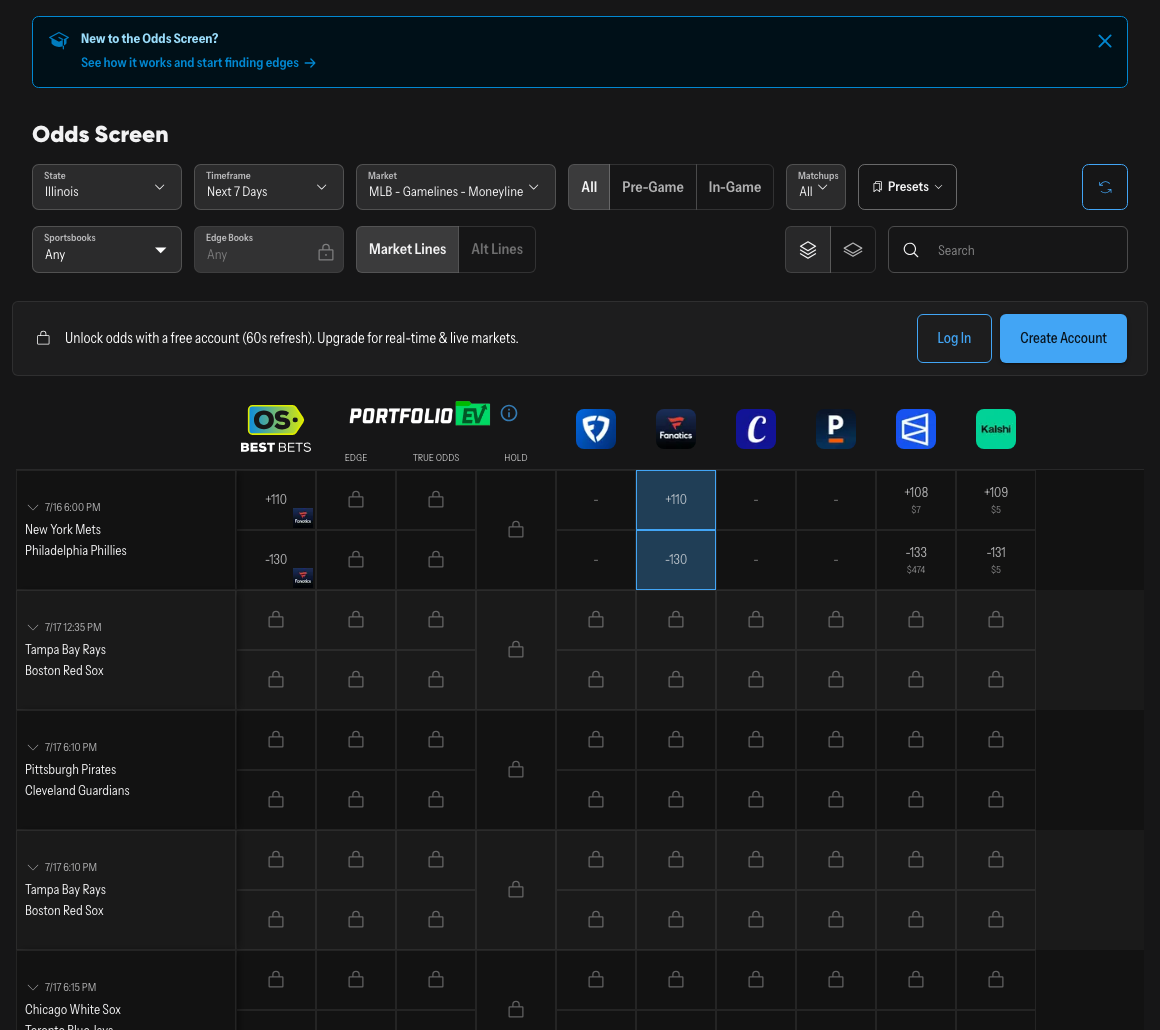
 The OddsShopper live odds screen — every book's price on one board, refreshed in real time. Open the live board.
In Summary (TL;DR)
The World Cup group stage betting menu changed more in 2026 than most bettors realize, and the change is where the value is. The tournament expanded to 48 teams in 12 groups of four, and the qualification math is new: the top two from each group plus the eight best third-place teams advance, sending 32 of 48 teams to the knockout round. That single rule reshapes every group market. "To advance" is now a far softer bar than "win the group," because a strong third-place finish can still go through, yet casual money keeps betting the splashier "group winner" and "win it all" markets. This guide breaks down the group-stage markets you can bet (to advance, group winner, exact finishing position, and match results), how the new format moves the value toward advancement and third-place math, and how to read the prices so you take the fair number. For the long-term outright and group-winner futures specifically, pair this with our World Cup futures guide.
Go deeper: How to Bet Team USA at the 2026 World Cup and World Cup Futures Picks: Ivory Coast, Colombia, Japan.
How the 2026 Format Changes the Math
Old World Cups ran 32 teams in eight groups of four, with only the top two advancing. The 2026 tournament runs 48 teams in 12 groups of four, and to fill a 32-team knockout bracket, FIFA added the eight best third-place teams to the 24 automatic top-two qualifiers.
For bettors, two things follow:
- "To advance" got much easier to hit. Two-thirds of the entire field reaches the knockouts. A decent team that finishes third in a tough group can still go through, so a "yes, advances" bet covers more outcomes than it used to.
- Third-place permutations create live value. Whether a third-place team qualifies depends on its points and goal difference versus other groups' third-place teams. That math is hard for casual bettors to track, which means the price often lags the real situation, especially live on the final group matchday.
The World Cup betting terms guide defines the market types; here we focus on how to bet the group stage under this format.
The Group-Stage Markets You Can Bet
When I bet a group, I start with the World Cup to advance odds, then compare them to the World Cup group winner odds, because the gap between those two prices is usually where the value sits.
- To advance (qualify for the knockouts). The cleanest group bet and, under the new format, often the best value for solid mid-tier teams.
- To win the group. A two-or-three-team race priced on the draw. Splashier and more heavily bet than "to advance."
- Exact finishing position / to finish top two. More granular markets that can offer value when you have a specific read on the order.
- Match markets within the group (3-way moneyline, totals, both teams to score). Each group game is its own market, and group-stage matches between mismatched sides can have soft totals.
- Group totals and specials. Some books offer group goals, both-teams-to-qualify, and similar derivative bets.
How to Read Group-Stage Odds
Convert every price to a probability before you judge it. Quick references:
- -160 implies
160 / (160 + 100)= about 61.5%. - +200 implies
100 / (200 + 100)= about 33.3%.
Two-way markets like "to advance / not advance" carry a small margin, roughly a 4% to 5% hold, far less than a 12-team group-winner futures board, where the implied probabilities sum well over 100%. That difference is exactly why "to advance" is often the fairer-priced way to back a team you like. OddsShopper's odds comparison tool converts and de-vigs every group market across books so you're comparing against a true number.
A Worked Example: Value on "To Advance"
Say a solid team is listed to advance at +120 at the tightest book, with the other side, not to advance, at -160.
- Step 1, convert. +120 implies
100 / (120 + 100)= about 45.5%, and -160 implies160 / (160 + 100)= about 61.5%. - Step 2, de-vig. Those two sides sum to about 107%; the extra 7% is the vig. Strip it out proportionally and the team's fair chance to advance comes down to roughly 42.5%, about +135. De-vigging always lowers the implied number, because you're removing the book's margin to reach the true number.
- Step 3, shop for a longer price. Now compare books. If another book lists the same team to advance at +155 (implied 39.2%), you're being paid as a longer shot (39.2%) than its fair 42.5% chance. Taking +155 when fair is +135 is the value; the +120 you started with implied 45.5%, already above fair, so it was a losing price over time.
That is the method: convert, de-vig, then shop for a price longer than the fair number. The new format makes advancement markets especially worth checking, because the public underrates how many teams actually get through, though limits on these markets can be thin early in the tournament. The live World Cup odds page keeps every match's board in one place while you shop.
Don't track 12 groups of third-place math by hand.OddsShopper's Portfolio EV and Sharp Sportsbook Algorithm de-vig and compare every group-stage price across books in real time, and flag where the offered odds beat the true odds. Start with a free 7-day trial, then code GROUPS20 cuts 20% off OS Pro or OS Core, which works out to less than a coffee a day.
Where the Value Hides in the Group Stage
- "To advance" on mid-tier teams. The format quietly made these bets easier to win, but pricing and public perception haven't fully caught up. A team you rate as a likely third-place qualifier can be a strong advancement bet.
- Fade overbet group favorites to win the group. A heavy favorite is often fairly priced to advance but overbet to finish first, where a coin-flip rival can be the value.
- Final-matchday live betting. Once results elsewhere are known, third-place qualification becomes a solvable math problem, and live prices often lag it. This is the sharpest group-stage edge of all.
- Soft totals in mismatches. A heavy favorite versus a minnow can have an inflated or deflated goal total depending on public lean; the number, not the matchup, is the bet.
- Motivation on the last matchday. A team already through may rest starters, and a team needing only a draw may sit back. These spots move totals and match lines in ways a model that ignores stakes will miss.
Sizing Group-Stage Bets
Group futures like "to advance" settle across three matches, while individual group games settle in 90 minutes, so size each to its variance: standard sizing on single matches, smaller on the longer-settling futures, always a sensible slice of your bankroll, and never a chase. OddsShopper's tools recommend a stake off your bankroll using fractional Kelly. A +EV group bet is an edge over many bets, not a promise on any one result.
The Bottom Line on Group-Stage Betting
The 2026 format is the edge: two-thirds of the field advances, third-place math is hard for casual bettors to track, and the public still overbets "win the group" and "win it all." Lean into "to advance" on mid-tier teams, fade overbet group favorites, attack the final-matchday live markets where third-place qualification becomes solvable, shop every book, and size for each market's settlement window. Pair this with our World Cup futures guide for the outright markets and check team prices on the title odds page.
OddsShopper's odds comparison and Portfolio EV run that process for you, surfacing the best group-stage number across books and flagging where it beats the true odds. Start with a free 7-day trial, then code GROUPS20 cuts 20% off OS Pro or OS Core, which works out to less than a coffee a day.
Bet only where it's legal and available, and only with money you can afford to risk. 21+ where legal; if betting stops being fun, step away.
Frequently Asked Questions
How does World Cup group stage betting work in 2026? With 48 teams in 12 groups of four, you can bet each team to advance, to win its group, to finish in an exact position, and on individual group matches. The top two in each group plus the eight best third-place teams advance, which makes "to advance" a softer, often better-value bet than it was in past tournaments.
How do the eight best third-place teams work? After 24 teams qualify automatically as group top-two, the eight third-place teams with the best records (points, then goal difference) across all 12 groups also advance, filling the 32-team knockout bracket. Tracking that math live on the final matchday is where a lot of group-stage value appears.
Is it better to bet "to advance" or "to win the group"? Often "to advance," especially for mid-tier teams. The expanded format means two-thirds of the field gets through, yet casual money keeps betting the splashier group-winner and outright markets, leaving advancement prices closer to fair or even soft.
What's the sharpest group-stage betting edge? Final-matchday live betting. Once results in other matches are known, whether a third-place team qualifies becomes a solvable math problem, and live prices frequently lag the real situation. Knowing the permutations before the book reprices is a real edge.
Should I bet group-stage match totals? They can offer value in mismatches and in last-matchday games where motivation shifts, a team already through may rest players, and a team needing a draw may sit deep. Read the stakes for each side, then bet the number rather than the matchup.
More on this: How To Bet Team USA: Where The Real World Cup Value Hides · World Cup Golden Boot Odds: Betting Guide & Value · How To Bet World Cup Futures: Find The Softest Prices · How To Read Betting Odds: American, Decimal, Fractional · What Does To Advance Mean? World Cup Betting Guide