Most Underdog content is about the standard Pick'em board, where you take a player Higher or Lower against a number. Rivals is a different game, and it rewards a different skill. Nobody here is asking whether one player clears a line. The question is which of two players wins a stat battle after Underdog spots one side a head start, which turns the exercise into grading a gap rather than a total. That single change is also why the numbers here can sit in the wrong place more often: a Rivals adjustment has to price two distributions and the relationship between them, where a Higher/Lower line only has to price one. More moving parts, more room for error. I have no public hit rate to point at, and neither does anyone claiming one, so what follows is a method rather than a promise. By the end of this Underdog Rivals strategy guide you will be able to grade a matchup in under a minute — and, just as importantly, know when a matchup you graded correctly still is not worth playing.
In Summary (TL;DR)
- Rivals Is Head-To-Head. You pick which of two players wins a stat category (points, receiving yards, strikeouts) after Underdog applies an adjustment to level the matchup.
- The Adjustment Is The Whole Game. One player is listed with a plus number that gets added to his final total before the comparison settles. You are betting the margin, not who is better.
- Entry Rules Are Tight. Standard entries start at two picks and Insured needs at least three, so a two-leg slip is Standard whether you want it to be or not. Underdog moves the caps, so read the entry screen rather than trusting any article's number.
- Standard Vs Insured is a payout-versus-variance choice, not a safety choice, and it is the same trade you make on any pick'em app.
- Beating The Gap Is Not The Bar. De-vig the matching props at DraftKings, FanDuel and BetMGM to price the true gap, then check that your side clears the break-even your multiplier sets — a 3x two-pick Standard needs about 57.7% per leg, not 50%.
- Who The Two Players Face Changes The Price. Same-game matchups swing wider than cross-game ones, which makes an identical cushion worth less. That, plus never pairing two legs that need the same outcome to land, is the Underdog pick'em strategy piece most guides skip.
What Is Underdog Rivals?
A Rivals matchup pits two players against each other in one stat category. You are not asking whether a player goes over a number. You are asking which player wins the comparison once Underdog applies its adjustment.
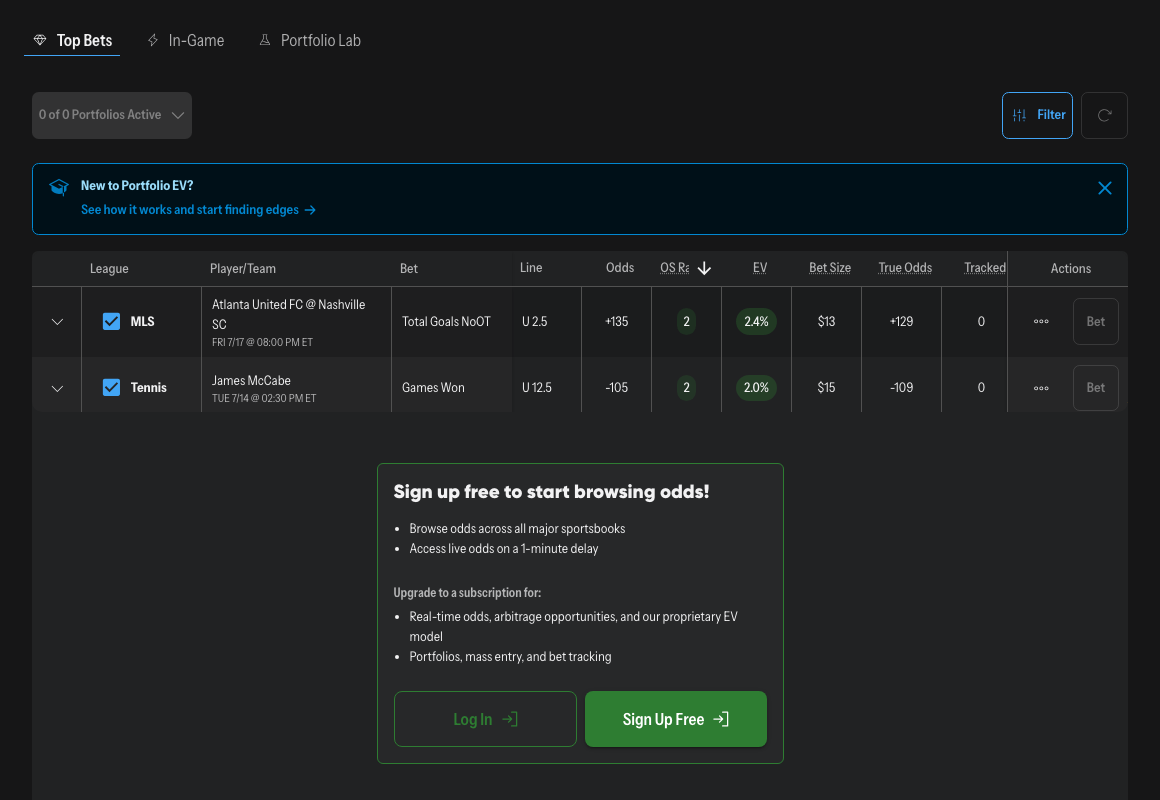
The OddsShopper +EV Screen.
The mechanic is worth stating precisely, because most write-ups describe it as a sportsbook-style spread and that is not quite how the card presents it. Underdog lists an adjustment on one side of the comparison, and that number is added to that player's final stat total before the matchup settles. If a receiver is listed at +12.5 receiving yards, he finishes with his real yardage plus 12.5, and whoever is higher after that addition wins the pick. Functionally it behaves like a spread, so it is fine to reason about it as one, but the plus number always sits on the side getting help.
Two rules shape how you build:
- Two Picks Is The Floor. The ceiling moves. Underdog has changed the maximum pick count on its pick'em formats more than once, and it varies by sport and state, so take the number off the entry screen rather than off any article, including this one.
- Insured Entries Need At Least Three Picks. A two-pick slip has to be Standard, because there is nothing to insure against when a single miss ends the entry.
That second rule matters more than it sounds, and I will come back to it when we get to entry construction.
Underdog also applies eligibility restrictions on which picks can share an entry, and those vary by sport and by how the two players are related. The ones you tend to bump into are the tightly-linked pairings — a quarterback alongside his own pass catcher, or two players whose numbers are mechanically the same event — because those turn a multi-pick entry into one repeated bet. The card itself will block an illegal combination, so read the restriction it gives you rather than assuming one sport's rules carry to another.
Standard Vs Insured Entries
Like the rest of Underdog, Rivals gives you two entry types, and the choice is about variance, not safety.
| Standard | Insured | |
|---|---|---|
| Minimum Picks | 2 | 3 |
| How It Wins | Every pick must hit | Pays a reduced amount if you miss one |
| Top-End Multiplier | Higher | Lower at the same pick count |
| Break-Even Per Leg | Set by the multiplier (a 3x two-pick needs ~57.7%) | Higher at the same pick count — the lower ceiling costs more than the salvage leg returns |
| What You Are Buying | Maximum leverage on your edge | A softer downside on a shaky leg |
| Best When | Every leg clears your +EV bar | One leg is thin, or the bankroll can't take a cold run |
The row that decides most entries is the first one. Because Insured needs three picks minimum, a two-leg Rivals entry is a Standard entry whether you like it or not, so the two-pick slip is where you should be most ruthless about only including sides you actually love. There is no wiggle room to buy.
That break-even row is the one most people get backwards, so it is worth saying plainly: a lower ceiling means a higher required win rate. Insurance does not lower your bar, it raises it. Work a three-pick Insured entry and the reduced top-end multiplier costs you more than the salvage payout on a 2-of-3 gives back, which pushes the per-leg break-even well above where a three-pick Standard sits. What insurance actually buys is a smoother ride on legs you were already happy to fire — not permission to include a leg you were not.
Beyond that, neither type is automatically smarter. If you are confident every leg clears the bar, Standard compounds that edge across the slip. If you want the same legs with less variance, Insured does that and charges you at the top end. It is the same trade-off as a PrizePicks Power Play versus a Flex Play, and the same math that drives how Underdog Fantasy multipliers work on the standard board.
The Only Question: Is The Adjustment Mispriced?
Expected value is the whole game. A Rivals pick is worth making when the side you take is more likely to beat the adjustment than its payout implies. Every pick'em board carries a margin, the same way a sportsbook carries hold, so a randomly chosen matchup is negative EV by default.
That last sentence is where most Rivals advice quietly goes wrong, mine included until I made myself write the number down. Beating the true gap only gets your side past 50%. It does not get you past the bar your multiplier sets. Work it backwards: a two-pick Standard entry paying 3x needs both legs to land, so break-even per leg is the square root of one-third — about 57.7%. A five-pick Standard at 20x needs roughly 55% a leg. Whatever multiplier your card actually shows, that is your real threshold, and "the adjustment is wider than the gap" clears none of it on its own. A reader who grades to 50% and stops will lose slowly and believe the process was fine.
The good news is that the gap itself is estimable, because the sportsbook market already prices both players individually. Each half of a Rivals matchup often has a matching player prop sitting at DraftKings, FanDuel, BetMGM and the rest of the market. Strip the vig out of those two-sided prop markets, convert them to fair projections, take the difference, and you have a market-grade estimate of the gap to hold against Underdog's adjustment. Line movement on those props between the morning and lock tells you when the market has learned something Underdog's card has not yet absorbed, and that lag is one of the more reliable places to go looking.
This is also why line shopping is not optional here. If one book has a receiver at 78.5 yards and another has him at 74.5, your fair projection moves several yards depending on which one you anchored to, and several yards is often the entire margin on a Rivals adjustment. Pull the same prop at two or three books before you trust any single one as your baseline. That habit is not Rivals-specific — it is the same comparison our live odds screen runs on game lines, applied to a player prop by hand.
Worked Example: Grading One Rivals Matchup
Here is the arithmetic on a single matchup. The numbers below are illustrative (shaped like a real card, not lifted from a live board) but the method is exactly what I run.
An example Rivals card pairs two receivers in receiving yards, with the adjustment on one side:
Ja'Marr Chasevs Justin Jefferson +12.5 receiving yards
Jefferson wins this pick unless Chase outgains him by 13 or more. Step one is not to ask who is better. Step one is to price the gap.
Pull each player's receiving-yards prop from the sportsbook market and de-vig it. Say the market shows:
| Player | Prop line | Over / Under | De-vigged fair line |
|---|---|---|---|
| Ja'Marr Chase | 82.5 | -115 / -105 | ~83.6 |
| Justin Jefferson | 74.5 | -110 / -110 | 74.5 |
Working the first row: at -115/-105 the two sides imply 53.5% and 51.2%, which sums to 104.7%. Those 4.7 points are the overround, the book's cut, which works out to a 4.5% hold on the market. Divide each side by that sum and the true Over probability is about 51.1%, slightly above a coin flip, so the fair line sits a bit above the posted 82.5.
Converting that extra 1.1% into yards depends on how widely the stat scatters. Receiving yards land roughly 40 yards either side of the projection, and at that spread one point of probability is worth about one yard, which puts the fair number around 83.6. Do not carry that rule of thumb to another stat. Strikeouts scatter about two, so there a point of probability is worth about a twentieth of a K. Apply the yards heuristic to a strikeout matchup and you will invent an edge that does not exist. Jefferson's -110/-110 market is already balanced, so his fair line stays at 74.5.
That gives a market-implied gap of 83.6 − 74.5 = 9.1 yards in Chase's favor. Underdog is offering 12.5. The adjustment is 3.4 yards wider than the gap the sportsbook market believes in, so Jefferson is the correctly-priced side — even though Chase is the better projected receiver in this example, and even though every instinct says take the guy with the bigger number.
There is the entire discipline in one line: the player you would pick in a vacuum is often the wrong side once the adjustment is on it. Flip the example and it works the other way. If Underdog had posted +6.5 instead of +12.5, the same 9.1-yard market gap makes Chase the play, and nothing about either player changed.
Now finish the job, because this is the step almost nobody takes. Is 3.4 yards enough? The difference between two receivers scatters wider than either one alone: two 40-yard spreads combine to about 57. A 3.4-yard cushion against a 57-yard spread moves the Jefferson side to roughly 52%. Correct side, and it really is the correct side. It is also nowhere near the ~57.7% a 3x two-pick Standard demands.
So the honest verdict on my own example is: right side, not enough of it. This is a discard, and switching it to Insured does not rescue it — remember that Insured needs a higher per-leg number than Standard at the same pick count, so moving a 52% leg there makes the bet worse, not safer. It sits out until the adjustment stretches further. Getting the side right and the threshold wrong is the most expensive mistake in pick'em, and it looks exactly like winning until the sample gets long enough to tell you otherwise.
Doing that on one matchup takes a minute. Doing it across a full Rivals card by hand is the tedious part, which is exactly why the tool exists.
Stop eyeballing the matchups.The tool surfaces every Rivals matchup where the posted adjustment is wider or narrower than the de-vigged market gap, so you skip straight to the mispriced sides instead of grading the card by hand. Run it in the OddsShopper Pick'Em Entry Builder, and use code RIVALS20 for 20% off your first OS Pro payment.
Correlation And Game Script In Rivals
The de-vigged gap tells you what the market thinks on average. Game script tells you how widely the actual result can swing around that average, and there are two separate correlation questions in Rivals that most write-ups mash into one.
Inside a single matchup, correlation shrinks or stretches the spread I just used to size the edge. Two running backs in the same game are close to anti-correlated by game flow. Whichever team leads, its back gets the clock-killing carries and the other one gets abandoned. That pushes results toward the extremes and widens the effective spread, which makes a thin edge worth less. Two receivers in different games have essentially no relationship, so the combined spread is the clean 57-yard figure from the example. Same 3.4-yard cushion, meaningfully different value, purely because of who is playing whom.
Across the legs of your slip, correlation is what turns one bad read into a 0-for-3. Two Rivals sides that both need the same weather, the same pace, or the same team to control a game are not two picks. They are one pick you paid for twice, and a Standard entry punishes that harder than anything else on the app.
Which brings the +12.5 back for its second use. A 3.4-yard cushion was already too thin for a two-pick Standard on a clean, uncorrelated matchup. Put that same edge inside a same-game running-back battle where the spread stretches, and it stops being an edge at all. Thin edges only survive clean spots — the fat ones are what you spend on messy ones.
How I Build A Rivals Entry
- Start from the tool's +EV sides, not the players you like. The Pick'Em Entry Builder surfaces the matchups where the adjustment is off the market gap.
- Price the gap, not the winner. De-vig both players' props, difference them, and compare to the posted adjustment.
- Convert the cushion to a probability and hold it to the multiplier's break-even. This is my actual bar: I want the side above roughly 60% before it goes on a Standard slip, a real cushion over the ~57.7% a 3x two-pick needs rather than a rounding error above it. Anything below that goes nowhere. Insured is not the consolation bracket for a thin leg, because its bar is higher still.
- Check who the two players are playing. Same-game matchups stretch the spread and shrink the value of a thin edge; cross-game matchups keep it clean. Then confirm no two legs on the slip need the same outcome to land.
- Respect the build rules. Insured needs three picks, so decide your entry type before you decide your leg count, not after.
- Size small and track every entry so you are judging a long-run sample rather than last night. Slow payouts can stretch how long that sample takes to become readable, so it helps to know how long Underdog Fantasy takes to pay out before you plan your bankroll around it.
If you want to see the same gap-pricing logic applied to a different Underdog format, the Battle Royale strategy breakdown walks through the tournament side of the app, and our how Underdog Fantasy works guide covers the standard board end to end.
Playing more pick'em than sportsbook?Stokastic's Props package runs the same de-vig-and-compare math across the full PrizePicks, Underdog and Sleeper boards. Code PROPS10 takes 10% off.
FAQ
How does Underdog Rivals work? You pick which of two players wins a stat category after Underdog adds an adjustment to one player's final total, then combine multiple picks into an entry. Standard entries need every pick to hit; Insured entries pay less but survive one miss.
What does a +12.5 adjustment mean in a Rivals matchup? That number is added to that player's actual stat total before the matchup settles. A receiver listed at +12.5 receiving yards wins his side unless the other player outgains him by 13 or more. Most adjustments carry a half-point, which is designed to keep an exact tie off the board; Underdog publishes its own rules for how a tied or voided selection is settled if one does occur, so check those rather than assuming a push is impossible.
What is the minimum number of picks for a Rivals entry? Two for a Standard entry and three for an Insured entry. The maximum moves by sport, state and product, so read the number on the entry screen rather than relying on any article's figure.
Is Rivals better than the standard Pick'em board? Neither is better by default. A Rivals adjustment has to price two distributions and the relationship between them, where a Higher/Lower line only prices one, which is simply more places for a number to end up wrong. The rule does not change: only take a side that clears the break-even your multiplier sets.
How do I find +EV Rivals picks? De-vig both players' matching props across DraftKings, FanDuel and BetMGM, difference the two fair lines, and find where Underdog's adjustment is wider than that market gap. Then convert the cushion into a win probability and confirm it clears your multiplier's break-even — around 57.7% per leg on a 3x two-pick Standard — because beating the gap alone only gets you past a coin flip. The OddsShopper Pick'Em Entry Builder runs that comparison across the whole card for you, and our free expert picks today page shows the same de-vig method applied to the sportsbook side.
Is Underdog Fantasy legal? Underdog operates in many U.S. states, but its product format, availability and rules vary by state and change over time. Check what is offered where you are, play only where you are of legal age, and stay within your means.
Build Smarter Rivals Entries
Come back to the number that started all of this. Underdog's +12.5 against a 9.1-yard market gap made the worse receiver the correct side, and no amount of watching either player would have told you that — the adjustment did. Then the same number turned around and told me not to fire it as a two-pick Standard, because 52% is not 57.7%. Both of those readings came from arithmetic, and neither came from knowing football.
That is the real shape of this format. You are not competing on who watches more film. You are competing on whether you priced the distance between two players and then checked that price against the bar your entry type actually sets — and the second half of that sentence is where almost everyone stops. Do both, size like you intend to still be here in six months, and the format stops being a lottery and starts being a job.
Find the mispriced Rivals matchups and the right entry type with the OddsShopper Pick'Em Entry Builder. New members get 20% off their first OS Pro payment with code RIVALS20.
Start with OS Pro Play only where you are of legal age, and within your means.
More on this: Underdog Playoff Best Ball Strategy: Draft To Survive · Positive EV Betting Strategy: Top-Down Vs. Bottom-Up Edges · PrizePicks MLB Strategy: Price Every Line Before You Play · Same Game Parlay (SGP) Meaning: How SGP Betting Works · NFL Underdog Picks