You grabbed a starting guard's points at More 24.5 this morning. Tonight the same square on the board says 26.5, and nobody at PrizePicks or Underdog sent you a memo about it. Most players shrug this off as an app quirk. It is not a quirk. It is the single most useful thing a pick'em app will ever show you, because a projection that moves is a projection admitting what it really is: a price. Read it that way and every move becomes information, some of it flattering, some of it not. By the end of this piece you will be reading a moved number the way sharp sports bettors read a closing line, and I will walk one NBA prop from the board to the sportsbooks to show you exactly how the reading works.
The Quick Answer
Your PrizePicks projection changed because the numbers on pick'em boards are prices, and prices respond to news: a confirmed starter, an injury report, MLB weather, and how much entry volume is piling onto one side. Sportsbook lines move for the same reasons, and pick'em boards follow them. Your already-submitted entry generally keeps the number it was submitted at; the new number applies to new entries. What is below: why the board's number rarely matches the sportsbook line on the same player, what a move toward or away from your side tells you about your pick, and one worked example that decides whether an entry was actually worth submitting.
A Pick'em Number Is A Price, Not A Prediction
The word "projection" does a lot of quiet work for pick'em operators. It sounds like a stat model's best guess at what a player will do, handed down from a lab. In practice, the number on the board behaves like a sportsbook line, and it moves on the same inputs:
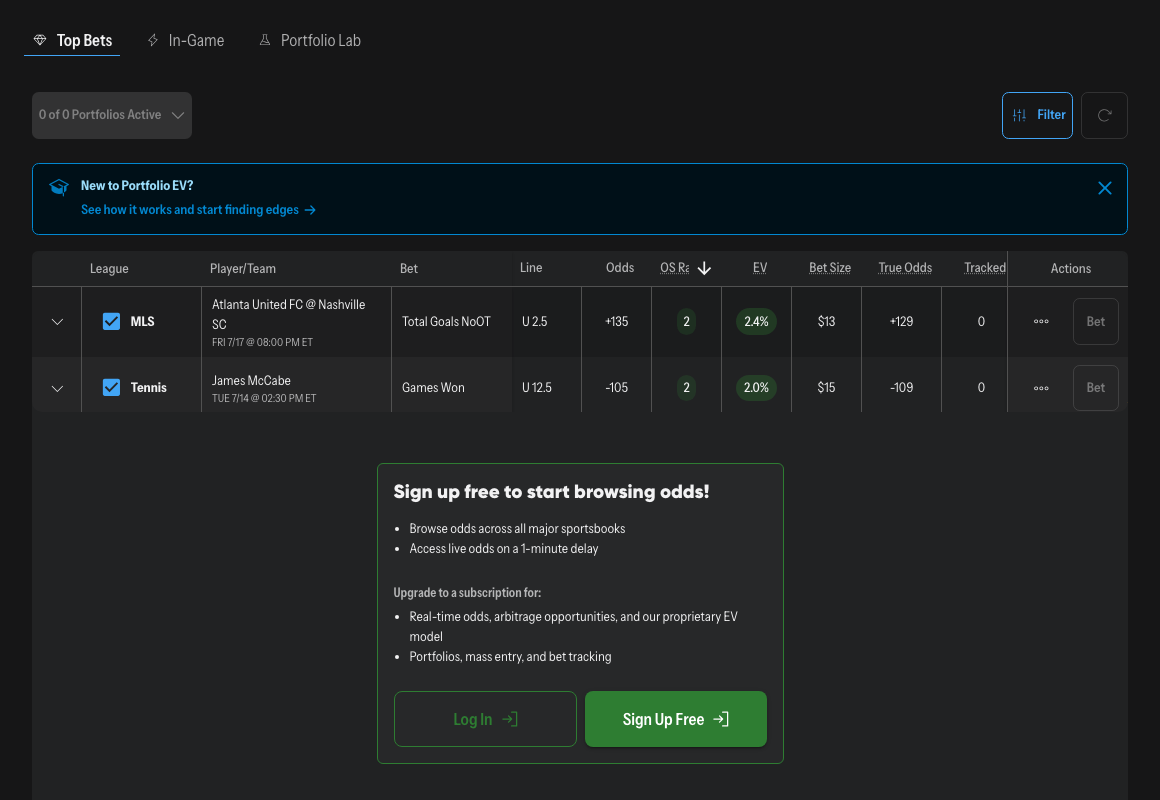
OddsShopper's +EV betting tool: every market priced against the de-vigged fair number, the same benchmark this article applies to pick'em boards.
- Injury And Rotation News. A star ruled out an hour before tip pushes usage to the second option, and every affected number on the board follows. This is the biggest single mover in the NBA.
- Confirmed Starters. MLB boards move when lineups post. A hitter dropping from second to sixth in the order loses real plate appearances, and his projection loses with them.
- Weather, Where The Sport Cares. Wind at an MLB park or in an NFL December game moves totals-shaped numbers, home runs and passing yards first.
- Where The Action Is Landing. If entries pile heavily onto one side of a square, the operator has the same incentive a sportsbook does to move the number toward balance. A one-sided number is risk on the operator's book, not yours.
Nothing on that list is scandalous. Pick'em operators price their product with a margin, exactly the way sportsbooks do, and moving numbers is how any pricing business manages risk. The point is not that something shady happened to your square. The point is that a "projection" responsive to news and money is a market price wearing a lab coat, and market prices can be shopped, compared, and beaten.
What Happens To The Entry You Already Submitted
As a general rule across pick'em apps, an entry is evaluated at the terms it was submitted with. If you took More 24.5 and the board later shows 26.5, your entry still needs 25 or more; the new number is for the next player who opens the app. The move changes what the square costs now, not what you already paid.
The meaningful exceptions are event-driven, not price-driven. When a player is scratched late, ruled out, or a market gets pulled, operators typically void or adjust that leg under their house rules, and those rules differ by operator, by sport, and by entry type, and they get revised. So treat the mechanics in this paragraph as how the category generally works, and treat your specific app's current help page as the authority on edge cases before you have real money on one. A wrong assumption about a void rule is an expensive way to learn where the fine print lives.
The practical takeaway is cleaner than the fine print: once you submit, the number you got is the number you own. Which means the question that matters shifts from "why did my number change" to "was the number I got a good one?" Answering that requires something the pick'em app will never show you: the rest of the market.
Why The Board's Number Doesn't Match The Sportsbook Line
Pull up the same player's points prop at a sportsbook and you will routinely find a different number than the pick'em board, a half point or a full point apart. That gap is where the economics of the product live.
A sportsbook charges you through the odds: both sides of a 25.5 might cost -110, and that extra juice over a fair coin flip is the book's margin. A pick'em entry pays fixed multipliers instead, so the operator cannot charge through the odds on each leg. The margin has to live somewhere else, and it lives in two places: the payout table, which pays less than the true parlay odds of your legs, and the placement of the projection itself. A board number shaded a half point against the popular side is margin doing its job quietly.
That is why comparing the board to the sportsbook market is the whole skill. The sportsbook line, especially the consensus across many books, is the closest thing to the market's honest opinion of the player's night, and stripping the vig out of it gets you to a true probability with no margin in it at all. Once you have that, the board's number stops being mysterious:
- Board Number Is Worse Than The Market's (More 25.5 when books say 24.5): the gap is working against you. Passing costs nothing.
- Board Number Matches The De-Vigged Market: you are paying the payout table's margin with no compensation. This is most squares, most days.
- Board Number Lags The Market In Your Favor (More 24.5 when books have moved to 25.5 or 26.5): the gap is working for you, and this is the only class of square worth your attention.
And the fastest way squares fall into that third class is precisely the thing that sent you to this article: the numbers move, and they do not all move at the same speed.
A Moving Projection Is The Market Grading Your Pick
Here is the part almost nobody explains in a pick'em context. Sports bettors have a name for being on the right side of a moved number: beating the close. Closing line value is the idea that the final, most informed price is the best judge of your bet, better over a season than your win-loss record, because results are noisy and prices are not. A bettor who consistently takes 24.5 before it closes 26.5 is doing something real, whether or not tonight's box score cooperates.
The same grade applies to your pick'em card, and the moved projection is the market handing it to you:
| The Board After Your Entry | What it says about your pick |
|---|---|
| Moved Toward Your Side (You Took More 24.5, Board Now 26.5) | You got the better of the number. Over a large sample, this is the most reliable read there is on your process, because prices are far less noisy than results. |
| Moved Against Your Side (You Took More 24.5, Board Now 23.5) | The market says you paid too much. One entry is noise; a pattern is a verdict. |
| Did Not Move | No new information. The entry is graded by the margin math above, nothing else. |
The first row is the one worth sitting with, because it rewires how a night like that feels. Your More 24.5 can lose at 26.5 and still have been the right entry; the market itself said so by leaving your number behind. Flip it around and the uncomfortable version is just as true: a winning entry that the board moved against was a bad price that got bailed out. Grade yourself on the moves, not the sweat, and you are measuring the part of the process you control — which number you took — instead of the part you don't. Which raises the only question that actually pays: how do you get on the right side of the move before you submit?
How To Evaluate An Entry Before You Submit
You do it by never letting the board be your only source of a number. The routine is short and mechanical:
- Find the same prop at the sportsbooks and take the market's temperature. The consensus number, and especially the best available number, is your benchmark. This is ordinary line shopping, the same discipline sharp bettors apply to every market on the live odds screen, MLB moneylines included: shop one market's price across every major book before betting anything.
- Strip the vig to get a true probability. A book's -115/-105 is not a probability until you remove the margin.
- Compare that probability to your entry format's breakeven. A two-pick entry paying 3x total needs the pair to hit 33.3% of the time, which is about 57.7% per leg. Sixty seconds of arithmetic, with the free odds calculator handling the American-odds-to-probability step, tells you whether the square clears the bar.
Doing that by hand for a six-leg card is homework, and that homework is exactly what the OddsShopper Pick'em Entry Builder automates: it de-vigs the sportsbook market behind every PrizePicks, Underdog, and Sleeper square, grades each More/Less by expected value against the exact breakeven for your chosen format, and re-runs the math live as you add legs. The benchmark is the true price, not anyone's picks. It is the same de-vigging approach covered in how to beat the sportsbook, pointed at pick'em boards.
Stop guessing whether the board's number is fair. OddsShopper prices every pick'em square against the real market, free for 7 days, and code OS15 takes 15% off OS Pro after the trial.
A Worked Example: One Prop, Two Numbers, One Decision
Take the kind of gap you will see on any NBA night. A starting guard's points sit at More/Less 24.5 on the pick'em board. At the sportsbooks, the same prop has already moved: consensus books hang 25.5 at -110 on both sides, and the best available price on the Over is out at -105.
| Pick'em board | Sportsbook market | |
|---|---|---|
| The Number | 24.5 | 25.5 (best Over price -105) |
| What It Implies | Even payout structure, margin in the payout table | A -110/-110 two-way de-vigs to an even 50/50 on 25.5 |
| The Gap | A full point in your favor on the More | — |
Read the middle row twice. If the market's honest opinion is that 25.5 is a coin flip, then clearing 24.5, a full point lower, is meaningfully more likely than 50%. Here is the rule of thumb that turns the point into a probability: a scorer averaging in the mid-20s lands on any single points total roughly 4-5% of the time, so each point of line is worth about four to five points of win probability. That puts the More at 24.5 somewhere in the mid-50s. It is an approximation, but a replicable one, and it is the number the rest of this decision runs on. That gap runs squarely in your favor, the board lagging a market that has already moved. This square belongs on the shortlist.
Now finish the math, because a candidate square still has to clear the entry's breakeven. In a two-pick 3x-payout entry, each leg needs about 57.7%. A mid-50s leg is close but likely short on its own, so this square earns its place next to your strongest other leg, not next to another coin flip; in formats with lower per-leg breakevens, it can clear on its own, depending on the current payout table. That is the honest, slightly unglamorous answer to whether pick'em entries can be worth it: the favorable gap is what makes a square a candidate, and the format's breakeven decides whether the entry cashes that edge or hands it back. Both numbers took us two minutes to find, and neither one came from the board.
Pick'em Pricing FAQ
Do Projections Lock In When I Submit My Entry?
Generally, yes: later moves apply only to new entries, not yours. The exception worth understanding is the event-driven one. A typical shape: you take a starting pitcher's strikeouts More at 6.5, and an hour before first pitch he is scratched. Most apps respond by voiding that leg and re-grading your entry at the smaller size, a 4-pick becoming a 3-pick with a 3-pick payout table, rather than letting a dead leg ride. How your app handles the in-between cases, a player who starts but leaves after one batter, say, is exactly the fine print worth reading before it costs you, because those rules vary by operator and format and get revised.
Why Is The Number Different From The Sportsbook Line?
Because the two products charge you differently. A sportsbook prices its margin into the odds on each side. A pick'em app pays fixed multipliers, so its margin lives in the payout table and in where the projection is set. A gap between the board and the de-vigged sportsbook number is normal, and reading which direction the gap runs is the core skill of pick'em play.
Does A Moving Line Mean I Was Right?
A move toward your side means you got a better number than the market's final opinion, which is the strongest single-entry signal available that your process was right, win or lose. A move against you means the reverse. One move proves nothing; a season of moves in your favor is how sharp bettors actually measure themselves, and it works the same on pick'em boards.
What's The Difference Between Flex And Power Plays?
As pick'em formats generally work, a Power-style play needs every leg to hit and pays a larger multiplier; a Flex-style play pays on a sliding scale that tolerates a miss, one or, at larger entry sizes, two, in exchange for a smaller top payout. The practical difference is the per-leg breakeven your picks have to clear: a two-pick entry paying 3x demands about 57.7% per leg, while longer cards with miss tolerance can pull the per-leg bar down into the mid-50s. That spread is exactly why the mid-50s square from the worked example above is a pass in one format and playable in another. Exact tiers and multipliers vary by operator and entry size and get revised, so run the math against the app's current payout table, not a remembered one.
Is PrizePicks +EV?
The product, like any pick'em operator or sportsbook, is priced with a margin, so the average square is not. Individual squares can be, when the board's number lags the sportsbook market by enough to clear your format's breakeven, which is measurable, not a matter of opinion: de-vig the market, compare, and only submit when the math clears, at stakes your bankroll supports. That discipline is the entire difference between playing the board and paying it.
More on this: Oklahoma At Michigan: Why 5.5 Is A Number To Lay · Why Did My Bet Get Voided? (And When A Book Can Do It) · Why Is My Bet Still Not Graded? Settlement, Explained · Why Is My Sportsbook Withdrawal Pending? What It Means · Why Did My Sportsbook Limit My Account? What It Means
Read The Board Like A Price
That moved projection that sent you here was never a glitch, and it was not aimed at you. It was a price doing what prices do, and it handed you the two habits this whole article reduces to. Never judge a square by the board alone; judge it against the de-vigged sportsbook market, the way we walked the 24.5 against the market's 25.5. And after you submit, grade yourself by which way the number moves, not by which way the sweat goes. Those two habits turn a moved number from something that happens to you into something you can read.
OddsShopper exists to make the first habit take seconds instead of minutes: every square on the PrizePicks, Underdog, and Sleeper boards, priced against the true market number, graded against your format's real breakeven. Try it free for 7 days, and code OS15 takes 15% off OS Pro if you stay.
21+ only. Sports betting and pick'em contests are legal only in regulated U.S. markets where available. Nothing here promises a financial outcome; play within a bankroll you can afford, and if it stops being fun, call 1-800-GAMBLER.