The game ended 40 minutes ago. You watched your player clear the number with your own eyes, the box score agrees with you, and the ticket still says pending. So you are asking the question every bettor eventually types into a search bar at midnight: why is my bet still not graded? The suspicion underneath it is always the same, that the book saw a winner and is sitting on it. I can save you the anxiety: grading is a data process, not a judgment call, and the wait almost always lives in one specific gap I will show you. By the end of this piece you will know the five ordinary reasons books hold a ticket, the exact order to check things in, and the one prop scenario where a bet you already "won" on TV flips overnight.
The Quick Answer
Your bet is still not graded because your sportsbook settles from an official league data feed, not from the broadcast or the box score you are looking at, and that feed publishes final, corrected numbers minutes to hours after a game visibly ends. Player props wait longest because official stat corrections can still change the outcome, and a parlay stays open until its slowest leg settles. The overwhelming majority of pending bets grade on their own with no action needed from you.
While you wait, it is worth knowing the reason sharp bettors hold accounts at several books has nothing to do with settlement speed: the same market is priced differently at different books, and OddsShopper's Odds Screen finds the best number for you. It is free for 7 days, and code OS15 takes 15% off OS Pro after the trial.
Below: the five ordinary causes ranked by how common they are, a realistic stat-correction case that flips a rebounds prop from a winner to a loser, and the four-step sequence to run before you ever contact support.
What Grading Actually Means (And Why It Is Not Instant)
A sportsbook does not settle bets by watching the game. It settles them by matching every open market against an official data feed, the league-sanctioned record of what happened, delivered through licensed stats providers. That distinction is the whole article. The broadcast ends when the clock hits zero; the official record is final only when the league's scorers have reviewed and published it. Your wait lives in that gap.
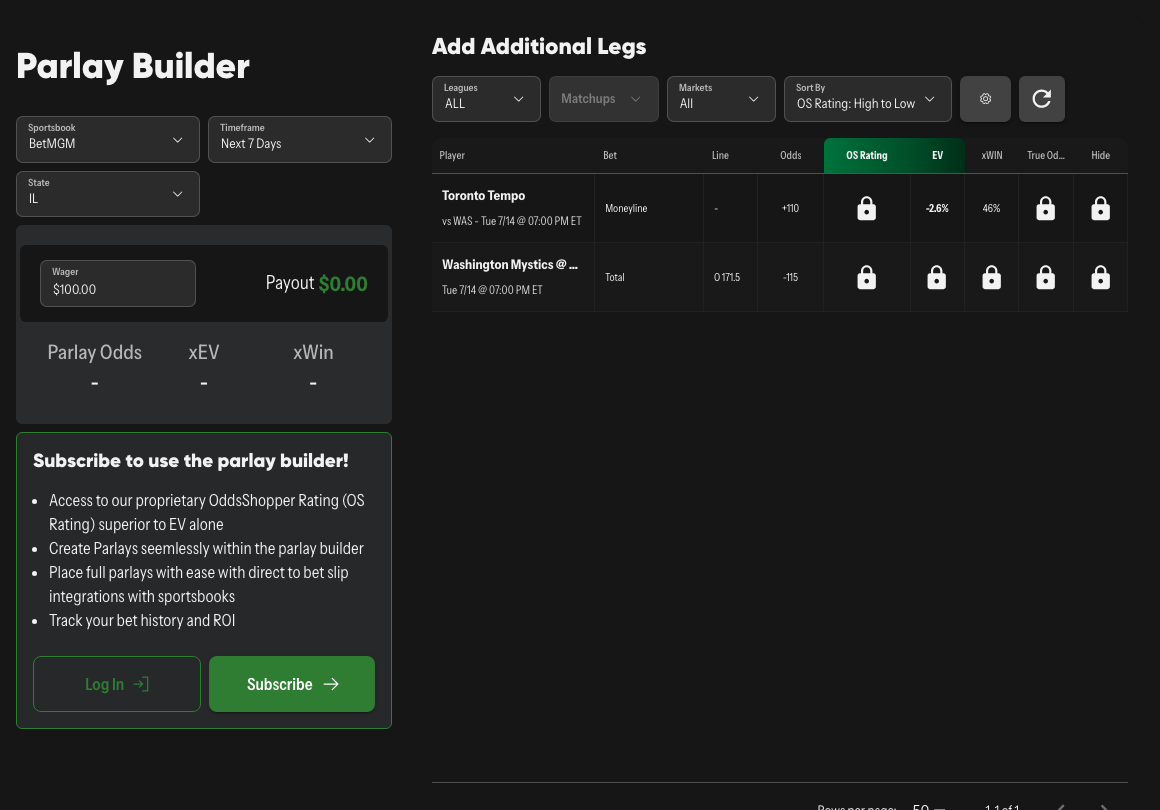
The OddsShopper Parlay Builder.
The pipeline looks like this:
- The game ends on your screen. Your ticket still says pending, correctly.
- The league publishes official final stats through its data feed. This can take minutes for a clean final score and hours for stat-level detail, because scorers review plays before the numbers become official.
- The book's settlement engine matches outcomes to markets and grades them in bulk. Straightforward markets, like a moneyline with a clean final, grade fast.
- Anything the engine cannot grade cleanly gets flagged for a human: an ambiguous market, a suspended game, a stat still under review.
Notice what is not in the pipeline: anyone deciding whether to pay you. A regulated book is required to pay every graded winner; the delay is upstream of the book, in the official record itself. That framing matters, because each of the ordinary causes below is just one of these pipeline stages running slow.
The Five Ordinary Reasons Your Bet Is Still Pending
Ranked by how often each one is the actual answer:
| Cause | What is happening | Which bets it hits |
|---|---|---|
| Official Stat Corrections | League scorers are still reviewing plays; the feed has not published a final stat line | Player props, especially rebounds, assists, tackles, receptions |
| Market Awaits Official Confirmation | The market's rules require the official result, not the apparent one | Race and tournament finishes, awards, anything subject to review |
| Game Delayed Or Suspended | The event is not officially final, so nothing on it can grade | Every market on that game |
| Parlay Waiting On Its Slowest Leg | The ticket grades only when the last leg does | Parlays, same-game parlays, teasers |
| Manual Review | The book's engine flagged the market for a human to grade | Obscure props, markets with unusual rule edges |
The top row deserves the emphasis, because it is the one nobody explains. A moneyline needs one number to grade: the final score. A rebounds prop needs a specific stat line to be official, and stat lines are exactly what leagues keep reviewing after the game ends. That is why your spread bet from the same game settled an hour ago while your prop is still hanging, and it is why props get their own section.
Player Props And The Stat-Correction Wait
The NBA and NFL both formally review stats after every game, and corrections are routine: a rebound credited to the wrong player in a scramble, an assist upgraded or removed on review, a tackle reassigned between defenders. Most corrections change nothing you bet on. But when your prop sits exactly at the number under review, the book has two options: grade fast from the preliminary box score and risk re-grading later, or hold the market until the official line publishes. Different books make different choices, which is why the same prop can be settled at one book and pending at another, on the same play, at the same moment.
Here is the shape of the case that fills betting forums every week.
A Worked Example: One Rebound, Two Different Grades
You put $50 on a center's over 9.5 rebounds at -110, a price that needs to win 52.4% of the time just to break even. The broadcast box score credits him 10 boards, so at the final buzzer you are counting your $45.45 profit.
| Time | What the record says | What your ticket says |
|---|---|---|
| 10:45 PM, Game Final | Broadcast box: 10 rebounds | Pending |
| 11:30 PM | Official feed publishes preliminary stats: 10 rebounds | Still pending at your book |
| Next Morning | League stat review reassigns one scramble rebound to a teammate: official line, 9 rebounds | Graded a loss |
That tenth rebound was never officially his; the broadcast just got to press before the scorers did. A book that held the market pending overnight was not stalling on your payout. It was waiting to find out the same thing you were, and in this case the wait saved it from grading a loser as a winner. Reverse the direction, a rebound added on review, and the same mechanism flips a losing ticket into a paid one the next morning. This is the single most common reason a prop hangs overnight, and it is worth remembering when we get to the question of whether a graded bet can ever be reversed.
Why Your Parlay Is Still Open
A parlay is one ticket with several dependencies, and it grades exactly once: when its final leg does. Six legs can be settled winners with the seventh still pending, and the ticket will correctly show open the whole time. Given what you now know about props, the practical corollary is obvious: a parlay carrying a player prop inherits the prop's stat-correction wait, so prop-heavy tickets are structurally the slowest bets you can hold.
Two more parlay-specific mechanics are worth knowing:
- A Voided Leg Triggers A Recalculation, Not A Loss. If one leg voids, say a postponed game, the book removes that leg and reprices the ticket at the remaining legs' odds. The recalculation itself can add settlement time.
- Long-Open Is Normal. A ticket sitting open long after most legs settled is the design working, not a malfunction.
If you build parlays regularly, this dependency logic is the same reason ticket construction matters more than leg count: the Parlay Builder assembles tickets from legs the market has priced in your favor, which is a better starting point than chaining favorites together and hoping the last leg hurries up.
What To Do When Your Bet Will Not Settle
Run these in order. Each step rules out everything above it.
- Confirm the event is officially final, not just over. Check the league's own site. A suspended, delayed, or under-review game is not final, and nothing on it will grade until it is.
- Check whether your market involves a correctable stat. If you are on a prop in a stat category that leagues review, the overnight wait you are experiencing is the system described above, not an error.
- Wait out the book's stated settlement window. Every major book publishes house rules with a settlement timeframe; DraftKings and FanDuel, for example, both keep theirs on public house-rules pages. Find yours in the help section and let it run before escalating.
- Contact support with the bet ID. The bet ID is on the ticket detail screen. A support agent can locate and escalate a specific wager in one step; a "my bet isn't settled" message without it cannot.
The order matters because support can only fix the rare cases. Steps one through three cover the common ones, and they resolve themselves.
When A Pending Bet Is Actually A Problem
Honest expectation-setting: the overwhelming majority of ungraded bets are procedural and settle without anyone touching them. A pending ticket becomes worth real escalation when all three of these are true: the event has been officially final for days, the book's own stated settlement window has clearly lapsed, and support has been contacted with the bet ID and has not resolved it. At that point, use the book's formal complaint process, and in regulated U.S. markets you also have the state gaming regulator behind it. Regulated books operate under license conditions that require honoring graded wagers, which is exactly why the slow-settlement horror stories that do circulate overwhelmingly involve unregulated offshore sites instead.
There is also a portfolio answer to settlement risk, and it is the one thing in this article you can act on today. A bettor with one account experiences every one of that book's waits; a bettor spread across several books, at stakes a bankroll supports, barely notices any single one of them. But the real reason to hold several accounts was never settlement speed; it is that different books hang different prices on the same market, and taking the best available number is how a bettor actually beats the sportsbook over time. OddsShopper's Odds Screen lines up live prices across 100+ sportsbooks and grades each one against the no-vig fair price, the market's implied fair number with the book's margin stripped out. The benchmark is the true price, not anyone's picks, and the number you take before the game is the part of this you control; everything after the final whistle belongs to the feed. And if a book ever hands you a bonus bet as a goodwill gesture for a real settlement error, do not burn it on a heavy favorite, where most of its value evaporates: the free bet converter shows how longer-odds spots turn it into the most expected value.
Stop leaving the better number on the table while you wait on the official feed. OddsShopper finds the best price across every book for you, free for 7 days, and code OS15 takes 15% off OS Pro after the trial.
Bet Settlement FAQ
How Long Should It Take For A Bet To Settle?
The published settlement window in your book's house rules is the only timeline that matters, not a forum anecdote. Expect the extremes to differ by market type: a moneyline on a clean final is among the fastest grades a book issues, while a prop tied to a reviewable stat, or a market that needs an official declared result, sits at the slow end.
Can A Graded Bet Be Reversed?
Yes, in narrow cases. House rules at major books reserve the right to re-settle a market when the official record changes, which is the stat-correction mechanism from the worked example above, or when a market was graded on an obvious error. It is uncommon, it runs in both directions, and it is the reason some books hold prop markets pending rather than grading fast from a preliminary box score.
Why Is My Parlay Still Open After Most Legs Won?
Because a parlay grades only when its last leg does. Settled winning legs do not partially pay; the ticket is one wager. If a leg voids, the book recalculates the ticket at the remaining odds, which can add time. An open parlay with one pending leg is behaving exactly as designed.
Does A Delayed Or Suspended Game Void My Bet?
Not automatically. Books apply their house rules, which typically give a game a window to reach an official result before markets void and stakes return. Until the book marks the event final or void, bets on it stay pending. The house-rules page at your book is the authority for its exact treatment.
Should I Worry That The Book Will Not Pay A Winning Bet?
Pending is a data state, not a solvency question: licensed U.S. books are required under their license conditions to pay graded winners, with the state regulator behind that requirement. Note that a graded win landing in your balance is also a different process from withdrawing that balance, which runs on its own rails with its own causes for delay.
More on this: Why You're Not Winning At Sports Betting (Fix It Free) · The Forecast Is Not The Price On A Kalshi Weather Market · Kalshi Weather Trading: '100 In Phoenix' Isn't A Trade · Three Guys Not Named Scottie: The Kalshi Edge At Bellerive · Why Byron Donalds (R) Will Win The Florida Governor Primary
The Feed Always Publishes
That ticket you are staring at is not a negotiation. Somewhere between the arena and your app, a league scorer is finishing the official record, and the moment it publishes, your bet grades the way it was always going to. The wait is the system being careful with the same numbers your money rides on. Now you know exactly where in the pipeline your particular wait lives, and the four steps to run on the rare occasion it truly stalls. What the wait should really teach you is that everything after the final whistle is out of your hands, so the edge has to come before it: the price you take when you place the bet. OddsShopper exists for exactly that job, lining up every book's price on one screen and grading each against the no-vig fair number, so the next ticket you sweat is one the market paid you properly to hold. Try it free for 7 days, and code OS15 takes 15% off OS Pro if you stay.
21+ only. Sports betting is legal only in regulated U.S. markets where available. Nothing here is legal or financial advice, and nothing promises an outcome; bet within a bankroll you can afford, and if it stops being fun, call 1-800-GAMBLER.