If you keep asking why you're not winning at sports betting even though you cash more bets than you lose, the answer is usually boring and free. I sat in that exact spot for a long time before I worked out that it almost always comes down to two quiet leaks, and neither one costs a dollar to plug. So when people ask me how to win at sports betting, I don't point them at a magic system — I point them here. No "lock of the week" package is going to fix it either, so save your money there. The fixes are unglamorous, they are free, and over a full season they decide how much of your edge you actually keep.
In Summary
If you are betting more winners than losers but your bankroll is stuck, the culprit is usually one of two habits you can fix for free:
- You Take The Worse Price. The same bet is rarely the same number across sportsbooks, and most people just fire at whatever app their money sits in. Paying a worse price on every bet quietly hands your edge back to the book.
- You Force Overs. Overs are fun, so most bettors lean on them, and books know it. They shade extra juice onto the over. Always backing the over means you are not actually hunting the best available bet.
Plug both and you are not handicapping any better. You are simply giving away less of what your picks are already worth. The rest of this guide shows the math, then the tools that do both fixes for you.
Watch: The 2 Free Fixes
Here is the original breakdown if you would rather watch it: Watch on YouTube. The article below expands on the same two fixes, with the worked numbers laid out in full.
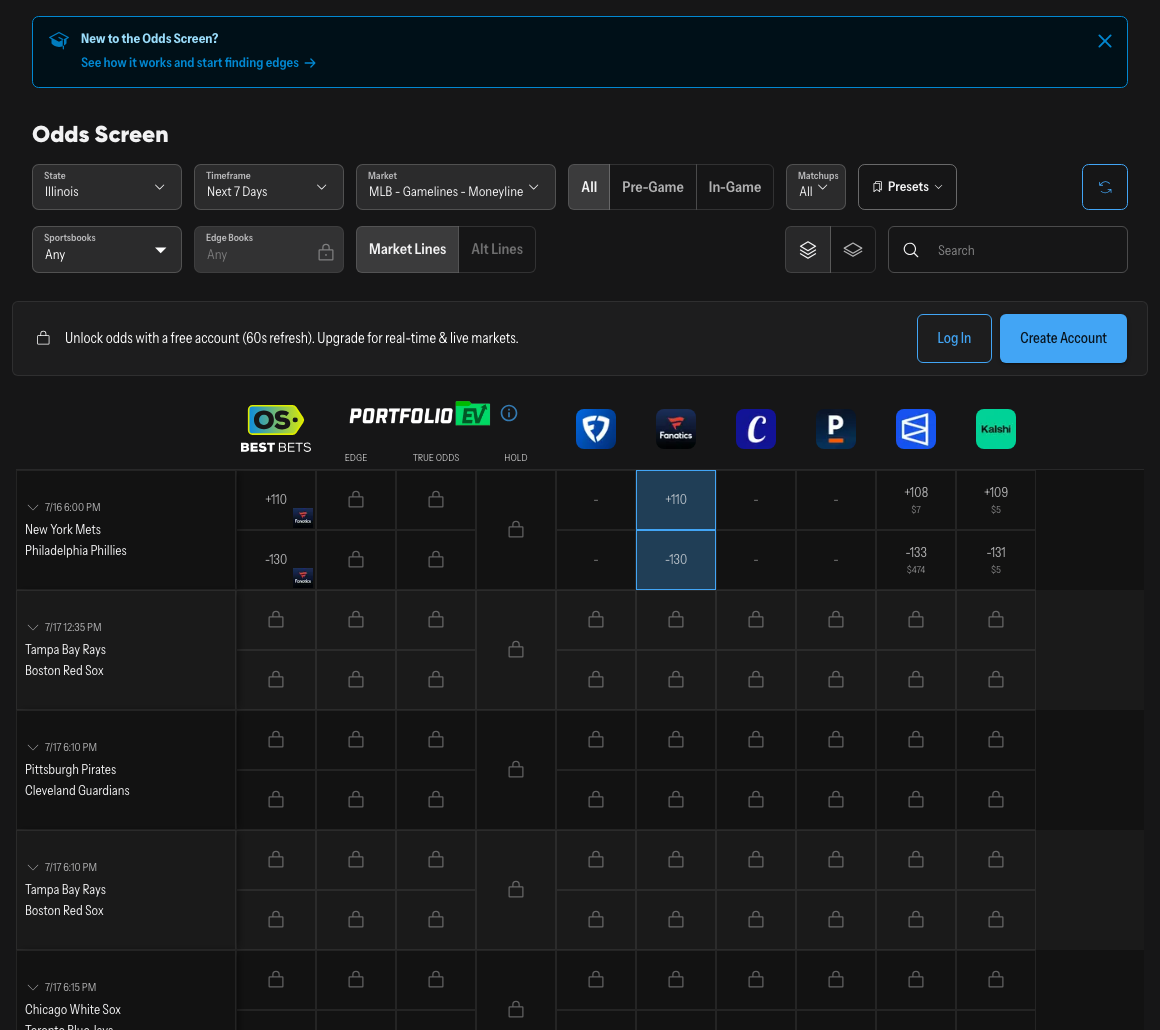
The OddsShopper odds screen lines up the same bet across every major book at once — the row that matters is the best available price, because that difference is money you keep before the game even starts.
Fix #1: Stop Taking The Worse Price
Every sportsbook prices the same game a little differently. DraftKings, FanDuel, BetMGM, and Caesars all run different models, carry different exposure, and react to bets at different speeds. So the same player prop or moneyline can be a noticeably different number at three apps you already have open, all at the same moment, for the identical bet.
As a hypothetical, say you like Joel Embiid over 33.5 points. Here is how the same over could look across two books:
| Sportsbook | Price on the same Embiid over | Risk to win $100 |
|---|---|---|
| Book A | -135 | $135 |
| Book B | -115 | $115 |
Remember, that is one bet, not two. Those are two prices for the same wager, and you get to choose which one you pay. Fire it at Book A and you risk $135 to win $100. Take the exact same over at Book B and you risk $115 for the same $100. You did not get sharper. You just refused the worse number, and risked $20 less to win the same $100 on a single bet. That habit is line shopping, and it is one of the simplest edges to capture, because it never asks you to be right more often. This is what line shopping sports betting really means: not a hotter opinion, just a better price on the opinion you already have. (If you bet football, our NFL odds comparison guide shows how far the same spread or prop drifts between books on a given Sunday.)
Why A Few Cents On The Price Adds Up
One bet, $20 of saved risk feels small. Run it across a hundred bets, or a full season of them, and if you consistently grab the best number instead of an average one, that gap compounds into real money off the identical picks. The books care about it for the same reason in reverse: every time you accept the worse price, win or lose the bet, you are handing them margin you never had to give up. (A related but separate signal worth learning: our closing line value guide shows how beating the number the market closes at — not just grabbing the best price now — is one of the strongest long-run signs you are betting well.)
Fix #2: Stop Forcing The Over
Be honest about how often you bet overs. Half the time? Seventy percent? Every single time? It is an easy trap, because the over is the fun side. You want to sweat a player going off, you want the game to hit 60 points instead of 15, you want your guy to do well. That is a great way to enjoy a Tuesday. It also happens to be a poor way to grow a bankroll.
Books know overs are the popular side, so they tend to shade more vig onto them. Lean on overs by default and you are paying a worse price and ignoring half the board. The fix is not to fall in love with unders instead. Stop caring which side it is, and only take the bet that is actually priced in your favor.
When OddsShopper looked at the bets its tool recommended across its 2023 NBA and NFL sample, a clear pattern showed up: far more of the +EV bets were unders than overs. In the NBA the over and under ROIs came out similar, yet the tool still flagged far more unders; in the NFL the skew was even more lopsided, with unders recommended at a far higher clip. The point is not to blindly bet unders. It is that the crowd piles onto overs, so the books shade them, and the value more often hides on the quieter side.
If you only ever bet overs, you are walking past every one of those spots. The whole betting overs vs unders argument misses the real point: it was never about which label you prefer, only about which price beats its true odds. The bettor who weighs both sides and takes whichever one is mispriced is the one putting the odds on their side. (If totals are new to you, start with our over/under betting guide; for football specifically, our NFL totals betting guide digs into why those over shades show up week after week.)
What "Making The Best Bet" Actually Means
Both fixes are really the same idea: take the bet whose price beats its true odds. That is what +EV, or positive expected value, means, and it is the whole foundation of positive EV betting — the math is simpler than it sounds.
A Quick Worked Example
Every American price implies a probability. Here is the gap that matters:
| Price | Implied chance to win |
|---|---|
| +120 (What The Book Offers) | about 45% |
| +105 (The True Odds) | about 49% |
If a book offers you +120 on something whose true odds are closer to +105, you are being paid as if it only hits 45% of the time when it really hits about 49%. That 4-point gap is your edge. Take that price every time it appears and the long-run expectation tilts in your favor, regardless of how any single bet lands. (Our +EV betting guide walks through finding these spots step by step.)
The whole game in one line: bet the side whose price is better than its true odds, and shop for that price across books. Over/under, favorite, or dog, the label never matters. The gap between the number you got and the number you should have gotten is the only thing that does.
This is also why the giant parlay screenshots on social media are not a model to copy. The people posting an $80,000 longshot hit are usually allowed to keep firing — what's called being reverse-limited: the book lets them bet freely precisely because their long-run record costs it nothing. Bettors who actually win consistently get limited fast. The quiet, repeatable edge is not the lottery ticket. It is taking the better price, on the better side, again and again.
How OddsShopper Does Both Fixes For You
The leak usually opens at bet time: you like the side, you see a playable number, and you skip the 30-second check that tells you whether another book is paying more. Doing that check by hand on every bet — five apps for the best number, then estimating whether the price beats the true odds — is a lot of work before kickoff. That is the entire reason our live odds screen — shop the number across every major book — and Portfolio EV tool exist. The odds screen lines up the same bet across the market at once and points you at the best available number, so the line-shopping fix is one glance. Portfolio EV calculates the true odds and flags the bets priced in your favor, so the "take the value, whatever side it is on" fix is handled too. Instead of you eyeballing five tabs, the tool surfaces the exact bets whose price beats their true odds and puts the best number on each one in front of you. It is the same two jobs from this article, done in seconds instead of across a stack of browser tabs.
New to OddsShopper? It scans the sportsbook market in real time, flags the bets priced in your favor, and shows you the best number on each one, the exact two fixes this article is about, done automatically. You can try it free for 7 days, and code WINMORE20 takes 20% off your first payment of OS Pro or OS Core if you subscribe.
Neither fix is exciting. Neither one asks you to predict a single outcome better than you already do. They just stop the slow bleed that keeps a winning record from becoming a winning bankroll. Want to see what a priced-in-your-favor bet actually looks like tonight? Our free expert picks are posted daily at no cost. (And once these two fixes are habit, the next lever is sizing, and our bankroll management guide covers staking to your edge.)
FAQ
Why am I winning bets but still losing money? Usually because you are taking a slightly worse price on every bet and leaning on the popular side (overs). Both chip away at the edge your picks earn. Fixing them is free.
What is line shopping in sports betting? It is the habit of placing the exact same bet at whichever sportsbook offers the best price. The same wager can be -135 at one book and -115 at another, and you get to choose which one you pay.
Is it bad to always bet overs? It is not that overs lose, it is that always betting them means you never hunt the best available bet. Books also tend to shade extra juice onto overs because they are the crowd's favorite. Take whichever side is actually priced in your favor.
Do I need accounts at multiple sportsbooks? To capture line shopping, yes. No single book is consistently the best price, so having accounts at several legal sportsbooks gives you more chances to find the best available number on any given bet — and a tool that compares them all is how you grab it every time without checking each app by hand.
What does +EV mean? Positive expected value: a bet whose price pays you more than its true odds suggest it should. Take +EV bets consistently and the math is on your side over a large sample, even though plenty of them lose along the way.
The Bottom Line
You do not need a secret system or a paid picks package to start betting at better prices. You need to refuse the worse price and stop forcing the fun side. Build those two free habits and your existing picks start keeping more money on their own.
If you would rather not chase it across five apps every night, that is what OddsShopper is for: it finds the best number and the bets priced in your favor automatically. Stop leaving the better number on the table. Try it free for 7 days, then code WINMORE20 takes 20% off your first payment of OS Pro or OS Core.
Betting carries risk, outcomes are never certain, and this is for entertainment in regulated U.S. markets where betting is legal. Always bet within your means. 21+.
More on this: NBA Championship Odds: Why The 76ers Are Only An 11 Percent Team · Why Is My Bet Still Not Graded? Settlement, Explained · Why Did My Sportsbook Limit My Account? What It Means · I Asked Three AIs for Tonight’s Best MNF Props · Oklahoma Should Win And Cover 5.5 At Michigan