What are Polymarket's fees? As of August 18, 2026, Polymarket US charges a taker fee that moves with the contract price and maxes out at $1.50 per 100 contracts at a 50-cent price, pays a maker rebate on resting orders, and charges nothing on settlement; the second cost, which never appears on a schedule, is the spread between bid and ask. The full formula, the rebate, and how to see the spread cost before you trade are below.
Most people searching for Polymarket fees want a single number, and Polymarket does not have one. What it has is a fee that moves with the price of the contract you are trading, plus a second cost that never appears on any schedule at all. Learn to see both and you can answer the only question that matters: for the specific market in front of you, what is this position really costing you before it can even pay off?
One note before the math, because it frames everything below. Polymarket US operates through CFTC-regulated entities as a designated exchange for event contracts, and it prices those contracts rather than posting a line against you. That distinction is why the cost shows up as a visible trading fee instead of margin hidden inside a price. And be precise about which Polymarket this is: the US app is the fiat, US-dollar product, and the fee schedule here is the US schedule. The international crypto product runs on different rails and different terms. Nothing here is a promise of profit, and trading involves real risk, including the loss of your entire position.
Two things to watch as the numbers unfold: the contract that costs the most to trade is the 50-cent coin flip, not the longshot or the near-certainty, and the spread between the buy price and the sell price can quietly cost you more than the fee ever will.
In Summary
- The Fee Is A Formula, Not A Flat Rate. Polymarket US's published schedule charges a taker fee of
0.06 × C × p × (1 - p), where C is your contract count and p is the price in dollars. It peaks at a 50-cent contract and shrinks toward both ends of the board. - The Ceiling Is $1.50 Per 100 Contracts, reached at a 50-cent price. At 90 cents the same 100 contracts cost 54 cents.
- Makers Get Paid. Rest an order on the book instead of taking one off it and Polymarket applies a maker rebate of
0.0125 × C × p × (1 - p), up to about 31 cents back per 100 contracts at a 50-cent price. - The Spread Is The Hidden Cost. In a thin market the gap between the buy and sell price can be several cents wide, which is a larger drag on a round trip than the trading fee itself.
- No Settlement, Deposit, Or Withdrawal Fee Is Listed. The published schedule charges you to trade, not to fund, hold, or get paid. Payment processors or your bank may still apply their own charges.
- Fees Round To The Nearest Cent Using Banker's Rounding, so a single longshot contract does not carry the round-up penalty some exchanges impose.
- Where OddsShopper Fits: our free EV calculator works in the same currency as a contract price, so you can turn "I think this is really 60%" and "the ask is 55 cents" into an actual expected-value number before you commit.
Verify before you trade.Polymarket revises its schedule periodically, so here is exactly how current these numbers are. The 0.06 taker and 0.0125 maker coefficients, the $1.50 per-100 ceiling, and the banker's-rounding rule are taken from Polymarket US's published fee schedule effective July 1, 2026, re-verified as the version still in force as of our August 18, 2026 check. Treat any fee figure you read anywhere, including here, as a snapshot, and confirm the current Polymarket fee schedule in the app before you fund an account.
Stay ahead of the markets.
Daily insights and expert picks on Kalshi, Polymarket, and what's moving markets.
Free forever. Unsubscribe anytime.
How Polymarket's Trading Fee Works
Every Polymarket contract resolves to either $1.00 or $0.00. It trades somewhere between 1 cent and 99 cents in the meantime, and that price reads straight as a probability. A contract at 30 cents is the market saying the outcome is roughly 30% likely.
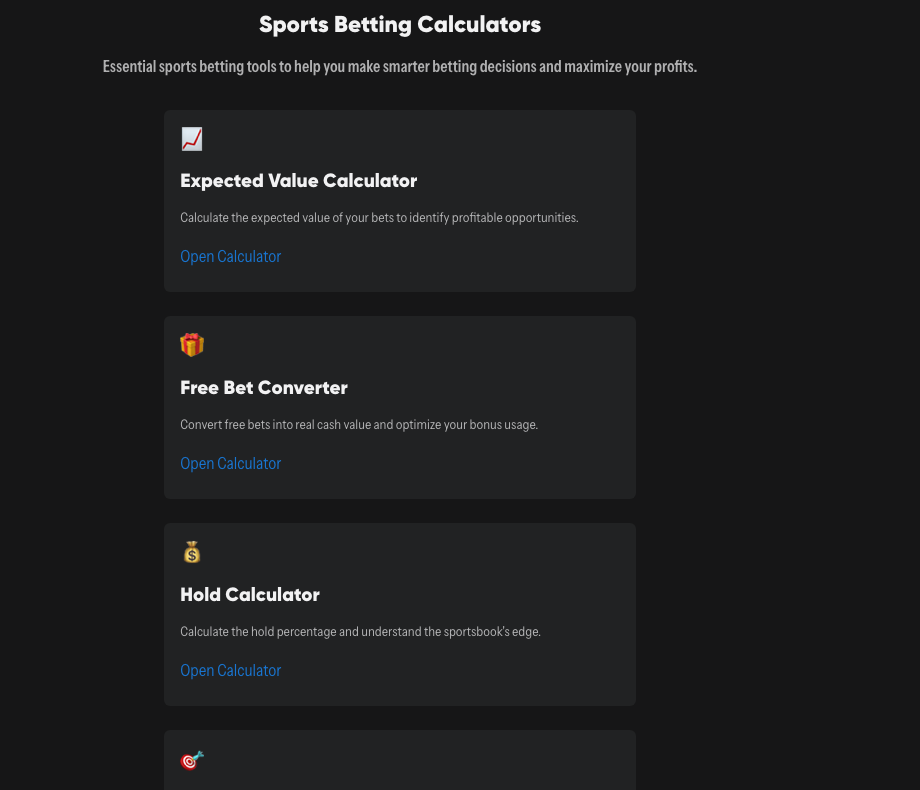
The OddsShopper Betting Calculators.
The fee is charged as a slice of the uncertainty in that price rather than a flat cut of your stake. Per Polymarket US's published schedule, a taker order costs:
fee = 0.06 × C × p × (1 - p)
Where C is the number of contracts and p is the price in dollars, so 50 cents is 0.50. Fees round to the nearest cent using banker's rounding, which rounds a value sitting exactly halfway to the nearest even cent.
The engine of that formula is the p × (1 - p) term, which is uncertainty itself. That term peaks at a 50-cent price, where it equals 0.25, and it shrinks toward zero as the price approaches either 1 cent or 99 cents. Polymarket charges you the most when the market is least sure, and almost nothing when the market has essentially made up its mind.
So the maximum taker fee on 100 contracts is 0.06 × 100 × 0.25, which is $1.50. On the $50.00 those 50-cent contracts cost, that is a 3% toll, and it is the worst case: Polymarket trading fees only get lighter from there as the price moves off 50 cents. Hold onto that $1.50. It ends up being the single most useful figure on the platform, and it comes back when we get to the spread.
The Fee Curve: Why The Coin Flip Costs The Most
That formula produces the following across the board.
| Contract Price | Taker fee on 1 contract | Cost of 100 contracts | Taker fee on 100 contracts |
|---|---|---|---|
| $0.01 | $0.00 | $1.00 | $0.06 |
| $0.10 | $0.01 | $10.00 | $0.54 |
| $0.25 | $0.01 | $25.00 | $1.12 |
| $0.40 | $0.01 | $40.00 | $1.44 |
| $0.50 | $0.02 | $50.00 | $1.50 |
| $0.60 | $0.01 | $60.00 | $1.44 |
| $0.75 | $0.01 | $75.00 | $1.12 |
| $0.90 | $0.01 | $90.00 | $0.54 |
| $0.99 | $0.00 | $99.00 | $0.06 |
The 50-cent row is the ceiling everybody quotes. The row worth staring at is the very first one. A single 1-cent contract carries a fee that rounds to zero, because the raw charge is under a tenth of a cent, far closer to $0.00 than to $0.01 under Polymarket's round-to-the-nearest-cent rule. The banker's part of the rounding only decides exact halfway cases, like the $0.015 fee on one 50-cent contract, which rounds to the even $0.02. This is a quiet advantage at the longshot end of the board: on some exchanges a 1-cent contract carries a 1-cent fee that doubles your outlay before the event starts, and Polymarket's rounding rule spares you that. Our companion breakdown of Kalshi fees walks through the round-up version of the same idea, which is the opposite trade-off.
The practical lesson is the same one every trader gets backwards: the coin flip is expensive and the longshot is cheap in fee terms, which is the reverse of how the prices feel. Size still matters more than price, but Polymarket's rounding means the cheap end of the board stays cheap in practice rather than turning punitive on small orders.
Maker Vs. Taker: When Polymarket Pays You
The formula above applies to a taker order, one that fills immediately against something already resting on the book. You are removing liquidity, and you pay for it.
Rest an order instead, at a price nobody has hit yet, and you become the maker. Polymarket does not just waive the fee here, it pays a rebate:
maker rebate = 0.0125 × C × p × (1 - p)
At a 50-cent price on 100 contracts, that rebate is 0.0125 × 100 × 0.25, or about 31 cents back, applied at the moment your order fills. So the same coin-flip position that costs a taker $1.50 in fees pays a maker roughly 31 cents. That is a swing of more than a dollar and a half on 100 contracts, driven by nothing but which side of the order book you sat on.
Patience is the discount here, with one honest asterisk: a resting order might never fill. In a thin market that means watching the price drift away from you while your order sits, which is a real cost even though it never prints on a statement. Traders who chase volume also earn taker-fee rebates once monthly volume clears defined tiers: 10% back from $250,000 in prior-month volume, 25% from $1 million, and 50% from $10 million. Those thresholds are not something a casual trader will touch, but they explain why the biggest accounts trade the same markets at a materially lower cost.
The Hidden Cost: The Spread
Now the cost the schedule never mentions, and on many markets the biggest one you will pay.
A contract does not have a single price. It has a highest price someone will pay for it, the bid, and a lowest price someone will sell it for, the ask. The gap between them is the spread, and when you take a position at the ask and later sell it at the bid, that gap is money you have handed to the market, on top of any trading fee.
Call back to that $1.50 ceiling. On a deep, liquid market the spread might be a single cent, smaller than the fee. On a thin one it can be five cents or more, which on 100 contracts is $5.00 of cost against a fee that never exceeds $1.50. The fee is the number Polymarket prints. The spread is the number the order book decides, and it is why liquidity, not the fee schedule, is usually the real question. A cheap fee on a wide spread is still an expensive position.
The point where this bites hardest is any trade you plan to exit early rather than hold to resolution. Hold to the end and you cross the spread once, on the way in. Trade in and out and you pay it twice, plus the taker fee on each leg. The math rewards conviction and punishes churn.
Rule of thumb before any ordercheck the gap between the bid and the ask before you look at the fee. If the spread is wider than about a cent and a half per contract, it is already a bigger cost than the worst-case trading fee, and a thin book should shrink your size before any formula does.
Worked Example: Your Fee-Adjusted Breakeven
The numbers below are illustrative, chosen to show the mechanics on a clean 50-cent market. Real prices move.
The price of a contract is already a probability, so the useful question is what the fee does to the probability you actually need to break even. Take a 50-cent market and buy 100 contracts as a taker.
| Order Type At $0.50 | Cost per $100 of payout | Breakeven probability |
|---|---|---|
| Taker | $51.50 | 51.5% |
| Maker (Rebate Applied) | $49.69 | 49.69% |
The taker row is straightforward: $50.00 for the contracts plus the $1.50 maximum fee is $51.50 of outlay against a $100 payout, so you need the outcome to hit 51.5% of the time to break even, against a price that says 50%. The fee added 1.5 points to your breakeven.
The maker row is the one worth sitting with. Rest the same order, collect the 31-cent rebate, and your outlay drops to $49.69, which is a breakeven below the 50% the price implies. The rebate does not just erase the cost of trading, it pays you to provide the liquidity, so your breakeven is better than the headline number on the screen. That only holds if your resting order fills, and if the spread has not already moved against you, which loops back to why liquidity is the whole game.
None of this tells you whether the price itself is right, and that is the part no fee schedule can answer. This is where our own math is useful, and the boundary matters: Polymarket is a prediction market, our tools are a separate utility we build, and what carries between them is only the arithmetic. Feed our free EV calculator the price and your own estimate of the probability, and it returns the expected value of the position. That 50-cent contract you think is really a 58% outcome stops being a hunch and becomes a number, and the gap between your read and the market's is the entire reason to take a position at all. We hold our own prediction-market calls to the same arithmetic: every verdict we publish is graded against settlement on our public scoreboard.
Settlement, Deposits, And Withdrawals
Search "does Polymarket charge fees" and you are usually asking about more than trading. The honest answer sits in the schedule itself: Polymarket US's published fee schedule lists a taker fee and a maker rebate, and it does not specify a settlement fee, a deposit fee, or a withdrawal fee. When a market settles Yes, each Yes contract pays out its full $1.00 with no cut taken at resolution. Run that through the worked example above: the taker who paid $51.50 for 100 contracts at 50 cents collects the full $100.00 at settlement, because the only fee in the whole life of that position was the $1.50 charged on the way in. The $10 you deposit to unlock the sign-up offer works the same way, arriving as $10 of buying power with nothing shaved off by Polymarket. You are charged to trade, not to fund your account, hold a contract to resolution, or collect on a winner.
The caveat worth keeping is that "not listed on Polymarket's schedule" is not the same as "free everywhere in the chain." Your bank or a third-party payment processor can apply its own charges when money moves in or out, and those sit outside anything Polymarket controls or publishes. Confirm the funding and withdrawal terms in the app for your chosen method before you move size, because that is the one part of the cost picture the trading schedule does not cover.
The cost cheat sheet.Trading: a taker fee up to $1.50 per 100 contracts, or a maker rebate if you rest the order. Spread: whatever the order book is charging, often the biggest line item on a thin market. Funding, holding, and payouts: nothing on Polymarket's own schedule, though your bank or processor might. Price a position by adding the fee and the spread, then check whether your read still clears both.
Before You Trade: Eligibility And State Rules
Availability is the fastest-moving fact on this page, so treat any list as a snapshot. Polymarket US runs under CFTC regulation at the federal level as a designated exchange for event contracts, and state rules apply on top of that. As of our August 18, 2026 check, Polymarket is unavailable in Arizona, Illinois, Massachusetts, Maryland, Michigan, Montana, Nevada, and Ohio, each for its own reason, mostly state enforcement actions and active litigation over whether CFTC-regulated event contracts fall under state law at all. That roster can move in either direction on a court ruling, sometimes inside a single week.
Minnesota: confirm current status before you do anything.Minnesota passed a law, set to take effect August 1, 2026, targeting the companies that operate and advertise prediction-market platforms rather than individual traders. Days before that start date, on July 27, 2026, a federal court temporarily blocked the state from enforcing it, and that preliminary injunction still stands as of our August 18, 2026 check, so the platforms remain available to Minnesota residents while the case plays out. That is a preliminary ruling, not a final one, and it can change quickly. Get current local guidance rather than relying on this paragraph.
Notice what the state fight does not touch: the fee schedule. Because Polymarket US prices event contracts on a federally regulated exchange rather than under state-by-state licenses, the taker formula, the maker rebate, and the $1.50 ceiling are one national schedule — where you live decides whether you can trade, never what the trade costs. That is a structural difference from state-licensed sportsbooks, whose pricing and promotions shift at every border.
Check the app's own eligibility screen for your state, and confirm you meet the 18+ requirement, before you fund anything. For the wider view, our explainer on Kalshi vs. Polymarket runs the two platforms side by side, fees included. None of this is financial or legal advice.
More on this: Polymarket Fees: What It Actually Costs To Trade · Kalshi Vs Polymarket NFL: Why The Cheaper Fee Loses · Polymarket Customer Service: Help On The Right Polymarket · US Open Tennis Odds 2026: Kalshi vs the Book on One Knee · How To Bet NFL On Polymarket: A Step-by-Step 2026 Guide
Claim The Sign-Up Offer While You Learn The Fees
If you are going to trade Polymarket anyway, the new-user offer is a cheap way to practice reading prices with the fee math above in front of you. Sign up through our link and, per Polymarket's current terms, you deposit $10, make one qualifying trade, and a $50 trading bonus lands in your account. A trading bonus is not withdrawable cash the second it posts; you use it to take positions, and your gains from those positions are yours. Our full walk-through lives at the Polymarket sign-up bonus guide.
Ready to start?Sign up for Polymarket through our link. Code OS3 is built in. Deposit $10 and make one qualifying trade to unlock the $50 trading bonus, then use everything above to read what each position actually costs.
We may earn a commission if you sign up through our link.
18+ Only. Restrictions and eligibility requirements apply. Not available in all jurisdictions. Trading is risky. 100% loss can occur. See polymarket.com/tos for more information. The Polymarket US App serves as an independent software provider and affiliate of Polymarket US and Polymarket Clearing, the CFTC-regulated exchange and clearing organization.
A final boundary deserves its own plain answer before the close, because it is the single most common confusion in this search: these figures are from the CFTC-regulated Polymarket US app, the fiat US-dollar product. The international crypto product runs on different rails and its own terms, so do not assume the two schedules match, and do not price a US trade off a screenshot of the other product.
Read the price before you trade it. Our free EV calculator turns a contract price and your own probability estimate into an expected-value number, so the fee is only ever part of the decision, not the whole one.
Ready to start?Sign up for Polymarket through our link. Code OS3 is built in. Deposit $10 and make one qualifying trade to unlock the $50 trading bonus.
We may earn a commission if you sign up through our link.
18+ Only. Restrictions and eligibility requirements apply. Not available in all jurisdictions. Trading is risky. 100% loss can occur. See polymarket.com/tos for more information. The Polymarket US App serves as an independent software provider and affiliate of Polymarket US and Polymarket Clearing, the CFTC-regulated exchange and clearing organization.