The first time I pulled up an NFL market on the Polymarket app, the thing that threw me wasn't the crypto or the app. It was that there were no odds. No -110, no +240, just a number in cents: a team to win the Super Bowl sitting at 14¢. That number is the whole game here, because on a prediction market the price is the probability, and once that clicks, betting NFL on it stops being intimidating and starts being a skill. The skill is telling a good contract price from a bad one, and that's the one workflow I'll walk you through, because it's the difference between clicking a number because it's in front of you and clicking it because it's actually cheap. Here's how NFL betting works on Polymarket, which markets are worth your time, and how I check every contract against the sportsbooks before I buy.
The Quick Answer
- Polymarket US Is A CFTC-regulated Event-Contract Exchange, Not A Sportsbook. You buy "Yes" or "No" contracts on an NFL outcome, and each one settles at $1 if you're right and $0 if you're wrong.
- The Price In Cents Is The Implied Probability. A contract at 14¢ is the market pricing that outcome at roughly a 14% chance, with no odds-to-percentage math required.
- Its NFL Depth Lives In The Season-Long Markets, And Now The Game-Day Moneyline. The Super Bowl winner board had traded about $63 million by October 4, 2026, and that Sunday morning's Colts-Commanders moneyline was a one-cent-wide book with $1.7 million resting on it on the global order book (the U.S. app runs its own). Weekly player props are listed but thin, so treat it as a futures and game-lines venue and leave the props to a sportsbook.
- The Edge Is The Comparison. A contract price is only worth taking if it beats the sportsbooks' honest number, so you strip the vig out of the book line and hold it next to the contract.
- Legality Is State-Specific, Dated, And Moving. Availability is described here as of October 4, 2026. Confirm your own state on Polymarket US before you fund anything, and note Minnesota's felony provision below.
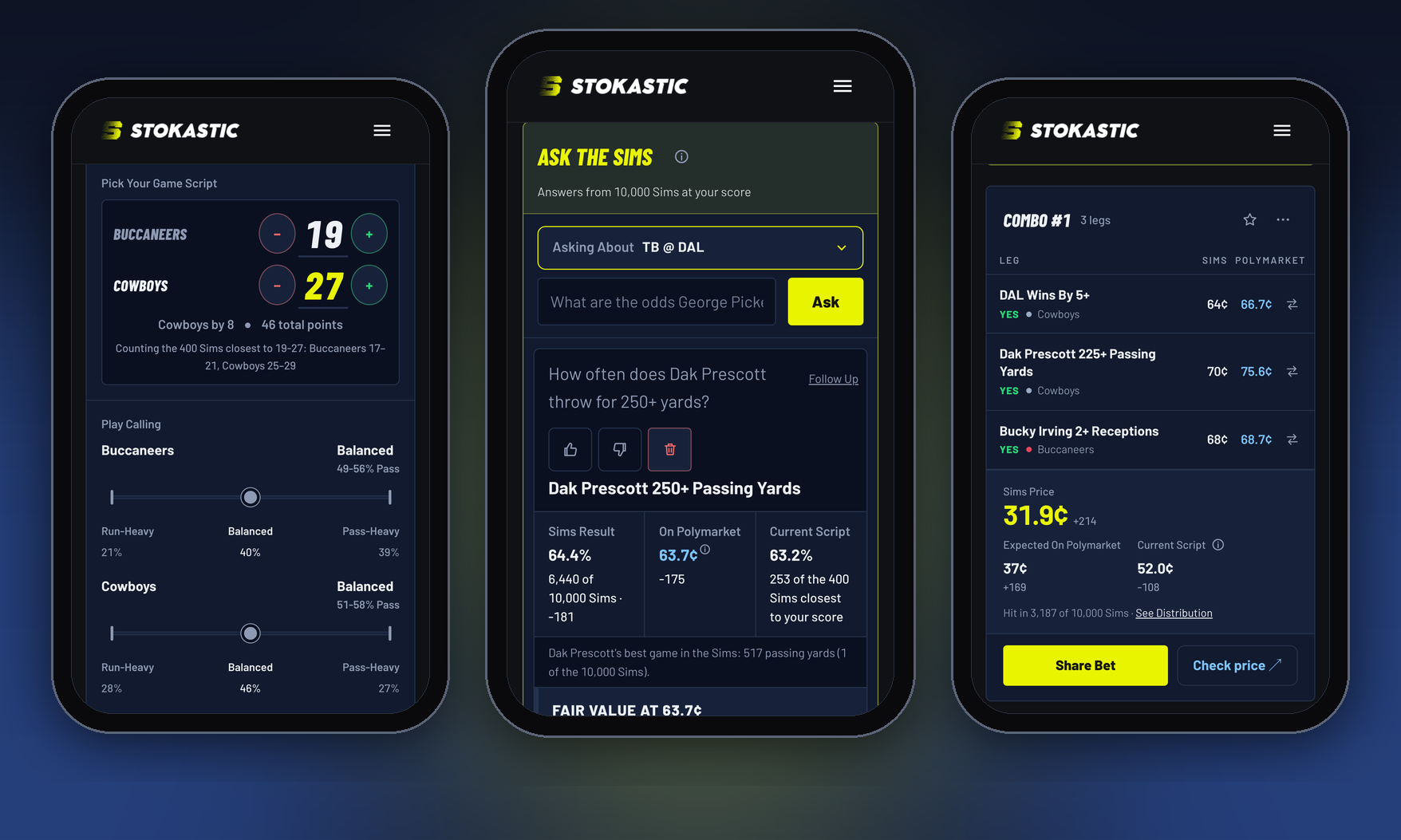 Price the combo before you buy it. The Polymarket Combo Simulator plays this week's game 10,000 times and prices any combo you build next to the price on Polymarket, on your phone, free, no login.
The full market-by-market liquidity table, the de-vig workflow that separates a cheap contract from an expensive one, a live Week 4 price pair with every venue on one line, and the dated, court-by-court legality picture are all below.
Signing up for Polymarket US?Our link installs the Polymarket US App and carries offer code OS3 — deposit $10 and make a qualifying trade to get a $50 trading bonus for new users: claim it here. Full walkthrough in our Polymarket sign-up bonus guide.
18+ Only. Restrictions and eligibility requirements apply. Not available in all jurisdictions. Trading is risky. 100% loss can occur. See polymarket.com/tos for more information. The Polymarket US App serves as an independent software provider and affiliate of Polymarket US and Polymarket Clearing, the CFTC-regulated exchange and clearing organization.
OddsShopper is a Polymarket partner and may earn a commission if you sign up through our links.
What Polymarket Is (And Isn't) For NFL
Start with the category, because everything downstream depends on it. Polymarket is not a sportsbook. It's a prediction market, an exchange where you trade contracts on whether a real-world event happens, and in the United States it operates as a CFTC-regulated event-contract platform. That's the same federal-commodities family that oversees futures trading, not a state-licensed sportsbook. The classification comes from the platform and its regulator, not from a legal opinion of mine, and it matters for one very practical reason: it's why Polymarket US can be available in some states with no legal sportsbook, and blocked in some states that have one. (For the full breakdown of why these are legally different animals, our guide on prediction markets vs. sports betting lays out the two maps side by side.)
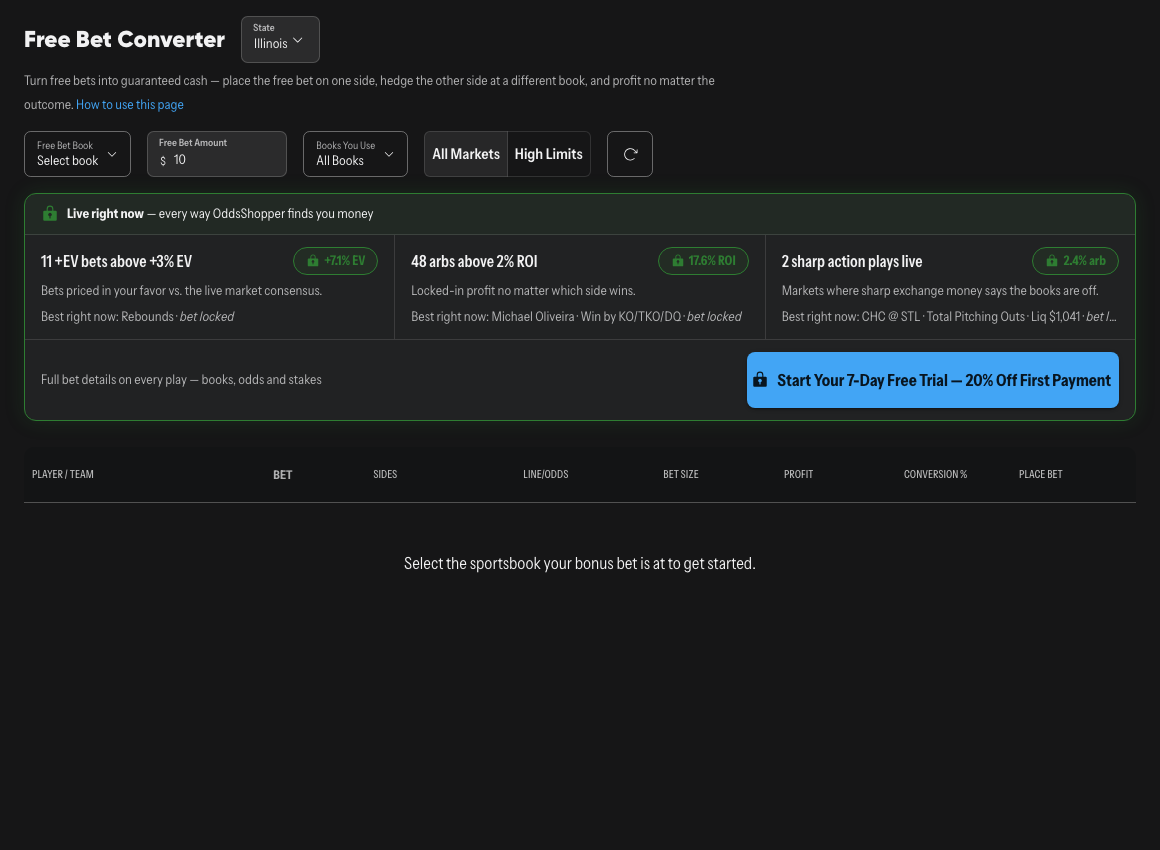
The OddsShopper Promo Converter.
Mechanically, every NFL contract is a Yes/No question. "Will the Chiefs win Super Bowl LXI?" You buy Yes if you think it happens, No if you don't, and at the end the contract is worth exactly $1 or exactly $0. Because of that binary settlement, the price it trades at in between, say 14¢, carries information a moneyline hides: it's the market's read on the probability, stated plainly. Hold that idea, because it's the hinge the whole workflow turns on later.
Funding And The USDC Question, Explained Plainly
NFL bettors coming from a normal sportsbook tend to get tripped up right here. The platform runs on USDC, a dollar-pegged stablecoin, so under the hood a contract is denominated in dollar units rather than settled straight to your bank. In practice, the U.S.-regulated Polymarket that relaunched after its late-2025 CFTC order is designed to feel like dollars. You fund an account, your buying power shows in dollars, and one winning contract pays a dollar. The crypto layer is mostly plumbing.
Two honest caveats, though. The U.S. platform — the Polymarket US App our link installs — and the older international site at Polymarket.com are separate products, and because Polymarket.com is view-only for U.S. users, everything in this guide refers to the U.S. app. The funding options (which may include card, bank transfer, or a direct USDC deposit) differ between them and keep changing as the U.S. version matures. So the one move I'd insist on: check Polymarket US's own current funding and eligibility pages before you deposit, rather than trusting any single number, including this one, that could be a version behind. This is a new, fast-moving product, and the mechanics are exactly the kind of thing that shifts month to month.
Which NFL Markets Actually Have Liquidity
Whether Polymarket is useful to you for football comes down to this, and the answer is the opposite of a sportsbook's. A book's deepest, sharpest markets are the weekly ones: this Sunday's spread, a star receiver's yardage prop, a same-game parlay. The Polymarket NFL markets still lean the other direction. They pool on the big, season-long questions where thousands of people want a position, and, as of this season, on the moneyline on the day a game is played. The depth figures below are from the Polymarket.com order book on the morning of October 4, 2026; the Polymarket US App runs its own book on the same questions.
| NFL Market On Polymarket | Typical depth | Best use |
|---|---|---|
| Super Bowl Winner | Deepest: about $63M traded and $7.4M resting on the 2027 Champion board | Season-long position, tight spread |
| Conference / Division Winner | Deep on conference: the NFC Champion board had traded $6.4M (division boards not re-pulled on this pass) | Futures with real two-way volume |
| Regular-Season MVP | Moderate: $1.2M traded, $433K resting | Player-narrative futures |
| Team Season Win Total (Over/Under) | Moderate (not re-pulled on this pass) | Preseason and early-season value |
| Single-Game Moneyline | Deep on game day (global book): $8.9M resting across the Colts-Commanders markets, the moneyline 1¢ wide; next Sunday's Bears-Packers held $24K | Usable on game day; the week-ahead book is still thin |
| Player Props / Weekly Specials | Listed but thin: $293K resting across 231 Chiefs-Raiders props, most never traded, 2 to 5¢ wide on the touchdown markets and far worse below them | A sportsbook does this better |
The row that changed since this page was written is the single-game one. In August the moneyline was the thin row; on the morning of October 4 the Colts-Commanders event held $8.9 million in resting orders across 331 markets, and the moneyline itself was 66 bid, 67 offered, a one-cent spread with $1.7 million resting on it and $698,000 traded on it in the prior 24 hours ($2.2 million across the full event). That is a sportsbook-grade book, on the global order book; the app runs its own, so read its depth before you size. It arrives late, though: the same book for next Sunday's Bears-Packers game held $24,000 in resting orders against $2,300 ever traded, with the Packers' spread markets 18 to 51 cents wide. The last row still reads the way it did. Props are now listed, 231 of them on Chiefs-Raiders alone, but Patrick Mahomes' anytime-touchdown market was 15 bid, 18 offered, Travis Kelce's was 32 bid, 37 offered, Rashee Rice's receptions line, over 4.5, was quoted 1 bid, 54 ask, and most of the rest had never traded. If you're chasing a specific NFL player prop, a quarterback's passing yards or an anytime touchdown, this is still the wrong tool. That's a sportsbook's home turf, and it isn't close. But the Super Bowl row at the top is strong: on a marquee futures question, the spread between Yes and No is tight enough that you can get in and out near the quoted price, which is exactly what you can't count on in a thin market. Liquidity, not the platform's logo, is what makes a price trustworthy, a lesson we dug into for the exchange next door in how to attack Kalshi's best sports markets, and it holds identically here.
The NFL framing that matterstreat Polymarket as a futures and game-day venue. Its edge is the season-long marquee market and the moneyline on the day the game is played, not next week's spread or a player prop. Match the market you want to the platform that actually pools money on it.
What Moved Since October 1
The two commits that touched this page on October 1, 2026 were housekeeping: one linked the Kalshi Parlay Simulator, the other locked the title and hero. Its prices were illustrative and its legal snapshot was dated August, so the court items below reach back further than the heading. Three things changed on this pass, all pulled between 8:22 and 8:25 a.m. ET on Sunday, October 4, 2026.
- The worked example got a live version. The Colts and Commanders were set to kick off at 9:30 a.m. ET that morning, and every venue in this guide priced the same question an hour before kickoff. Exchange rows are listed the way OddsShopper's live odds screen shows them, with the trading fee folded into the price, so they read like a sportsbook line; the all-in column is that price as cents per $1 contract.
| Venue | Colts | All-in cost | Commanders | All-in cost |
|---|---|---|---|---|
| OddsShopper no-vig fair | 66.8¢ | 33.2¢ | ||
| Polymarket US App (OddsShopper screen row) | -208 | 67.5¢ | +179 | 35.8¢ |
| Polymarket.com order book (view-only for U.S. users) | 66¢ bid / 67¢ ask (-203 listed) | 67.0¢ | 33¢ bid / 34¢ ask (+194 listed) | 34.0¢ |
| Kalshi (66/67 on its book, -218 listed all-in) | -218 | 68.6¢ | +181 | 35.6¢ |
| DraftKings | -218 | 68.6¢ | +180 | 35.7¢ |
| FanDuel | -230 | 69.7¢ | +190 | 34.5¢ |
Read the favorite column first. The Polymarket US App's -208 ties the best sportsbook price on the whole screen, -208, which WynnBET and CoolBet both posted, and beats DraftKings and FanDuel by one to just over two cents. Now read the dog column, where it flips: +179 on the app is among the worst Commanders numbers on the board, worse than FanDuel's +190 and even the global Polymarket.com book's own 34-cent ask, with only a handful of books, at +175 to +178, below it. Same game, same app, opposite verdicts, which is the two illustrative tables in the worked example further down happening at once. The fair column then settles what the comparison alone can't: every price in this table sits above the 66.8/33.2 de-vigged read, and the only Colts number on the whole screen underneath it was Novig's -199, a near-zero-hold exchange row, so the cheaper venue is still the right venue, but nothing in this table clears the bar. One more thing the screen shows, and the reason the app gets its own row: OddsShopper lists Polymarket's two books separately, and the global book's listed -203 was half a cent better than the app's -208, a gap that reads as cost, not as a different opinion about the game.
- The Super Bowl board, the number this page opens on. The 14-cent contract in the opening paragraph is now a live quote. On October 4 it was the Buffalo Bills' ask on the Polymarket.com book, 13 bid, 14 offered, at the top of a 2027 Champion board that had traded about $63 million. Kalshi's board on the same question had the Bills at 12 bid, 13 offered, a cent cheaper, with 8.4 million contracts traded on that one team, roughly $1.1 million of notional at today's 13 cents against Polymarket.com's $1.1 million on the same market: two books, the same money, prices a cent apart. The next three names run the comparison both ways: the Rams were 11/12 on both exchanges, the 49ers 8.7/8.8 on Polymarket.com against 9/10 on Kalshi, the Chiefs 8.6/8.7 against 7/8. Two books, one question, and the cheaper side changes team by team, which is why the comparison is a habit rather than a rule of thumb. Those are the global book's quotes, which U.S. users can view but not trade; the Polymarket US App runs its own book on the same question, so read the app's ask before you price anything.
- The map moved, and the August snapshot is gone. Since this page was written, two federal appeals courts have ruled that states may enforce their gambling laws against sports event contracts, in cases brought by Kalshi: the Ninth Circuit on August 28 and the Sixth Circuit on September 25. New Jersey has asked the Supreme Court to resolve the split with the Third Circuit's April ruling the other way, a federal judge in Chicago blocked Illinois from enforcing its gambling provisions against Kalshi's sports contracts on October 2, Missouri gave six operators 30 days from September 18 to stop offering sports contracts, and Minnesota's felony statute stayed blocked under the July 27 injunction. The legality section below now carries the October 4 version, and the Quick Answer stamp matches it.
What did not move is the method. The fair column in that table is OddsShopper's de-vigged read, and the section after next explains how to build it; the two illustrative tables in the worked example end at the same sentence this live one does: convert, then buy the cheaper one, and pass when nothing is under fair. The next section is the mechanics, and the step that matters most is the fifth, where a thin quote tells you not to place the order at all.
How To Bet An NFL Market On Polymarket, Step By Step
Once you know what you're buying, the mechanics are quick:
- Fund your account. Add funds per Polymarket US's current deposit options, and confirm your state is eligible before you do (more on that below).
- Find the market. Search the NFL question you want: a Super Bowl or conference winner, a team's win total, a game moneyline.
- Pick Yes or No. Buying "No" on the Chiefs to win the title is just betting they won't, at its own price. Every question has two sides you can take.
- Read the price as a probability. A 14¢ contract implies about a 14% chance and pays $1 if it hits. That's your cost-to-payout in one number.
- Set your size, then choose your order. Take the price that's posted, or set your own with a limit order. On a deep Super Bowl market a limit order a cent under the ask usually fills; on a thin contract, a week-ahead game or a player prop, it can sit unfilled for hours or never fill at all, and that non-fill is itself a signal the market's too illiquid to bother with. On October 4 the Chiefs-Raiders board had Rashee Rice's receptions market, over 4.5, quoted 1 bid, 54 ask; there is no limit order to place there, the quote itself is the answer.
- Confirm. Review the contracts and cost, then place it. Because it's an exchange, you can often sell out of the position before the season resolves rather than sweating it to February, though selling early usually means handing back some expected value for certainty.
That's the full loop. But placing the bet was never the hard part. Knowing whether that 14¢ was a good 14¢ is, and that's the promise from up top.
Don't take a contract price on faith, check it against the whole market. OddsShopper strips the vig out of every sportsbook's NFL line so you can read it as a true probability and hold it right next to a Polymarket contract. Start with OddsShopper's free tools, then use code POLYNFL20 for 20% off OddsShopper Pro.
The Edge: Comparing A Contract Price To The Book
This next workflow is the reason a value bettor should care about Polymarket sports betting at all. A contract price is already an implied probability, which is the good part, but is it a good probability? The only way to know is to compare it to the rest of the market, and the rest of the market is the sportsbooks. For a combo of NFL contracts, run the combo through 10,000 sims first; the simulator shows the fair price next to the exchange's ask.
The catch is that you can't compare them straight. A sportsbook's NFL futures price at DraftKings 🎁, FanDuel 🎁, or BetMGM 🎁 has the book's margin, the vig, baked into it, and futures markets carry some of the heaviest hold on the board, often a 30% margin or more once you add up every team on a Super Bowl board, so the probability you'd read straight off a +400 looks far fatter than the book's real opinion. The fix is to de-vig the book line. Strip the margin out and you're left with the book's honest implied probability, in the exact same 1-to-99-cent unit a Polymarket contract trades in. That de-vig step is the one people skip, and it's the whole ballgame. (New to it? Our prediction markets vs. sports betting guide walks the de-vig math in full.)
That's the job OddsShopper's tools do so you're not doing it by hand:
- No-Vig Fair Odds: the tool scans any sportsbook's NFL line and converts it into a true implied probability, the same cents unit the contract trades in.
- The +EV screen flags the prices sitting in your favor against that fair number, so you're weighing edges, not hunches.
- The live odds screen lets you shop the number across every major book at once, so you're judging a single contract price against the whole market's consensus instead of one book's take.
- The Liquidity Tool tracks the real-money orders flowing across the prediction exchanges, Kalshi and Polymarket included, flips each to the sharp side, and shows the arb margin against the sportsbook price, so you're weighing a contract against where the money actually is rather than reading it in isolation.
None of those require a Polymarket account. They're what turn "14¢ feels cheap" into "14¢ is two points under the de-vigged book number, so it clears the bar." Want the human read alongside the math? Our free NFL expert picks show where our analysts land before you ever price a contract.
Tools for thisthe Polymarket Combo Simulator prices every Polymarket combo against the sims; the Kalshi combo builder is the Kalshi version.
A Worked Example: One Super Bowl Future, Two Prices
Say you want to back a contender to win the Super Bowl, and you're deciding whether Polymarket or your sportsbook has the better number. Using round, illustrative figures rather than any live price (the same convert-then-compare exercise, run live on Sunday's Colts-Commanders moneyline and on the Super Bowl board, is in the What Moved section above):
| Venue | Price shown | Implied probability |
|---|---|---|
| Polymarket (Yes Contract) | 16¢ | ~16% |
| FanDuel Futures (Raw) | +400 | ~20% |
| FanDuel Futures (No-Vig) | margin stripped out | ~17% |
The sportsbook's raw +400 looks like a 20% shot, but futures carry a heavy margin, so once you de-vig it — normalizing across every team on the board rather than reading that one price in isolation — the book's honest read on that team lands lower, illustratively around 17% once that heavy futures hold is stripped out. Now the comparison is clean: Polymarket's 16¢ contract is priced below the book's true 17% number, which means for once the exchange is the cheaper unit. You're paying 16 for something the sharpest read says is worth about 17. That's a small, real gap, and it's only visible because you converted both venues to the same unit first.
Now flip it, because it goes the other way just as often. Say a second contender's contract and book line look like this, again in round, illustrative figures:
| Venue | Price shown | Implied probability |
|---|---|---|
| Polymarket (Yes Contract) | 24¢ | ~24% |
| DraftKings Futures (Raw) | +350 | ~22% |
| DraftKings Futures (No-Vig) | margin stripped out | ~19% |
Here the trap reveals itself the second you convert. The 24¢ contract reads like a fair 24% shot on its own, but the de-vigged book number lands at roughly 19%, so the sportsbook's raw 22% is the cheaper of the two and the contract is the worse overpay, handing over 24 for something worth about 19. Neither side clears the bar, though: 22 against a 19 fair read is a losing price too, and when both venues sit above fair the trade is no trade. The move is never "always bet Polymarket." It's "convert both to a true probability, then take whichever side is cheaper than it should be," the same +EV habit whether the price is on an exchange or a sportsbook. Two identical-looking cents prices, opposite verdicts, and the only thing that told them apart was the de-vig.
The one-line rule to carry into every NFL marketthe venue with the cheaper true price wins the bet, not the venue with the shinier interface. A Polymarket contract and a de-vigged sportsbook number live in the same 1-to-99-cent world once you convert them, so let the number pick the side.
Costs, Liquidity, And Risk
Nothing here is free, even without a visible vig. On the Polymarket app the cost reaches you through some mix of fees and the bid-ask spread, the gap between what buyers will pay and sellers will accept, and that spread is where thin markets bite. The October 4 pull put a number on each of those costs: the cost shows up as the half-cent between the global book's listed -203 and the app's -208 on the same 66/67 Colts line, the app's fee inside its number; the spread is Rashee Rice's over-4.5 receptions market quoted 1 bid, 54 ask; the exit risk is the Packers' spread markets sitting 18 to 51 cents wide a week before kickoff. On a deep Super Bowl contract the spread is tight; on an obscure market it can be wide enough to eat the gap you thought you had, and you may not be able to exit at a fair price when you want to. A spread that wide is also a warning about the price itself: the fair probability you just converted a contract into isn't trustworthy when the book behind it is that thin, so recompute the number before you size in rather than trusting a cents price no one is really standing behind. Fee structures differ and change, so read Polymarket US's current fee page rather than a number you saw quoted months ago.
And the obvious one: a contract can settle against you. A "Yes" you bought at 60¢ is worth $0 if the event doesn't happen, and any futures position can lose everything you put in. Size for the market you're actually in: on a week-ahead moneyline or a player prop where the bid-ask is wide, a good chunk of your apparent edge can be spread rather than signal, so size down there and save the real money for the deep markets where the price is trustworthy. And only risk what you can afford to lose. If it stops feeling like reading a market and starts feeling like chasing one, that's the signal to step back, and every regulated platform posts responsible-gaming resources for exactly that.
Is It Legal To Bet NFL On Polymarket?
This is the part that matters most to get right, so here's the dated, honest version, and none of it is legal advice. Polymarket returned to U.S. users through a CFTC-regulated exchange, with its U.S. platform live since December 2025, and it operates under CFTC oversight as an event-contract market rather than a state-licensed sportsbook. As of October 4, 2026, its U.S. availability is uneven and actively contested, and the contest has moved into the appeals courts. Two federal appeals courts have now ruled that states may enforce their own gambling laws against sports event contracts, in cases brought by Kalshi, the other big exchange: the Ninth Circuit on August 28 in Nevada's case and the Sixth Circuit on September 25 in Ohio's and Tennessee's, against the Third Circuit's April ruling for Kalshi in New Jersey. New Jersey has asked the Supreme Court to resolve that split, with Kalshi's response due November 9. The trial courts are still going both ways: on October 2 a federal judge in Chicago blocked Illinois from enforcing its licensing and gambling provisions against Kalshi's sports contracts (Polymarket was not a party to that case), while Missouri's attorney general gave Kalshi and five other operators 30 days from September 18 to stop offering sports contracts there. Polymarket US has been geo-blocked in Nevada since a state court's restraining order in February and halted its sports markets in Tennessee after a January cease-and-desist; two third-party trackers updated on October 1 and 2 list the app as unavailable or restricted in Arizona, Connecticut, Illinois, Maryland, Massachusetts, Michigan, Montana, Nevada, Ohio and Tennessee between them, and the two lists do not agree with each other, which is the point. Which specific states are on or off the list has shifted repeatedly and can change on the timeline of a court order, so treat any snapshot as temporary and check your own state directly rather than trusting a named list on any page, including this one. Our Kalshi legality map tracks every one of those cases by docket.
One line worth flagging: Minnesota passed a law, effective August 1, 2026, that makes it a felony to operate, service, or advertise a prediction-market platform in the state. On July 27, days before that start date, a federal judge blocked the state from enforcing it, and that order was still in place on October 4. Judge Katherine Menendez's preliminary injunction, granted in the suit that Kalshi, Polymarket US, the CFTC and the United States brought against the state, found the statute "likely preempted in many respects" by the Commodity Exchange Act. The provision targets the companies running these platforms rather than individual traders, and because the block is a preliminary injunction rather than a final ruling, the state cannot enforce it for now, which is not the same as the app being open to you; run Polymarket US's eligibility check for Minnesota before you fund, and the picture there can change quickly. The cautious move if you're there: don't assume anything on this page is settled law, and check current guidance before you trade. Everywhere else, treat every availability claim here as an October 4, 2026 snapshot, because this map has been redrawn repeatedly and courts and state regulators are still actively contesting how sports event contracts are treated. The clearest source of truth is Polymarket US's own eligibility check for your state on the day you sign up, not this page, and not any blog post. For a fuller look at how Polymarket's map compares to the other big exchange, see our Kalshi vs. Polymarket breakdown.
How To Bet NFL On Polymarket — FAQ
How does Polymarket work for NFL betting? You buy Yes/No contracts on an NFL outcome, such as a team to win the Super Bowl, a division, or a game. Each settles at $1 if it hits and $0 if it doesn't, and the price in cents is the market's implied probability for that outcome.
What NFL markets are on Polymarket? Its deepest board is the Super Bowl winner, with the NFC winner and MVP boards behind it, and on game day the single-game moneyline now carries real depth (the global Polymarket.com book on Colts-Commanders, which U.S. users can view but not trade, held millions in resting orders at a one-cent spread on the morning of October 4, 2026; the Polymarket US App runs its own book, so check its depth before you size). Weekly player props are listed but thin, several cents wide with little traded, so they remain a sportsbook's domain.
Do I need crypto to bet NFL on Polymarket? It runs on USDC, a dollar-pegged stablecoin, but the U.S. platform is designed to feel dollar-denominated and offers standard funding options that keep evolving. Check Polymarket US's current deposit page for what's supported where you are.
Is betting NFL on Polymarket legal? Polymarket US operates as a CFTC-regulated event-contract exchange, not a state-licensed sportsbook, which is a classification rather than a blanket statement that it's legal everywhere. Availability is state-specific and changing. As of October 4, 2026 the app is blocked or restricted in roughly ten states, two federal appeals courts have ruled since late August that states may enforce their gambling laws against sports event contracts, and Minnesota's felony law for operating, servicing or advertising these platforms has been blocked by a federal preliminary injunction since July 27, 2026, so it is not being enforced while that case continues. Confirm your own state on Polymarket US before funding. This isn't legal advice.
Is Polymarket better than a sportsbook for NFL? Neither wins outright. Polymarket is strong on season-long futures with transparent, probability-first prices and the ability to trade out early; a sportsbook is far deeper on props and on next week's board, and by game-day morning the moneyline is competitive. The sharp move is to compare a contract price to the de-vigged book number and take whichever is cheaper.
The Bottom Line
Betting NFL on Polymarket only looks exotic until you accept the one idea it's built on: the price is the probability. Once you read a 14¢ Super Bowl contract as "about 14%," the platform stops being a crypto novelty and becomes what it actually is, a venue with real depth on the season's biggest questions and on the game-day moneyline, and a genuine edge waiting in the gap between its prices and the sportsbooks'. Play the markets where the money pools, skip the thin ones a book does better, and never take a contract on faith. Convert both venues to a true number first, then buy the cheaper one. That habit is the entire difference between trading a price because it's in front of you and trading it because it's a good one.
Turn any NFL line into a true probability.OddsShopper de-vigs every sportsbook price so you can read it in the same units a Polymarket contract trades in, and the Liquidity Tool tracks where the real money is moving across the prediction exchanges. Start with the free tools; code POLYNFL20 takes 20% off OddsShopper Pro. New to the exchanges? Start with our Kalshi step-by-step guide and the Polymarket sign-up walkthrough.
More on this: NFL 2026 on Kalshi: Every Board We Track · Kalshi NFL Picks: Every Market, AI-Scored · NFL MVP Odds: Kalshi Prices Josh Allen Cheaper Than Polymarket · Kalshi Vs Polymarket NFL: Why The Cheaper Fee Loses · How To Bet NFL Futures On Kalshi (And Get Paid To Wait)