Kalshi contracts show up in the same feeds as your DraftKings 🎁 parlays now, so it is easy to assume prediction markets and sports betting are the same thing wearing different logos. They are not. One is a federally regulated financial exchange; the other is a state-licensed sportsbook. That single distinction changes how prices are set, where you are allowed to play, and what each one is actually good for. Here is the honest side-by-side, minus the affiliate-code noise.
| Prediction markets (Kalshi, Polymarket) | Sportsbooks (DraftKings, FanDuel, BetMGM) | |
|---|---|---|
| What It Legally Is | CFTC-regulated event contracts | State-licensed sports wagering |
| Who Regulates It | The CFTC (federal) | Each state's gaming commission |
| How Prices Are Set | An order book: buyers and sellers set the price | The book sets the line and bakes in a margin (the vig) |
| How You Exit | Sell your contract before the event resolves | The bet stands until it wins or loses (cash-out where offered) |
| What You Can Trade | Elections, economics, weather, culture, and sports | Deep sports markets: props, parlays, live, alt lines |
| Where It's Available (As Of July 2026) | 40+ states, but a different map than sportsbooks | Wherever the state has legalized sports betting |
| Typical Cost | Trading fees plus the bid-ask spread | The vig baked into the odds |
They Are Not The Same Thing: The Legal Line
Start here, because everything else follows from it. A prediction market like Kalshi is a CFTC-designated contract market. The Commodity Futures Trading Commission is the same federal agency that oversees commodity and futures trading, and it treats an event contract as a financial instrument, not a sports wager. Kalshi is regulated at the federal level; Polymarket returned to U.S. users through a CFTC-regulated exchange after its QCEX acquisition and a CFTC amended order, with its U.S. exchange live since December 2025 (iOS-only for now, as of July 2026).
Signing up for Polymarket?Our link carries offer code OS3 — a Deposit $10, get a $50 trading bonus for new users: claim it here. Full walkthrough in our Polymarket sign-up bonus guide.
OddsShopper is a Polymarket partner and may earn a commission if you sign up through our links. 18+ Only. Restrictions and eligibility requirements apply. Not available in all jurisdictions. Trading is risky. 100% loss can occur. See polymarket.com/tos for more information. The Polymarket US App serves as an independent software provider and affiliate of Polymarket US and Polymarket Clearing, the CFTC-regulated exchange and clearing organization.
A sportsbook is the opposite arrangement. DraftKings, FanDuel 🎁, BetMGM 🎁 and the rest are licensed state by state by each state's gaming commission. That is why sports betting is legal in some states and simply does not exist in others.
Because the two run on different legal rails, their maps do not line up, and in some cases they invert: prediction markets operate in states where sportsbooks are not licensed, and are restricted in some states where sportsbooks are fully live. So "is it legal where I am?" has two separate answers depending on which one you mean. Treating a Kalshi contract as "just another bet" is the mistake that gets people confused, and it is the reason this comparison matters. The law here is also still moving: state regulators and courts are actively contesting how sports-related event contracts should be treated, which is part of why availability shifts so often.
The one-line version: a sportsbook is a house you bet against; a prediction market is an exchange where you trade against other people.
How The Pricing Works: Order Book Vs. The Vig
Here the difference becomes something you can feel in your returns.
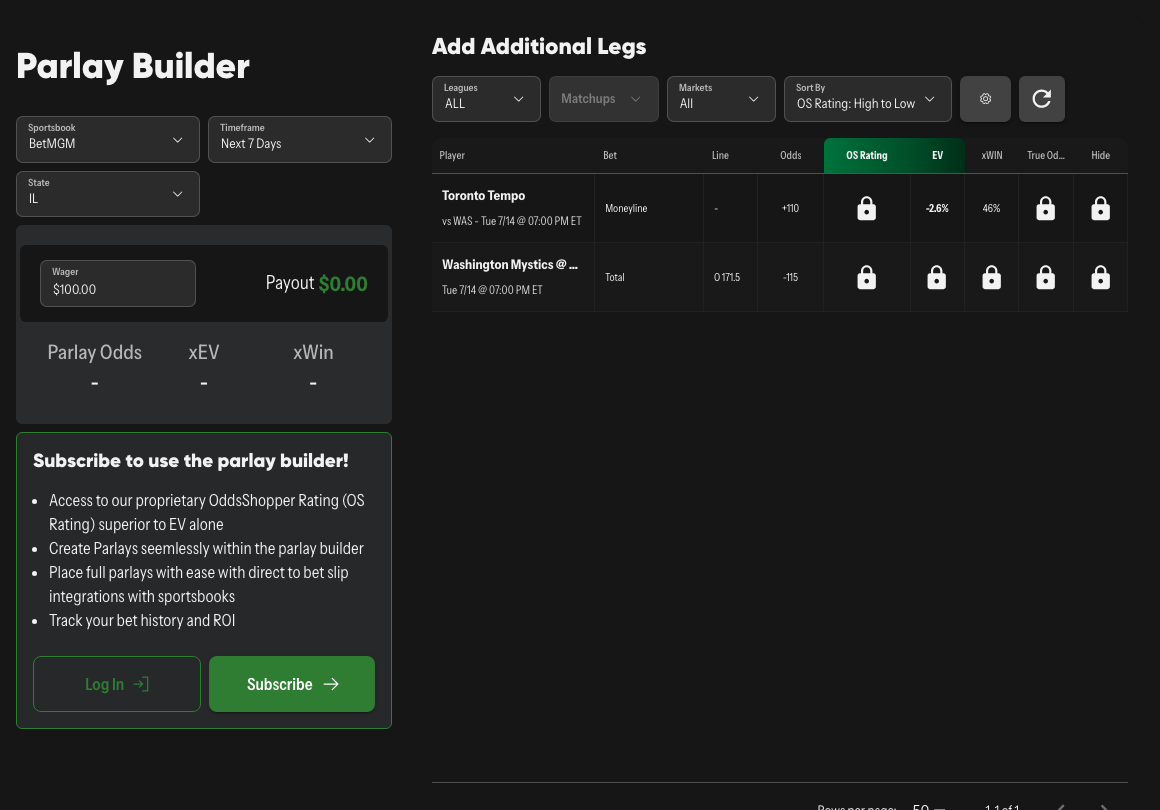
The OddsShopper Parlay Builder.
Prediction markets set their prices through an order book. Every contract settles at either 100 cents (the event happened) or 0 cents (it did not), and it trades somewhere in between until then, so the price itself is the market's implied probability. Say a contract for the Chiefs to win the Super Bowl is trading at 62 cents: the market is pricing that outcome at roughly a 62% chance. Think it is worth more and you buy; think it is worth less and you sell. Because it is an exchange, you can also trade out of a position before the event resolves, though selling early usually means giving up some expected value in exchange for certainty, which is a risk-tolerance choice, not a free lunch.
A sportsbook works the other way. The book sets the line and builds its margin into the odds, and that margin is the vig (also called juice or hold). See a market priced at -110 on both sides and the book is not offering an even bet: the extra dime is its cut, usually around a 4% to 5% hold on a standard two-way market. Post that same Chiefs price at -150 and the raw odds imply about a 60% chance, but part of that number is the book's margin, not the true probability.
The takeawayboth systems are quoting a probability. A prediction market shows it in cents; a sportsbook hides it inside the odds. Strip the vig out of the sportsbook line and you can finally compare the two on equal footing.
That last step is exactly the gap OddsShopper's tools were built to close. The no-vig fair odds feature removes a book's margin for you, so you can line up a sportsbook's true implied probability against a prediction-market contract price on the same event and see which side is actually offering the better number.
We push this comparison further in Kalshi exchange vs sportsbook, with worked examples on both sides.
A Worked Example: One Game, Two Prices
Say the Chiefs are the side you want to back for a title. Here is how the same outcome can look across both venues, using round illustrative numbers rather than any live price:
| Venue | Price shown | Implied probability |
|---|---|---|
| Prediction Market | 62¢ contract | ~62% |
| Sportsbook (Raw Odds) | -150 moneyline | ~60% |
| Sportsbook (No-Vig) | margin stripped out | ~58% |
The sportsbook's raw -150 looks like a 60% shot, but once you remove the book's built-in margin, its true read on the Chiefs is closer to 58%. That no-vig number is a yardstick, not a price you can bet at, but it is the honest benchmark for judging whether the market's 62-cent contract is rich or cheap for the side you want. Lining both up on de-vigged terms beats eyeballing a cents price against a moneyline, and it is the job the no-vig view does for you.
We extend this to a three-way comparison — both major exchanges against the books — in Kalshi and Polymarket vs sportsbooks.
What Each One Is Actually Good For
Neither one wins outright. They are built for different jobs.
Prediction markets are strong when you want:
- Events Beyond Sports. Elections, interest-rate decisions, economic data, weather, and pop-culture outcomes all trade as contracts. A sportsbook cannot touch most of these.
- Transparent, Probability-First Pricing. A price in cents is an implied percentage with no odds-conversion math required.
- The Ability To Exit. You can sell a winning or losing position before resolution instead of sweating it to the final whistle.
Sportsbooks are strong when you want:
- Depth In Sports. Player props, same-game parlays, alternate lines, live in-game markets, and boosts exist at a granularity prediction markets rarely match.
- Promotions. Welcome offers, odds boosts, and free bets are a sportsbook feature, and a real part of the value if you use them well.
- The Line-Shopping Game. With the same game priced across every major book, the edge is finding the best number, which is the whole discipline serious bettors live in.
If you are chasing a specific NFL player prop, the sportsbook is your venue. If you want to take a position on who wins the election or whether the Fed cuts rates, the prediction market is. Plenty of people use both, for different reasons, and there is nothing contradictory about that.
Where You Can Use Each One (As Of July 2026)
Availability is the part that changes most often, so treat these as a snapshot dated July 2026 and always confirm on the platform's own eligibility page before you sign up.
- Kalshi operates as a CFTC-designated contract market available in 40-plus states. It is restricted or limited in Arizona, Massachusetts, Maryland, Michigan, Montana, Nevada (sports contracts paused), and Ohio.
- Polymarket is back for U.S. users through its CFTC-regulated exchange, live since December 2025 and iOS-only at the moment. It is blocked in Arizona, Illinois, Massachusetts, Maryland, Michigan, Montana, Nevada, and Ohio.
One hard line to underline: Minnesota has passed a law, effective August 1, 2026, making it a felony to operate, host, or advertise a prediction-market platform — aimed at the companies, not individual traders, and currently in litigation. The safe move for Minnesota residents is still to hold off and check current state law first, because platform access there is likely to be cut off.
Sportsbook availability follows the separate state-legalization map, which is why you can find yourself in a state with legal sportsbooks but restricted prediction markets, or the reverse. Check both independently. The rules here move quarter to quarter, so a status that is true today can flip, and the platform's eligibility check is the source of truth, not a blog post.
The Costs And Risks On Both Sides
No product is free, and it is worth being clear-eyed about what each one costs you.
On a sportsbook, the cost is the vig described above. It is invisible because it is baked into the odds, but it is the reason beating the closing line matters so much. On a prediction market, the cost is a combination of trading fees and the bid-ask spread, the gap between what buyers will pay and what sellers will accept. Thin markets carry wider spreads, and in a low-liquidity contract your order may not fill at the price you wanted, or may not fill at all. Liquidity risk is real: a market with few participants can be hard to enter and harder to exit.
And the obvious one that applies to both: no outcome here is certain, prices move, and you can lose the money you put in, so only ever risk what you can afford to lose. When it stops being fun, step away, and use the responsible-gaming resources every regulated platform provides.
How OddsShopper Fits
OddsShopper does not run a sportsbook or a prediction market, which is exactly why it is useful for comparing them. It sits on top of the whole market and does the math you would otherwise do by hand.
The no-vig fair odds feature takes any sportsbook line and shows you the true implied probability underneath the margin, so you can hold it up against a prediction-market contract price on the same event and instantly see which venue is offering the better deal. The +EV screen flags the spots where a price is in your favor, and the hold display tells you how heavy a book's margin is on a given market before you ever click bet. The EV Calculator lets you check any single price against its fair value in seconds, and the Arbitrage tool surfaces the price gaps across sportsbooks where the same market is mispriced enough to bet both sides. The Sharp Action tool goes a step further and reads where exchange and prediction-market money is moving, which is signal you cannot get from a sportsbook's posted line alone.
New to OddsShopper?It scans every major U.S. sportsbook, flags the bets priced in your favor, and shows each line's no-vig fair odds so you can compare a book's true price to any prediction-market contract on the same event. Its Sharp Action tool even reads where exchange and prediction-market money is moving. You can try OS Pro free for 7 days, and code PREDICTVS20 takes 20% off your first payment of OS Pro or OS Core if you subscribe.
If you want to go deeper on the prediction-market side specifically, our platform guides break down how sports contracts work on Kalshi, a full Kalshi review, and the Polymarket sign-up details.
Go Deeper On Kalshi Markets
- Exchange vs sportsbook: where the money actually goes
- The asymmetric payoff problem in event contracts
The Bottom Line
Prediction markets and sports betting overlap on your screen but not in the fine print. A prediction market is a federally regulated exchange where you trade contracts against other people at transparent, probability-based prices, and it reaches beyond sports. A sportsbook is a state-licensed house that sets the line, keeps the vig, and offers the deep sports menu and promotions. Know which one you are using, check the rules for your state before you sign up, and price every outcome on both against its true no-vig number.
Ready to stop leaving the better number on the table? Start your 7-day free trial of OS Pro, and use code PREDICTVS20 for 20% off your first payment of OS Pro or OS Core. It de-vigs every sportsbook line so you can compare it to any prediction-market contract on the same event, and the Sharp Action tool shows you where the exchange money is going.
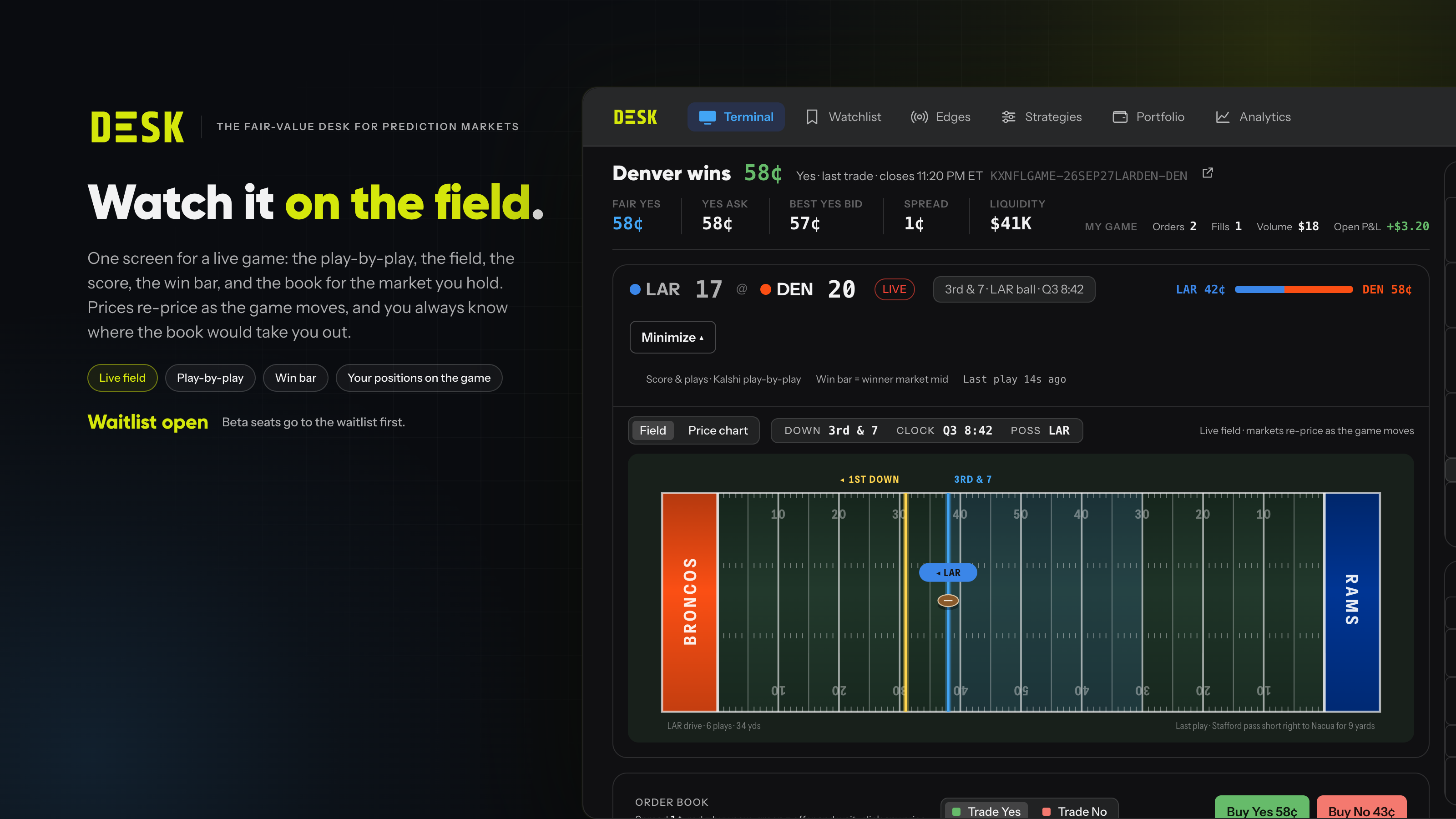
More on this: Prediction Markets vs Sportsbooks: Kalshi Odds Gaps Today · How To Bet Sports On Kalshi: 4 Steps, Odds In Cents · Politics Markets For Sports Bettors: Base Rates, Rules · Kalshi Liquidity Explained: Why Deep Books Win