Kalshi is worth an account for one reason and carries one real risk. The reason: there is no house and no vig, so its price on a game is a genuinely independent second market to shop against the books, and it is cheaper than the sportsbook line often enough to matter. The risk is not the platform. It is where you live. Three federal appeals courts have now ruled on the core question of whether federal rules override state gambling law, two of them against Kalshi, and two petitions ask the Supreme Court to settle it (the Court has not yet agreed to hear either). At least a dozen states have moved to challenge or restrict Kalshi, Minnesota passed a felony ban on operating a prediction market that a federal judge blocked before it took effect, and that fight is still running. Everything else on this page — the cents, the fees, the promo code question, the thin markets — is downstream of those two facts.
What Is Kalshi?
Founded in 2018, Kalshi is a prediction-market exchange regulated by the Commodity Futures Trading Commission (CFTC) as a Designated Contract Market. That regulatory status matters more than any feature: because the platform answers to the same federal agency that regulates commodity futures rather than a state gaming commission, it has operated in many states under its federal registration without seeking the state-by-state gaming licenses a sportsbook needs, even as several states move to restrict it. Whether that federal footing holds up where you live is the next section, and the unresolved one.
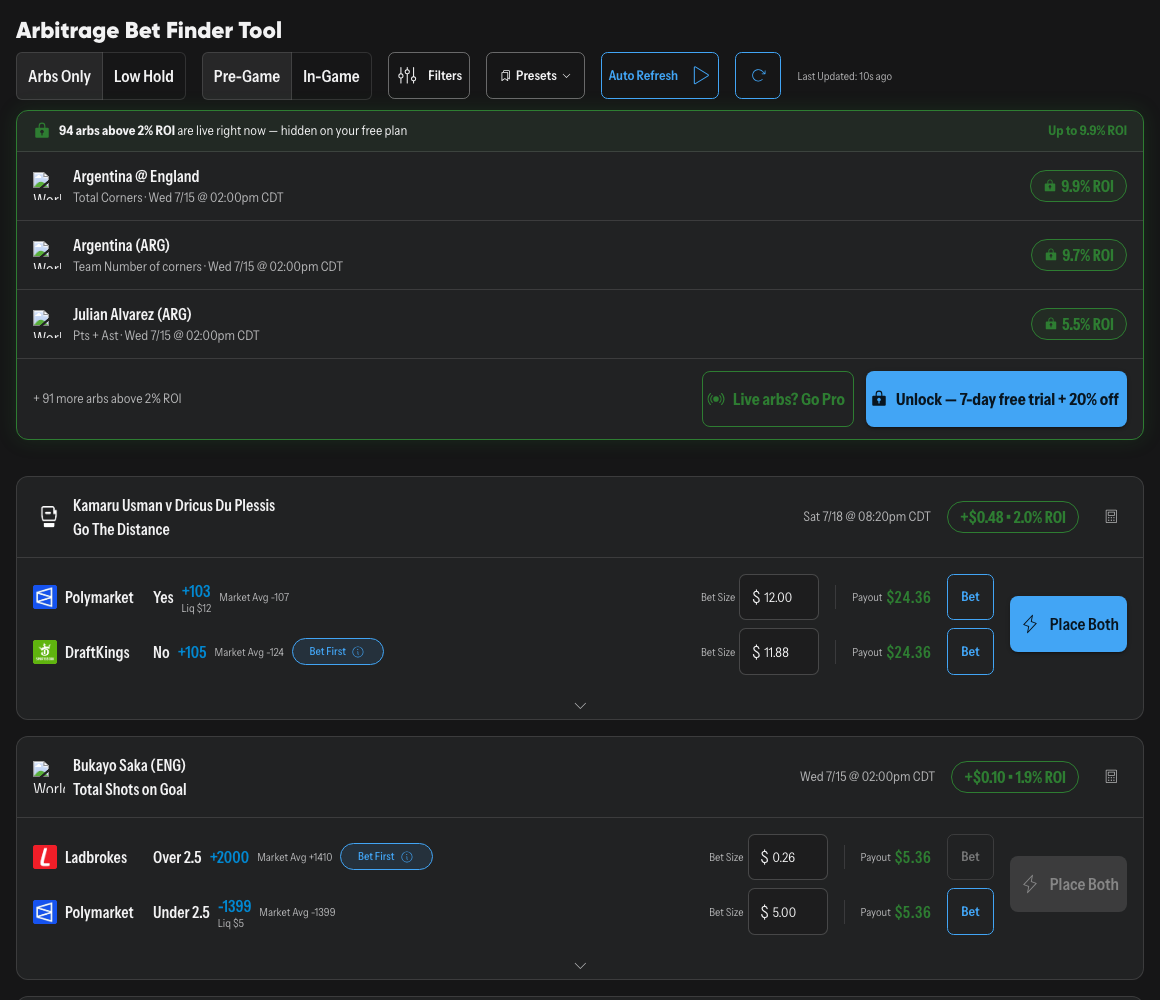
The OddsShopper Arbitrage Tool.
Instead of "betting" against a house, you trade event contracts with other participants. Each contract settles at either $1 (the event happened) or $0 (it did not), and it trades anywhere in between while the outcome is undecided. There is no bookmaker setting a line and baking in a margin. Prices move because buyers and sellers push them, and Kalshi makes money on trading fees rather than on vig. That "no house" structure is the core difference from a sportsbook, and it is why the prices behave more like a market than a betting line.
Sports, and the multi-leg parlay contracts built on them, are where the platform's biggest days now come from. The scale is real: Kalshi was valued near $22 billion in May 2026, with June reports of talks at roughly $40 billion, and on the first NFL Sunday of 2026 (September 13) the exchange cleared a record $2.433 billion in a single day, one day after a $2.426 billion Saturday. Parlay contracts were more than half of both days, and straight football contracts were about $410 million of Sunday's total. Exchange volume and sportsbook handle are not measured the same way, so treat those figures as scale rather than a head-to-head comparison; either way they show how fast the space has grown.
These are market prices and estimates, not predictions of fact and not financial advice.
Can You Use Kalshi In Your State?
This is the catch, and it is the one thing on this page worth checking before anything else. The reason Kalshi has kept trading through challenge after challenge is a federal-preemption argument: that the CFTC, not state gaming regulators, has jurisdiction over event contracts. Courts have split on it, and the split is now formal. In April 2026 the Third Circuit sided with Kalshi against New Jersey. On August 28 the Ninth Circuit went 3-0 the other way in Nevada's case, holding that sports event contracts are sports bets rather than federal "swaps" and that Nevada's gaming law applies. New Jersey asked the Supreme Court to settle the question on September 2, Robinhood and Crypto.com filed a second petition the following week, and Kalshi asked the full Ninth Circuit to rehear its case on September 9, the same day a federal judge in Iowa and the Tenth Circuit in Utah's case each refused to shield it from state enforcement.
On September 16 a Ninth Circuit panel sided unanimously with two California tribes, Blue Lake Rancheria and Chicken Ranch Rancheria, on the gaming question, holding that the tribes are likely to win their argument that Kalshi's sports contracts are gambling covered by federal Indian gaming law when they are bought on tribal land; the panel did not order Kalshi to stop and sent the tribes' injunction request back to the trial judge. The next day Kalshi and Montana officials jointly asked a federal court to dismiss the lawsuit Kalshi had filed against the state, with Montana agreeing to bring no enforcement action until Kalshi's bid for further review is denied or the full Ninth Circuit rules, whichever comes later; the judge had not approved the deal when it was reported on September 18. On September 24 Kalshi told a federal court that it had switched off its markets on the lands of the three California tribes suing it (the two that won on September 16, plus Picayune Rancheria), which Bloomberg Law reported as the company's first voluntary geofence. Then on Friday, September 25, a third appeals court ruled: a unanimous Sixth Circuit panel held that Kalshi had not shown its sports contracts are "swaps" inside the CFTC's exclusive jurisdiction, and that even if they were, federal law does not preempt Ohio's or Tennessee's gambling laws; it reversed a Tennessee trial judge who had sided with Kalshi and upheld an Ohio judge who had sided with the state. Kalshi's spokesperson said the ruling "shows exactly why a state-by-state patchwork doesn't work." On that question the count is now two circuits against Kalshi and one for it (the Tenth Circuit's September 9 order in Utah's case only refused Kalshi short-term protection), and that split is what the Supreme Court petitions are built on.
The state list keeps growing: Arizona, Connecticut, Iowa, Maryland, Massachusetts, Michigan, Nevada, New Jersey, New York, Ohio, Utah, Washington and Wisconsin have moved against the platform in court, by fine, by criminal charge or by shutdown order, Minnesota passed a felony ban on operating a prediction market (a federal judge blocked it days before its August 1 start date), and CBS Sports' state tracker, updated September 25, still marks sports prediction markets not live in Nevada, Michigan and Utah, and lists Washington as live with a note that a federal judge halted Kalshi's markets there.
So there is no honest blanket answer, and anyone giving you one is guessing. The fight is unsettled and moving fast, the app's own eligibility screen is the final word on where you sit today, and a review that told you otherwise would be the review lying to you.
How Kalshi Prices Work (Cents Are Just Probability)
The one concept that unlocks Kalshi is that a contract's price in cents is its implied probability. A team trading at 60¢ means the market thinks that outcome is about 60% likely. If it hits, the contract settles at $1.00, so you bought a 60% shot for 60 cents. If it misses, it settles at zero and you lose the 60 cents.
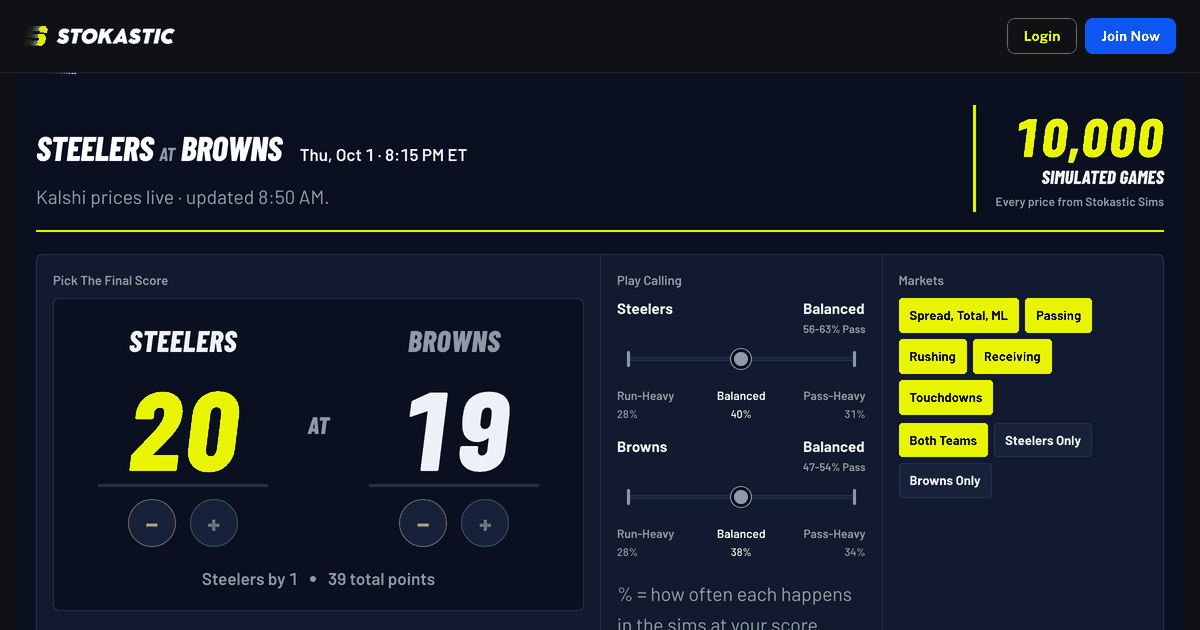 Kalshi sells combos too. The Kalshi Parlay Simulator prices any combo of a game's contracts against 10,000 simulated games before you buy it.
It is the same information a sportsbook gives you as American odds, only expressed differently:
| What You See | Kalshi (cents) | Sportsbook (American odds) | Implied probability |
|---|---|---|---|
| Modest Favorite (Illustrative) | 60¢ | around -150 | ~60% |
| Coin-Flip Market (Illustrative) | 50¢ | around +100 | ~50% |
| Longer Shot (Illustrative) | 25¢ | around +300 | ~25% |
| Live: Rams To Beat The Broncos (Pulled 11:30 a.m. ET Sept. 27) | 55¢ (the Rams Yes and a No on the Broncos both ask 55¢) | -125 (BetMGM, Circa, Pinnacle and five more) to -134 (Caesars) | 55% (Kalshi) vs 55.6% to 57.3% (books) |
| Live: Broncos To Beat The Rams (Same Pull) | 46¢ (the Broncos Yes and a No on the Rams both ask 46¢) | +113 (Caesars, Pinnacle and Bet105) to +105 (BetMGM, Circa and five more) | 46% (Kalshi) vs 46.9% to 48.8% (books) |
The live rows are the whole review in one game. Pulled Sunday morning, September 27 (about 11:30 a.m. ET, just under nine hours before the Sunday night kickoff in Denver), the Rams cost 55¢ at Kalshi. Kalshi lists a separate contract for each team, and a No on the Broncos pays exactly what a Yes on the Rams pays (a tie pays 50¢ either way). At this pull both routes asked the same 55¢, so there was no cheaper door. No sportsbook on the OddsShopper screen was that cheap: the best book price was -125 (55.6%), shared by BetMGM, Circa, Pinnacle and five others, with FanDuel at -126 (55.8%), DraftKings at -130 (56.5%) and Caesars the outlier at -134 (57.3%). Strip the vig from each of the 28 books quoting both sides and the consensus fair number was 53.9%, so the exchange sat under every book's posted price and still 1.1 points above fair, before the trading fee (the cons section below puts a number on it).
The Broncos were the side priced at fair, and the fee decided the venue. A No on the Rams and the Broncos' own Yes both asked 46¢, a tenth of a point under the 46.1% fair number and under every book; the best sportsbook price on the screen was +113 (46.9%), shared by Caesars, Pinnacle and Bet105. On a 100-contract order the fee at that price is 1.74¢ a contract, which lifts the all-in cost to 47.7¢, and half the board beat that: 14 of the 28 books at +110 or better, several of them offshore or Ontario-only, with Caesars the US-licensed book at the top and DraftKings' +110 (47.6%) among them. FanDuel's +108 (48.1%) did not.
Caesars had the worst sportsbook price on the screen for the favorite and a share of the best one on the underdog in the same game, which is the case for checking every price on every game instead of trusting one app. Nothing on either side beat the fair number once the fee was counted: the closest was the Broncos at 46¢ before the fee, and the fee ate the tenth of a point. So the comparison told you where to shop, not what to bet. The same side-by-side runs on every game.
Once you can read both boards in the same units, the two markets become directly comparable, which is exactly where the opportunity lives. For the full step-by-step of placing a trade, market orders versus limit orders, and setting your own number, see our step-by-step Kalshi guide; for picking the deepest, most tradeable markets, see how to attack the best Kalshi liquidity.
Stay ahead of the markets.
Daily insights and expert picks on Kalshi, Polymarket, and what's moving markets.
Free forever. Unsubscribe anytime.
What Moved Since September 21
This page was last edited on September 21. Three things are new in this edition.
- A Third Appeals Court Ruled, And It Went Against Kalshi. On September 25 a unanimous Sixth Circuit panel held that Kalshi had not shown its sports contracts are swaps inside the CFTC's exclusive jurisdiction, and that federal law does not preempt Ohio's or Tennessee's gambling laws. That makes two circuits against Kalshi, the Ninth and the Sixth, and one for it, the Third. On the app today, CBS Sports' tracker, updated the same day, still lists Ohio as live; Tennessee's judge had sided with Kalshi and that ruling is now reversed, so the eligibility screen is the check there. What it changes for the Supreme Court is the odds it takes the question, because a two-to-one split is harder to leave alone than a one-to-one.
- Kalshi Geofenced Three California Tribes' Lands. After the Ninth Circuit's September 16 ruling for the tribes, Kalshi told a federal court on September 24 that it had switched off its markets on the lands of the three tribes suing it, which Bloomberg Law reported as its first voluntary geofence. No state changed status on the tracker.
- The Live Game Is Sunday Night's. Giants at Rams has been played, so the price table now carries Rams at Broncos, pulled September 27 at 11:30 a.m. ET: Kalshi sat under every book on both sides before the fee, and a fee within a penny of its maximum on a 100-contract order put it behind all but one book on the favorite and half of them on the underdog. The numbers are in the pull above. The row goes stale at kickoff; the read does not.
None of that changes the promo-code answer, which is the next thing most readers ask.
Is There A Kalshi Promo Code?
Kalshi's own new-user offers change often (a referral bonus, a sign-up credit, a limited-time code, usually tied to a minimum trade), so this page does not print an amount that will be wrong next week; our Kalshi promo code page tracks the current offer and its terms.
The more useful answer is that on an exchange the promo is never the edge. A one-time bonus is small next to paying a better price than the books on games you were going to bet anyway, every week, for a season. One note to avoid confusion: the KALSHI20 code in this article is an OddsShopper discount for our own odds-comparison tools, not a Kalshi bonus.
Kalshi Vs. The Sportsbooks: Where The Edge Is
Because Kalshi is a peer-to-peer market and a sportsbook is a house with a built-in margin, the two frequently price the same outcome differently. When Kalshi's implied probability is cheaper than the sportsbook's true (de-vigged) number, Kalshi is the better buy. When it is the other way around, the book wins that one. Your job is to know which is which on each game. The Rams-Broncos pull above is what that looks like in practice: the Rams cost 55¢ against a 53.9% fair number and a best book price of 55.6%, so the exchange was the cheaper ticket, but a point over fair before the fee and behind 27 of the 28 books after it; on the underdog, 46¢ became 47.7¢ with the fee and Caesars' +113 (46.9%) sat under it, so a book was the better price there, and nothing on the screen beat the 46.1% fair number once the fee was counted. On combos, the edge is easier to see: run the combo through 10,000 sims and compare the sims' price with Kalshi's ask.
| Kalshi (exchange) | Traditional sportsbook | |
|---|---|---|
| Who You Trade Against | Other participants | The house |
| Where The Margin Goes | Trading fees | Vig baked into the line |
| Can You Set Your Own Price? | Yes, with a limit order | No, you take the posted line |
| Why Prices Differ | Supply and demand | Bookmaker's number plus margin |
| Best Use For A Bettor | Find the mispriced side | Deep liquidity, familiar markets |
The practical move is to line them up side by side. Convert Kalshi's cents to a probability, strip the vig out of the sportsbook price to get its fair number (ideally across several sharp books, since a market consensus beats any single book's line), then take whichever side is priced better than that fair estimate. Do that by hand and it is slow. This is where the tooling earns its keep: the tool scans 100+ sportsbooks and surfaces the best number across the books on each side, giving you a clean market baseline to hold up against Kalshi's board, so you can catch the game where Kalshi's price beats DraftKings 🎁, FanDuel 🎁, or BetMGM 🎁 instead of eyeballing two screens. Open the OddsShopper odds screen next to Kalshi's board on tonight's biggest game and the gaps jump out.
Since Kalshi is an exchange rather than a book, there is a second thing worth watching: how much depth actually sits behind a price. OddsShopper's Liquidity Tool is built to read exchange and prediction-market liquidity, so you can gauge how real a Kalshi number is, meaning whether there is enough behind it to trade at size, before you commit. That is the part we keep coming back to, because a cheap price only helps if you can actually get filled on it.
New to OddsShopper?It scans 100+ sportsbooks in real time and flags the bets priced in your favor, which is the exact side-by-side comparison this review just walked through, done automatically. Try it free for 7 days, and OddsShopper code KALSHI20 takes 20% off OS Pro or OS Core if you subscribe (this is an OddsShopper discount, not a Kalshi offer).
The Honest Cons You Should Know
An exchange is not a free lunch, and a fair review has to cover the downsides.
- Settlement Rules Can Surprise You. In January 2026, some NFL futures markets were closed early and initially settled short before the error was corrected — a reminder that how and when an exchange resolves a market is itself a variable you are exposed to. Read how a specific market settles before you put money on it.
- Liquidity Is Thin Outside The Marquee Markets. A big NFL or NBA game has enough resting orders that you get filled near the posted price. A niche market can have wide spreads and a price you cannot actually trade at size. Our Kalshi liquidity guide covers how to tell the difference and stick to the deep markets.
- Fees Are Not Zero. No vig does not mean no cost. A trading fee applies to every fill, so factor it into any edge you think you have; a razor-thin price advantage can evaporate after fees, and the two live rows above show both outcomes: the standard fee on a 100-contract order at 55¢ ($1.74 under the fee formula, a cent under the $1.75 maximum, which comes at exactly 50¢) lifts the Rams' all-in cost to 56.7¢, the same -131 the OddsShopper screen showed for Kalshi and behind every book but Caesars, while on the Broncos the same fee turned a price a tenth of a point under fair into one that 14 books beat. A one-contract order pays 2¢, because the fee rounds up to the next cent.
None of this makes Kalshi a bad tool. It makes it a tool you use with your eyes open, on the markets and states where it makes sense, and the discipline that goes with it is to take the better-priced side of the same outcome and pass when neither market beats the true odds — the same selectivity behind positive-EV betting and arbitrage.
Tools for this: price any Kalshi combo against the sims, or the Polymarket Combo Simulator for Polymarket's book.
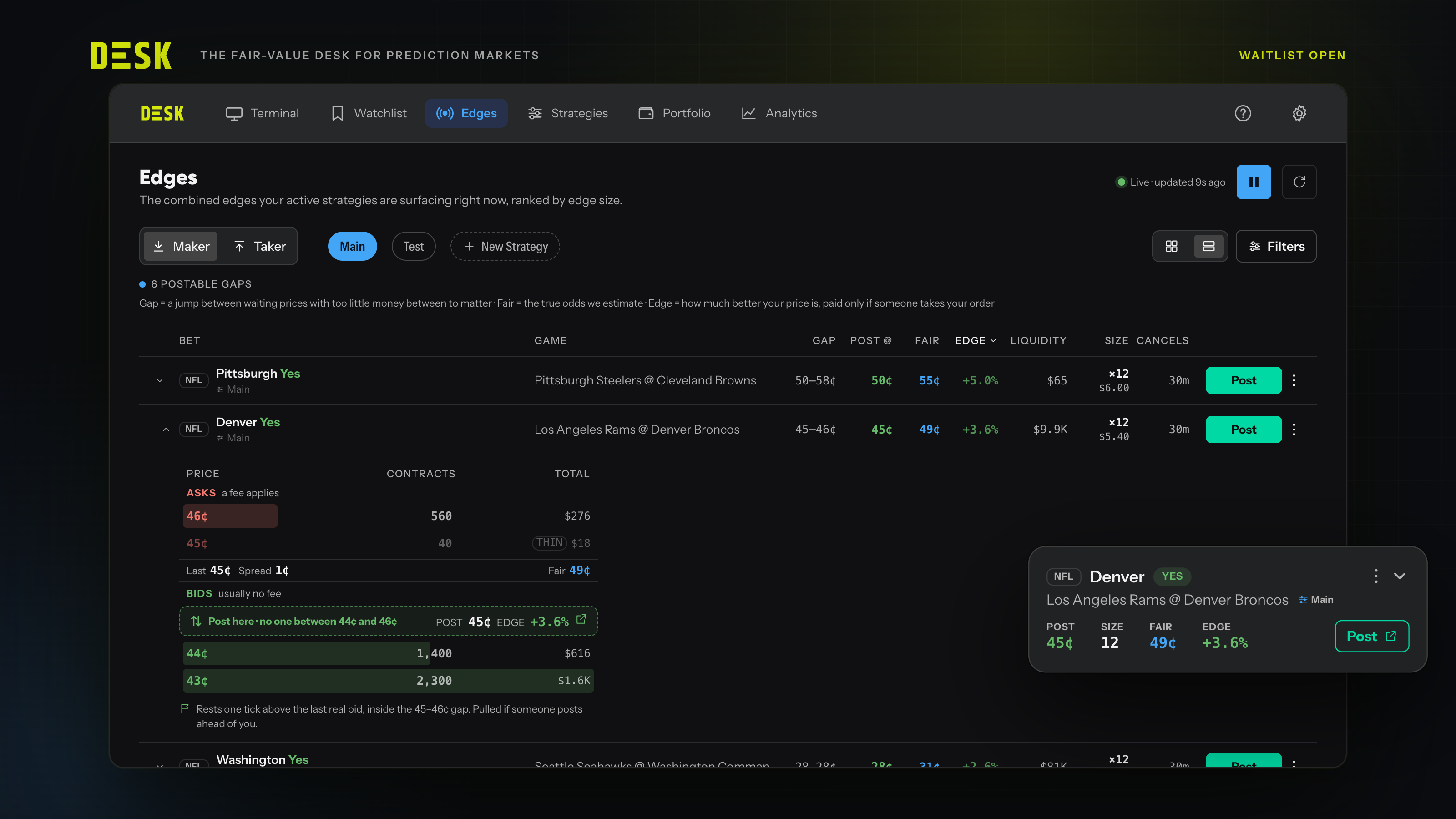
More on this: Is Kalshi Legit? What CFTC Regulation Protects (2026) · Kalshi Promo Code 2026: Current Offers And How They Work · ProphetX Review 2026: Is ProphetX Legit? States & Fees · Underdog Predict Review 2026: How The Fantasy Giant's Prediction Market Works · How To Bet Sports On Kalshi: 4 Steps, Odds In Cents
Make it a routine: pull up tonight's biggest game on both boards, convert Kalshi's cents to a probability, compare it against the de-vigged consensus from the books, subtract Kalshi's fees, and only fire when the edge clears a threshold you set ahead of time, passing on the thin markets where a wide spread eats the value. OddsShopper builds that book consensus and flags the +EV and arbitrage spots for you, so the part you do by hand shrinks to a glance. OddsShopper code KALSHI20 takes 20% off OS Pro or OS Core after the 7-day free trial.
Nothing here is financial advice. Prediction-market and sports-betting availability and legality vary by jurisdiction; know your state's rules and play responsibly. If gambling stops being fun, call 1-800-GAMBLER.
Trade prediction markets on Polymarket too.Most readers here already have Kalshi — Polymarket is the other major venue, and code OS4 adds a $50 trading bonus on a $10 deposit: Get the Polymarket bonus →
Affiliate disclosure: OddsShopper earns a commission on signups through this link. Terms as stated by Polymarket; 18+, availability varies by state.