A Kalshi market with no liquidity is not broken. It is empty. When only a handful of contracts rest on each side, the number on the screen is a price nobody is committed to, your limit order sits there all day, and a market order pays a nickel or a dime to cross. The fix is not a different order type. It is a different market, and you can tell which is which in about five seconds by reading the depth before you trade.
| Liquid market | Thin market | |
|---|---|---|
| Bid-Ask Spread | 1–2 cents | 5–10+ cents |
| Size Resting On Each Side | Hundreds of contracts | A handful |
| Limit Orders | Fill fast, often at the bid | Sit unfilled |
| Posted Price | One you can actually get | Often untradeable |
Illustrative ranges, not fixed thresholds. Always confirm depth in the live order book before you bet.
What Is A Liquid Kalshi Market?
Kalshi is an exchange, so when you buy a Yes or No contract you are trading against other people through an order book, not against a house, and liquidity is simply how much size is sitting in that book waiting to trade. A liquid market has lots of buyers and sellers stacked up at prices close together; a thin one has just a few, scattered far apart. New to the mechanics? Our step-by-step Kalshi guide covers the order ticket itself.
The deepest sports markets are the ones you would guess: NFL and big NBA or MLB game moneylines, plus the marquee championship futures. Those are where the spread is a penny or two and the cost of getting in or out is close to nothing. Out on the niche boards the spread can be a nickel or a dime wide, which is real money out of your entry and exit before you have had an opinion about anything.
One caveat up front: the legal status of sports event contracts has been contested and shifts over time, so confirm what is available where you are.
For the conceptual foundations — depth, spreads, and why liquidity begets liquidity — see our prediction market liquidity explainer.
Stay ahead of the markets.
Daily insights and expert picks on Kalshi, Polymarket, and what's moving markets.
Free forever. Unsubscribe anytime.
How Kalshi Liquidity Works (Reading The Order Book)
Every Kalshi market has two numbers worth reading before you click: the best bid (the highest price someone will pay you for a Yes contract right now) and the best ask (the lowest price someone will sell one to you for, which is what you pay to buy). The distance between them is the spread, and the size resting at each price is the depth.
Take a liquid moneyline on a nationally televised game: it might show Yes bid at 57 cents and offered at 58, with hundreds of contracts available on each side. You can buy at 58, sell back at 57, and barely feel the spread, the way a sharp price on a top sportsbook barely moves when you bet it. A thin futures market on an obscure outcome might show 40 bid, 52 offered, with a handful of contracts each. The midpoint there is misleading, because you can only really buy near 52 or sell near 40, and any size beyond the few resting contracts moves the market. Reading depth before you bet tells you whether the number on the screen is one you can really get.
How I read an order book in practiceBefore I risk a dollar, I check one thing: is there real size stacked within a cent or two of the posted price? If there is, the number on the screen is one I can actually get at size. If the depth is a few contracts scattered a dime apart, I treat the posted price as fiction and wait for a market with more behind it.
The firms resting those orders are the subject of our Kalshi market maker deep dive.
How To Attack A High-Liquidity Kalshi Market
Once you have found a deep market, work it like this:
- Confirm the depth. Check that there is real size on both the bid and the ask, and that the spread is tight (a cent or two). That is your green light that the posted price is tradeable.
- Convert the cents to implied probability. A contract at 58 cents is the market pricing that outcome at about a 58% chance, before Kalshi's small trading fee. That single number is what lets you compare it to a sportsbook's odds.
- Line it up against the sportsbooks. Pull the same outcome at the books, strip out the vig, and convert their odds. If a book has your side at a de-vigged 60% and Kalshi has it at 58 cents (about 58% implied, before Kalshi's trading fee), Kalshi is the better number.
- Take the better-priced side, not the exchange by default. Sometimes the books are sharper. The discipline is to bet whichever side is priced below its true probability, wherever that is.
- Improve your number with a limit order when the spread gives you room (more on that next).
The faster you can do steps 2 and 3 across every market, the more often you catch the spots where Kalshi and the books disagree.
Market Orders Vs. Limit Orders (The Exchange Edge)
This is where liquidity pays you directly. A market order crosses the spread immediately: a market buy takes the best ask, a market sell hits the best bid, so you pay the spread for the convenience of an instant fill. A limit order lets you post the exact price you want and wait for someone to take the other side. On a sportsbook you take the number or you don't; on Kalshi you can ask for a better one.
Depth is what makes that ability pay, because limit orders only help if they fill. If Yes is 57 bid at 58, you can post a buy at 57 to join the bid instead of paying the 58 ask, and if it fills you pocket the cent a market-order bettor just gave away. On a thin market the same limit order can sit unfilled all day, which is exactly why depth matters: liquidity is what turns "set your own price" from a nice idea into a tool you can actually use.
Finding The +EV Side: Kalshi Vs. The Sportsbooks
Because a Kalshi price is set by an order book rather than one house, it often disagrees with the sportsbooks, and that disagreement is the opportunity. Take a hypothetical: a title contender is 58 cents on Kalshi (about 58% implied) to win a Finals game, while FanDuel 🎁 and DraftKings 🎁, once you strip out the vig, both sit closer to a 60% no-vig probability. If the Kalshi contract settles on the same outcome as the book's bet, the exchange is selling the same bet cheaper than the consensus, and on a deep market where you can actually get filled, that is a +EV side.
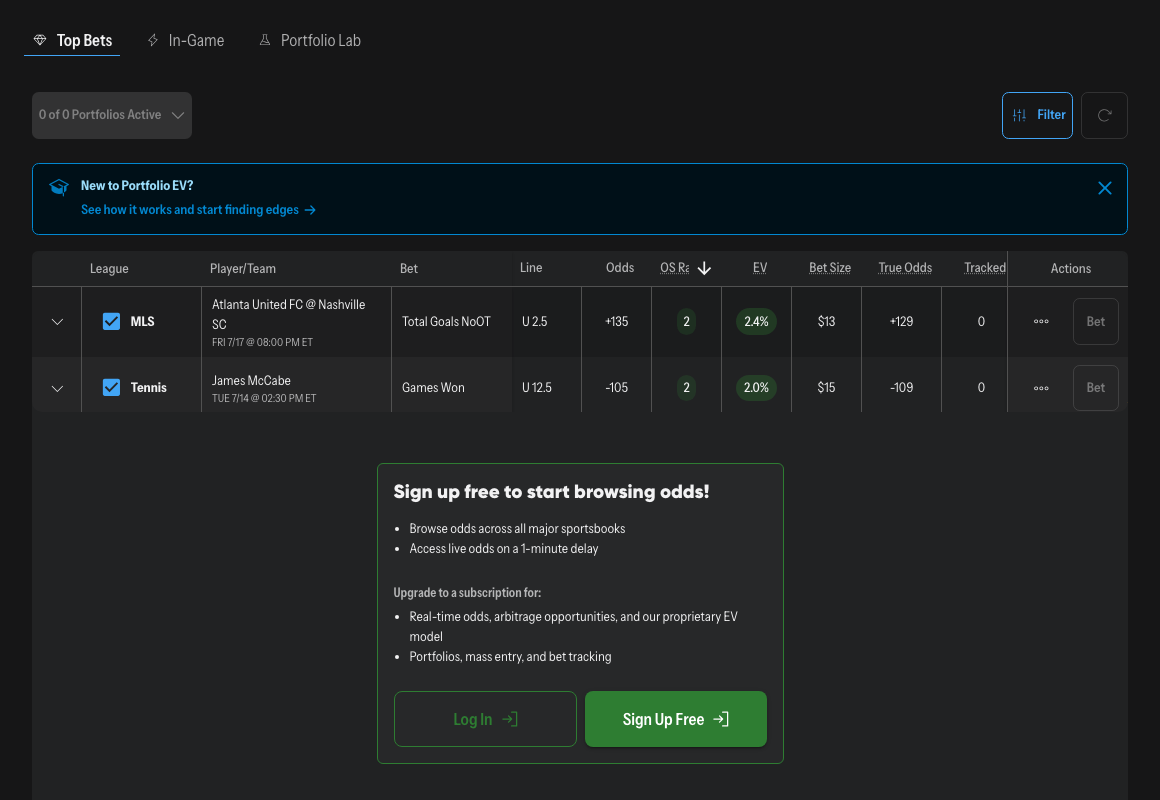
The OddsShopper +EV Screen.
My filter is narrow, and depth is the first line of it: tight spread, enough resting size to cover the stake, fee subtracted before I compare, and I pass unless what is left clears a couple of points. Anything thinner gets eaten by the fee and the slippage. It cuts the other way as often as not, so the exchange never gets the benefit of the doubt, and plenty of games are priced identically on both boards. When there is no gap, the bet is no bet.
When the two are far enough apart, you can sometimes play the discrepancy across the exchange and a book for a defined gap, the same idea as arbitrage. Liquidity is the make-or-break there, because an arb only works if you can get both fills at size before the prices move, and the books move fast to limit anyone doing it repeatedly.
Don't eyeball it. Line Kalshi up against every book.The OddsShopper odds comparison and Arbitrage tool put Kalshi right next to the sportsbooks so you can convert, compare, and take the best number on the markets deep enough to bet, and flag the spots where the exchange and a book are far enough apart to back both sides of a gap while they are still fillable. Try it free for 7 days, then code KALSHI20 takes 20% off OS Pro or OS Core if you stay.
Line Kalshi up against every sportsbook with the OddsShopper odds tools, and catch the book-vs-exchange gaps with the Arbitrage tool. New here? Every new member gets a free 7-day trial, plus 20% off OS Pro or OS Core with code KALSHI20.
Trade prediction markets on Polymarket too.Most readers here already have Kalshi — Polymarket is the other major venue, and code OS4 adds a $50 trading bonus on a $10 deposit: Get the Polymarket bonus →
Affiliate disclosure: OddsShopper earns a commission on signups through this link. Terms as stated by Polymarket; 18+, availability varies by state.
More on this: Kalshi Liquidity Before Close: The Book Empties Out · Which Kalshi Markets Are Actually Liquid? We Measured 48 · How To Bet On Kalshi If You Already Bet Sports · Prediction Market Liquidity: Why It Decides If You Can Trade · Kalshi Review 2026: No Vig, But One Catch In Your State