Who is favored for NFL MVP after Week 3? Josh Allen, at 25 cents on Kalshi, 24 cents on Polymarket as of 8:30 AM ET Tuesday, September 29. He was 27 cents on Kalshi before the first kick of the week.
MVP voting rewards production on a winning team, and Josh Allen gave voters the win in Week 3 without the passing. The Bills beat the Chargers 24-16. Allen threw for 204 yards with no touchdown passes and two interceptions, and both of his touchdowns came on the ground. The Chargers were sixth in the league in 2025, sixth against the pass. Kalshi took 2 cents off him, from 27 to 25.
Brock Purdy made the biggest move of the week. He threw four touchdowns and 297 yards in a 36-30 win over the Cardinals and climbed 7 cents to 19. Lamar Jackson added 3 cents to 11 after the Ravens won 34-31 in Dallas. Drake Maye fell the furthest, 3 cents to 2, after a 35-6 loss in Jacksonville with no touchdowns and two interceptions. Tyler Shough, Dak Prescott and Jalen Hurts each gave back 2 cents.
In this week's update
- The odds. Kalshi and Polymarket side by side, each name's move since the last close before Week 3, and where he is cheapest to buy.
- Every name in the top 16. The Week 3 line, why the price sits where it does, and what he needs to stay in the race.
- What moves it next. The Week 4 games that can reprice the top of the market by Sunday night.
Stay ahead of the markets.
Daily insights and expert picks on Kalshi, Polymarket, and what's moving markets.
Free forever. Unsubscribe anytime.
The Odds After Week 3
Kalshi and Polymarket as of 8:30 AM ET Tuesday, September 29. "Before Week 3" is Kalshi's close at midnight ET going into Thursday, September 24.
| Player | Kalshi before Week 3 | Kalshi now | Move | Polymarket | Cheapest place to buy |
|---|---|---|---|---|---|
| Josh Allen | 27¢ | 25¢ | ▼ −2¢ | 24¢ | Polymarket |
| Brock Purdy | 12¢ | 19¢ | ▲ +7¢ | 16.2¢ | Polymarket |
| Lamar Jackson | 8¢ | 11¢ | ▲ +3¢ | 15¢ | Kalshi |
| Patrick Mahomes | 9¢ | 9¢ | — | 9.9¢ | Kalshi |
| Joe Burrow | 9¢ | 8¢ | ▼ −1¢ | 7.4¢ | Polymarket |
| Trevor Lawrence | 5¢ | 6¢ | ▲ +1¢ | 6.9¢ | Kalshi |
| Tyler Shough | 5¢ | 3¢ | ▼ −2¢ | not listed | Kalshi |
| Caleb Williams | 4¢ | 3¢ | ▼ −1¢ | 5.4¢ | Kalshi |
| Dak Prescott | 5¢ | 3¢ | ▼ −2¢ | 2.1¢ | Polymarket |
| Matthew Stafford | 4¢ | 3¢ | ▼ −1¢ | 2¢ | Polymarket |
| Jahmyr Gibbs | 2¢ | 3¢ | ▲ +1¢ | 2.1¢ | Polymarket |
| Drake Maye | 5¢ | 2¢ | ▼ −3¢ | 1.1¢ | Polymarket |
| Kyler Murray | 1¢ | 2¢ | ▲ +1¢ | not listed | Kalshi |
| Jalen Hurts | 4¢ | 2¢ | ▼ −2¢ | 3.2¢ | Kalshi |
| Jordan Love | 2¢ | 2¢ | — | 0.8¢ | Polymarket |
| Jared Goff | 1¢ | 1¢ | — | 1.6¢ | Kalshi |
| Bryce Young | 1¢ | 1¢ | — | not listed | Kalshi |
| Justin Herbert | 2¢ | 1¢ | ▼ −1¢ | 0.7¢ | Polymarket |
| Bo Nix | 1¢ | 1¢ | — | 1.2¢ | Kalshi |
| Jaxson Dart | 1¢ | 1¢ | — | 0.4¢ | Polymarket |
| CJ Stroud | 1¢ | 1¢ | — | not listed | Kalshi |
| Jaxon Smith-Njigba | 1¢ | 1¢ | — | not listed | Kalshi |
| Baker Mayfield | 1¢ | 1¢ | — | 0.5¢ | Polymarket |
| Daniel Jones | 1¢ | 1¢ | — | not listed | Kalshi |
What Wins The Award, And What Moved The Odds
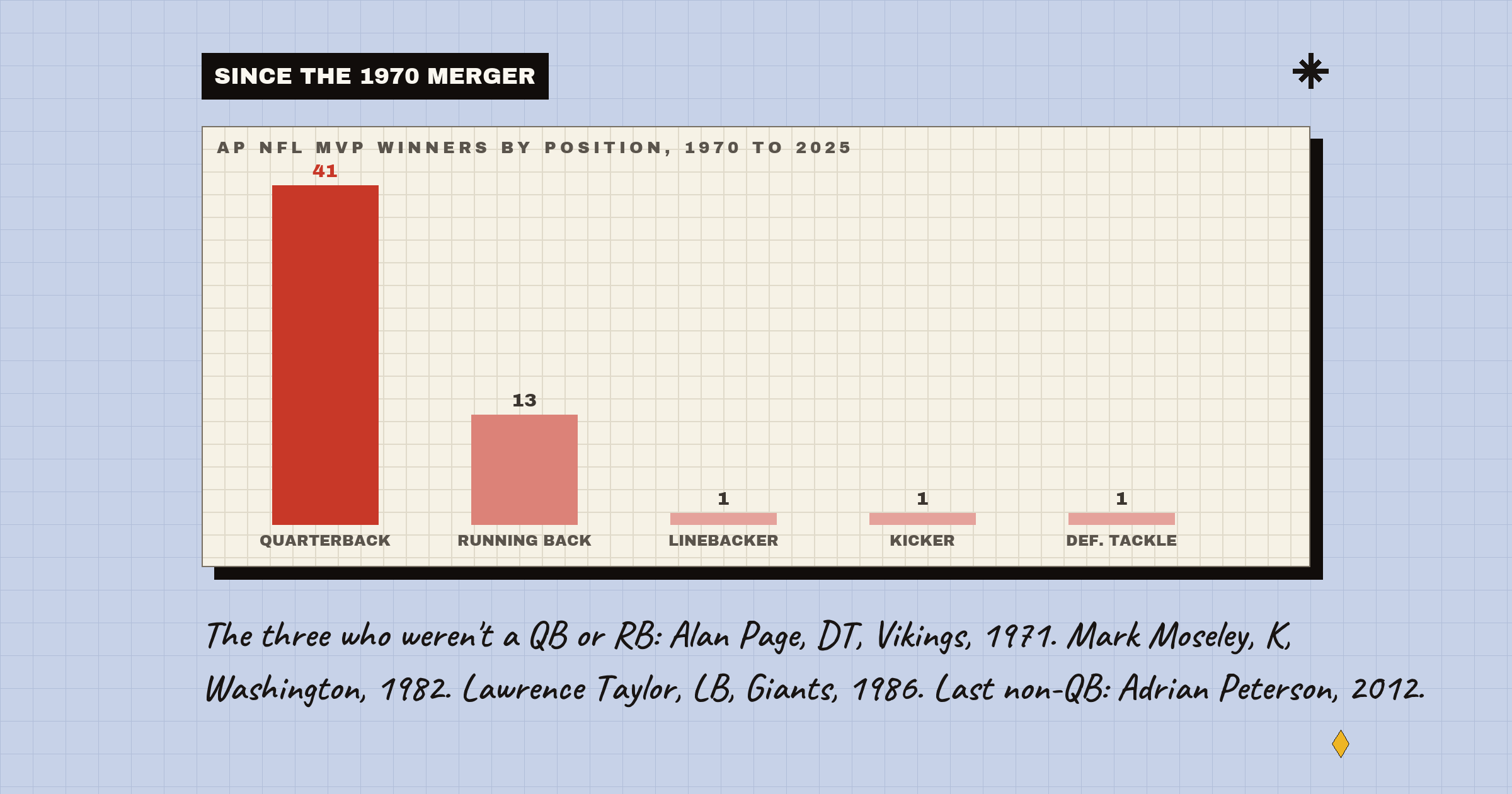
Voters start with the team's record, then count total touchdowns, passing and rushing, and look at passing volume after that; when two cases are close, the story settles it. The Week 3 prices followed that order. Tyler Shough threw four touchdowns and lost 2 cents because the Saints lost to the Raiders, while Purdy threw four in a win and gained 7. Joe Burrow's three touchdowns in a 30-27 loss at Pittsburgh cost him a cent.
Up: Brock Purdy climbed 7 cents to 19 on four touchdown passes and 297 yards in a 36-30 win over the Cardinals. Lamar Jackson rose 3 cents to 11 after two touchdown passes and 50 rushing yards in a 34-31 win at Dallas. Trevor Lawrence added a cent to 6 after three touchdown passes in a 35-6 win over the Patriots. Jahmyr Gibbs went to 3 cents on 99 rushing yards and two scores against the Jets. Kyler Murray moved from 1 cent to 2 after the Vikings won 23-16 in Tampa.
Down: Drake Maye dropped 3 cents to 2 after a 35-6 loss at Jacksonville with no touchdowns and two interceptions. Josh Allen slipped 2 cents to 25 because the win came with no touchdown passes. Tyler Shough fell 2 cents to 3 when four touchdowns weren't enough to beat the Raiders. Dak Prescott lost 2 cents to 3 after one touchdown in a home loss to Baltimore. Jalen Hurts went from 4 cents to 2 after a 27-7 loss in Chicago. Joe Burrow, Caleb Williams and Matthew Stafford each lost a cent, to 8, 3 and 3.
Flat: Patrick Mahomes held at 9 cents after two touchdowns in a 24-10 win at Miami against a defense that ranked 25th in 2025. Jordan Love stayed at 2 cents after throwing 53 times in a 35-14 home loss to the Falcons. Jared Goff stayed at 1 cent while Gibbs scored twice on the ground in the win over the Jets.
Through Week 3
Josh Allen, Bills · 25¢ ▼ −2¢
Allen threw for 204 yards with no touchdown passes and two interceptions, took four sacks and ran for two touchdowns in a 24-16 win over the Chargers, sixth in 2025 against the pass. He is still the favorite at 25 cents because the Bills keep winning. What he needs to stay in the race: touchdown passes against the Patriots on Sunday, a defense that ranked 10th against the pass in 2025.
Brock Purdy, 49ers · 19¢ ▲ +7¢
Purdy threw for 297 yards and four touchdowns on 27 attempts with no interceptions in a 36-30 win over the Cardinals. That took him from 12 cents to 19 on Kalshi, and Polymarket has him cheaper at 16.2. The Cardinals were 27th against the pass in 2025. What he needs to stay in the race: the same touchdown output against the Broncos on Sunday, eighth in 2025 and ninth against the pass.
Lamar Jackson, Ravens · 11¢ ▲ +3¢
Jackson completed 15 of 20 for 186 yards and two touchdowns, ran for 50 yards, and the Ravens won 34-31 in Dallas. The Cowboys were last in the league in 2025 and 31st against the pass, which limits how much the win adds. He rose 3 cents to 11 on Kalshi and sits at 15 on Polymarket. What he needs to stay in the race: a clear win over the Titans on Sunday.
Patrick Mahomes, Chiefs · 9¢ — no move
Mahomes went 20 of 24 for 246 yards, two touchdowns and an interception in a 24-10 win at Miami, and his price stayed at 9 cents. The Dolphins were 25th in 2025 and 26th against the pass, so the win added nothing. What he needs to stay in the race: a multi-touchdown game at Las Vegas on Sunday against a Raiders defense that was 22nd against the pass in 2025.
Joe Burrow, Bengals · 8¢ ▼ −1¢
Burrow threw for 282 yards and three touchdowns with no interceptions, and the Bengals still lost 30-27 at Pittsburgh. The loss cost him a cent, down to 8 on Kalshi, and Polymarket has him at 7.4. What he needs to stay in the race: a win over the Jaguars on Sunday, a game that also decides whether Trevor Lawrence stays in it.
Trevor Lawrence, Jaguars · 6¢ ▲ +1¢
Lawrence threw three touchdowns and an interception on 182 yards in a 35-6 win over the Patriots, a defense that ranked 11th in 2025 and 10th against the pass. He added a cent to 6 on Kalshi. The passing yards are thin for an MVP case, and that keeps him in single digits. What he needs to stay in the race: a win at Cincinnati on Sunday against Joe Burrow.
Tyler Shough, Saints · 3¢ ▼ −2¢
Shough threw for 255 yards, four touchdowns and an interception against the Raiders, and the Saints lost 35-27 as 3.5-point favorites. Kalshi took 2 cents off, down to 3, because four touchdowns in a loss count for less than two in a win. Polymarket has no price on him. What he needs to stay in the race: a win over the Falcons on Monday, October 5.
Caleb Williams · 3¢ ▼ −1¢
Williams did not post a Week 3 stat line, and his price slipped a cent to 3 on Kalshi. Polymarket has him higher at 5.4, so Kalshi is the cheaper place to buy him. With nothing new for voters to count this week, the price drifted. What he needs to stay in the race: a game on the stat sheet with touchdowns in a win.
Dak Prescott, Cowboys · 3¢ ▼ −2¢
Prescott threw for 276 yards and one touchdown on 41 attempts, and the Cowboys lost 34-31 at home to the Ravens as 3-point underdogs. One touchdown in a loss cost him 2 cents, down to 3 on Kalshi, and Polymarket has him at 2.1. What he needs to stay in the race: a win at Houston on Sunday with more than one touchdown pass.
Matthew Stafford, Rams · 3¢ ▼ −1¢
Stafford threw 53 times for 390 yards, two touchdowns and two interceptions, and was sacked four times in a 30-26 loss at Denver. The Broncos were eighth in 2025 and ninth against the pass. The yards came without the win, and he lost a cent to 3 on Kalshi. What he needs to stay in the race: a win at Philadelphia on Sunday.
Jahmyr Gibbs, Lions · 3¢ ▲ +1¢
Gibbs ran 20 times for 99 yards and two touchdowns in a 31-24 win over the Jets, who were 30th in 2025. He rose a cent to 3 on Kalshi, and he is the only running back in this group. Polymarket has him at 2.1. What he needs to stay in the race: another multi-touchdown game at Carolina on Sunday.
Drake Maye, Patriots · 2¢ ▼ −3¢
Maye threw for 199 yards, no touchdowns and two interceptions, and was sacked three times in a 35-6 loss at Jacksonville. The Jaguars were fourth in 2025, overall and against the pass. He fell 3 cents to 2 on Kalshi, the biggest drop of the week, and sits at 1.1 on Polymarket. What he needs to stay in the race: a win at Buffalo on Sunday against Josh Allen.
Kyler Murray, Vikings · 2¢ ▲ +1¢
Murray threw for 168 yards, one touchdown and one interception in a 23-16 win at Tampa Bay. The win moved him from 1 cent to 2 on Kalshi, and Polymarket has no price on him. The Vikings are winning, but 168 yards and one touchdown won't draw votes. What he needs to stay in the race: a bigger passing day against the Dolphins on Sunday.
Jalen Hurts, Eagles · 2¢ ▼ −2¢
Hurts threw for 153 yards with no touchdown passes and an interception, ran for one score, and the Eagles lost 27-7 at Chicago as 3.5-point favorites. He fell 2 cents to 2 on Kalshi, and Polymarket has him at 3.2. What he needs to stay in the race: a win over the Rams on Sunday with touchdowns through the air.
Jordan Love, Packers · 2¢ — no move
Love threw 53 times for 312 yards, two touchdowns and an interception, and the Packers lost 35-14 at home to the Falcons as 4.5-point favorites. His price held at 2 cents on Kalshi, and he is 0.8 on Polymarket. Those passing yards came in a lopsided loss and didn't help his case. What he needs to stay in the race: a win at Tampa Bay on Sunday.
Jared Goff, Lions · 1¢ — no move
Goff completed 25 of 32 for 269 yards and two touchdowns with no interceptions in a 31-24 win over the Jets. He stayed at 1 cent on Kalshi and 1.6 on Polymarket, while Gibbs's two rushing touchdowns took some of the credit. What he needs to stay in the race: a bigger share of the Lions' touchdowns at Carolina on Sunday.
What Moves The Odds In Week 4
- Patriots at Bills, Sunday 10/04: Josh Allen at 25 cents faces a New England defense that was 10th against the pass in 2025, and Drake Maye at 2 cents needs the upset.
- Broncos at 49ers, Sunday 10/04: Brock Purdy at 19 cents gets a Denver defense that ranked eighth in 2025 and just held Matthew Stafford to a 30-26 loss.
- Titans at Ravens, Sunday 10/04: Lamar Jackson at 11 cents plays at home after the 34-31 win in Dallas.
- Jaguars at Bengals, Sunday 10/04: Joe Burrow at 8 cents and Trevor Lawrence at 6 play each other, and one of them takes a loss.
The Bottom Line
Allen is still the favorite at 25 cents on Kalshi, and after his 2-cent drop and Purdy's 7-cent gain, Purdy is 6 cents behind. Allen and Purdy are cheapest on Polymarket at 24 and 16.2, while Jackson and Mahomes are cheaper on Kalshi at 11 and 9. We update this page every Tuesday.
Prices shown are market odds; our reads are model estimates, not predictions of fact and not financial advice.
Hero illustration: OddsShopper, in the house collage style. Josh Allen photo by Erik Drost, licensed CC BY 2.0; photos cropped, toned, and composited.
More on this: NFL 2026 on Kalshi: 49 Live Boards, 10 Days To Kickoff · Kalshi vs DraftKings: Every NFL Opener Is Cheaper On Kalshi · Drake Maye MVP Odds: Someone Bet Six Figures Against Him · Sam Darnold MVP Odds
If you trade on Polymarket, code OS4 gets new users a $50 trading bonus on a $10 deposit on the Polymarket US App — affiliate link; we may earn a commission. 18+ Only. Restrictions and eligibility requirements apply. Not available in all jurisdictions. Trading is risky. 100% loss can occur. See polymarket.com/tos for more information.