Every NBA game on the board comes with a set of numbers next to it, and those numbers are the whole game. Learn to read an NBA betting line and you know exactly what a bet needs to happen to win, how much it pays, and which side the sportsbook thinks is stronger. Most beginners can pick a team just fine. Where they leak money is in reading the line wrong, or in taking the first price they see instead of the best one. This guide walks through the three main NBA betting lines, how to read the plus and minus, and how to make sure the number you bet is actually the best one available. The habit I keep coming back to, after years of staring at these boards, is dead simple: read the line right, then shop it.
TL;DR: NBA Betting Lines At A Glance
- Point Spread — the margin the favorite must cover. Minus = favorite gives points, plus = underdog gets them. A win by the exact number on a whole-number spread is a push.
- Total (Over/Under) — the combined points both teams score, winner ignored. Bet over or under the posted number; an exact landing is a push.
- Moneyline — who wins outright, no margin. Minus is what you risk to win $100; plus is what a $100 bet returns.
- The Plus/Minus Rule — the minus sign always marks the favorite on both the spread and the moneyline. Spot it first.
- The Real Edge — the same NBA line is priced differently at every book, and taking the best number every time is an edge you can build without out-handicapping anyone. That is what OddsShopper automates.
Watch: How To Read NBA Betting Lines
This walkthrough from the OddsShopper channel breaks down the NBA bet types on a real board, from point spreads to same game parlays. It pairs with everything below.
What Is An NBA Betting Line?
A betting line is the number a sportsbook posts to price and balance a game. Three lines cover almost every NBA bet you will place: the point spread, the total, and the moneyline. Books like DraftKings, FanDuel, BetMGM, and Caesars all post their own version of each one, and the numbers are not always the same from book to book. That last part matters more than most beginners realize, and it is where the real edge lives.
Quick tipthe minus sign always marks the favorite, whether you are looking at a spread or a moneyline. Once you can spot that sign on sight, the rest of the number is just arithmetic.
The Point Spread
The point spread is the sportsbook's handicap. It sets a margin the favorite has to beat and gives the underdog a cushion, so a bet on either side is close to a coin flip on price. The favorite carries a minus sign, the underdog a plus sign.
Say a favorite is listed at -5.5. Here is what each side needs to cash:
- Favorite -5.5: wins the bet by winning the game by 6 points or more.
- Underdog +5.5: wins the bet if that team loses by 5 or fewer, or wins the game outright.
- Whole-Number Spread (Like -6): a win by exactly 6 is a push, and your stake is refunded. The half-point "hook" exists so there is no tie.
The spread is why margin of victory is everything on this bet. Your team can win the game and still lose the bet if it does not cover the number.
The Total (Over/Under)
The total, also called the over/under, is a projection of the combined points both teams score. You are not betting on who wins, only on whether the final adds up to more or less than the posted number. If the total is 224.5, the over cashes at 225 combined points and the under cashes at 224. As with the spread, a whole-number total that lands exactly on the line is a push and gets refunded, which is why so many totals carry a half-point.
The total ignores the winner completely. One team can score 130 and the other 90, and all that matters is that the 220 combined cleared or missed your number.
The Moneyline
The moneyline strips everything else away. You are picking who wins the game outright, with no spread and no margin to worry about. The price is where the favorite-versus-underdog gap shows up.
Minus numbers show what you risk to win $100. Plus numbers show what you win on a $100 bet. For example, a favorite at -190 means you lay $190 to win $100, while an underdog at +160 means a $100 bet wins you $160. The bigger the favorite, the more you have to lay to win the same $100, which is the book charging you for the safer side.
Here is how the three lines line up side by side:
| Line | What you're betting on | How to read it |
|---|---|---|
| Point Spread | Margin of victory (does the favorite cover?) | Minus = favorite gives points; plus = underdog gets points |
| Total (Over/Under) | Combined points, both teams | Bet over or under the posted number; exact = push |
| Moneyline | Who wins outright | Minus = risk to win $100; plus = win on a $100 bet |
Turn The Plus And Minus Into A Probability
The table above tells you what the plus and minus mean; the next step is turning that price into the number that actually matters — the win probability the book is charging you for. A minus price converts with the formula odds ÷ (odds + 100): a -190 favorite is 190 ÷ 290, or about 66% implied. A plus price uses 100 ÷ (odds + 100): a +160 underdog is 100 ÷ 260, or roughly 38%. If mental math is not your thing, run any price through our odds converter and it spits out the implied probability for you. Do that and you stop seeing "favorite" and "underdog" and start seeing a break-even percentage you can argue with. This same math carries into player props and boosted prices, so the habit pays off everywhere on the board. For a fuller walkthrough of American, decimal, and fractional pricing, see our guide on how to read betting odds.
Why The Same Line Is Different At Every Book
This is where a lot of beginners leave money on the table. The same NBA game is priced a little differently at every book, and those small gaps are real money over a season. A favorite might be -190 at one book and -175 at another. An underdog might be +150 in one place and +165 in another.
Take that underdog example. A winning $100 bet returns $150 in profit at +150, but $165 at +165. Same team, same result, more money in your pocket, purely because you took the better number:
| The Same Underdog, Two Books | Price | $100 winner returns | You keep |
|---|---|---|---|
| Book With The Shorter Number | +150 | $150 profit | — |
| Book With The Best Number | +165 | $165 profit | +$15 |
That $15 looks small on one bet. Multiply it across every wager you place in a season and shopping the line becomes one of the few edges a recreational bettor can build without handicapping a single game better than anyone else. I would rather bank that $15 for free than sweat a smarter read on the game.
Part of why the numbers differ is that every book bakes a margin (the vig) into its line, so the price you see is never the true, no-vig fair price. A standard two-way NBA market posted at -110 on both sides carries roughly a 4.5% hold — the book's built-in cut — and the deeper that hold, the worse your price. De-vig the two sides against each other and you get closer to the fair number; comparing books does the same thing from the outside. Watching how a line moves toward tip-off is a separate skill from shopping books at the same moment — that is closing line value, whether you beat the number the market settled on, and it is the clearest sign over time that you are on the right side. If you want the mechanics, our guides on how to find +EV bets and closing line value go a level deeper.
There is a bigger idea underneath all of this: you are betting the price, not the team. The best bet on the board is the one priced most in your favor, which can be a favorite or an underdog. And not every game has an edge at all. Sportsbooks price most NBA games efficiently, so forcing a bet on a game with no value is how bankrolls bleed out. Selectivity, plus getting the best number when you do bet, is the entire edge.
New to OddsShopper?It scans every major sportsbook and lines up their NBA numbers side by side, so you can grab the best price on the board in one click instead of checking apps by hand. You can try it free for 7 days, and code NBALINES20 takes 20% off your first payment of OS Pro or OS Core if you subscribe: Start your free trial.
Beyond The Main Lines: Props And Parlays
The spread, total, and moneyline are the game lines, but the NBA board runs deeper. Player props let you bet a single player's stat line rather than the game, most commonly points, rebounds, or assists. You will also see points-plus-rebounds-plus-assists (PRA), which simply adds the three categories into one number, so any point, board, or dime counts toward it. Because a player can pile up all three, PRA lines sit higher than a straight points line for the same player. You can browse the live NBA prop board on the OddsShopper player props screen.
Then there is the same game parlay (SGP), which stacks multiple bets from one game into a single ticket that pays a bigger multiplier but needs every leg to hit. A parlay is only as good as the individual bets inside it: well-priced legs make a good parlay, and bad ones make a bad parlay no matter how tempting the payout. My rule is that every leg has to earn its spot on its own price before I stack it, because the multiplier can hide a bad number fast. It all comes down to getting real value on each leg, which is the same lesson that runs through every bet on this page. To see what a stack actually pays before you place it, run the legs through our parlay calculator.
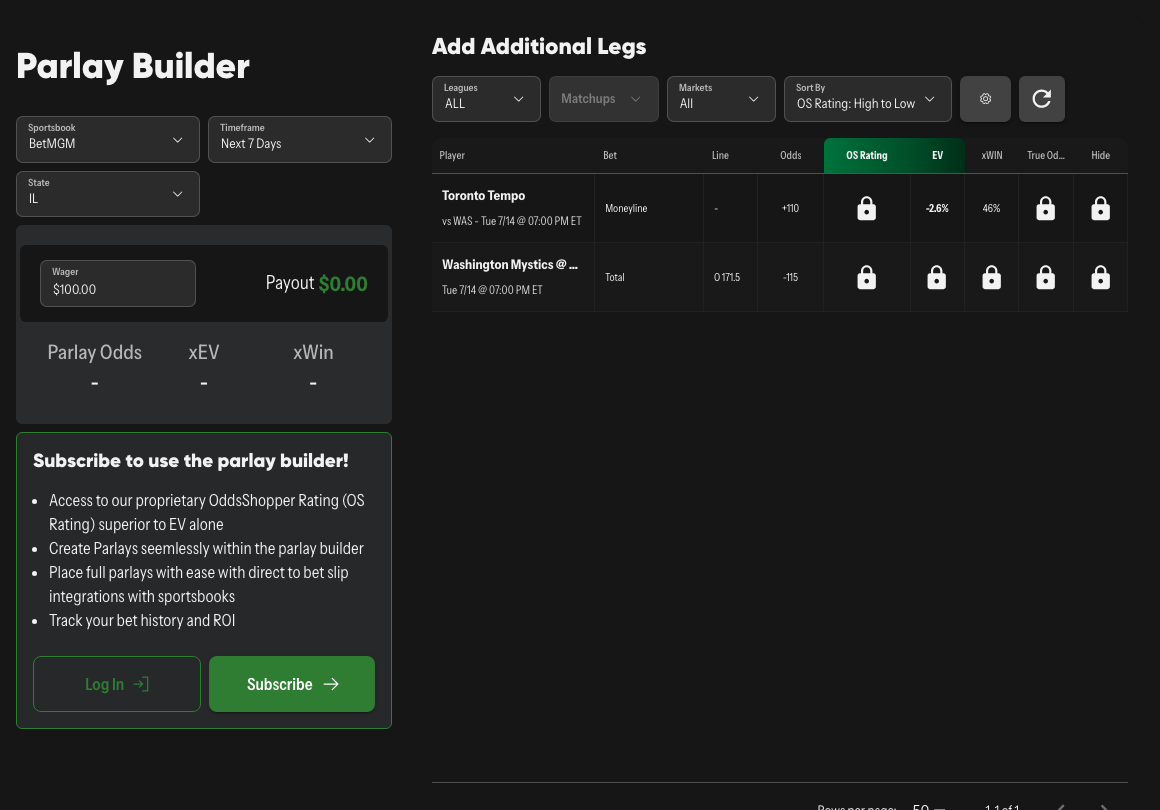
The OddsShopper Parlay Builder lets you assemble and price a same game parlay leg by leg.
Where To Find The Best NBA Betting Lines
Reading the lines is step one. Getting the best version of each one is step two, and doing it by hand across a dozen apps is slow enough that the number can move before you bet. This is the exact problem we built OddsShopper to solve. The OddsShopper NBA odds screen pulls every book's spread, total, and moneyline into one view, and the tool surfaces the best price on the board so you never have to eyeball a dozen apps. It also flags the prices that beat the wider market, which is how I turn "shop the number" from a chore into a habit that actually sticks. For the over/under specifically, our deeper over/under betting guide walks the totals math in full.
The Bottom Line
An NBA betting line is not decoration, it is the contract: it tells you what has to happen, what it pays, and how the book sees the game. Get fluent in the point spread, the total, and the moneyline, learn to read the plus and minus on sight, and then make a rule of taking the best number available every single time. Picking winners is hard. Reading a line correctly and shopping it for the best price is a skill anyone can build, and it compounds all season.
Ready to stop leaving the better number on the table?OddsShopper puts every sportsbook's NBA line in one place and highlights the best price on the board. Try it free for 7 days, then use code NBALINES20 for 20% off your first payment of OS Pro or OS Core: Start your free trial.
More on this: Soft Betting Lines: Finding +EV In NBA Summer League · NBA Championship 2027 Odds: Live Title Prices By Team · NBA Next Team Odds: Every Star's Landing-Spot Market, Scored · How To Bet NBA Assists Props: A Strategy Guide · How To Bet NBA Points Props: A Strategy Guide
Frequently Asked Questions
What are NBA betting lines? NBA betting lines are the numbers a sportsbook posts to price a game. The three main ones are the point spread (the margin the favorite must cover), the total or over/under (combined points scored), and the moneyline (who wins outright).
What does a minus sign mean on an NBA line? A minus number on the point spread marks the favorite, which is giving up points. On the moneyline, that minus is how much you have to risk to win $100, so -190 means you lay $190 to win $100.
What does a plus sign mean on an NBA line? A plus number on the point spread marks the underdog, which is getting points. On the moneyline, that plus is your profit on a $100 bet, so +160 means a $100 bet wins $160 — and converts to an implied win probability of about 38%.
Do you have to bet the favorite to cash an NBA spread? No. The spread is built to make either side close to a coin flip, so the underdog covers as often as the favorite. The better spread bet is whichever side is priced most in your favor after you shop it across books, not the team more likely to win the game outright.
What is the over/under in NBA betting? The over/under, or total, is the combined points both teams are projected to score. You bet whether the final total is over or under the posted number, no matter who wins. If the total lands exactly on a whole number, the bet is a push and your stake is refunded.
Why are NBA betting lines different at each sportsbook? Each book sets its own price, so the same game can be a slightly different number at DraftKings, FanDuel, BetMGM, or Caesars. Taking the better price on the same bet adds up over a season, which is why comparing lines across books before you bet is worth the habit.