Parlay Betting Strategy: The Smart Way to Bet Parlays
Last updated: June 18, 2026
In Summary
Most parlay advice stops at "all your legs have to win." The real parlay betting strategy starts one step earlier, at the price. The exact same parlay can pay +369 at one book and +580 at another, and the number you take decides whether you make money over a long run of these bets, win or lose on any single ticket. Two habits do almost all the work: shop every leg across books so you take the best price on the whole parlay, and stack legs that are positive expected value instead of vig-inflated longshots. A parlay just multiplies the edge of its legs, so good legs compound an edge and bad ones compound the house's. Below is exactly how to bet parlays the smart way, with real numbers.
Watch the Video
Prefer to watch? Here is the full breakdown on the OddsShopper YouTube channel. Watch on YouTube.
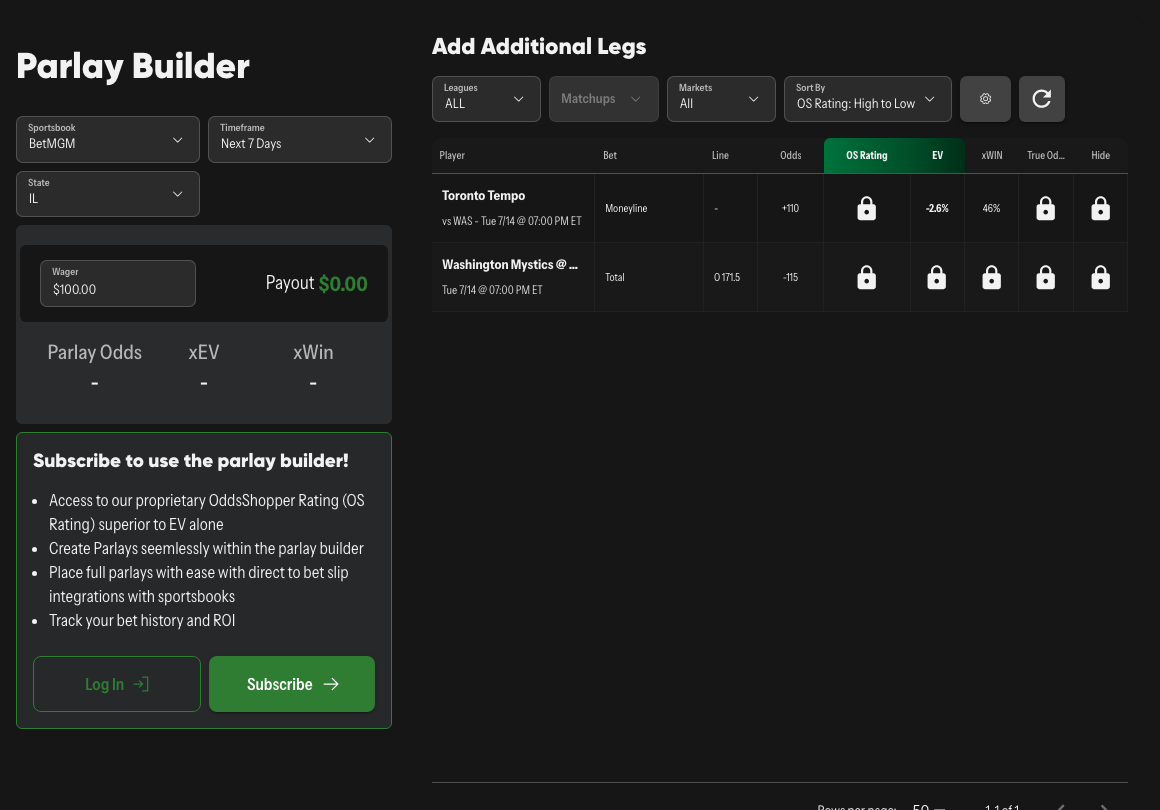
The OddsShopper Parlay Builder.
Stop Leaving Money on the Table
Ask yourself one question: is there anywhere else in your life where you'd happily hand over more money than you owe? Probably not. Yet that's what most parlay bettors do every time they tap "place bet" without checking the price.
Think of the sportsbook a little like the taxman. It's going to take its cut one way or another, and that cut on a parlay is the vig, the margin baked into the odds for the privilege of taking your bet. You can't make the vig disappear. But you can shrink how much of it you pay, because the same parlay is priced differently at every book, and the gaps are bigger than most people realize. The book is counting on you not to look.
So the first rule of any smart parlay strategy has nothing to do with which teams you pick. It's this: before you place a parlay, how cognizant are you of the price you're getting? If the honest answer is "not very," that's the leak, and it's a bigger one than your bet selection.
The Price You Take Decides Whether You Win: A Real Example
Here's a real example that makes the point better than any theory. Picture a three-leg same-game parlay on a Buccaneers-Lions playoff game: Baker Mayfield over 275 passing yards, Mayfield two-plus passing touchdowns, and a Mike Evans anytime touchdown against a soft Detroit secondary. One combination, four books:
- FanDuel: +369
- BetMGM: +400
- DraftKings: +550
- Caesars: +580
Same three legs. The price swings from +369 to +580 depending on where you look. On a $100 bet that's the difference between roughly $369 and $580 in profit if it cashes, about $200 on one ticket. That sounds small until you stretch it over a season of parlays.
Here's the part that matters even if the bet loses, which is most of the time with parlays. The price you take sets your break-even rate, the share of these bets you'd need to win just to come out even. The formula for any American-odds bet's implied probability (its break-even percentage) is:
Break-even % = 100 ÷ (odds + 100)for a positive-odds bet. So +580 needs 100 ÷ 680 = 14.7%, while +369 needs 100 ÷ 469 = 21.3%.
Read that again. At Caesars' +580 you only have to hit this kind of bet about 15% of the time to break even. At FanDuel's +369 you'd need to win it over 21% of the time, on the identical legs. The worse price quietly raises the bar your picks have to clear, on every bet, forever.
Now run it over volume. Say you placed this exact bet 100 times and won 20% of them, a realistic clip for a longshot parlay:
- At +580 (Caesars): 20 wins × $580 − 80 losses × $100 = +$3,600.
- At +369 (FanDuel): 20 wins × $369 − 80 losses × $100 = −$620.
Same picks, same 20% win rate, and one version nets you about $3,600 while the other loses you a few hundred. That's a swing north of $4,200 created by nothing but the price. Go back through your own bet history and you'll almost certainly find parlays, winners and losers both, where you handed the book hundreds of dollars just by not shopping. It's never really about one ticket. It's about how much you quietly give back over time.
Shop Every Leg, Take the Best Price
The fix is mechanical and it's free: line shopping. Have access to as many sportsbooks as you reasonably can, and build (or price) the same parlay at each one before you bet, so you take the best available number on the whole ticket. This single habit will take you a long way toward not bleeding your bankroll, and it requires zero handicapping skill. You're not predicting anything better. You're just refusing to take a worse price on a bet you were going to make anyway.
The catch is doing it fast. Lines move, and manually re-entering a multi-leg parlay across five apps before tip-off is a grind. This is where an odds-comparison tool earns its keep: OddsShopper scans 100+ sportsbooks at once and shows you where the same bet is priced best, so taking the top number becomes a glance instead of a chore. If you want the manual version, the principle still holds, just be the person who checks.
New to OddsShopper?It scans 100+ sportsbooks in real time and flags the bets priced in your favor, then shows you which book gives the best number on the exact parlay you're building, the work this section just did by hand. You can try it free for 7 days, and code SCORE25 takes 25% off OS Pro or OS Core if you subscribe.
Build Parlays From +EV Legs, Not Longshots
Shopping the price is the floor. The ceiling is what you're putting in the parlay to begin with.
Here's the idea most parlay guides get backwards. A parlay isn't a special kind of bad bet. It simply multiplies the expected value of its legs. Stack legs that are positive expected value (priced better than their true probability) and that edge compounds in your favor. Stack the random, juiced longshots most casual bettors throw together and the house edge compounds against you. That second pile is why parlays earned a sucker-bet reputation, and it's avoidable. The parlay isn't the problem. The legs are.
A few things follow from that:
- Every leg has to be +EV. That's the whole game. A four-leg parlay where all four legs are +EV is a better bet than a two-leg parlay with one coin-flip leg, because each +EV leg adds edge. The old "keep it to two or three legs" rule exists because people pad parlays with bad longshots to chase a payout; legs themselves aren't the danger.
- It's the number of +EV legs that matters, not the leg count. What more legs really add is variance, a lower hit rate and bigger swings, even when every leg is +EV. So size longer parlays smaller, and never add a marginal filler bet just to lengthen the ticket.
- Mind correlation in same-game parlays. Combining linked outcomes (a favorite's moneyline with the game going over, say) can carry an edge, but only when the book misprices that link. Books already shade same-game-parlay odds to account for correlation, so the edge is real only where their model is off. We go deep on that in our same game parlay strategy guide.
- No +EV legs means no parlay. Plenty of markets are priced efficiently, with both sides offering no edge. When you can't find legs that are priced in your favor, the right move is to pass. Having action on a game is not a strategy; betting only where the number is in your favor is.
Finding +EV legs by hand across every market and book is the hard part, which is exactly what a +EV tool is for. OddsShopper's algorithm tracks the market in real time, and the tool surfaces only +EV legs for your parlay, each tagged with its EV% and OS Rating so you can see how much edge is really there before you add it to the ticket. You choose the legs instead of guessing, so you're building on top of real value rather than stacking lottery tickets and hoping. (For the definition and full mechanics of how parlays pay out, start with our parlay betting explained guide.)
Aim for Closing Line Value on Every Leg
Once you're shopping the price and stacking +EV legs, there's one more habit that separates bettors who win over time from everyone else: getting closing line value on every leg of every parlay.
Closing line value, or CLV, just means you got a better price when you placed your bet than the price that market closed at. If you bet a leg at +130 and it closes at +110, you beat the closing line. In a liquid, efficient market, consistently beating the close is the single best sign that your bets were priced in your favor, because the closing number is the market's sharpest estimate of the true odds. (Worth a caveat: CLV only means something in a liquid market. A line that moves because of hype in a thin market is artificial, not proof you found an edge. Our closing line value guide covers when to trust it.)
That's the mechanism behind the whole strategy: find prices the books haven't corrected yet and pounce before they move. Books pay people a lot of money to erase those edges, so they don't last. Consistently getting CLV on your legs is how you confirm you're on the right side of the bet, regardless of whether any single parlay wins or loses.
Size Parlays Like the Higher-Variance Bets They Are
None of this works if a cold streak wipes you out first. Parlays hit less often than straight bets by design, so they swing harder, which means they belong at a smaller slice of your bankroll than your single bets. Size each parlay to its edge and its variance, lean on the fractional-Kelly approach the tools recommend, and never chase a loss by piling into a bigger parlay to "win it back." A real edge only shows up over a long run of bets, and the point of disciplined sizing is to still be betting when it does. Our bankroll management guide has the full framework.
One more discipline worth stating plainly: never let the fact that you like a combination be the reason you place it. Decide the legs are +EV first, take the best price, then bet. Liking the picks before checking the price is the mentality that keeps the books in business.
Frequently Asked Questions
Is there a parlay betting strategy that actually wins? There's no approach that wins every parlay, and anyone promising that is selling something. What disciplined bettors do is stack only +EV legs, shop every leg for the best price across books, and aim to beat the closing line, so their edge compounds over a long run of bets. The parlay multiplies the value of its legs, so good legs and good prices are the whole strategy.
Why does the same parlay pay different odds at different books? Each sportsbook prices a parlay with its own margin and its own read on the legs, so the identical combination can pay +369 at one and +580 at another. Taking the worse number quietly raises the win rate you'd need just to break even, which is why shopping every leg across books is free expected value.
How many legs should a parlay have? There's no magic count. What matters is that every leg is +EV, not how many there are. More +EV legs compound more edge, but they also add variance and lower your hit rate, so size longer parlays smaller. The real mistake isn't adding a leg; it's adding a bad, vig-inflated leg to chase a payout.
What is closing line value and why does it matter for parlays? Closing line value means you got a better price on a leg than the price that market closed at. In a liquid market, consistently beating the close is the clearest sign your bets were priced in your favor, since the closing number is the market's best estimate of the true odds. Getting CLV on your legs confirms you're on the right side, win or lose on any single ticket.
Are same-game parlays a good strategy? They can be, but only when the book misprices the correlation between linked legs. Sportsbooks already shade same-game-parlay odds to account for correlation, so the edge exists only where their model is off. Treat correlation as an occasional edge to find, not an automatic one, and shop the same-game parlay across books like any other bet.
Stop handing the book the better number. The OddsShopper Parlay Builder stacks only +EV legs and shops the price across 100+ books, so your edge compounds in your favor instead of leaking out as vig. Try it free for 7 days, then code SCORE25 takes 25% off your first payment of OS Pro or OS Core. Bet 21+ where legal, and only what you can afford. Start your free trial
More on this: What Is SGP In Betting? Same Game Parlay Strategy · Golf Top 20 Parlay Odds: Scheffler Plus Two: Kalshi Odds · Kalshi Same Game Parlays: What You Can And Cannot Combine · Underdog Playoff Best Ball Strategy: Draft To Survive · PrizePicks MLB Strategy: Price Every Line Before You Play