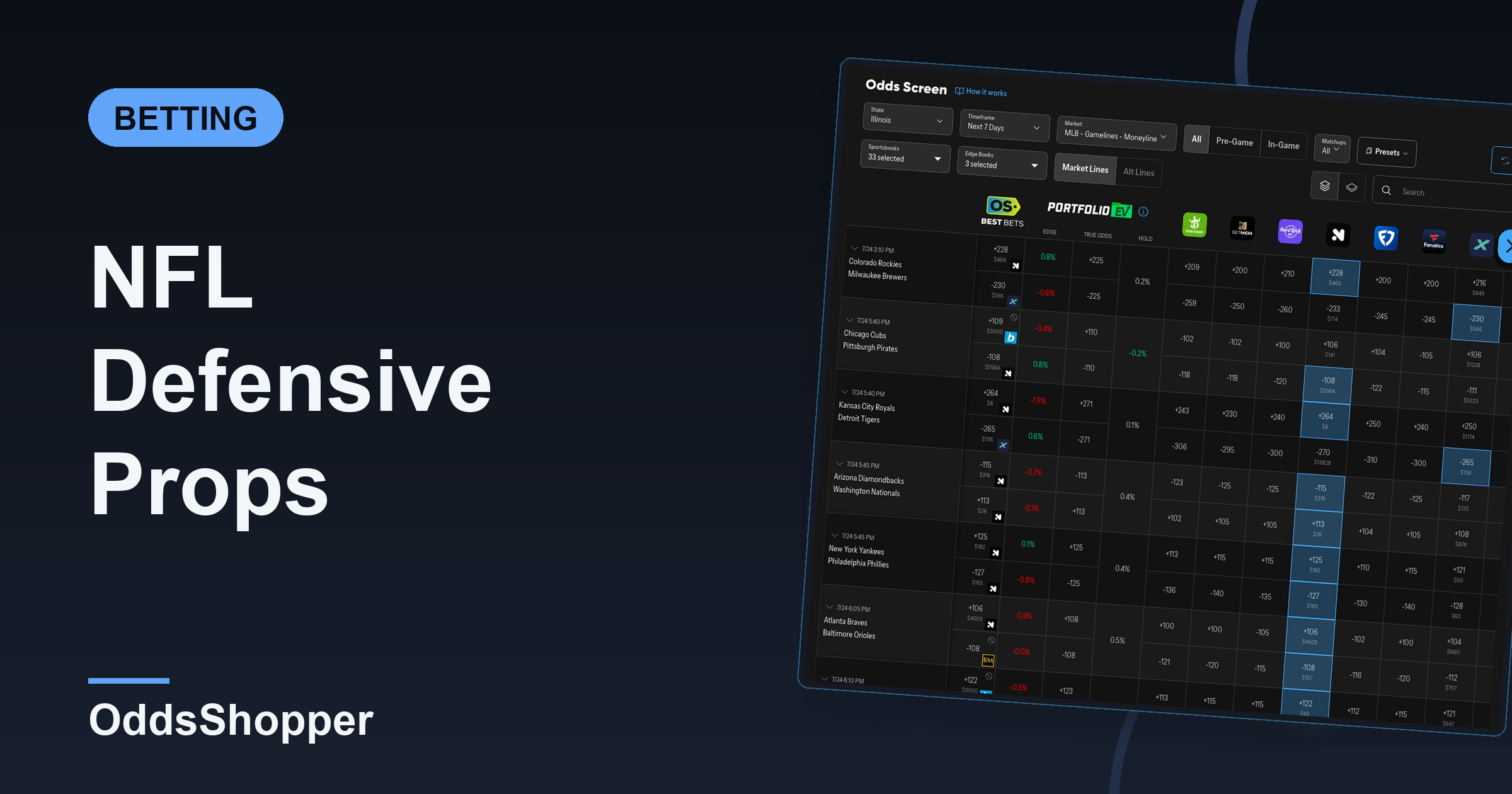
People searching for a +EV bet tracker usually arrive with one of three versions of the same question, so I'll answer them up front. Which platforms list +EV bets across multiple markets: OddsShopper's +EV screen prices every market it carries across 20+ sportsbooks, and the same account can save a filter on that screen and track the record of everything that filter surfaces. For football, the best site for identifying +EV bets is that same screen, which covers NFL and college football sides, totals, and props wherever books post them. For tennis matches, the best EV bet tracker is one whose board actually carries tennis: moneylines and set markets are on that same board wherever books post them, which matters because most trackers treat tennis as an afterthought.
But "lists +EV bets" is the easy half of the job. The hard half is what happens after you bet: does the tool tell you whether you are actually beating the market, or just whether you cashed last night? That second question is where nearly every bet tracker falls down, and it is the one I want to spend this piece on. I'll lay out the checklist I use, give Pikkit its due (it does a few things better than anyone), and then show you the one readout in the rebuilt OddsShopper Portfolios that Pikkit does not advertise and that I have not seen elsewhere.
The Quick Answer
The best +EV bet tracker grades every bet against the closing line, across every book you actually bet at, and then tells you how much of your closing-line value is real edge versus variance. Pikkit is the strongest pure logging app I have used; OddsShopper Portfolios is the one that pairs the +EV feed, the tracking, and the CLV-versus-variance review in one place. The five-point checklist, the Pikkit comparison, and the Review-tab readout are below.
What A +EV Bet Tracker Actually Has To Do
Most people shop for a bet tracker the way they shop for a budgeting app: does it log everything, does it look nice, does it sync. Those are table stakes. If your goal is +EV betting, the tracker's real job is to keep score of the thing that predicts your future profit, and that thing is not your P&L. It is closing line value.
Here is the checklist, in the order it matters:
- It grades against the closing line, automatically. Every bet you log should be compared to where the market closed. If you took a prop at +130 and it closed +105, you beat the close. If you took it at +130 and it closed +160, you did not, no matter what the box score said. A tracker that only shows W-L and units is a diary, not a scoreboard.
- It separates CLV from variance. Even beating the close is noisy over a few hundred bets. The best tracker tells you how much of your CLV number could plausibly be luck and how much is repeatable. Of the trackers I have used, none does this well. More on it below.
- It covers every book and every market you bet. If you bet props at four books and futures at a fifth, a tracker that only knows two of them is grading a partial you.
- It sits next to the +EV feed. The friction of finding a bet in one app and logging it in another is exactly the friction that makes people stop logging. Bet, track, review, one place.
- It lets you tune what counts. Which markets, which books, what minimum edge. Your track record should be the record of a strategy, not a pile of everything you ever clicked.
Notice how far down "nice bankroll graph" falls. Read what +EV betting is if the closing-line framing is new; the rest of this piece assumes you buy the premise.
Pikkit And The Other Trackers: What They Do Well
I am not going to pretend Pikkit is bad. It is not. Its own pitch is "all of your bets and friends in one place," and it delivers on that: BookSync tracks your performance across your sportsbooks (its words), there is a live-tracking view for open bets, a line-shop screen across 30+ books, and a social layer where you follow other bettors and copy a bet into your own slip. It advertises a CLV feature (as of this writing, pikkit.com lists CLV but no variance breakdown), and it has a 4.9 rating from 18K+ app reviews. If what you want is a clean, automatic diary of every bet you place with a community attached, Pikkit is the best-built version of that product I have used.
Most trackers I have tried answer the logging question far better than the CLV-versus-variance question. They are fine at item one on the checklist and mostly silent on item two.
Which is the gap. A tracker that shows you a CLV number without telling you how much of it is noise is handing you a stat you cannot act on. Beating the close by 1.5% over 80 bets and beating it by 1.5% over 2,000 bets are completely different pieces of information, and a single green number treats them the same.
The Thing Most Trackers Skip: CLV Versus Variance
This is where the rebuilt OddsShopper Portfolios earns the space in this article. The OddsShopper team reworked the old PortfolioLab into Portfolios this August, and the piece of it I keep coming back to is the Review tab, which analyzes every bet you have tracked against the closing line and shows how much of your CLV is attributable to variance.
I am not the only one who noticed. Bettor @WSBTradesAlerts, who shares a referral link in the post, put it plainly in a post walking through the Review tab: "you can see how much of your CLV is part of variance — something Pikkit doesn't even tell you." A reply under that post is the whole philosophy in one line: short-term P&L is noisy, but consistently beating the closing price gives you much better EV.
That reply is the reason this readout matters. Your bankroll over a month is mostly luck. Your CLV is less noisy than your bankroll, but over a month it is nowhere near clean, and the tracker worth trusting is the one that draws the line between the two for you instead of letting a hot streak convince you the strategy works.
Multi-Book, Multi-Market Coverage: Football, Tennis, And Everything Else
Back to the three questions from the top, because coverage is where trackers quietly fail. A tracker can only grade what it can see, and it can only see the books and markets it prices.
Portfolios is built on top of the same board as OddsShopper's +EV top bets screen, which prices markets across 20+ sportsbooks and de-vigs them to a fair price. That is what backs up the football and tennis answers: NFL and CFB sides, totals, and props sit on the screen wherever books post them, and tennis moneylines and set markets sit on the same board. Whatever you save as a portfolio filter, on any of those markets, is what gets tracked and reviewed.
Tennis is the market where I judge a tracker hardest, and here is why. Books post and pull tennis lines fast, a retirement or a rain delay can wipe a market mid-match, and the number that counts as "the close" is far less obvious than it is for an NFL side that sits on the board all week. A tracker that grades your tennis bets against a stale snapshot will hand you a CLV figure that means nothing. Grading against the board that priced the bet in the first place, at the same books, is the only way that number stays honest, and it is why the feed and the tracker being the same product matters more here than anywhere.
The live product describes a portfolio in one sentence I like: "A portfolio is a named, saved filter state. On = its bets are in your feed and it can notify you. Off = we quietly track its record." That last clause is the sleeper feature. You can build a portfolio for a strategy you are not ready to bet yet, leave it off, and let it accumulate a track record before you risk a dollar on it.
What The August Rebuild Added
The public overview from @WSBTradesAlerts' post on the rebuild lists what changed, and here is each item, described exactly as far as that post and the live product show it, no further:
- Updated Profit Track Record for each portfolio.
- Custom Devigging Versus OddsShopper's Preset Devigs, so you are not locked to the OS preset.
- A Daily Swing Range derived from your portfolio settings.
- Filters Preset On The Main Screen rather than buried a click deep.
- Portfolio Quick-Access Tuning, so adjusting a saved portfolio is a short trip.
- The Review Tab, analyzing all tracked bets against CLV, covered above.
The usage note in that same post is worth repeating because it is exactly the workflow the checklist points at: set the portfolio, enable notifications, review the alerts, keep sizing consistent, and average plays across multiple books when more than one has value. That is item four and item five on the checklist happening in the same screen. If you want the click-by-click, the Portfolios setup walkthrough covers building your first one, and what Portfolio EV means covers why spreading many small +EV bets is the strategy in the first place.
Tracker Checklist Comparison
Below is the checklist from above laid against the two products, using each product's own live copy plus the posts linked in this piece. One framing note first: these are two different shapes of tracker. Pikkit grades your betting history, whatever you placed and wherever you placed it. Portfolios grades a strategy, the saved filter and every bet it surfaces, which is why it can keep a record for a portfolio you have switched off. Decide which of those you actually need before you read the rows.
| What The Tracker Has To Do | Pikkit | OddsShopper Portfolios |
|---|---|---|
| Logs Bets Across Your Books | Yes, BookSync across your sportsbooks | Tracks the record of every bet its saved filter surfaces, on or off |
| Grades Each Bet Against The Closing Line | Yes, CLV feature | Yes, Review tab |
| Shows How Much Of Your CLV Is Variance | Not advertised on pikkit.com | Yes, Review tab |
| Sits Next To A +EV Feed | Not advertised (line shop across 30+ books) | Yes, built on the +EV screen across 20+ sportsbooks |
| Lets You Tune Markets, Books, And Edge Threshold | Not advertised beyond analyzing your history | Yes, that is what a portfolio is |
| Social / Follow / Copy Bets | Yes, core feature | No |
| Tracks A Strategy Before You Bet It | Not advertised | Yes, portfolio set to Off |
The row I would point a friend to is the third one. Everything else on that table is a preference. It is the difference between knowing your number and knowing whether to trust it.
A Worked Example (Illustrative)
Say you run a portfolio for NFL player props, minimum edge set where you like it, across the books you hold. Over September the portfolio's tracked record shows 140 bets, up 3.2 units, beating the close by an average of 1.6%. Without a variance readout, that is a happy story and you scale up.
Here is the problem with 140. Prop prices are noisy: the same player total can close 15 or 20 cents apart at two books, and a single week of injury news can swing a whole week of closes in your favor by accident. A sample that size can make CLV look cleaner than it really is, and nothing in a bare CLV number tells you which world you are in. The Review tab exists so you do not have to guess where that line sits. If it shows that variance explains a meaningful share of that 1.6%, the disciplined move is to keep the portfolio on, keep the sizing flat, and let the sample grow. If the edge persists beyond what variance appears to explain, you have a stronger case for scaling cautiously, bankroll permitting. Same bets, same numbers, completely different decision. A tracker exists to make that second decision possible.
FAQ
Is Pikkit a +EV bet tracker? Pikkit is a bet tracker with a CLV feature. Its homepage advertises line shopping, BookSync across your sportsbooks, live tracking, copy bets, and a CLV feature; it does not advertise a +EV feed or a CLV-versus-variance readout.
Does OddsShopper track bets from any sportsbook? Portfolios is not a sportsbook-sync app in the BookSync sense. It tracks the record of the bets your saved portfolio filters surface, priced across 20+ sportsbooks, and the Review tab grades those tracked bets against the closing line.
What is CLV and why does it matter more than profit? Closing line value is the difference between the price you bet and the price the market closed at. Over a large sample it predicts profit far better than short-term results, because the closing line is the sharpest public estimate of the true probability. The tracking guide on how to find +EV bets walks through it in more depth.
Where is the Review tab? It sits in the OddsShopper tools nav next to Portfolios, at oddsshopper.com/tools/review, and it reads your account's tracked portfolio bets once you are logged in. OS Pro carries the full +EV feed and the deeper tools and comes with a 7-day free trial.
The Bottom Line
The best +EV bet tracker is the one that keeps the score you can trust. Pikkit keeps the most complete diary. OddsShopper Portfolios keeps the diary next to the feed that produced it, and its Review tab is the only place I know of that tells you how much of your CLV you should actually believe. If you also harvest book promos alongside your +EV volume, the Free Bet Conversion Calculator is the natural companion for turning site credit into tracked, real-money +EV bets.
Here is how I would start: one portfolio, the market you bet most, sizing flat until the Review tab has a few hundred tracked bets to work with, and no change to that sizing until the variance share of your CLV stops moving. That is the whole discipline, and the tracker does the bookkeeping. FREE 7-day trial, plus code CUSTOM30 for 30% off your first payment of OS Pro or OS Core.
More on this: Closing Line Value Vs. Variance: Your P&L Is Lying To You · Devig Calculator: Find Fair No-Vig Odds From -110 Prices · How To Bet On Horses: 6 Horse Racing Bet Types Explained · Polymarket Fees Explained: What Trading Actually Costs · What Is A Betting Exchange? Peer-to-Peer Betting Explained