What Is A Betting Exchange?
A betting exchange is a marketplace where you bet against other people instead of a house. There is no bookmaker setting a line and no margin baked into the price. You either take a price someone else has posted or post your own and wait for another user to take the other side. That one structural change rewrites almost everything about how the price is built and how you find an edge, and it is the reason I keep coming back to exchanges when the number at a traditional sportsbook looks shaded. I'll walk through exactly how a betting exchange works, why it has no vig, how it differs from a sportsbook and from a prediction market, and where you can try one today.
The Quick Answer
A betting exchange is peer-to-peer: you bet against other users, the platform only runs the marketplace and matches the two sides, and it earns a small commission instead of building a margin into the price. You either take an offer already on the order book or make your own by posting the price you want and waiting for a match. The modern US exchanges, ProphetX among them, run as federally regulated prediction-market exchanges in the same family as Kalshi and Polymarket US, not as state-licensed sportsbooks. The full make-or-take walkthrough, the side-by-side against a sportsbook, and a worked example in cents are below.
Stay ahead of the markets.
Daily insights and expert picks on Kalshi, Polymarket, and what's moving markets.
Free forever. Unsubscribe anytime.
Betting a Kalshi combo on this game?Kalshi Parlay Simulator before you buy it: 10,000 simulated games price every combo next to the price on Kalshi.
How A Betting Exchange Works
Start with the thing a betting exchange removes: the house. At a normal sportsbook you take a number the book has set, and the book is the counterparty on every ticket. An exchange deletes that middleman. It is an order book: a live list of prices other bettors are willing to pay or accept on each outcome, with the best bid and the best offer sitting a cent or two apart on a busy market and much wider on a quiet one. A price of 45¢ on a team means the market is pricing that team at roughly a 45% chance to win, and a matched contract pays $1 if it does. If you want the plumbing under that, our plain-English guide to how prediction markets work covers the contract mechanics in full.
Two verbs run the whole system, and they are worth learning because they replace the "take it or leave it" of a betting slip:
- Take. You accept a price another user has already posted. If the best available price on a team is 45¢ and you like it, you take it and you are matched instantly.
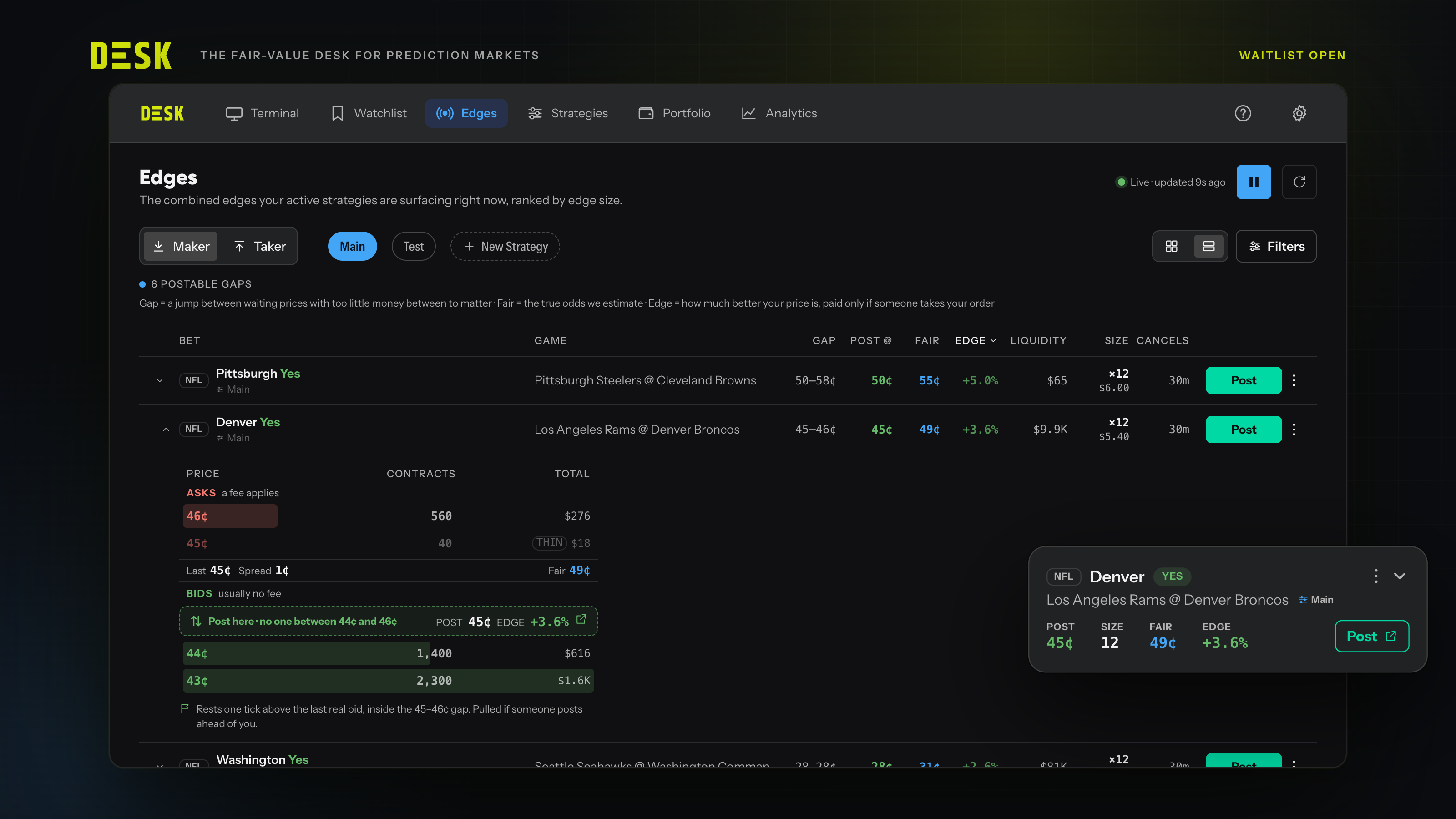
- Make. You post your own price and wait. Say 45¢ is showing but you want to pay 42¢. You make that market by posting your bid at 42¢. Nothing happens until another user takes the other side at your number. The moment someone does, your play is matched and becomes a live position.
Hold onto that word, matched. Until an order is matched it is just a resting offer on the book, not a live bet. And because two real users have to agree on a price for anything to happen, every matched number is a real meeting point of money on both sides rather than a figure a risk desk handed down.
The short versionan exchange is a marketplace, not a bookmaker. You take a posted price or make your own, another user fills the other side, and that match is your position.
Why A Betting Exchange Has No Vig (And What It Charges Instead)
Here's the payoff of deleting the house, and it is the single biggest reason to care about exchanges. A traditional sportsbook builds its profit into the odds. Pull the same game up at two books and you will see both sides shaded so the implied probabilities add up to more than 100%. Bettors know that overround as the vig, the tax you pay on every bet, and on a typical two-way market it works out to roughly a 4.5% to 5% hold for the book. It is how a sportsbook makes money on balanced action no matter who wins.
An exchange makes money a completely different way. It never sets the line, so it has nothing to shade. Instead it charges a small commission, usually a low single-digit percentage on winning plays; a few exchanges skip commissions on many trades and charge explicit fees only on certain order types. Either way, nobody is baking a fat margin into the price, which means the number on the screen is a much cleaner, market-implied probability than a book's shaded line. Two costs remain, and I want to be exact about them because "no vig" is not "free": the commission or fee, and the gap between the best bid and the best offer, which is a real trading cost paid to whoever is on the other side of your order, not revenue the venue skims. After both, you are looking at a cleaner market-implied probability than a shaded line, but it is still a market's opinion, not the true odds, so you still need your own fair number. Our Kalshi fees vs. sportsbook vig breakdown puts real numbers on that gap, and the spread is the vig explains the one cost an exchange never advertises.
Which is why the fair price is the only number that matters here; the worked example below turns that idea into an actual decision. At a book, beating the vig is a constant drag. On an exchange, the drag is a known, transparent commission, and the price can sit much closer to a clean market probability, once you have checked the spread, the depth, and the fee. Your whole job becomes deciding whether the true probability is better than the price on offer, the same logic behind finding bets with positive expected value, just with a cleaner starting number.
Betting Exchange Vs. Sportsbook
Because the difference is structural, it shows up everywhere once you look. This is the side-by-side I wish someone had handed me the first time, and the exchange column is where a winning bettor's account actually gets to stay open.
| Feature | Traditional Sportsbook | Betting Exchange |
|---|---|---|
| Who You Bet Against | The house | Other users |
| Who Sets The Price | The book (line + margin) | The market (make/take) |
| How The Platform Profits | Vig baked into the odds | Commission or explicit trading fee (plus the gap between the best bid and the best offer) |
| Can You Set Your Own Price? | No: take it or leave it | Yes: post your number and wait |
| Winning Players | Often limited or restricted | Less likely to be limited for winning alone; liquidity, eligibility, and compliance rules still apply |
| Exit Before The Result? | Sometimes, priced with a margin | Often, at a live market price if there's liquidity |
The row I keep circling back to is the second-to-last one. A sportsbook is a business that profits when you lose, so a consistent winner is a liability, and books are known to limit or restrict sharp accounts. An exchange has far less reason to limit a winner, because it is not taking the other side of your play; its revenue comes from commissions or trading fees under its posted schedule, not from your losses. Your winning play does not need a book's permission, only a willing user on the other side. For anyone who takes this seriously, that difference decides where the account lives.
The trade-off is liquidity. A sportsbook usually offers an immediately actionable price up to its limits; an exchange only fills your play if another user wants the other side at your number. On thin markets you may wait, or have to move your price to get matched. Call it the cost of a fairer number, and read our piece on why liquidity decides whether you can trade before you post a big order on a quiet board.
Betting Exchange Vs. Prediction Market
This is where the modern picture gets interesting, and where a lot of the current confusion lives. A prediction market is a venue where you trade contracts on whether an event happens, such as an election, a Fed decision, a game, or even tomorrow's high temperature. It is peer-to-peer and priced by the market, which is exactly the exchange mechanic described above. The main difference is historically one of framing and regulation: prediction markets like Kalshi and Polymarket US trade event contracts under federal (CFTC) oversight, while classic betting exchanges framed the same trades as sports bets.
In the US that line has effectively merged. Several of the modern sports "betting exchanges," ProphetX among them, now operate as federally regulated prediction-market exchanges under CFTC oversight, which is an important distinction: their regulatory home is with the prediction markets, not the state-by-state sportsbook system. Federal oversight is why availability can look so different from a normal book. A CFTC-regulated exchange can be live in nearly every state rather than only in states that have legalized traditional sports betting, though that jurisdiction is still being litigated state by state; our state-by-state legality guide tracks it. Here is how the three venues line up:
| Traditional Sportsbook | Betting Exchange | Prediction Market | |
|---|---|---|---|
| Platform Earns | Vig (roughly 5% hold) | Commission or explicit fee | Commission or fee |
| Regulator | State licensing | Federal (CFTC) for the modern US sports exchanges | Federal (CFTC) |
| Examples | DraftKings, FanDuel | ProphetX, Novig | Kalshi, Polymarket US |
Read across the Regulator row and the point lands: the modern US exchange and the prediction market share a mechanic and a regulator, and only the sportsbook sits apart. (Classic offshore betting exchanges answer to their own jurisdictions; this page is about the US venues you can actually open today.) The two right-hand columns are a branding lineage, not a legal divide; since the 2026 designations they answer to the same federal regulator, exactly the merger the prose above describes. One nuance on that "earns" row: ProphetX takes a 2% commission on net winnings for straight trades, while Novig charges no fee on pre-game straight trades and attaches fees to certain order types such as live and parlay trades. Same idea, no baked-in vig, just a different small fee, and both schedules can change, so read the current one before you trade. For the fuller contrast, our breakdown of prediction markets vs. sports betting and the head-to-head on why an exchange is not a book both live in this cluster.
Learn the make-or-take mechanic once and it transfers across every one of these venues. One thing that will not transfer is the old moneyline. Exchanges have been moving their displays off American odds and onto percentages, and Novig already made the switch; our guide to the Novig odds format change has the translation table if the new look throws you.
A Worked Example: Reading The Fair Price On An Exchange
Let me make the "fair price is everything" point concrete. Say the side you like is resting on an exchange at 47¢, meaning the market prices it at about a 47% chance and a matched contract pays $1 if it hits. Is that a good price? At a book you would just eyeball it. On an exchange you can be precise.
First, find the fair number. Pull the same game up on the free live odds screen, which shops the price across every major book, and de-vig the two sides into a true percentage. Suppose removing the margin puts the true chance at 50%, a coin flip. Now the read is instant:
- The exchange is asking 47¢ for a contract that pays $1, which is a 2.13 decimal price.
- The fair price is 50¢, a 2.00 decimal price.
- Paying 47¢ for a 50% outcome is a positive-expected-value trade before the fee, so I take it. If I think I can do better, I make a market a tick lower, bid 46¢, and wait for someone to fill it.
That middle row is the whole method: the three-cent gap between what the market asks and what the outcome is worth is your edge, and it is only visible once you compute the no-vig number. The same discipline is behind every row on the free top bets screen, which ranks sportsbook prices by exactly this gap. The exchange just gives you a cleaner price to measure against, and the freedom to name your own if the resting offer isn't good enough. Subtract the commission before you count the edge: in expected-value terms ProphetX's 2% on net winnings costs roughly half a cent per contract here, which trims a three-cent gap but eats about half of a one-cent gap, which is why I would rather post my own number and wait than pay up for a thin gap. Two rules of thumb I actually use: I pass on any edge under two cents after the fee, and when only a handful of contracts are resting at the displayed price I size down, because the second fill will come at a worse number.
If you ever land bonus funds and want to know what they're actually worth in real dollars, the free bet converter does that math too. Same principle: turn a headline number into its true value before you act on it.
Where To Try A Betting Exchange: ProphetX
If you want to see the make/take mechanic in your own hands, ProphetX is a peer-to-peer sports exchange that runs as a federally regulated prediction-market exchange. Since June 2026 it has operated under CFTC oversight, and as of August 2026 it lists availability in 49 states, everywhere except Nevada, which is far wider than most traditional books. Several states are contesting federal jurisdiction over these exchanges in court, so availability and eligibility rules can change; confirm it operates where you live and that you meet its age requirement before you fund an account. None of this is legal advice, just a nudge to check your own state first. Our ProphetX review covers states, fees, and funding, and how to bet on ProphetX walks through placing a first make-or-take order.
New users get a straightforward welcome offer: trade $50 and get $75. You place your first $50 of qualifying plays and ProphetX credits the $75, typically within 24 hours and subject to the current terms. Treat the extra $20 as a bigger first swing at a price you already liked, not a reason to force a play you would not otherwise make. For the full step-by-step, our ProphetX sign-up bonus guide walks through claiming it.
Ready to try the exchange for yourself?Sign up for ProphetX through our link. Code STOK2 is built in. New users trade $50 and get $75 to put behind a price they actually like.
Eligibility and location requirements apply. Trading on an exchange involves risk, including the possible loss of the funds you put up. The welcome offer requires placing qualifying plays, is subject to ProphetX's current terms, and is not a payout you are owed. Confirm the current offer and full terms on ProphetX before you sign up. If gambling stops being fun, step away. Call 1-800-GAMBLER if you need help.
The One Gut-Check To Carry In
Once the house is gone, the whole game narrows to a single habit you can run in about 30 seconds before any exchange play. Pull the fair, no-vig percentage off the odds screen. Compare it to the price resting on the exchange. Subtract the small fee and check there is still liquidity at your number. If the gap survives all three, take it or make your own a tick better; if it does not, pass and wait for a market that pays you. That is the entire method a fairer venue unlocks, and it is why I keep an exchange open next to my book: not because the price is automatically better, but because the moment it is, nothing is standing between me and the number.
Age minimums are set by each platform (Kalshi is 18+; some exchanges require 21+), so confirm the platform's minimum, and that it operates where you live, before you sign up.*
Frequently Asked Questions
What is a betting exchange? A betting exchange is a marketplace, usually a website or app, where you bet against other users instead of a house. You take a price another user has posted or make your own by posting a price and waiting for someone to match it. The platform runs the market and takes a small commission rather than setting a line with a margin.
How is a betting exchange different from a sportsbook? At a sportsbook you bet against the house at a line the book sets, and the book's margin (the vig) is built into the odds. On an exchange you bet against other users at a market-set price, the platform charges a commission instead of a margin, and you can post your own price and often exit a position before the result.
Why is there no vig on a betting exchange? The exchange never sets the odds, so it has no line to shade. It earns money through a small commission or explicit trading fee rather than an overround baked into the price, and the schedule varies by platform, which means the number on the screen is close to the true, market-implied probability once you account for the commission. In practice I still de-vig the sportsbooks on the free odds screen first, because the exchange price only means something measured against that fair number.
Is a betting exchange the same as a prediction market? They use the same peer-to-peer, make/take mechanic. Several modern US sports betting exchanges now operate as federally regulated prediction-market exchanges, in the same regulatory family as Kalshi and Polymarket US rather than a state-licensed sportsbook. Learn to read one order book and you can trade all of them; the only real difference left is whether the contract is framed as a sports bet or an event outcome.
Is ProphetX a betting exchange? Yes. ProphetX is a peer-to-peer sports exchange that runs as a federally regulated prediction-market exchange. New users can trade $50 and get $75 through our sign-up link with code STOK2, subject to the current terms. Confirm it operates in your state and that you meet the age requirement before signing up.
Is a betting exchange legal in the US? The modern US exchanges operate under federal (CFTC) regulation as prediction-market exchanges, which is a different framework from state-by-state sportsbook licensing and can mean far wider availability; ProphetX, for example, listed 49 states as of August 2026, with Nevada the lone holdout. Rules and availability still change, and several states are contesting federal jurisdiction in court, so confirm the platform operates where you live before funding an account. This isn't legal advice.
What is peer-to-peer betting? Peer-to-peer betting means your bet is matched against another bettor's opposite position instead of against a sportsbook's own money. A betting exchange is the platform that runs this: you make or take a price, another user fills the other side, and the exchange earns a commission for hosting the match rather than a margin for setting the line.
How does a betting exchange work? You either take a price already posted on the order book or make your own by posting the number you want and waiting for another user to match it. Once two users agree on a price, the play is matched and becomes a live position, with no bookmaker setting the line or taking the other side of your bet.
More on this: Prediction Market Vs Sportsbook: An Exchange Is Not A Book · Prediction Markets Vs. Sports Betting: The Real Difference · Kalshi Fees Vs. Sportsbook Vig: Which Costs You More? · ProphetX Vs Novig: Which Betting Exchange Wins? (2026) · How To Bet On ProphetX: Make Or Take Odds In 49 States