If you have watched Kalshi and Polymarket show up in your feeds next to sportsbook odds, the natural question is whether the whole thing is even legal. The short version is yes, at the federal level, but with a real catch that trips people up: prediction markets do not follow the same legal map as sports betting, so the honest answer depends on which platform you mean and which state you live in. By the end of this guide you will be able to answer "can I actually trade where I live" for both Kalshi and Polymarket, and you will know the one state where the answer is about to carry criminal weight. None of this is legal advice; it is a plain-English snapshot dated to July 2026, and the rules move fast.
The Short Answer: Federally Legal, Fought Over State By State
Prediction markets in the United States are legal under federal oversight. Kalshi operates as a CFTC-designated contract market, and Polymarket returned to U.S. users through a CFTC-regulated exchange. That federal framework is why, as of July 2026, both platforms report availability in most of the country, even while several states contest or restrict access.
Signing up for Polymarket?Our link carries offer code OS3 — a Deposit $10, get a $50 trading bonus for new users: claim it here. Full walkthrough in our Polymarket sign-up bonus guide.
OddsShopper is a Polymarket partner and may earn a commission if you sign up through our links. 18+ Only. Restrictions and eligibility requirements apply. Not available in all jurisdictions. Trading is risky. 100% loss can occur. See polymarket.com/tos for more information. The Polymarket US App serves as an independent software provider and affiliate of Polymarket US and Polymarket Clearing, the CFTC-regulated exchange and clearing organization.
The catch is that individual states are pushing back. Regulators and courts in several states are actively contesting whether sports-related event contracts should be allowed, and a handful have moved to restrict or block the platforms outright. So "are prediction markets legal" has a federal answer (broadly yes) and a state answer (it depends), and the state answer is the one that decides whether the app will actually let you place a trade.
Federal and state are two different questions.This guide answers both for Kalshi and Polymarket, so you know which one applies to you.
Living in a state where a prediction market is restricted but sportsbooks are fully legal does not leave you on the sidelines. Tools like OddsShopper work across every legal sportsbook in your state, and later in this guide you will see how the same platform lets you price a prediction-market contract against a true sportsbook number when both are available to you. You can try it free for seven days, but first, the legal picture.
Prediction Markets Are Event Contracts, Not Sports Bets
This is the distinction that everything else hangs on, so it is worth getting right up front. A prediction market like Kalshi is a CFTC-designated contract market. The Commodity Futures Trading Commission is the federal agency that oversees commodity and futures trading, and it treats an event contract as a financial instrument, not a sports wager. Polymarket returned to U.S. users through a CFTC-regulated exchange, following its QCEX acquisition in July 2025 and a CFTC amended order in November 2025.
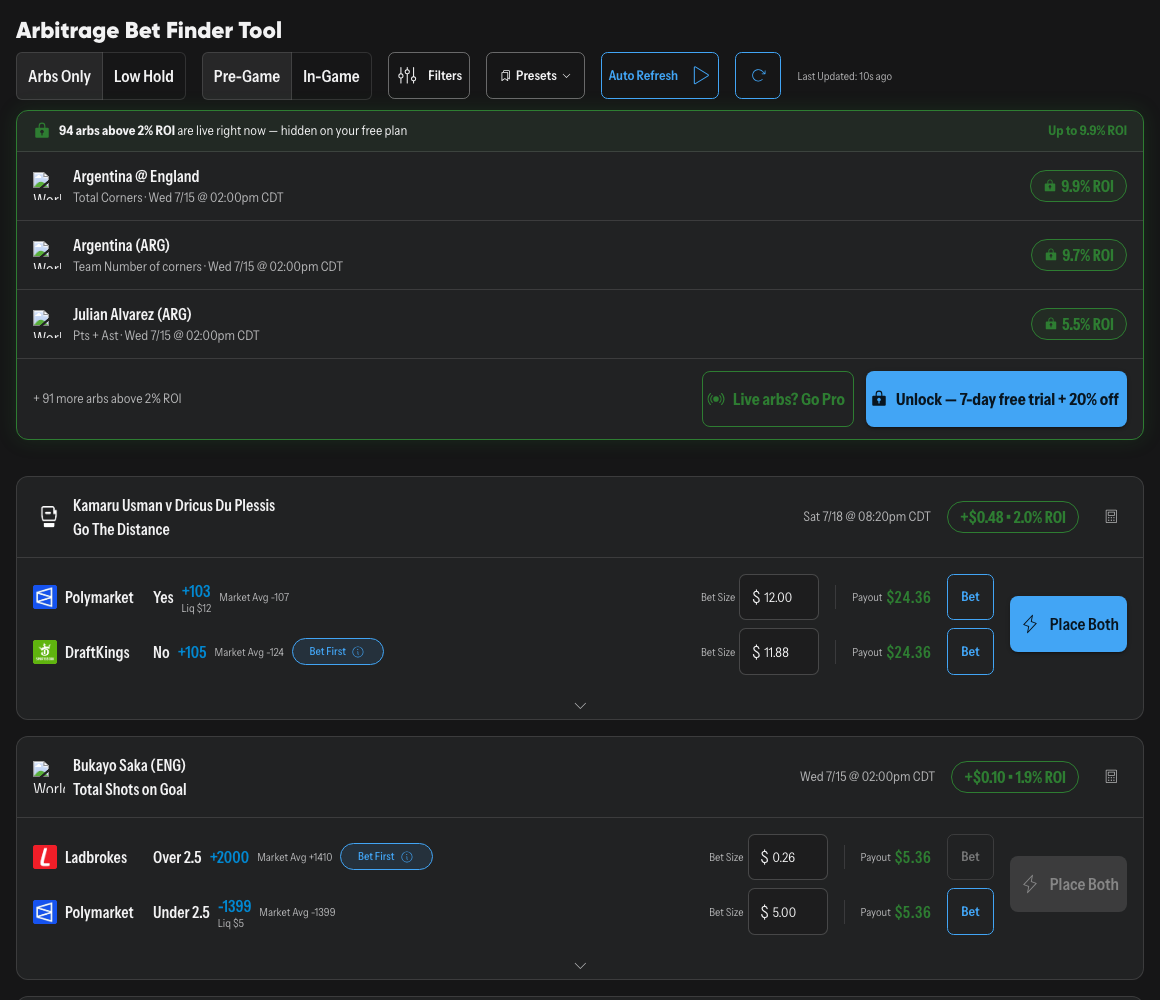
The OddsShopper Arbitrage Tool.
A sportsbook is the opposite arrangement. DraftKings 🎁, FanDuel 🎁, BetMGM 🎁, Caesars and the rest are licensed state by state by each state's gaming commission. That is why sports betting is legal in some states and simply does not exist in others.
The one-line version: a sportsbook is licensed by your state to take bets; a prediction market is a federally regulated exchange where you trade contracts against other people.
Hold onto that split, because it is the reason the two legal maps do not line up, and in some states they even invert. It also explains why the answer keeps changing: when a legal category is this new and this contested, the availability list gets redrawn every few months.
Where Kalshi Is Legal Right Now (As Of July 2026)
Kalshi operates, as of July 2026, as a CFTC-designated contract market available in 40-plus states. It is restricted or limited in a specific set: Arizona, Massachusetts, Maryland, Michigan, Montana, Nevada (where sports contracts are paused), and Ohio. New Jersey tried to restrict Kalshi and lost: a federal injunction, affirmed by the Third Circuit in April 2026, lets Kalshi operate there.
In practice that means most U.S. adults can open and fund a Kalshi account as of July 2026, but if you are in one of those states you may find sports markets paused, your access limited, or the platform unavailable while the legal fights play out. The status in a contested state can change on the timeline of a court order, not a calendar year.
Where Polymarket Is Legal Right Now (As Of July 2026)
Polymarket's U.S. story is more recent. Its U.S. exchange has been live since December 2025, the sign-up waitlist was removed in May 2026, and as of July 2026 the U.S. product is iOS-only. Like Kalshi, it reaches most of the country but is walled off in several states.
Polymarket is blocked in Arizona, Illinois, Massachusetts, Maryland, Michigan, Montana, Nevada, and Ohio as of July 2026. If you use an Android phone, note that the U.S. app is iPhone-only for now, which is an availability limit of a different kind, one of platform rather than law.
Prediction Market Legality By State: The Snapshot
Because the two platforms publish different restriction lists, the cleanest way to read this is side by side. The table below shows the states each platform has placed on a restriction list, plus Minnesota, whose felony rule is a separate matter of state criminal law rather than a platform block. States not named in a platform's row fall outside its restriction list, where each platform reports availability in 40-plus states, but absence from a list is not a personal green light, so always confirm on the platform's own eligibility page before you sign up. This is a July 2026 snapshot and nothing here is frozen.
| State | Kalshi (as of July 2026) | Polymarket (as of July 2026) |
|---|---|---|
| Arizona | Restricted / limited | Blocked |
| Illinois | Not on restricted list | Blocked |
| Massachusetts | Restricted / limited | Blocked |
| Maryland | Restricted / limited | Blocked |
| Michigan | Restricted / limited | Blocked |
| Montana | Restricted / limited | Blocked |
| Nevada | Sports contracts paused | Blocked |
| New Jersey | Not restricted — operates under a federal injunction affirmed by the Third Circuit (April 2026) | Not on blocked list |
| Ohio | Restricted / limited | Blocked |
| Minnesota | Operator-felony law from Aug 1, 2026 (see below) | Operator-felony law from Aug 1, 2026 (see below) |
| Any State Not Listed Above | Outside the restricted list (40-plus states) | Outside the blocked list (40-plus states) |
The row I keep coming back to is New Jersey. It is one of the biggest, most mature sports-betting markets in the country, and it tried to shut Kalshi down — but a federal court enjoined the state, the Third Circuit affirmed that injunction in April 2026, and Kalshi operates there today. Illinois, meanwhile, lands on Polymarket's blocked list but not Kalshi's. Two platforms in the same legal category, publishing different state lists. That is the clearest proof that you cannot assume one platform's status tells you the other's, and you certainly cannot assume a sportsbook's status tells you either. It is also why a state's absence from a list is a prompt to check your own eligibility, not a guarantee that you are clear to trade.
FREE 7-day trial+ code PMLEGAL20 for 20% off your first payment of OS Pro or OS Core. New to OddsShopper? It scans every major U.S. sportsbook and flags the bets priced in your favor, and its no-vig fair odds let you hold a sportsbook's true probability up against any prediction-market contract on the same event. See today's edges free
Minnesota Banned The Platforms On August 1, 2026
Everything above is about access. Minnesota is about something more serious. Minnesota has passed a law, effective August 1, 2026, that makes it a felony to operate, host, advertise, or provide a prediction-market platform in the state. It targets the companies, not individual traders, and it is being challenged in federal court — but the practical effect is that platform access in Minnesota is likely to be cut off.
Minnesota residents: do not trade.Treat August 1, 2026 as a hard stop, and confirm current state law before doing anything at all. Expect the platforms themselves to pull back, and confirm the current status before doing anything.
If you live in Minnesota, the responsible move is to steer clear entirely and confirm the current state law before doing anything. This is the single hardest rule on the page, and it overrides everything else in this guide for Minnesota residents.
Why The Legal Map Doesn't Match Sports Betting
Come back to that federal-versus-state split from earlier, because it is what makes the whole picture look scrambled. Sportsbooks live or die by a state gaming commission's license, so their map follows state legalization. Prediction markets answer to the CFTC at the federal level, so their baseline is national, and the state restrictions are exceptions carved out by ongoing legal challenges rather than a state-by-state licensing regime.
Run the two maps on top of each other and they refuse to line up. You can sit in a state with a thriving sportsbook scene and still find a prediction market paused or restricted, which is exactly the Nevada situation. You can also be in a state with limited sports betting and have full prediction-market access. "Is it legal where I am" therefore has two separate answers, one for each product, and you have to check them independently. Treating a Kalshi contract as "just another bet" subject to the same rules as your sportsbook is the assumption that gets people confused.
What The Legal Status Doesn't Protect You From
Being legal is not the same as being free or without risk, and it is worth being clear-eyed about the parts the legality question does not cover.
- Fees And Spreads. A prediction market's real cost is a mix of trading fees and the bid-ask spread, the gap between what buyers will pay and what sellers will accept. It is a genuine cost even when a contract looks like a clean cents price.
- Liquidity. Thin markets carry wider spreads, and in a low-volume contract your order may fill at a worse price than you wanted, or not fill at all. Liquidity risk is real and it is separate from legal risk.
- Losing Money. No outcome here is certain, prices move, and you can lose what you put in, so only ever risk what you can afford to lose. These products are for adults, and if a sportsbook is part of your mix, use that platform's responsible-gaming tools when you need them.
None of those risks show up in a "legal or not" answer, but all of them show up in your results, which is the natural bridge to the tool side of this.
How OddsShopper Helps You Price Either One
OddsShopper does not run a sportsbook or a prediction market, and that is exactly why it is useful here. It sits on top of the whole market and does the math you would otherwise do by hand, which matters in two situations that this legal picture creates.
If a prediction market is restricted in your state but sportsbooks are legal, OddsShopper works across every major book you can actually use. Its no-vig fair odds feature strips a book's margin out of any line to show the true implied probability underneath, the +EV screen flags the prices sitting in your favor, and the hold display tells you how heavy a book's margin is before you ever click bet. The EV Calculator checks any single price against fair value in seconds, and the Arbitrage tool surfaces the gaps where the same market is mispriced across books.
If both a prediction market and a sportsbook are available to you, the same no-vig number becomes a yardstick. Take a sportsbook's line, strip out the vig, and you get its honest read on an outcome, which you can then set beside a prediction-market contract price on the same event to see which venue is offering the better number. The Sharp Action tool goes further and reads where the sharp money is moving across the sportsbook market, which is signal a book's posted line will not show you on its own.
Ready to price both sides the smart way? Start your 7-day free trial of OS Pro, and use code PMLEGAL20 for 20% off your first payment of OS Pro or OS Core.
See today's edges free It de-vigs every sportsbook line so you can compare it to any prediction-market contract on the same event.
For more on how these platforms actually work, our guides cover prediction markets versus sports betting, how sports contracts work on Kalshi, a full Kalshi review, and the Polymarket sign-up details.
The Bottom Line
Prediction markets are legal in the United States at the federal level, thanks to CFTC oversight of Kalshi and Polymarket, but the state map is where the real answer lives, and it is still being drawn. Each platform reports availability in 40-plus states, a specific set restrict or block one or both, the two platforms do not even agree on which states, and Minnesota bans the platforms outright on August 1, 2026. Check your state for the exact platform you want to use, confirm it on that platform's own eligibility page, and treat every status here as a July 2026 snapshot. And whichever venue you end up in, price every outcome against its true no-vig number before you commit.