Every bettor keeps two ledgers. The first is the one you check compulsively: profit and loss. The second is the one that actually knows whether you're any good, and most bettors never look at it. That ledger is written at the closing line, and the version of it has to answer a question your bankroll can't: how much of this result is skill, and how much is noise? By the end of this piece you'll see what an honest answer looks like on a real record, a 17-bet sample graded in plain language, and the two levers that move the number.
The Quick Answer
Closing line value (CLV) measures whether you consistently beat the price the market settled on at game time, and it separates skill from luck far faster than results do, because short-term P&L is mostly variance. The rebuilt OddsShopper Portfolios added a Review tab that reads every tracked bet and hands you a verdict: where your result lands in your own portfolio's range of outcomes, plus your timing and price capture. What that verdict looks like on a real 17-bet record, and what to do about each readout, is below.
What Closing Line Value Actually Measures
The closing line is the last price a sportsbook posts before an event starts, and in liquid markets it's the sharpest number that book will ever hang, because it has absorbed every bet, injury report, and line move that came before it. Closing line value is the gap between the price you bet and that final price. Take a side at +105 and watch it close at -110, and you beat the close; the market moved toward your position after you got in, which is evidence you saw value before it was priced away. Do that once and it means little. Do it across hundreds of bets and it's the best single indicator we have that your process is positive expected value, win or lose on any given night. The deeper mechanics live in our full closing line value guide, including the no-vig math and the fake-CLV traps.
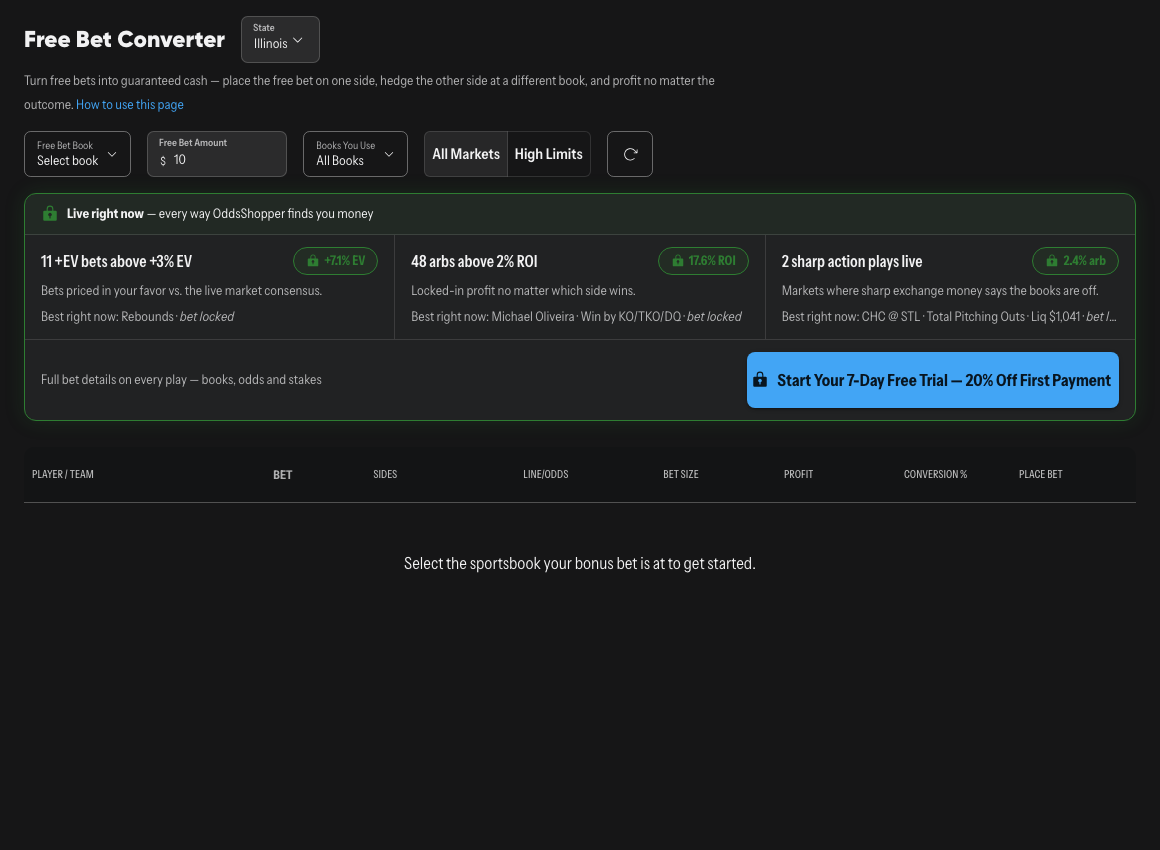
The OddsShopper Promo Converter.
So if CLV is the real ledger, why does anyone grade themselves on profit instead? Because profit feels like the point. The problem is what profit does over small samples.
Short-Term P&L Lies To You
At standard -110 pricing you need to win 52.4% of your bets just to break even. That's a thin line, and variance stomps all over it in the short run. A bettor with zero edge, flipping coins at -110, will routinely run five wins above or below expectation across a 100-bet sample — and every so often ten — as a matter of ordinary luck. The same zero edge produces both "up nicely and feeling like a sharp" and "down bad and questioning everything."
It cuts the other way too. A bettor who beats the close relentlessly can sit on a losing month, sometimes two, while the sample catches up to the edge. If you grade yourself on the scoreboard, you will fire your best process during a cold stretch and double down on a lucky bad one. This is exactly how sharp bettors think about it, and it's why one reply under the Review-tab tweet from the Portfolios rebuild launch put it cleanly: short-term P&L is noisy, but consistently beating the closing price gives you much better EV.
The rulegrade your process at the close, and grade your results only once the sample is big enough to mean something. Everything in between is weather.
The uncomfortable part: knowing this doesn't help you apply it. You can't eyeball your bet history and see which slice of your +12 units was skill. You need something that reads every bet against the close and does the distribution math for you. Doing that math is the job the rebuild gave the Review tab.
The Review Tab: A Verdict, Not A Vibe
OddsShopper Portfolios is the August 2026 rebuild of the old PortfolioLab, and the launch got noticed. @WSBTradesAlerts called it a massive rehaul and ran through the new features, but the account came back to single out the Review tab, putting it this way: "you can see how much of your CLV is part of variance — something Pikkit doesn't even tell you."
Here's how the tab actually presents that. It doesn't hand you an acronym or a raw CLV percentage. It analyzes every bet you've tracked and leads with a verdict: your result placed at a percentile of your own portfolio's range of outcomes. The real readout that made me stop scrolling graded a tracked record at the 7th percentile of its portfolio's outcome range, and then added the caveat every honest grader owes you: 17 bets is a small sample.
Sit with what that framing does. A 7th-percentile result means the record landed near the bottom of what this exact portfolio, with these exact bets, could plausibly have produced. That's the variance share made visible: the tab is telling you how unlucky (or lucky) your scoreboard is relative to your process, instead of letting the scoreboard speak for itself. And by flagging 17 bets as small, it refuses to let you draw a season's worth of conclusions from a fortnight of results, in either direction.
Under the verdict sit three readouts that explain why your number is what it is:
| Readout | What it shows |
|---|---|
| Timing | When edges were posted vs. when you actually placed, and the EV you caught vs. missed in that window |
| Price Capture | How much of the posted price you actually got on the bets you placed |
| Your Picks | How the bets you personally chose skew relative to everything your portfolio surfaced |
The row I keep coming back to is timing. Every edge has a shelf life: it gets posted, the market catches on, the number moves. The timing readout shows the window between the edge appearing and you acting on it, and how much EV leaked out in between. It's the difference between owning a good process and actually being present for it.
OddsShopper Portfolios ships with OS Pro, which scans 100+ sportsbooks for mispriced lines and comes with a 7-day free trial. Code CUSTOM30 takes 30% off a new member's first payment.
Reading A 7th-Percentile Verdict Like An Adult
Say that 17-bet, 7th-percentile record is yours. Remember the 52.4% breakeven line from earlier: over 17 bets, variance alone can bury a process that clears it. So the verdict isn't "you're bad." It's "your result is near the floor of your own range, and the sample is too small to convict anyone." What you do next depends on the readouts underneath:
- Price Capture Strong, Timing Tight? You're getting the numbers your process found, close to when it found them. The percentile is mostly noise. The only fix is more bets, not different ones.
- Price Capture Weak? You're placing the right bets at the wrong prices, arriving after the market has already eaten the edge. That's not variance, and no sample size will rescue it.
- Timing Readout Showing Missed EV? Edges are posting while you're at work or asleep. Notifications and faster routines recover real EV here before you change a single opinion.
- Your Picks Skewing Worse Than The Feed? The bets you hand-select are dragging on the bets the portfolio surfaced. That's a hard thing to learn about yourself, which is precisely why a tool has to be the one to say it.
Two of those four fixes are about price, and both get easier with more outs. If you're adding a second book to shop against, start with the book's current offer and how to claim it, and run any bonus bets it hands you through the free bet converter instead of spraying them on longshots. Better prices in, better price capture out.
The Rest Of The Rebuild Feeds The Same Verdict
The Review tab is the headline, but the other rebuild pieces exist to make its verdict sharper. Custom devigging lets you choose between OS weights, the preset reference books OddsShopper has always priced from, and Custom weights, where you pick and weight the books that set your fair price (vig-removal methods stay on the OS default for now, with more methods listed as coming soon). The rebuilt track record keeps verified results separate from replayed ones — a record built by replaying a setup over past bets is labeled Replayed and never blended with Verified results (backtesting a custom-weights setup is itself listed as coming soon). And the daily swing range shows, from your own portfolio settings, how big your up and down days can get, so the variance lesson above is priced in before you live it. The full tutorial walks through setup, and what Portfolio EV is covers the concept underneath.
FAQ: Beating The Closing Line
How do I know if I'm beating the closing line? Compare the price you bet to the final pre-game price on every bet, across your whole sample, ideally against the no-vig close. Doing this by hand is miserable, which is the job the Portfolios Review tab automates: it reads every tracked bet against the close and places your result at a percentile of your own portfolio's range.
How many bets before CLV means anything? More than you'd like. CLV converges on the truth much faster than P&L, but a 17-bet sample still earns a small-sample caveat from any honest grader — the Review tab prints that caveat right on the verdict. Treat early readouts as direction, not destiny.
Does beating the close matter if I'm losing money? Yes, and it's the most valuable time to know it. Consistently beating the close while losing is the signature of a good process in a bad stretch. The reverse, profiting while losing to the close, is the signature of luck you shouldn't count on.
The Bottom Line
Your P&L is a scoreboard. The closing line is a judge. Variance controls the first one for far longer than feels believable, which is why the question "am I actually beating the books" can't be answered by the number you check every night. It gets answered by reading every tracked bet against the close and being told, in percentile terms, how much of your result your process earned. That readout used to be a spreadsheet project. Now it's a tab.
OddsShopper Portfolios on OS Pro tracks your bets, grades your timing and price capture, and gives you the verdict straight, with a 7-day free trial to see your own number. Code CUSTOM30 takes 30% off your first payment.
Bet responsibly. Odds, prices, and tracked results move constantly, and no outcome is promised. Anyone who needs help with a gambling problem can call 1-800-GAMBLER.
More on this: Closing Line Value (CLV) Explained: Beat the Close · Best +EV Bet Tracker: What To Look For (And What Most Skip) · Devig Calculator: Find Fair No-Vig Odds From -110 Prices · How To Bet On Horses: 6 Horse Racing Bet Types Explained · Polymarket Fees Explained: What Trading Actually Costs