A Kalshi price is a probability. A contract at 62 cents means the market gives that outcome a 62% chance: it pays $1.00 if the event happens and nothing if it does not, so 62 cents is what a 62% shot is worth. In sportsbook terms that is -163. There is no -110 or +260 on a Kalshi board, only a number from 1 to 99 cents, and that number is the implied probability every other odds format makes you work out.
Below 50 cents the contract is an underdog and converts to a plus number; above 50 it is a favorite and converts to a minus number; 50 cents is +100, a coin flip.
Our Sims don't guess: they play Chiefs at Seahawks 10,000 times, snap by snap, and count how often each bet comes through. Ask them anything about the Chiefs and Seahawks, for free.
Ask The Sims about Chiefs at Seahawks on Kalshi
The Chart: Cents To Probability To American Odds
The chart runs from a longshot to a near-certainty. The middle column is the cent price read as a probability; the right column is the same position the way a sportsbook would quote it.
| Kalshi Price | Implied probability | American odds | Read |
|---|---|---|---|
| 5¢ | 5% | +1900 | Deep longshot |
| 10¢ | 10% | +900 | Longshot |
| 20¢ | 20% | +400 | Underdog |
| 25¢ | 25% | +300 | Underdog |
| 30¢ | 30% | +233 | Underdog |
| 35¢ | 35% | +186 | Slight dog |
| 40¢ | 40% | +150 | Slight dog |
| 45¢ | 45% | +122 | Near coin flip |
| 50¢ | 50% | +100 | Coin flip (pivot) |
| 55¢ | 55% | -122 | Slight favorite |
| 60¢ | 60% | -150 | Favorite |
| 62¢ | 62% | -163 | Favorite |
| 65¢ | 65% | -186 | Favorite |
| 70¢ | 70% | -233 | Solid favorite |
| 75¢ | 75% | -300 | Strong favorite |
| 80¢ | 80% | -400 | Heavy favorite |
| 90¢ | 90% | -900 | Very heavy favorite |
| 95¢ | 95% | -1900 | Near-certainty |
Every price above 50 has a twin the same distance below it, carrying the same American number with the sign flipped: 60¢ is -150 and 40¢ is +150, 65¢ is -186 and 35¢ is +186. Learn one half of the board and you have both. Small moves off the pivot are bigger than they look once converted. A contract at 57¢ feels close to a coin flip and is already -133.
The Formula, Both Directions
For a price the chart skips, the math is two short rules split at 50 cents, with P as the price in cents.
Price above 50 (favorite):   American = -(P / (100 - P)) x 100
Price below 50 (underdog):   American = ((100 - P) / P) x 100
Run 57¢ through the favorite rule: -(57 / 43) x 100 = -133. Run 29¢ through the underdog rule: ((100 - 29) / 29) x 100 = +245.
Going the other way is two steps: turn the American odds into a probability, then read that probability as cents.
Favorite (-X):   probability = X / (X + 100)
Underdog (+Y):   probability = 100 / (Y + 100)
Cent price = probability x 100
A sportsbook line of -150 implies 150 / 250 = 0.60, or 60 cents on Kalshi. A +250 underdog implies 100 / 350 = 0.286, or 29 cents. This is the direction you use to hold a sportsbook line against a Kalshi price on the same game.
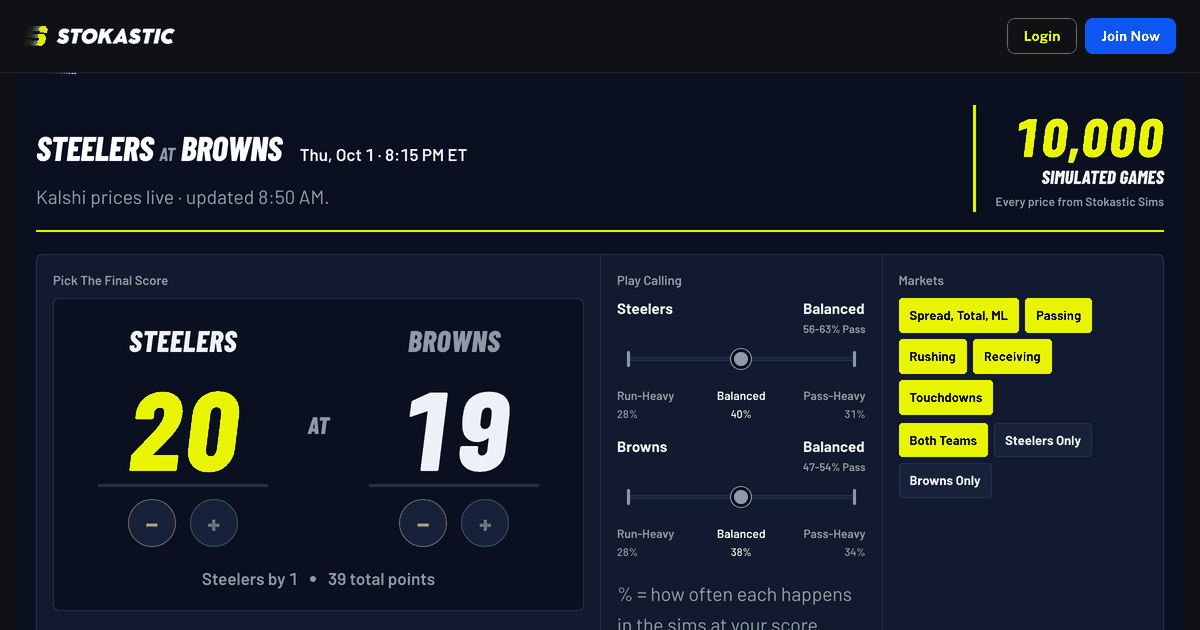 Cents are a probability, and a combo multiplies them. The Kalshi Parlay Simulator prices any combo of a game's contracts against 10,000 simulated games, next to Kalshi's ask.
A Real Contract: Seattle At 62 Cents
On Sunday, Sept. 6, 2026, at 6:20 a.m. ET, Kalshi's "Seattle wins?" contract for the NFL season opener, New England at Seattle on Wednesday, Sept. 9, showed a 62¢ bid and a 63¢ ask. The bid is what a buyer was offering; the ask is what you paid to get in, so when you are buying, the ask is your price. The ask, 63 cents, is a 63% chance, and the one-cent gap between the two is the spread. In American odds that is -170 at the ask (-(63 / 37) x 100) and -163 at the bid. With sportsbooks showing Seattle at -165 and -175, the exchange sat in the middle of the market: fair, not a steal.
The sticker price is not your break-even. Kalshi charges a trading fee on top of the contract, heaviest near 50 cents, and on one contract at 63¢ the fee rounds up to 2 cents, so the real entry was 65 cents, which converts to -186. A contract you read as -170 costs what -186 costs, and that gap is enough to turn "cheaper than the book" into "the book was cheaper." The fee curve is in our Kalshi fees guide.
What Happened To The 62-Cent Contract
For three days the price barely moved: 62¢ bid and 63¢ ask through Tuesday, Sept. 8, then 61¢ and 62¢ on game day up to the 8:20 p.m. ET kickoff.
Then the game happened to it. New England led 10-3 with the ball near midfield as the fourth quarter opened, and at 10:38 p.m. ET the Seattle contract traded at 13¢. Run that through the underdog rule and it is +669: the contract that read -170 on Sunday morning was a 13% shot on Wednesday night. Drake Maye threw an interception a minute later, Drew Lock hit Jaxon Smith-Njigba for a 45-yard touchdown to tie it with 11:28 left, and a Jason Myers field goal put Seattle ahead with 5:50 to play.
Seattle won 13-10 and Kalshi paid the contract at $1.00 at 11:29 p.m. ET. Anyone who paid the 63¢ ask on Sept. 6 made 37 cents a contract before the fee and 35 cents after it. A cent price is a probability at one moment, not a verdict. A 62¢ price said Seattle loses 38 times in 100, and for most of that night the game looked like one of the 38.
A live one to practice on, read as of October 20, 2026, at 4:06 a.m. ET: Kalshi's "Seattle wins" contract for Week 7, Kansas City at Seattle, kicking off at 8:20 p.m. ET on Sunday, Oct. 25, showed a 55¢ bid and a 56¢ ask. A 56¢ ask is -127 before the fee, six cents cheaper and 36 points of American odds longer than the 62¢ this page opens on. The fee on one contract at 56¢ rounds up to 2¢, so the real entry is 58¢, or -138. The spread is one cent, so buying costs 56¢ and selling gets you 55¢; three days earlier it was three cents wide.
There is a separate contract for each team, and the Kansas City contract showed 43¢ bid and 45¢ ask, so a No on Kansas City asked 57¢, a cent more than Seattle's own Yes: this time the Seattle contract was the cheaper way in. Early Tuesday, eight sportsbooks on the live odds screen, which shops the number across every major book, had Seattle between -134 and -140 with Kansas City +112 to +120. BetRivers had Seattle at -137 and Kansas City at +112; -137 implies 58% before the book's margin comes out and 55% after it, so the exchange's 58¢ real entry sat three cents above the book's fair number, and on this read the book was the cheaper venue.
Prices on this page are the market's at the time stated and move; the conversions are estimates, not predictions of fact and not financial advice.
What Moved Since Oct. 17
The practice quote above replaced one pulled Oct. 17 for the same game, so for once the contract did not settle between editions. It finished a cent higher, the spread narrowed to a cent, and the sportsbooks moved the other way.
- The Chiefs' 22-6 Win Made Seattle A Coin Flip For An Hour. From the Oct. 17 read, 52¢ bid and 55¢ ask, the ask drifted to 57¢ by early Saturday afternoon and sat mostly at 57¢ to 58¢ through the night, 55¢ bid and 58¢ ask at 11 p.m., with no Seattle game to move it. Then Kansas City beat the Chargers 22-6 at home on Sunday, Oct. 18, to go to 5-0, and in the 7 p.m. hour ET, as that game was ending, the Seattle contract traded as low as 49¢ before the ask closed the hour at 54¢. Run 49¢ through the underdog rule and it is +104: the contract that asked 58¢ on Saturday night was a coin flip for one trade on Sunday evening. By midnight it was 54¢ bid and 55¢ ask, the Oct. 17 ask to the cent with the bid two cents closer.
- The Exchange Added A Cent While The Books Took Ten Points Off. The contract held 54¢ bid and 55¢ ask through Monday afternoon, was 55¢ bid and 56¢ ask by 4 p.m., touched 57¢ around midnight and was 55¢ bid and 56¢ ask at the read. The sportsbooks went the other way across the same three days: Seattle was -144 to -150 at eight books early Saturday and -134 to -140 early Tuesday, with Kansas City shortening from +120 to +125 into +112 to +120. A cent up on the exchange and about ten points of American odds off at the book is the whole reason the comparison below moved from a wash on Oct. 17 to three cents in the book's favor today: the two venues read the Chiefs' win differently, and the gap between them is the trade.
- Kalshi Listed The Next One. Seattle's contract has traded about 36,000 contracts in its life, up from 1,934 at the Oct. 17 read, and its spread went from three cents to one over the same three days. At 12:06 a.m. ET on Oct. 20 Kalshi opened Seattle's following game, Chicago at Seattle on Monday, Nov. 2, and at the read it showed a 40¢ bid and a 72¢ ask: a listed market, not yet a priced one, and this page's next practice quote once Sunday night's contract settles.
The two contracts before this one were the whole lesson of this page. The 49ers contract was 29¢ at halftime, 72¢ with a quarter to play and 1¢ six minutes later. Seattle's contract against Denver was 24¢ at halftime, 2¢ inside the last 90 seconds of regulation, 57¢ when the field goal tied it, and 1¢ in overtime, and each of those was the right price for the game as it stood at that minute. Seattle has not played since the Oct. 17 read, and this one still ranged from 49¢ to 58¢ in three days and finished a cent higher; Sunday night is where it meets the same test. The number you convert is only the number at the moment you convert it, which is why the chart above is a translation and not a forecast.
Settlement Rules Can Make The Same Price A Different Bet
A sportsbook moneyline grades on the final score, overtime included, and refunds a tie. A Kalshi contract grades on its own written rules, and the Kansas City-at-Seattle contract above spells them out: it covers the game "originally scheduled for Oct 25, 2026," a tie settles at 50 cents to each side rather than a refund, a game postponed but started within 48 hours of its original kickoff keeps the market open and settles on the official final result, and a game not started inside 48 hours settles at a fair price, not a return of your stake. Overtime counts because the official final does. A prop contract can carry its own cutoff, and the price alone will not tell you which rules you are holding. Read the contract's rules before you treat 63¢ as interchangeable with -170. The cases where the two differ are where an arb that looked airtight becomes two separate bets, which our prediction market arbitrage guide covers.
Comparing A Kalshi Price To A Sportsbook Line
A sportsbook line is a probability plus the book's margin, so to hold it against a Kalshi price you strip the margin first. Take the Sept. 9 opener's line, worked through: a book had Seattle at -170 and New England at +150. Those imply 63% and 40%, and the 3 points over 100 are the book's hold. Remove it and Seattle's fair probability is 61%, or 61 cents. Now the comparison is clean: 61 cents fair at the book against 63 cents on Kalshi, closer to 65 with the fee, so on those numbers the book was the cheaper venue. Run the Oct. 25 line above the same way: BetRivers' -137 on Seattle and +112 on Kansas City imply 58% and 47%, and the 5 points over 100 are the hold. Remove it and Seattle's fair probability is 55%, or 55 cents, against a 56¢ ask that is 58¢ with the fee: the book is three cents cheaper, the September opener's answer again, where the Denver game's -155 line and the Oct. 17 read had both been a wash. The arbitrage tool prints that fair price for every book it tracks. For a combo of contracts, the comparison runs the other way: price any Kalshi combo against the sims and you see whether the exchange's ask is fair before you pay it.
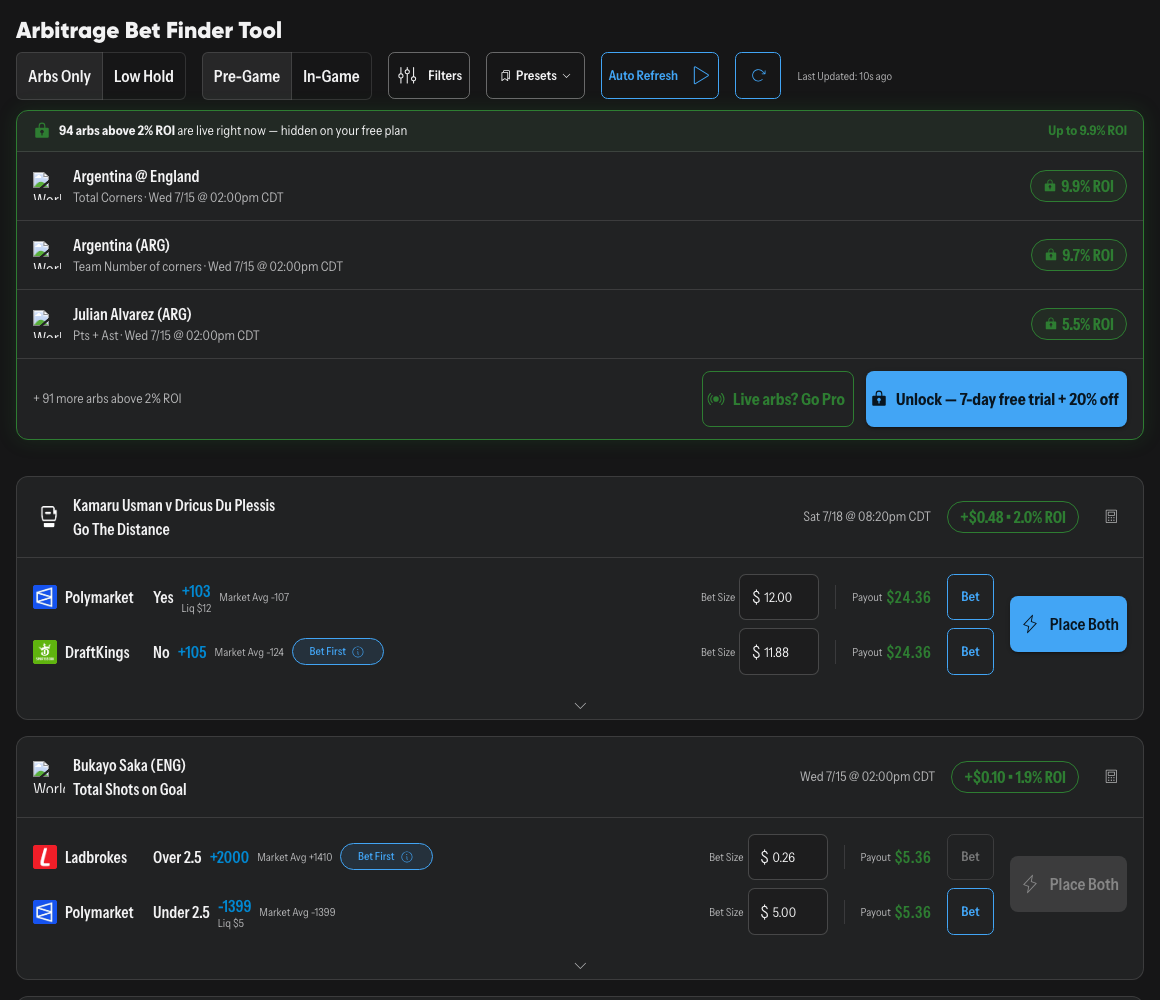
The OddsShopper Arbitrage Tool.
See the real price on both sides.OddsShopper Pro prices every sportsbook market at no-vig fair odds, so you can hold a book's true probability next to a Kalshi cent price and see which venue is cheaper. Use code KALSHIODDS20 for 20% off your first payment.
State Rules Before You Trade
Kalshi is a CFTC-designated exchange that operates nationally, but its sports contracts were restricted or contested in 21 states as of October 15, 2026, and the list moves month to month; the state-by-state map is on our Kalshi legality page. Whether a state can stop it is in court. In April 2026 the Third Circuit sided with Kalshi 2-1 and blocked New Jersey from enforcing its gambling law against the exchange, and New Jersey asked the Supreme Court to take the case on Sept. 2, 2026. On Aug. 28 the Ninth Circuit went the other way, 3-0 for Nevada, calling the sports contracts bets under state law. On Sept. 25 the Sixth Circuit joined it, 3-0 for Ohio and Tennessee: Kalshi had not shown its sports contracts are swaps inside the CFTC's exclusive jurisdiction, and federal law does not preempt either state's gambling law. The count is two appeals courts against the exchange and one for it. On Oct. 9 Kalshi asked the full Sixth Circuit to rehear that case, arguing the panel misread the Commodity Exchange Act on both preemption and what counts as a swap and that the CFTC's new proposed rules undercut the ruling. Between Sept. 22 and Oct. 8 eleven friend-of-the-court briefs landed on the Supreme Court's docket in the New Jersey case, No. 26-299: Ohio, 38 other states and the District of Columbia filed on Oct. 7, and the NFL, the American Gaming Association, 145 tribes and tribal organizations and former CFTC chairman Gary Gensler were among six filers on Oct. 8. Nothing has been filed since, and Kalshi's answer to the petition is due Nov. 9. Minnesota's law against operating a platform (it targets operators, not traders) has been blocked by a federal judge since July 27 while that case runs. The list moves with each ruling, so check Kalshi's own eligibility screen the day you fund an account, and see are prediction markets legal for the wider picture.
Stay ahead of the markets.
Daily insights and expert picks on Kalshi, Polymarket, and what's moving markets.
Free forever. Unsubscribe anytime.
Tools for this: the Kalshi combo builder turns cents into a combo price against 10,000 simulated games; the Polymarket Combo Simulator does the same for Polymarket.
More on this: Prediction Markets vs Sportsbooks: Kalshi Odds Gaps Today · AFC East Odds: Drake Maye Made The Super Bowl, Buffalo's Favored · Arsenal Vs Chelsea Odds: Chelsea Money Keeps Coming. The Price Won't Budge · Darian Mensah Heisman Odds: A Favorite Built On 30 Throws · Kansas Senate Race 2026 Odds: The Bet That Moved Nothing