The best college football betting tips have almost nothing to do with math and everything to do with information. There are more than 130 FBS programs, and on a big Saturday the card can run past 60 games. No sportsbook employs enough people to price all of that as sharply as it prices the dozen-plus games on an NFL Sunday, and no bettor can follow all of it either. That is the whole fight in CFB: the market is stretched thin, you are stretched thin, and the winner is whoever concentrates their attention better.
OddsShopper's Ben Rasa calls college football his favorite sport to bet and one of the most profitable markets out there, and the three tips he lays out in the video below all attack that same weakness from different directions. Two of them are about catching the market pricing stale information. The third, the one Ben calls the most underutilized angle in all of college sports, is about making the market's biggest problem your biggest advantage. We will get there, but it lands harder once you see the first two.
The Quick Answer
The three college football betting tips from Ben Rasa's breakdown: read rosters through the transfer portal instead of trusting returning production, audit a team's schedule before you trust its record, and specialize in a small set of teams or one conference instead of skimming all 130-plus. Each one exploits the same structural fact, which is that CFB has too many teams for the books to price tightly. The full breakdown, including the Kent State schedule example that shows exactly how a false narrative gets priced into a line, is below.
Watch The Video
The tips in this guide come straight from Ben Rasa's breakdown of how to bet college football: watch on YouTube or in the player above. The live odds screen, the line-shopping tool this guide leans on throughout, looks like this:
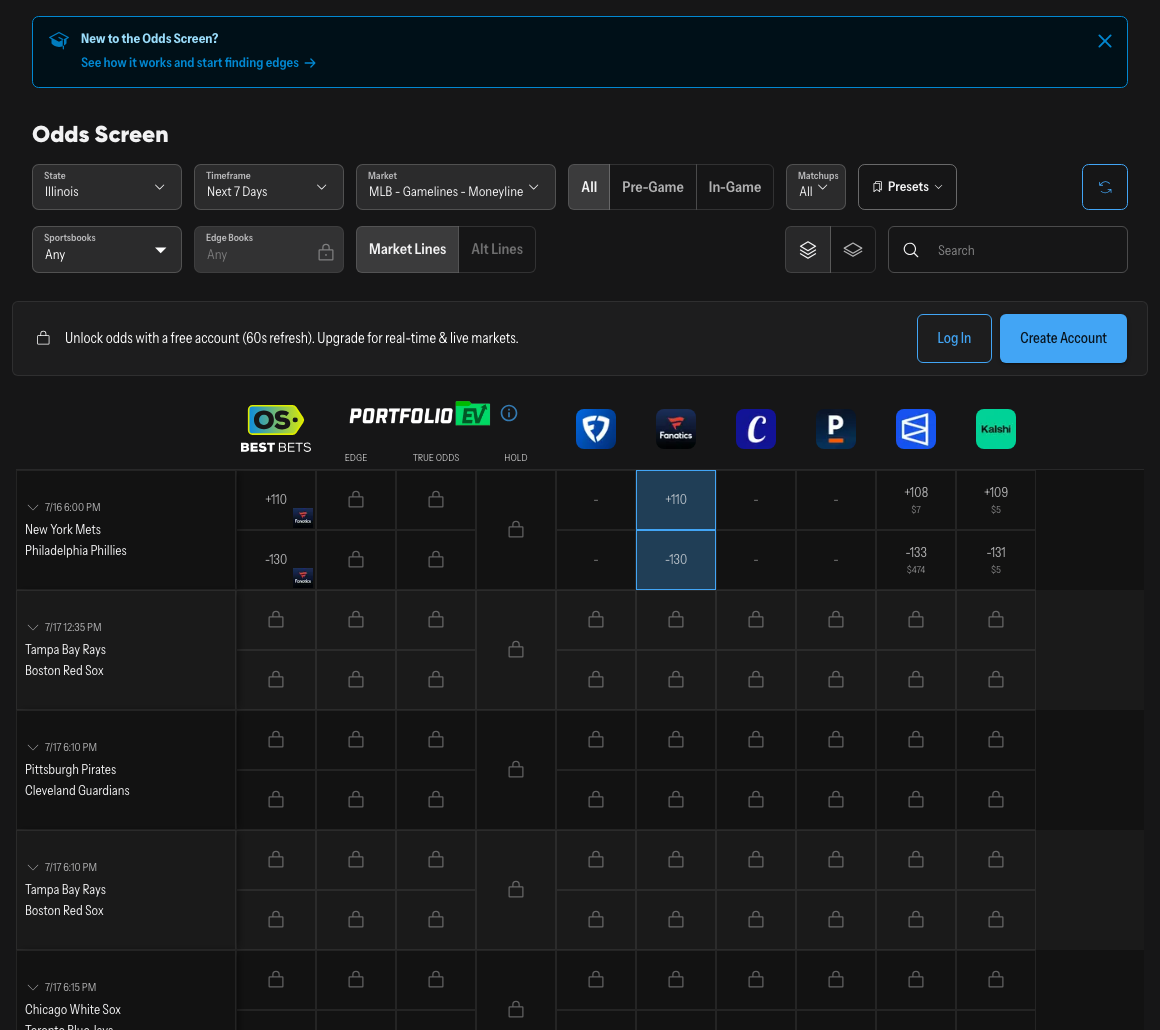
The OddsShopper Odds Screen.
Tip 1: Read Rosters Through The Transfer Portal
In the NFL, 32 rosters change at the margins. In college football, the transfer portal means a roster can turn over almost completely in one offseason, with no sit-out year to slow it down. A quarterback buried on the bench at one school can start for another the following September. That has broken the classic handicapping shortcut of "returning production": a team can lose its whole two-deep on paper and come back better, because what left matters less than what arrived.
Colorado in 2023 is the extreme example Ben points to. Deion Sanders took over a program coming off a miserable season, moved on from most of the existing roster, and rebuilt it with dozens of portal additions. By a basic returning-production read, Colorado looked like a team about to get even worse. Anyone reading the roster the old way had them dead wrong, and the portal-built team outran that expectation immediately.
Colorado is the loudest case, but the same read applies quietly across the sport every year. A team that "lost its quarterback" may have portaled in a better one. A team that returns everyone may have returned a group that was not very good. The work is checking who actually came in, not just who left, and the teams that made big portal splashes tend to open the season undervalued while rosters full of new pieces that never gel end up overvalued.
There is no single clean data feed for this, and Ben is honest about that: it comes from digging. Google, social media, and whatever beat coverage you can find are the sources, and that homework being annoying is exactly why the edge exists. Which raises the obvious question: if rosters can lie, what about the thing everyone trusts even more, the record?
Tip 2: Audit The Schedule Before You Trust A Record
College football schedules are not built for fairness. Small-conference programs routinely sell early-season road games to power-conference schools for a payday: they take a beating, fund their athletic department, and get on with the season they actually care about, which is the conference race. The big schools get warm-up wins. Both sides know the deal. The betting market, staring at a 1-3 record in late September, often forgets it.
Worked Example: Kent State And The Record That Lied
Ben's example is Kent State, a MAC program whose non-conference schedule one season was a case study in scheduling for money rather than wins:
| 2022 Kent State Non-Conference Game | Result |
|---|---|
| Vs. Long Island (non-FBS) | Won 63-10 |
| At Washington | Loss |
| At Oklahoma | Loss |
| At Georgia | Loss |
That is a 1-3 start built entirely out of games that could not have gone any other way. Kent State was never beating Washington, Oklahoma or Georgia on the road, and was never losing to Long Island. Those four results carried almost no information about how good Kent State actually was, yet a cursory look at the standings said "this team is struggling." Ben's point is that once Kent State got back to playing the Ball States and Akrons of the world, opponents on their own level, they were immediately undervalued, because the market had soured on a record that meant nothing. Ben also pulls up a week-one board in the video with Kent State posted as 34.5-point underdogs at UCF and San Jose State catching 30.5 in the same window. Lines that size are the sport telling you these games are financial transactions, not measuring sticks.
That leads to one of Ben's favorite plays in all of college football: target small-conference teams that were fed an impossible non-conference schedule, and back them early in conference play, after the public has given up on them through no fault of their own. It cuts the other way too. A power team that opens 4-0 by four touchdowns a game against overmatched opponents has proven nothing yet, and its number in the first real conference test can be inflated for the same reason. None of this means blindly backing every team that lost its non-con games. It means the record is a starting point for an audit, not a conclusion. Every result gets discounted by who it came against, the same resume honesty that drives smart college football win totals handicapping in August.
The Standing Tip: Never Pay Retail For Your Number
Before the last angle, one piece of housekeeping Ben insists on because it applies to every bet you will ever place. Books compete for your business, and Ben frames the cost of ignoring that as a regret test: don't get to January and realize the year that finished break-even could have been a winning one because you never took the offers or shopped for the better number. Keep accounts at multiple books, take the offers that make sense for you, and shop every number on the live odds screen before you fire. This matters even more in college football than in the NFL: DraftKings, FanDuel, BetMGM and Caesars will not all land on the same number for a Tuesday MACtion game, because nobody is watching those markets closely enough to keep them in line. Line shopping is the closest thing to free EV in this market; the full case for why CFB numbers vary so much between books is in our college football betting strategies guide. Getting the best of the number is table stakes. The last tip is about finding the number worth betting in the first place.
Tip 3: Become A Specialist
Here is the angle Ben flags twice before he even gets to it, the one he calls the strongest in college sports and the most underutilized: stop trying to know everything. With 130-plus teams, murky injury reporting, and depth charts that shift weekly, nobody can track the whole sport. Jack of all trades, master of none is a losing profile in a market this wide. The bettor who follows 10 or 20 teams, one or two conferences, and actually knows them beats the bettor skimming 60 games every Saturday.
Specializing means learning the beat writers, the personnel, the schedules and the depth charts for your slice of the sport. Do that and the mispricings start finding you. You will catch a line that makes no sense because you know the quarterback has been banged up all year, or that a key starter has not practiced, for a team nobody else is paying attention to. Ben is clear he is not calling that inside information; these are angles sitting in plain view for whoever is actually paying attention, because attention, not intelligence, is the scarce resource in college football. The books cannot watch everything either, which is why CFB lines are softer than NFL lines to begin with; our college football vs. NFL betting breakdown digs into that gap.
Notice this is the same lesson as the first two tips, concentrated. The portal edge and the schedule edge both existed because the market carried stale information about teams nobody watches closely. A specialist is simply someone positioned to catch those mistakes every single week. A MAC specialist did not need to discover the Kent State angle after the fact; they saw it forming in real time. Pick your conference, and Ben's advice is that it does not matter which one, even the Sun Belt, as long as you go deep instead of wide. In college basketball, with over 350 teams, the same logic applies with even more force.
You do not need to win every game or bet every game. Focus on a handful, know them cold, and let the rest of the card go. Pair that discipline with sensible staking from our bankroll management guide and you are structurally ahead of most of the market before kickoff.
Turning The Tips Into A Weekly Routine
Put together, the three tips form one repeatable loop. In the offseason, map the portal winners and losers in your chosen conference. In September, log which of your teams played schedules that say nothing about them. From October on, hunt the numbers the broader market gets wrong about the teams you know best, and grade yourself against the close with closing line value rather than short-term wins and losses. If your CLV is positive, meaning the line movement keeps finishing on your side of the number you took, the results tend to follow over a large enough sample. If you are newer to the sport and need the mechanics first, spreads, key numbers and bet types are covered in how to bet on college football, and if you like combining angles, mind the correlation rules in college football parlays.
The finding part is where tools earn their keep. OddsShopper Pro scans the CFB board across 20+ major legal US sportsbooks, surfaces the best available number on any side you like, and flags the +EV prices a stretched market leaves behind, which is exactly where a specialist's edge shows up. You can also see what our experts are backing for free on the free expert picks page. Use code CFBTIPS20 for 20% off your first month of OS Pro or OS Core.
Frequently Asked Questions
What is the most profitable way to bet college football? Ben Rasa's answer is specialization: follow one or two conferences deeply enough that you catch injury, depth chart and portal news before the market prices it. CFB's 130-plus teams mean the books cannot sharpen every number, and the soft ones cluster around the teams fewest people watch.
Does the transfer portal really change how you should handicap CFB? Yes. Returning production used to be a reliable proxy for team quality, but a roster can now be rebuilt in one offseason. Judge teams by who arrived, not just who left, and date any roster fact you rely on, because portal news spoils fast.
Should I avoid betting on teams with losing records in September? Not automatically. A small-conference team that went 1-3 against three road powers and one cupcake has told you nothing about its real level. Audit who the results came against before trusting the record; teams soured on by the public after impossible schedules are often the best early conference-play value in the sport.
The Bottom Line On College Football Betting Tips
College football is the widest, messiest, most information-hungry betting market in American sports, and that is precisely why Ben calls it one of the most profitable. The market's weakness is coverage: too many teams, too many games, too much news for anyone to price perfectly. Every tip here is a way of out-covering it. Read the rosters the market reads lazily, audit the schedules it takes at face value, and plant your flag in a corner of the sport where you can know more than the number does. Then shop the price on everything. Do that for a season and you will spend less time hunting for a bet on Saturdays and more time recognizing one.
More on this: College Football Playoff Semifinal Odds: The 1-For-8 Bye · How To Bet College Football On Kalshi: Markets & Value · \ud83c\udfc8 College Football Week 0 Odds: All 8 Games, Priced Early · Kalshi College Football Picks This Week: Every Board, Scored · College Football Parlays: Why Most Lose, Build Smarter