The best college football betting strategies all start from one edge that hides in plain sight: college football is a softer market than the NFL. There are more than 130 FBS teams playing every Saturday, and no sportsbook sharpens all of those numbers as tightly as it sharpens the dozen-plus games on an NFL Sunday. That gap is the reason a disciplined college football bettor can beat the market: the edges the pros have already wrung out of pro football are often still sitting there in a Group of Five conference game on a Tuesday night. If you want the full contrast, we lay it out in college football vs. NFL betting; this guide is the framework our team uses to attack CFB, from the lines worth hunting to the spots the market keeps mispricing.
None of it requires a model. It requires knowing where the soft numbers live, when to fire, and which situational angles actually move a college football line. Let's build it.
TL;DR: The College Football Betting Strategy Cheat Sheet
- Hunt The Ignored Games. The value is heaviest where attention is thinnest — mid-tier and Group of Five games carry looser numbers than the ranked primetime marquee.
- Line Shopping Is Free EV. CFB books disagree more than NFL books, so the same bet at a better price is the single most reliable edge in the sport.
- Time It: favorites early (before the public inflates them), underdogs late (as the number drifts your way), and let injury and weather news — not the calendar — drive totals.
- Key Numbers Matter Less Here Than In The NFL. High totals and frequent two-point conversions scatter margins, so treat 3 and 7 as a minor tiebreaker, not a pillar.
- Situational Angles Are The CFB Edge: byes, look-aheads, letdowns, rivalries, travel, and bowl motivation move a young, emotional sport.
- Judge Yourself By Closing Line Value, not last Saturday's record.
Why College Football Lines Are Softer Than The NFL
Efficiency is a function of attention. Every dollar and every sharp opinion in football floods toward the same handful of NFL games, so those markets tighten fast and the edges shrink to fractions of a percent. College football spreads that same money across a Saturday card that can top 50 games, many between teams a casual bettor has never watched. Books lean on models and copy the market to price the deep end of the card, which means the mid-tier and Group of Five games carry looser numbers and bigger book-to-book disagreement than anything in the pros.
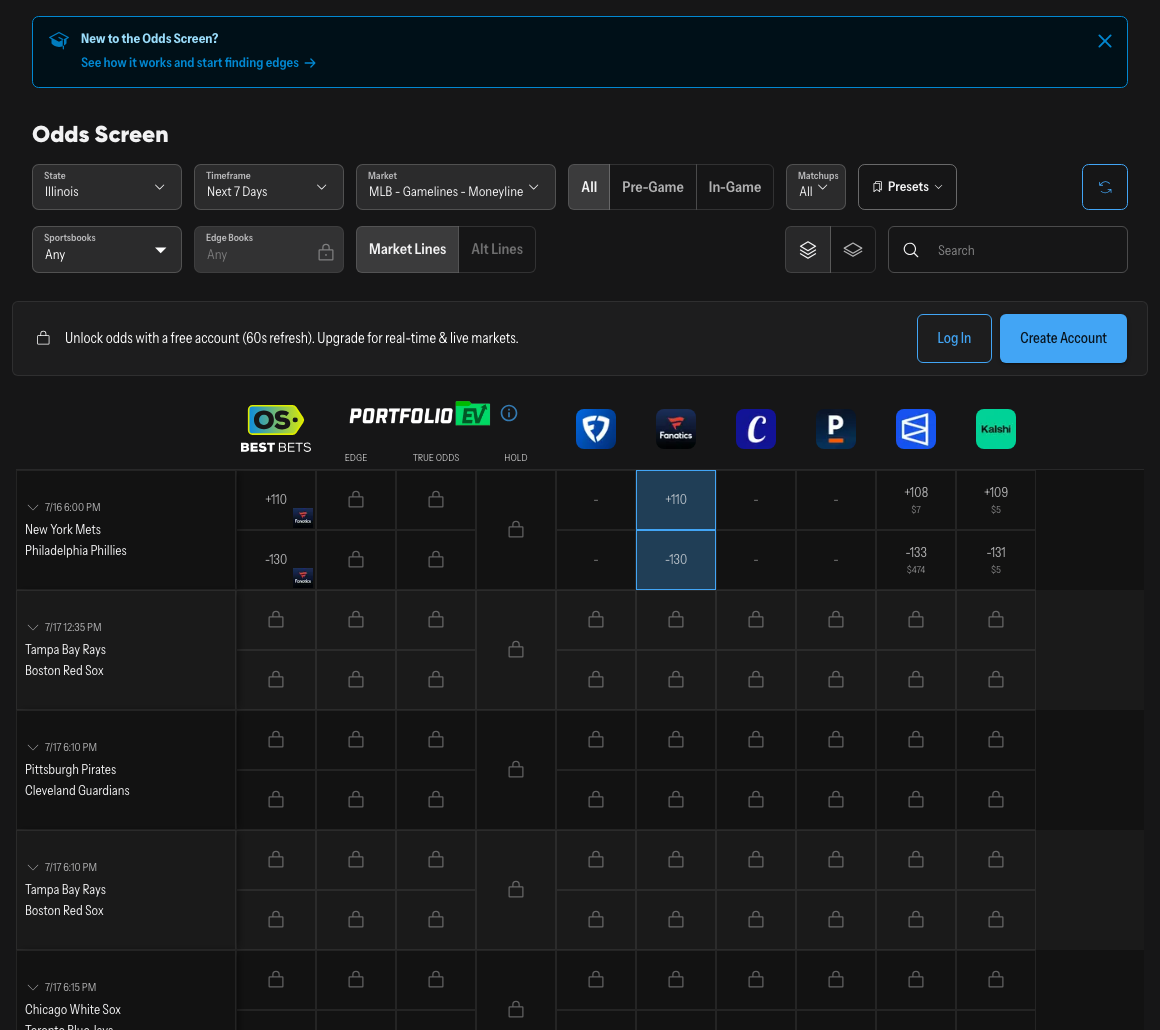
The OddsShopper Odds Screen.
This is the whole thesis of college football betting strategy: the value is heaviest where attention is thinnest. The marquee ranked matchup on Saturday night is nearly as efficient as an NFL game, because everyone is betting it — the same efficiency that makes our NFL betting strategy lean so heavily on price and situational spots rather than raw handicapping. The 11 a.m. ET conference game between two unranked teams is where a stale opener and a two-book price gap can hand you real expected value. Hunt the games the public ignores, not the one on the primetime marquee.
Line Shopping Is Free EV In College Football
One habit matters more than any other: shop your number. The same bet at a better price is free expected value, and because CFB books disagree with each other more than NFL books do, line shopping is worth even more here than in the pros. A spread posted at -3 at one shop and -2.5 at another is not a rounding error. It is the difference between a push and a win on every game that lands on a field goal.
First, a quick definition the rest of this guide leans on. +EV means positive expected value: a bet priced in your favor that, placed many times over, tends to profit in the long run. The price you get is what makes a bet +EV, so the number is not a detail. It is the bet.
Worked Example: The Same Bet At Two Prices
Watch what the price does to your break-even. Say you want a road underdog on the moneyline, and DraftKings has them at +150 while FanDuel has them at +135.
| Book | Price | Break-even win probability |
|---|---|---|
| DraftKings | +150 | 40.0% |
| FanDuel | +135 | 42.6% |
Same team, same bet. At +150 your break-even is 40%; at +135 you need the team to win 42.6% of the time just to tread water. Taking the +135 when +150 is sitting one tab over hands the book 2.6 percentage points of edge for nothing. Do that across a full college football season and you can be a sound handicapper who still loses money, purely on prices. Multiply it across BetMGM, Caesars, ESPN BET, and every other book posting the game, and the best available number is rarely the one on the app you happen to have open.
OddsShopper does that legwork for you. The college football odds screen compares odds across 100+ legal US sportsbooks on one page, so the best available number is one glance instead of ten logins. Under the hood, OddsShopper strips the vig (the book's built-in cut) out of the market to estimate the true, no-vig price of a bet, then ranks bets by +EV against that fair number. In plain terms, it tells you not just who has the best price, but whether that price is actually better than the bet is worth. That distinction is the game, because beating one book doesn't matter unless you're also beating the true odds. For more on why the softest corners of the board are where edges survive, see our breakdown of whether the market can be beaten.
Try this before your next college football bet.OddsShopper scans 100+ legal US sportsbooks and flags the exact bets priced in your favor, the same +EV read this guide teaches you to do by hand. Start free for 7 days, and code CFBEDGE20 takes 20% off OS Pro or OS Core if you subscribe: Start your free trial. Must be 21+ where legal.
Key Numbers Matter Less In College Football
In the NFL, key numbers are a pillar of spread betting. Pro scoring is low and tightly packed, so games cluster on 3 (the field goal) and 7 (the touchdown), and getting on the right side of those two numbers is a real edge. College football is a different animal, and importing the NFL's key-number gospel is one of the most common mistakes bettors make here.
Two things wash out the value of key numbers in CFB:
- Huge Totals Spread The Margins Out. College games routinely post totals in the 50s and 60s with spreads that can reach 30-plus points. When scoring runs that high and that variable, final margins scatter across a wide range instead of piling onto 3 and 7, so any single number carries less weight than it does in the pros.
- Two-Point Conversions Are More Common. College teams go for two more often than NFL teams, partly because college overtime rules force two-point tries, which nudges margins off the classic numbers: a converted two-pointer turns a would-be 7-point game into an 8-point one. It is a secondary effect next to the scoring variance above, but it pulls a few more results away from the 3s and 7s an NFL bettor is trained to protect.
So treat key numbers as a minor tiebreaker on the occasional tight-spread game, not a core CFB strategy. On a close spread near a field goal, getting -2.5 instead of -3.5 still has some value. But key numbers are not where you win at college football. They are a footnote next to line shopping, timing, and situational reads.
That also means buying points is usually a bad deal in CFB. Books sell half-points at inflated juice because they know bettors overpay for them, and in a sport where margins are this spread out, the point you buy rarely changes the result. Take a favorite laid at -17: paying extra to move it to -16.5 is close to pure waste, because almost no college games are decided by exactly 17. That number is out in the wide-open middle of the margin distribution, not on a spot where results cluster, so the half-point you bought will hardly ever flip a loss into a win — you just paid juice for a point that doesn't do anything. Half-points are only worth their price near the numbers where results pile up: if you ever buy a point, do it on a tight spread crossing 3, where that half-point actually flips outcomes, and only when the book isn't gouging the juice to sell it.
Timing The Market: Favorites Early, Underdogs Late
A line is not static, and when you bet is part of the price you pay. Openers are posted by a small number of originators and sharpen through the week as money and information arrive. The practical read for most weeks:
- Bet Favorites Early. Public money piles onto favorites and overs as Saturday approaches, nudging those prices up. If you like a favorite, Monday or Tuesday usually beats waiting.
- Bet Underdogs Late. As that public money inflates the favorite, the dog drifts to a better number closer to kickoff. Patience on a dog is usually paid.
These are tendencies, not laws. Sharp money can hit a number early, and an injury or weather report can override the calendar entirely, so check for movement before assuming a price will only get better. College football adds a timing edge the NFL doesn't. Because books can't sharpen 50-plus games at once, the soft openers on lower-profile games are where the earliest value lives and they move fast once a sharp bettor hits them. If your read is on a Group of Five or mid-tier game, grabbing the opener before the market corrects is often the best number you'll ever see on it. Let injury and weather news, not the calendar alone, drive totals, since a report can collapse a number before casual money even shows up.
Situational Angles That Move College Football
If line shopping is the biggest edge, situational handicapping is the one most unique to college football. Eighteen-to-twenty-two-year-olds playing an emotional, tradition-soaked sport are far more prone to letdowns, look-aheads, and flat efforts than salaried pros, and those swings move lines. The angles our team keeps coming back to:
| Situation | The read |
|---|---|
| Off A Bye | A well-coached team with an extra week of prep is situationally favorable; the coaching gap in CFB is wide, so the better staff makes more of the rest advantage. |
| Look-Ahead Spot | A contender facing a soft opponent the week before a rivalry or ranked showdown can play flat. The market is slow to fully discount the trap. |
| Letdown Spot | A team coming off an emotional signature win or a rivalry game often stumbles the next week against a lesser foe. |
| Rivalry Games | Records and form matter less when familiarity and emotion take over, so a live home dog getting points can be underpriced if the market leans on the favorite's résumé. |
| Travel And Environment | Cross-country trips, altitude, and hostile night crowds matter more in CFB, where home-field edge is larger than in the pros. |
| Motivation And Bowls | Bowl season brings opt-outs (draft-bound stars sit), interim coaches, and lopsided motivation. Read who actually wants to be there. |
The discipline is to treat these as reasons to lean toward a number you already like, not standalone systems. A home dog in a rivalry game on the right side of a key number is a stack of small edges pointing the same way, which is exactly the kind of spot worth pressing. The same soft-market logic applies before a snap is even played: preseason college football win totals are among the earliest and softest numbers on the board, and grabbing a well-reasoned side in August often beats the close by Week 3.
Totals Carry A Structural Under Lean
Two facts shape the totals market. Casual money overwhelmingly lands on overs, because rooting for points is more fun than rooting for a slog, and books know it, so they shade the posted total up to meet that demand and lean a little extra juice toward the over on top of it — the same built-in edge that makes sportsbooks money on every ticket. Put those together and the under is structurally the side carrying less public tax.
Treat it as a lean, not a rule. Blindly taking every under is a dead edge in efficient markets. The version worth acting on is narrower: when the posted total sits above your no-vig fair number and your read is a coin flip, the under is the cleaner side because you're not also paying the inflated over premium on top of a shaded number. Absent that, you should need a real reason to lay the over tax. Weather sharpens it further: heavy wind grounds the passing and kicking game, so a windy forecast is a natural nudge toward the under, especially in November and bowl-season road games.
Closing Line Value Is Your Scoreboard
Closing line value (CLV) is the difference between the price you bet and the number the market closes at. If you take a team at +7 and it closes at +5.5, you beat the close, which is the sharpest signal you were on the right side of the information. Over a season, beating the closing line is the most honest scorecard you have, more reliable than your short-term win-loss record, because results over a small sample are noise and price is the thing you actually control. Beating the close by a meaningful margin on a losing bet is still a sign you made a good bet, especially when you do it repeatedly.
CFB rewards CLV hunting in a specific way: because so many opening numbers are soft, the bettor who fires a well-reasoned early opinion regularly beats the close as the market catches up over the week. One caveat: CLV only means something when the closing number itself is sharp. A thin line an influencer nudged is artificial movement, not evidence you found an edge, so lean on CLV in the liquid markets where the close reflects real money. Track whether you consistently beat those closing numbers. If you do, you have real evidence your process is sound, even while the weekly results swing. Pair that habit with a bankroll management plan so you can size to your edge instead of your gut.
Common College Football Betting Traps To Avoid
The fastest way to improve is to stop doing the losing things. The recurring leaks:
| Trap | Why it costs you |
|---|---|
| Only Betting Ranked/Primetime Games | Those are the efficient markets; the value is in the ignored games. |
| Buying Points Off A Giant Spread | Paying inflated juice for half-points that rarely change a college result. |
| Chasing A Blowout Favorite | Big CFB spreads invite garbage-time backdoors and empty covers. |
| Betting The Ranking, Not The Number | The AP poll is already priced into the line. |
| Ignoring Situational Spots | Letdowns and look-aheads move CFB lines the box score won't show. |
| Fighting The Closing Line | Whatever you're thinking is usually already in the number. |
The theme runs through all of them: the market is efficient enough on the games everyone watches that convenience and emotion get punished, and soft enough on the games nobody watches that discipline gets paid. Bet where you have an edge, not where the cameras are.
Using OddsShopper To Bet College Football Smarter
Everything above is doable by hand. It's also slow, and the edges are measured in fractions of a percent that only add up if you catch them every week. That legwork is what the OddsShopper toolkit automates:
- The college football odds screen puts 100+ legal US sportsbooks' numbers for a game on one page: the tool surfaces the best available number and the bets priced in your favor across the whole Saturday card, often before the market corrects a soft opener, which is the timing edge this guide is built on.
- Portfolio EV ranks straight bets by their edge against the true, no-vig price, so you're betting the number, not the ranking.
- The arbitrage tool and Free Bet Converter help you capture value from promos and cross-book price gaps, subject to book limits and how fast the prices move.
That's the difference between reading about line shopping and actually doing it on all 50 games at once.
The Bottom Line On College Football Betting Strategy
Winning college football betting is not about picking more games right. It's about respecting a market that is soft where nobody's looking and sharp where everybody is. Hunt the ignored games, shop every number for free EV, bet favorites early and dogs late, lean on the situational spots the sport produces, respect the structural under, and judge yourself by closing line value rather than last Saturday's record. Bet the number the sportsbook misprices, not the team you like, and do it every week.
Frequently Asked Questions
What Is The Best College Football Betting Strategy?
One of the highest-value habits is line shopping the soft markets: college football spreads money across 130-plus teams, so books can't sharpen every game, and the mid-tier and Group of Five matchups carry looser numbers and bigger book-to-book price gaps than the pros. Attack the ignored games, take the best available price, and judge your process by closing line value.
Why Are College Football Lines Softer Than The NFL?
Sharp money and attention concentrate on a small number of NFL games, tightening those markets fast. College football's Saturday card can top 50 games, so books lean on models to price the deep end of the card, leaving stale openers and larger disagreements on lower-profile games.
When Should I Place My College Football Bets During The Week?
As a general tendency, favorites are often better early, before the public inflates the price, and underdogs better later as the number drifts. Totals are the exception: let injury and weather news drive them, not the calendar. On low-profile games, grabbing a soft opener early is often the best number you'll get, since the market corrects it as money arrives.
Do Key Numbers Matter In College Football Betting?
Less than they do in the NFL. College football's high totals and frequent two-point conversions scatter final margins across a wide range instead of clustering them on 3 and 7, so key numbers are a minor tiebreaker on tight-spread games rather than a core strategy. Line shopping, market timing, and situational angles move the needle far more.
What Are Situational Angles In College Football Betting?
They are scheduling and motivation spots that move a young, emotional sport: teams off a bye, look-ahead and letdown games around rivalries, travel and hostile environments, and bowl motivation with opt-outs. Use them to lean toward a number you already like, not as standalone systems.
Bet The Number, Not The Ranking
You now have the season-long framework. The last step is doing it every Saturday without logging into ten sportsbooks for 50 games. New to OddsShopper? It scans 100+ legal US sportsbooks to find the best college football number and the bets the market has priced in your favor, the exact +EV work this guide walks through, in seconds. Try it free for 7 days, and code CFBEDGE20 takes 20% off OS Pro or OS Core if you subscribe: Start your free trial. Stop leaving the better number on the table. Must be 21+ where legal; if gambling is a problem, call 1-800-GAMBLER.
More on this: \ud83c\udfc8 College Football Week 0 Odds: All 8 Games, Priced Early · College Football Betting Tips: 3 Edges The Market Is Slow To Price · Kalshi College Football Picks This Week: Every Board, Scored · How To Bet College Football On Kalshi: Markets, Prices And Where The Value Is · College Football Parlays: Why Most Lose, Build Smarter