College football is one of the most fun sports to bet and one of the easiest to lose money on, and those two facts are related. Saturdays give you a dozen games at once, the point spreads run wider than anything you will see in the NFL, and a 40-point favorite can still let you down against the number. This guide covers the CFB basics a new bettor actually needs: how college football odds work, the bet types you will use, the way college lines differ from the pros, and the handful of habits that separate the people who last from the people who reload every week.
How College Football Betting Odds Work
Every college football bet comes down to three core markets. Learn these and you can bet any game on the board.
- Point Spread (The Main CFB Market). The favorite gives points, the underdog gets them. If Ohio State is a 14-point favorite, you write it as Ohio State -14 and their opponent as +14. Bet the favorite and they have to win by 15 or more for you to cash. Bet the dog and you win if they lose by 13 or fewer, or win outright. A spread is the market's way of pricing the expected margin so either side is a roughly balanced bet, which is why it is the market most bettors start with.
- Moneyline (Who Wins, Straight Up). No points, just the winner. Because college games are so often mismatches, moneylines get extreme fast. A big favorite might be priced at -2000 (risk $2,000 to win $100), while a heavy home dog sits at +900 (risk $100 to win $900). The bigger the mismatch, the more lopsided the price.
- Total, Also Called The Over/Under. The book posts a combined-points number, say 51.5, and you bet whether the two teams combine to score more (over) or fewer (under). College totals often run higher than NFL totals because many college games feature faster tempo and wider gaps in defensive quality.
Prices on spreads and totals usually sit around -110, which is the book's cut, or vig, baked into the bet. That -110 means you risk $110 to win $100, so you actually need to win about 53% of your bets just to break even, not merely more than half. That gap is why winning long-term takes more than picking sides correctly. If reading American odds is still new to you, start with our full guide to reading betting odds, then come back.
Why The Best Price Matters More Than The Pick
Here is the single most important idea in this whole guide, and it is the one beginners skip. The same college football bet is rarely priced the same at every sportsbook, and taking the worse number is the fastest way to bleed a bankroll without ever making an obviously bad bet.
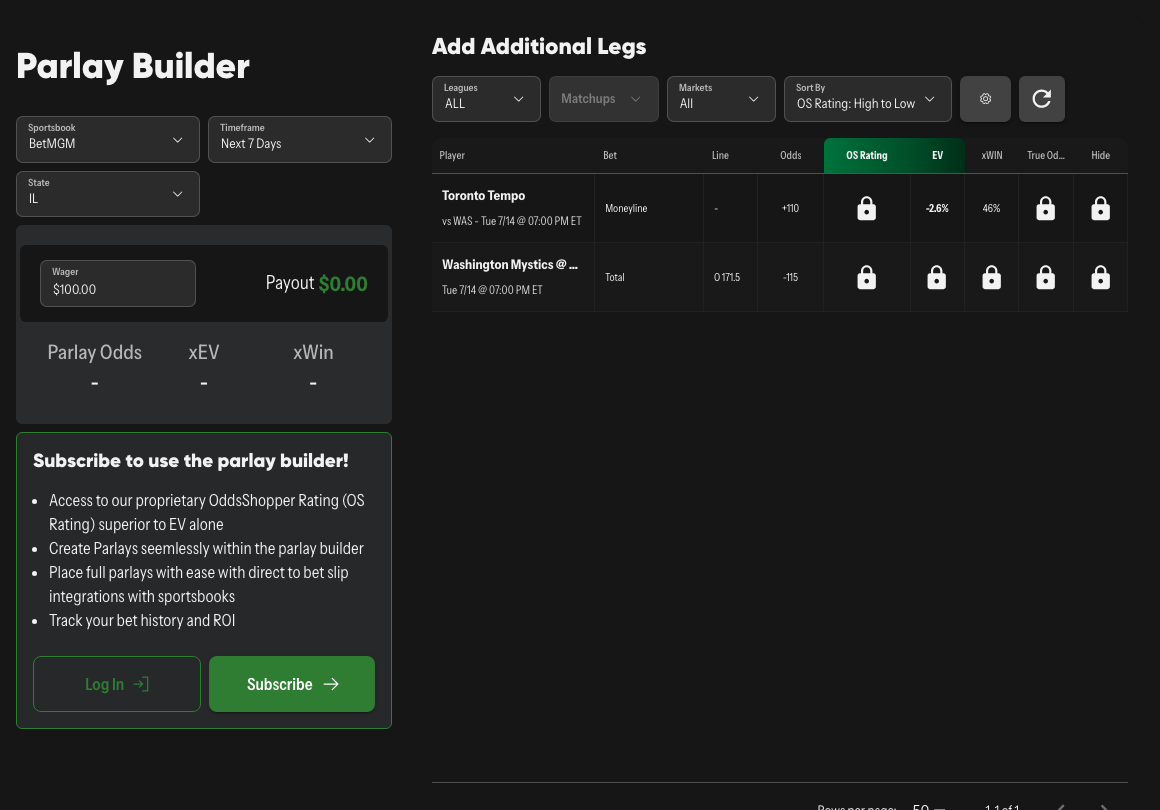
The OddsShopper Parlay Builder.
Two quick examples of why price is everything:
- On a moneyline, +220 pays far more than +150 for the exact same team to win the exact same game. At +150 a winning $100 bet returns $150 in profit; at +220 it returns $220 in profit. If two books are on that game, the +220 is a better price you are giving away by taking the +150.
- On a spread, one book might hang Georgia -7 (-110) while another offers Georgia -7 (-102). Identical bet, better price. Over a full college season of bets, those little differences add up to real money and often decide whether you finish ahead.
Checking every book by hand while lines move all Saturday is slow, and that is exactly the job the OddsShopper odds screen does for you: it compares the same college football bet across the major sportsbooks in real time, so you instantly see who has the best number. We will come back to the tools once the bet types are covered, because the habit only pays off once you know what you are shopping for.
Key Numbers: Why 3 And 7 Matter In Football
Football scoring is not random. Points come in 3s (field goals) and 7s (touchdowns), so games land on certain final margins far more often than others. The two most important key numbers are 3 and 7, with 10 and 14 close behind.
Why it matters for a beginner: getting your spread on the right side of a key number is worth real money. Take a dog on the +7 to +7.5 range. A 7-point loss is one of the most common margins in football, and the exact number you hold decides what happens: at +7.5 that 7-point loss wins, at flat +7 it pushes and your stake comes back, and at +6.5 it loses. A half-point line like +7.5 can never push, because a push only happens when the margin lands exactly on a whole number. So grabbing +7.5 or -2.5 instead of +6.5 or -3.5 crosses the key number and is genuine edge, not a rounding detail.
| Key Number | Why it matters | Beginner move |
|---|---|---|
| 3 | One of the most common margins; games decided by a field goal | Prefer a dog at +3.5 over +2.5; be wary laying -3.5 |
| 7 | A one-touchdown game, the next most common margin | +7.5 is a real upgrade on +6.5 |
| 10, 14 | Two scores; common but less frequent than 3 and 7 | Worth crossing when the price is cheap |
Some books let you "buy" a half-point to move a spread across a key number. It can be worth it only when the move actually crosses 3 or 7 and the extra juice is cheap. Buying points that do not cross a key number is a trap the books are happy to sell you. A caution specific to college: because CFB spreads are so wide and scoring is higher, key numbers carry a little less weight than they do in the NFL, so do not overpay for them on a big line.
The College Football Bet Types You Will Use
| Bet Type | What it is | Beginner guidance |
|---|---|---|
| Straight Bet | One selection (a spread, moneyline, or total) standing on its own | The default. Live here while you learn |
| Parlay | Two or more selections combined; every leg must hit for it to pay | Small stakes only. Each leg you add must also win, so every extra leg lowers your chance of cashing the ticket while the book's edge compounds against you |
| Player Prop | A bet on one player's stat line (passing yards, rushing yards, receptions, anytime TD) | Often softer than sides and totals, but limits are lower and injury/depth-chart news matters more |
| Teaser | A football parlay where you move each spread a set number of points in your favor for a smaller payout | A niche key-number tool, and weaker in CFB than the NFL |
A few honest notes. Straight bets are where you should live, because they are the cleanest way to back a number you like. Parlays are fun and the payouts are eye-catching, but the book bakes its hold into every leg, so adding legs compounds the house edge against you unless every single leg is a bet you would make on its own. Our parlay guide breaks down how to build them sanely. Teasers move the line in your favor across key numbers, but they work best in the tighter-scoring NFL; college margins are more spread out, so key-number teasing is less reliable and often not worth the reduced payout.
Player props deserve a beginner's attention for a specific reason: they are softer than sides and totals. Books post a huge volume of college player props every Saturday and cannot sharpen them all, so a rushing-yards or receiving-yards number that lags the news can survive longer than a mispriced spread. That is not a promise of profit, but it is where a disciplined new bettor is most likely to find a number the market has not corrected.
How College Football Lines Differ From The NFL
This is the part most "how to bet" guides skip, and it is where college football actually rewards or punishes you. CFB is not just the NFL with different logos.
- Talent Gaps Are Enormous, SO Blowouts Are Common. A national power can be a 35-point favorite over a Group of Five opponent. That creates two problems for the naive bettor: giant spreads are hard to handicap, and a favorite that goes up big will often empty its bench in the second half, which craters both the cover and the over. Always account for garbage time before laying a huge number.
- Totals Run Higher And Swing Harder. More possessions, faster tempo, and softer defenses mean 60-plus totals show up in college and almost never in the pros. Casual money loves the over, so it is worth checking whether a total has been bid up too far rather than assuming the over is the right side. When the public inflates a number, the better price can quietly end up on the under.
- Backup-QB Dropoff Is Steeper. In the NFL the talent floor is high; in college the gap between a star quarterback and his backup can be a chasm. An injury or a benching moves a college line far more than the equivalent NFL news, so the injury report is not optional reading.
- Motivation And Situation Matter More. Rivalry week, a letdown after a huge win, a look-ahead to a ranked opponent, or a bowl game a team does not care about will all bend a result. These "spots" are real, though they are already partly baked into the line, so treat them as tiebreakers, not standalone bets.
- Limits Are Lower And Lines Are Softer. Books take smaller bets on college than on the NFL and cannot sharpen every game on a packed Saturday schedule the way they sweat a Sunday NFL card. That is good news for a value bettor: softer markets can create more chances to find mispriced numbers, especially on smaller games and props, if you are shopping for them.
Beginner takeawayThe biggest college edges live in the corners the books cannot police, the smaller games and the player props, not on the marquee prime-time matchup everyone is hammering. Point your attention where the market is soft.
Bankroll Basics: How Not To Go Broke By October
You can bet well and still go broke if you size bets badly. A few rules keep you in the game.
- Set A Dedicated Bankroll. Only money you can comfortably lose, kept separate from rent and bills. This is the amount you are working with for the whole season, not one Saturday.
- Bet In Units, Not Vibes. A unit is a fixed slice of your bankroll, commonly 1 to 2 percent. If your bankroll is $1,000, a unit is $10 to $20. Bet one to two units on a normal play, never a random amount because a game "feels" safe.
- Size To The Edge, Not The Excitement. Your most confident, best-priced bet gets a bit more; a longer-shot dog or a prop gets less. Never fire the same stake on a -150 favorite and a +500 longshot.
- Never Chase. Losing a few bets is normal variance. Doubling your stakes to "win it back" with no added edge is how beginners turn a bad Saturday into a blown season.
Our bankroll management guide goes deeper, but if you only take one rule, take this: stake to the edge and the price, never to how sure you feel.
Where Beginners Actually Lose Money
Almost every losing college football bettor is doing at least one of these. Cutting them out is more valuable than any single pick.
- Only betting favorites and overs. They are the fun, obvious side, which is exactly why the public piles on and the books shade the price against them. Fun is not the same as value.
- Ignoring key numbers. Laying -3.5 when -2.5 was available at another book, or taking +6.5 when +7.5 was one tap away, quietly costs you games you should have pushed or won.
- Never line shopping. Betting everything at one app means routinely taking the worse number. Over a season it is the difference-maker.
- Overloading parlays. Six-leg parlays feel like a cheap lottery ticket, but the book's edge is baked into the price of every leg, so piling on legs that are not each a bet you would make on its own just compounds the hold against you.
- Betting the narrative instead of the number. A team's brand, a hot take, or a revenge storyline is usually already priced in. Whatever you are thinking, the market has probably already accounted for it.
Bet College Football The Smart Way: Find The Best Number And The +EV Edge
Everything above points at one skill: taking the best available price and only betting when the number is in your favor. That second half matters as much as the first. If every book has a game priced efficiently, the sharpest move is often no bet at all, and passing a coin-flip market is usually the right call, not a missed opportunity. Doing this by hand across a dozen books, on a Saturday with dozens of games kicking off, is not realistic, which is the exact problem OddsShopper is built to solve.
A Worked Example: Shopping The Same Underdog
Here is the edge in numbers, using round figures so the math is clear. Say you want to bet a home underdog, and the college football market looks like this across four books:
| Sportsbook | Price on the same home underdog |
|---|---|
| DraftKings | +7 (-115) |
| FanDuel | +7 (-108) |
| BetMGM | +7.5 (-110) |
| Caesars | +7 (-105) |
Three things jump out once you compare them side by side. Caesars offers the cheapest juice at -105, so if you want +7 you take it there, not the -115 at DraftKings 🎁. But BetMGM 🎁 is offering +7.5, a half-point better, which crosses the key number 7. On a 7-point loss, one of the most common football margins, that +7.5 wins outright, while the flat +7 at every other book merely pushes and returns your stake. That half-point is the difference between getting paid and getting your money back, and you only spot it by looking at all four books at once. That is line shopping, and it does more for your bottom line than any single pick.
Stop leaving the better number on the table.OddsShopper scans the major sportsbooks and instantly flags which one has the best college football price, doing automatically the line shopping this section just walked through by hand. Its +EV bet finder goes further, de-vigging each market to its estimated fair price and surfacing the bets it flags as +EV rather than just popular. You can try it with a free 7-day trial, and code CFBBET20 takes 20% off OS Pro or OS Core if you subscribe.
The deeper idea underneath line shopping is expected value, or +EV. A bet is +EV when the price you got is better than the true odds of it happening, which means it is expected to be profitable over a long run of bets even though it will lose plenty of individual Saturdays. You do not judge a +EV bet by whether it won; you judge it by whether the number was in your favor when you placed it. OddsShopper's tools estimate that fair price for you by removing the vig, so instead of guessing, you can see the gap between the estimated fair number and the price a book is offering. If you want to see how the sharpest bettors use this, our sharp money guide shows where the professional action lives.
A Few Realities Before Your First Saturday
- Variance Is Real, Especially In College. Upsets, backdoor covers, and garbage-time scores will swing your week. Well-priced bets balance out over a large sample, not over one Saturday.
- Do Not Fire Blind. Betting with no line shopping and no read on the fair price is just donating to the book. Check the number first, every time.
- It Is 21+ And Legal Only In Regulated U.S. Markets Where Betting Is Offered. Bet only where it is legal, only what you can afford, never chase losses, and reach out for help if it stops being fun (1-800-GAMBLER).
Frequently Asked Questions
How do I start betting on college football as a beginner? Sign up at a legal sportsbook in your state, deposit, and start with straight bets on the point spread, moneyline, or total. Pick one game you understand, take the best available price for that bet across the books, and size it to a small fixed unit of your bankroll. Add parlays and props slowly once you understand the trade-offs.
What is the difference between the spread and the moneyline in college football? The spread is a margin bet: the favorite must win by more than the number and the underdog can lose by fewer than it (or win outright). The moneyline is simply who wins the game straight up, with no points. Because college games are often mismatches, moneylines on big favorites get very expensive, which is why many bettors prefer the spread.
What are the key numbers in college football betting? The most important key numbers are 3 and 7, because so many football games are decided by a field goal or a touchdown, with 10 and 14 next in line. Getting your spread on the right side of a key number, like +7.5 instead of +6.5, is a real edge, so it is worth shopping for and sometimes worth buying a cheap half-point to cross one.
Why do college football totals go so high? College football has more possessions, faster tempo, and a wider range of defensive quality than the NFL, so combined-point totals routinely run higher. Casual bettors also love the over, so books can shade overs slightly, which means the under is often the better-priced side once the public money comes in.
Is line shopping really worth the effort for college football? Yes, and arguably more than in any other football market. With dozens of games and thousands of props each Saturday, prices vary widely from book to book and lines stay soft on smaller games. Taking the best available number on every bet is often the entire difference between a winning and a losing season, which is why a tool like OddsShopper that compares them for you does the heavy lifting.
The Bottom Line On Betting College Football
Betting college football rewards the boring stuff. Learn the three core markets (spread, moneyline, total), respect the key numbers 3 and 7, remember that college lines blow out and swing harder than the NFL, size your bets to a fixed unit, and above all take the best available price on every wager. Do that and you are already avoiding the mistakes most beginners make, who bet favorites and overs at whatever number their one app happens to show.
Ready to bet college football the smart way? The single highest-leverage habit is taking the best number on every bet, and OddsShopper does that work for you: the major sportsbooks compared in real time, the best CFB price surfaced instantly, and the bets it flags as +EV using de-vigged fair pricing. Try it with a free 7-day trial, then use code CFBBET20 for 20% off OS Pro or OS Core if you subscribe. See today's edges free
More on this: College Football Week 2 Predictions: The Machines Won't Take Texas · College Football Playoff Semifinal Odds · How To Bet College Football On Kalshi: Markets & Value · \ud83c\udfc8 College Football Week 0 Odds: How Kalshi Priced 8 Games · Kalshi College Football Picks This Week: Every Board, Scored