If you have signed up for a sportsbook in the last few years, you have almost certainly been handed one: "Bet $5, get $150 in bonus bets," or a $100 free bet dropped in your account after your first deposit. It looks like the book is handing you cash, and it is worth claiming, but a $100 free bet is not $100. Understanding why is the difference between a promo you cash out and one you quietly waste. I have converted a lot of these credits over the years, and the mechanics are simpler than the fine print makes them look. Here is exactly what a free bet is and how it works.
TL;DR: Free Bets In 30 Seconds
- A free bet (also called a bonus bet or bet credit) is a promo wager where a win pays only the profit; the stake is never returned.
- That missing stake is why a $100 free bet is worth roughly $70 to $80 in real cash at best, and far less if you fire it on a short favorite or let it expire.
- The smart play is to convert it: bet the credit at longer odds at one book, hedge the other side with cash at a second book, and bank the difference. Full walkthrough: how to convert a free bet.
- The terms that move the value most: minimum odds, the expiry window, and whether the credit is single-use or can be split.
What Is A Free Bet?
A free bet is a promotional credit a sportsbook gives you to place a wager without risking your own cash. The catch is in how it pays: when a free bet wins, the book returns only your winnings, not the stake. A normal cash bet gives you back your stake plus your profit. The free bet gives you the profit alone.
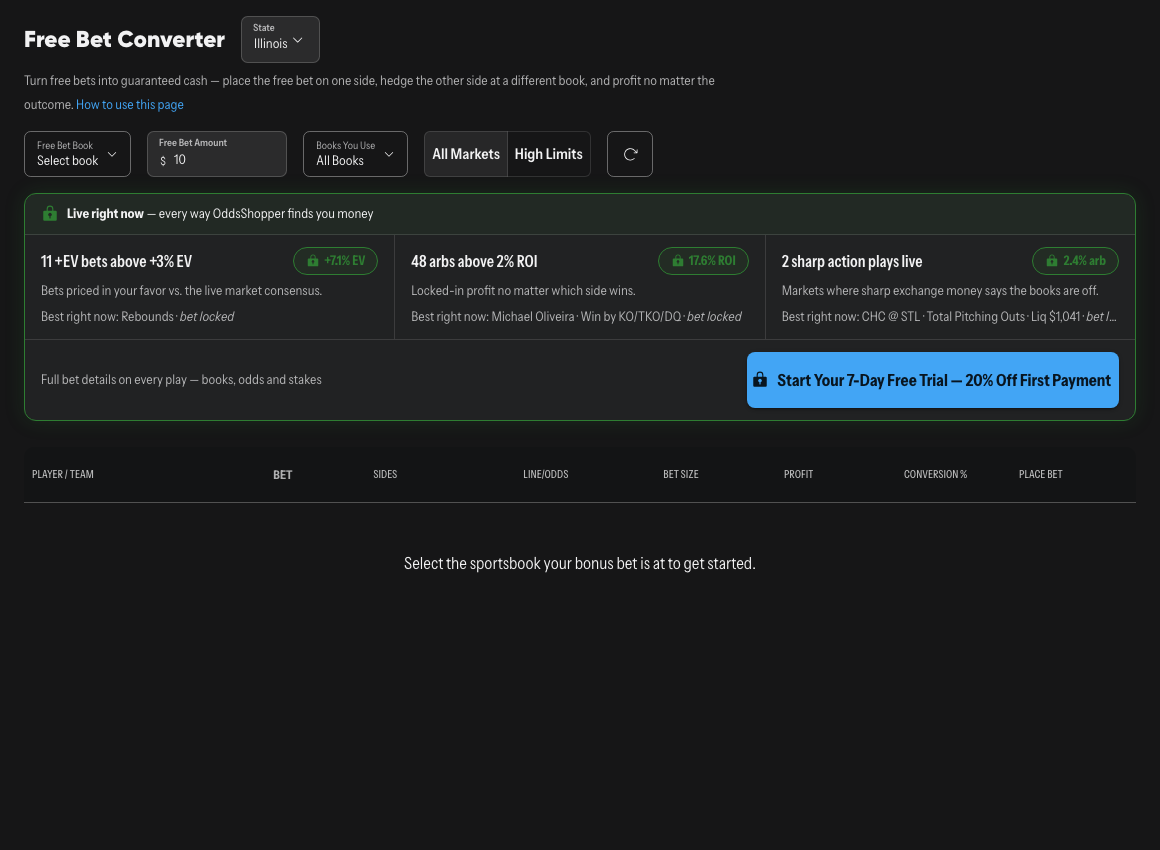
The OddsShopper Promo Converter.
That one mechanic is the whole story, and it is the free bet meaning in a single line: profit only, stake never returned. Bet $100 of your own money at +200 (decimal 3.00; if the notation is new, start with how to read betting odds) and a win returns $300: your $100 back plus $200 profit. Use a $100 free bet at the same +200 and a win pays only the $200 profit, because you never put up the $100 to begin with, so there is nothing to return. The credit itself is spent the moment you place it, win or lose.
The one rule to remembera free bet pays your winnings only. Your own cash bet returns your stake plus your profit; a free bet returns the profit and nothing else. That is the entire reason a $100 free bet is worth less than $100.
Most U.S. sportsbook welcome offers use this stake-not-returned structure, including common ones from DraftKings 🎁, FanDuel 🎁, BetMGM 🎁, and Caesars. The headline number ("$150 in bonus bets") is the face value of the credit, not cash you can withdraw. We track the current crop in our best free bet offers roundup, and the biggest wave lands every fall around NFL kickoff, when books compete hardest for new NFL bettors.
Free Bet, Bonus Bet, Bet Credit: Same Thing, Different Names
You will see this promo called a few different things depending on the book, and they almost always mean the same product:
- Free Bet — the older, generic industry term.
- Bonus Bet — the term DraftKings, FanDuel, BetMGM, and Caesars now use instead of "free bet."
- Bet Credit — used by some books, and common at international sportsbooks like bet365.
All three describe the same stake-not-returned credit: you place it like a normal wager, and a win pays only the profit. There are small print differences from book to book, but if you understand a free bet, you understand a bonus bet. The one thing worth confirming on any new offer is whether the stake is in fact withheld from a winning payout (it usually is) and whether the credit is a single wager or can be split into several.
How Do Free Bets Work?
Walking through the full lifecycle, a free bet moves through three stages:
- You earn the credit. It arrives through a welcome offer ("Bet $5, get $150 in bonus bets"), a deposit match, a refer-a-friend bonus, a loyalty reward, or a "sorry your bet lost" refund. The book adds a credit to your account, usually as one lump or as several smaller bonus bets.
- You place it as a wager. You choose a market, apply the free bet instead of cash, and confirm. Most books require you to use the full credit on a single selection (you cannot bet $40 of a $100 credit and save the rest unless the offer explicitly allows partial use).
- You collect the winnings only. If the wager wins, the profit lands in your withdrawable balance and the credit is gone. If it loses, the credit is simply gone. Either way, the "stake" never comes back.
A quick illustration of the payout math (the numbers show the mechanic, not a live line): a $100 bonus bet on a +250 underdog wins $250 in profit, versus the $350 a $100 cash bet would return. Fire that same $100 bonus bet on a -250 favorite and a win pays just $40 in profit. That gap is why where you place a free bet matters far more than most people realize.
None of this is charity, either. The credit is acquisition spend the book expects to win back through the vig once you are a regular, which is worth understanding on its own; our guide to how sportsbooks make money makes the whole promo economy click. Their math only works if most people burn the credit casually. The next section is about not being most people.
Why A $100 Free Bet Isn't Worth $100
Because a free bet only ever pays profit, its true value is always less than its face amount. How much less depends entirely on what you do with it.
The smart play is not to gamble the credit away on a single side and hope. It is to convert it: place the free bet on one side of a two-way market at one book, then back the other side with your own cash at a second book. In a clean two-way market the hedge is set so one side pays either way, and you keep most of the credit's value as withdrawable cash, as long as both wagers stand and the market does not push or void. This is called free bet conversion, and it is a low-risk process rather than a coin flip.
Done well, at longer odds with a well-shopped hedge, that turns a $100 free bet into roughly $70 to $80 in real cash. Done badly, by firing it on a short favorite or letting it expire, the same $100 credit is worth $30 or nothing. Here is what the conversion looks like at different prices, using a $100 free bet and a hedge shopped to a tight two-way market (illustrative math showing the mechanic, not live lines):
| Free Bet Odds | Hedge odds (other side) | Cash hedge stake | You keep either way | % of face value |
|---|---|---|---|---|
| +150 | -155 | $91 | $59 | 59% |
| +200 | -210 | $135 | $65 | 65% |
| +250 | -260 | $181 | $69 | 69% |
| +300 | -310 | $227 | $73 | 73% |
| +400 | -410 | $322 | $78 | 78% |
The row I keep coming back to is the last one: the same $100 credit keeps almost $20 more at +400 than at +150. That is why minimum-odds floors barely hurt you, and why parking a bonus bet on a heavy favorite is the most expensive mistake in this entire subject. The catch is that every row assumes you found a tight price on the cash side, and that only happens when you shop the hedge across every major sportsbook instead of taking the first number your book shows you. We break down the exact value math in our guide on whether free bets are worth it, and the full step-by-step in how to convert a free bet. The takeaway for now: the credit is worth real money, just never the sticker.
New to OddsShopper?It scans every major sportsbook, and once you enter your bonus bet amount, the Free Bet Converter finds a high-converting pairing on the live board and sizes your cash hedge for you, so you keep as much of the credit as the prices allow. Code FREEBET20 takes 20% off your first OS Pro or OS Core payment, and OS Pro comes with a 7-day free trial to start.
The Free Bet Terms That Decide What It's Worth
Before you place a free bet, read the terms attached to it. The two I always check first are the expiry window and the minimum odds, because those are the ones that quietly control how much you actually keep:
| Term | What it means | Why it matters |
|---|---|---|
| Stake Not Returned | A win pays only your profit, never the credit | The core reason the credit is worth less than its face value |
| Minimum Odds | The credit only counts at or above a price floor set in the offer's terms | The floor blocks very short prices; longer odds can convert better when the hedge is priced well |
| Expiry Window | Free bets expire fast, often within days of landing; the deadline is in the offer's terms | An unused credit converts at 0 percent; use it as soon as it lands |
| Single Vs. Multi-Use | One lump credit, or several smaller bonus bets | Splitting into smaller credits can let you convert across more markets |
| Rollover / Playthrough | Some "bonus" offers require you to wager the amount several times | A pure free bet usually has none, but the winnings sometimes do; read carefully |
A couple of these deserve a closer look. Minimum odds are the book's way of stopping you from parking the credit on a heavy, short-priced favorite, and they line up with good strategy anyway, since a stake-not-returned bet earns more profit at longer prices. Rollover is where "free" offers get murky: a true free bet has no playthrough on the credit itself, but a deposit-match "bonus cash" promo often makes you turn the money over several times before any of it is withdrawable. Those are not the same product, even when a book markets them side by side.
How To Turn A Free Bet Into Cash
You do not need to memorize the math to bank a free bet, but the principle is simple: bet the credit at longer odds on one side, hedge the other side for cash at a second book, and shop that cash side for the best available number. The better the price you get on the hedge, the higher your conversion rate, which is exactly the kind of price-shopping the OddsShopper odds screen and Free Bet Converter are built to do across every book at once.
Three tool surfaces do the heavy lifting on this job: the Free Bet Converter finds the pairing and sizes the hedge, the odds screen shops the cash side for the best price, and the EV Calculator sanity-checks what any single-sided play is actually worth before you fire it. If you would rather run the numbers by hand first, our free bet calculator guide walks through the exact formula, and my honest advice is to do that at least once, because the math sticks better when you have worked a conversion yourself.
One honest caveat: converting a free bet is low-risk, not risk-free. Lines move between your two bets, books can void or limit wagers, and a market can push. The full worked example, the conversion-rate math, and the traps to avoid live in our dedicated guide on how to convert a free bet.
Frequently Asked Questions
What is a free bet? A free bet is a promotional credit from a sportsbook that lets you place a wager without risking your own money. The key detail is that a winning free bet pays only your profit, not the stake, so a $100 free bet at +200 returns $200 rather than the $300 a $100 cash bet would.
What is a bonus bet? A bonus bet is the same thing as a free bet under a newer name. DraftKings and FanDuel now call these credits "bonus bets," but they still pay only the winnings and not the stake, exactly like a free bet.
How do free bets work? The book gives you a credit, you apply it to a wager instead of cash, and if the wager wins you collect only the profit while the credit is consumed. If it loses, the credit is simply gone. You cannot withdraw the credit itself.
Why is a free bet worth less than its face value? Because the stake is never returned. A cash bet gives back your stake plus profit; a free bet gives back profit only. That missing stake is why a $100 free bet is worth roughly $70 to $80, not $100, even when you use it well.
Can you withdraw a free bet directly? No. The credit is not cash and cannot be cashed out. Its value only becomes withdrawable once a free-bet wager wins and pays profit into your balance, which is why the conversion play exists.
Do free bets expire? Almost always, and usually quickly; many books give you only days, and the exact deadline is in your offer's terms. An expired free bet is worth nothing, so it is best to use it as soon as it lands rather than saving it for a game you like later.
What are the minimum odds on a free bet? Many free bets carry a minimum price, and the exact floor is spelled out in the offer's terms. That restriction generally works in your favor, since longer odds pay more profit per dollar and convert at a higher rate.
Can you use a free bet on a parlay? Often yes, though some offers restrict the credit to single wagers or specific markets. Check the promo terms, because a parlay changes the odds and therefore how the credit converts.
More on this: Free Bet Calculator: Turn Bonus Bets Into Cash · Free Bonus Bets: How To Use Sportsbook Bonus Offers · Free Sports Betting Picks: Where To Find And Vet Them · Are Free Bets Worth It? The Stake The Book Keeps · Best Free Bet Offers: How To Spot And Cash One
The Bottom Line
A free bet, or bonus bet, is a stake-not-returned credit: a winning wager pays only your profit, so a $100 free bet is really worth about $70 to $80 in cash, not the full sticker, and only if you convert it instead of letting it expire or blowing it on a favorite. Understand the terms, place it long, and hedge the other side for cash at a second book. And once the cash is banked, put it to work on plays with a real edge, starting with our free expert picks today.
Just got a bonus bet? OddsShopper's Free Bet Converter scans every major sportsbook, finds the highest-converting pairing, and tells you the exact hedge stake to bank the most of it as cash. Use code FREEBET20 for 20% off your first OS Pro or OS Core payment, and start with OS Pro's 7-day free trial.