Wouldn't it be nice to have the sharpest World Cup bets sitting in front of you without knowing a thing about soccer? Or baseball, tennis, or the WNBA? That is the whole pitch behind the OddsShopper Liquidity Tool: it watches where sharp bettors are putting real money down on the betting exchanges and prediction markets, then shows you the same side so you can get it before the price is gone.
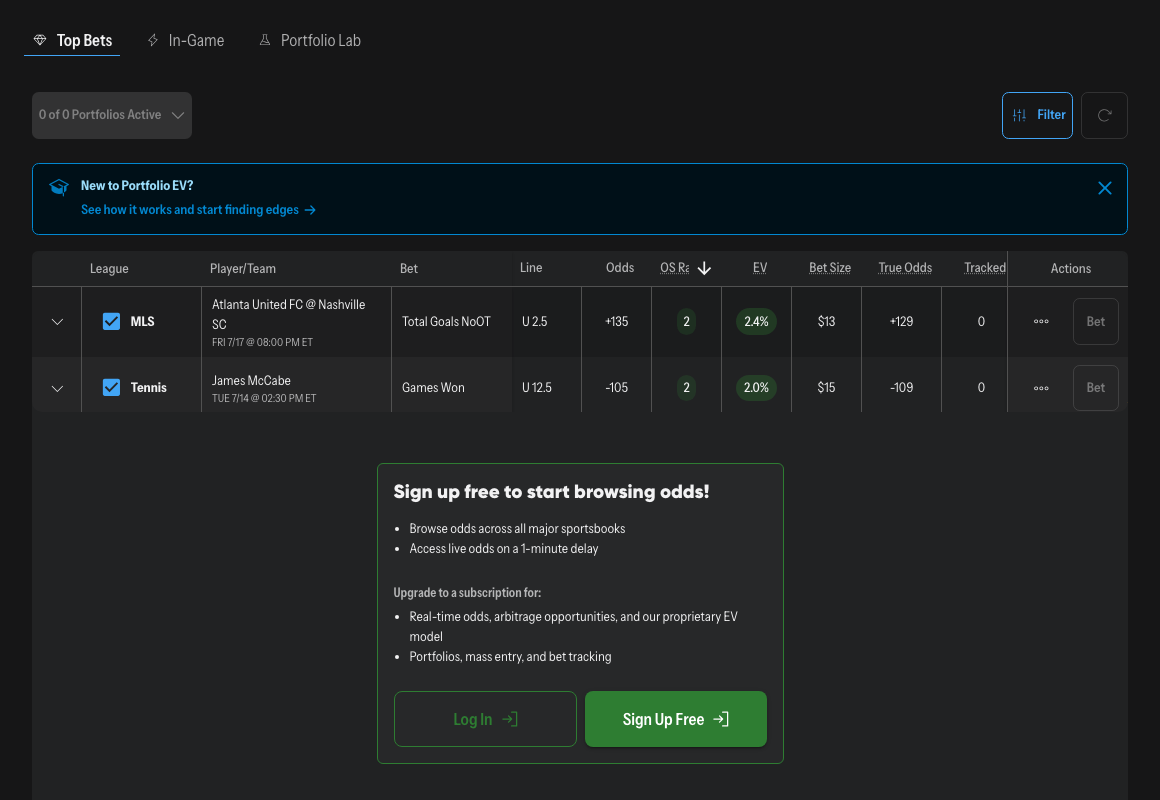
The OddsShopper +EV Screen.
In Summary
- The OddsShopper Liquidity Tool shows high-liquidity orders across betting exchanges and prediction markets, identifies the sharp side of each order, and lets you click Bet to add it to your bet slip.
- Because it reads where the money is rather than who is playing, it works across sports. The walkthrough points to World Cup soccer, baseball, tennis, and the WNBA as examples.
- Filters let you pick your books, your sharp sources, sports and leagues, market types, a minimum liquidity threshold, and an odds range, then save the whole setup as a preset.
- A match-or-beat toggle hides any bet where your book's price is worse than the sharp exchange price, so you only see bets you can actually get at a fair number.
- The recently introduced In-Game Liquidity Tool shows high-liquidity sharp-money orders on games that are currently in play.
- This is an edge over time, not a promise on any single bet. Tailing sharp money puts you on the side the sharps backed, but lines move and books limit winners, so size carefully and shop the price.
Watch: The OddsShopper Liquidity Tool In Action
OddsShopper demos the Liquidity Tool below, from finding a sharp order to setting filters and saving a preset. It is the fastest way to see exactly what the tool does on a live board.
What "Liquidity" Means In Betting (And Why It Points To Sharp Money)
Liquidity is just how much money is sitting on a given price. On a betting exchange or a prediction market, every bet is an order, the way a stock trade is an order, and the order book shows you exactly how much money is stacked behind each side. When a large, high-liquidity order lands on one side of a market, that is usually a sharp bettor getting down serious size. These exchanges and prediction markets are where that high-liquidity sharp action shows up.
The Liquidity Tool reads all of that order flow for you. In practice, the tool scans every high-liquidity order across those venues and surfaces the sharp side, so instead of refreshing exchanges yourself you see the orders that matter in one place and, more importantly, which side the sharp money is on. You are tailing the order, not guessing the game. If you want the strategy foundation behind this, our guide to following sharp money covers why sharp action is a real signal in the first place.
How To Use The Liquidity Tool
The tool itself is straightforward. You are looking at all of the high-liquidity orders across the exchanges and prediction markets, and you tail the sharp side of each order. Here is the flow:
- Scan the board. Every high-liquidity order shows up with the bet, the market, and how much money is behind it across the markets it appears in.
- Read the sharp side. The tool flags which side the size is on. That is the side you are tailing.
- Click Bet. Hit the Bet button on an order and it drops straight into your bet slip at your book, no copying numbers by hand.
- Place your bet. From there you choose your own stake, sized to your bankroll rather than copying the sharp's dollar amount, and place it on the side the sharps are on.
That is the loop. The skill is not in handicapping the event. It lives in reading the liquidity and getting the same number, or a better one, while the price is still there.
The whole edge in one lineyou are not betting the game, you are tailing the order. The high-liquidity sharp side is the signal; the tool gets you onto that side and lets you compare it to your book's price.
New to OddsShopper?The Liquidity Tool watches the exchanges and prediction markets where sharp bettors move real money, then shows you the same side so you can grab it before the price moves. New users can try it free, and returning users get 25% off OS Pro or OS Core with code LINDY25.
The Filters: Build A Preset That Only Shows Your Bets
The filters are where the tool goes from a firehose to a feed of bets you actually want. Everything is up to your discretion, and once it is dialed in you save it as a preset so it loads that way every time.
| Filter | What it does |
|---|---|
| Books | Pick which sportsbooks you actually bet at, so the feed only shows prices you can get. |
| Arb-Eligible Books | Limit to books where an order can create an arbitrage. Useful if you only care about arbs on books you can still bet at freely. |
| Sharp Sources | Choose which exchanges and prediction markets the high-liquidity orders come from. |
| Sports And Leagues | Narrow to the sports and leagues you want, from World Cup soccer to MLB to tennis to the WNBA. |
| Market Types | Moneylines, spreads, totals, props, whatever you want to see. |
| Minimum Liquidity | Set a floor on order size. Want to see any order with $500 or more in liquidity? That is where you set it. |
| Odds Range | Cap the prices you will tail so you are not chasing heavy favorites or longshots you do not want. |
Save that whole setup, name it something like "Sharp Money," and it shows up ready to go. You can also turn on notifications so a qualifying order pings you the moment it lands, and you can choose whether to see only high-confidence orders or every high-liquidity order regardless of confidence.
The Match-Or-Beat Toggle Is The One To Know
One filter is worth calling out on its own. When you toggle on match or beat the sharp price, the tool hides any bet where your book's odds are worse than the sharp exchange price. So if sharp money is out there but no sportsbook is offering a number close to as good, that bet simply will not show up.
That matters because tailing a sharp at a worse price gives back the edge that made the bet good in the first place. Getting the same number the sharp got, or better, is the whole point. This is line shopping baked into the feed. If you ever want to check the market by hand, open a live odds screen — shop the number across every major book and you will see the same price comparison the toggle runs for you. And if you want the deeper version of why the price matters, our explainer on closing line value covers why beating the price the market settles at is the cleanest proof you are betting +EV.
When A Sharp Order Creates An Arbitrage
The tool also shows when an order is creating an arbitrage opportunity, which the walkthrough says sharps will often do to get their orders filled. To get filled in a low-liquidity market, a sharp will sometimes accept a slightly worse number. Arbitrage bettors then come in and take the other side because it closes a low-risk arb for them. The sharp gets the size they needed filled, the arber locks in their position, and both walk away happy.
Worth a caveat, though: the arb-eligible filter exists because certain books are far more valuable for this than others. You might not care that an order creates an arb on a book like BetMGM 🎁, where arbing tends to get you limited within a day or two anyway. Arbitrage is low-risk when both legs land at the listed prices, but books limit arbers fast, so most bettors treat it as a stepping stone rather than the main event. Our arbitrage betting explainer breaks down the mechanics and the limit risk in full.
The In-Game Liquidity Tool
The newest addition extends all of this to live betting. The In-Game Liquidity Tool watches games that are currently in play and surfaces any sharp money showing up with high-liquidity orders in real time. Live markets move fast, so seeing the sharp side of an order as it lands is exactly when this is most useful. If live betting is your thing, pair it with our live +EV betting guide.
Why The "You Don't Need To Know The Sport" Part Is True
Here is the piece that surprises people. Because the tool reads liquidity and order flow rather than the matchup, your knowledge of the sport stops being the bottleneck. You do not need an opinion on a World Cup group-stage match or a WNBA total to tail a high-liquidity sharp order on it. The sharp who placed the order did the work, and you are simply reading where their money went.
It travels across sports cleanly for the same reason. Because it reads liquidity rather than the matchup, the same feed, filters, and presets work on soccer, baseball, tennis, and the WNBA alike. For a careful bettor the honest framing matters here: most bettors do not beat the books over time, and tailing sharp action is about consistently putting yourself on the side the small group of long-term winners backed. It puts you on the sharp side of the market; it does not make any one bet certain. If you also want to find your own +EV bets from scratch, our how to find +EV bets guide is the companion to this one, and our free expert picks today are there when you would rather have the read done for you.
Liquidity Tool Vs. A Standard +EV Tool
Most sharp-money products in this space share a shape: read an exchange or prediction market, flag the money, point you at a price. Where the Liquidity Tool separates is what it hands you at the end. A standard +EV tool tells you a number is theoretically mispriced; the Liquidity Tool tells you where real sharp size actually went and only shows the bet if you can still get it at that number or better.
| Liquidity Tool | Standard +EV tool | Line-shopping screen | |
|---|---|---|---|
| Signal Source | Real sharp money on exchanges and prediction markets | A model's fair price vs. book price | Book prices side by side |
| What You Tail | The order the sharps filled | The gap the model found | The best listed number |
| Cross-Sport | Yes — reads liquidity, not the matchup | Depends on the model's coverage | Yes |
| Price Protection | Match-or-beat toggle hides worse prices | You check the gap yourself | You compare by hand |
The row that matters most is signal source. A model can be wrong about a fair price, but a large, filled order on an exchange is real money from someone who does this for a living — so when a model edge and a sharp order both point at the same market, the liquidity read is the one to lean on.
Frequently Asked Questions
What is the OddsShopper Liquidity Tool?
It is a tool that shows high-liquidity orders across betting exchanges and prediction markets, identifies the sharp side of each order, and lets you tail that bet straight into your sportsbook bet slip. It is built around order flow, so it works across sports rather than depending on sport-specific knowledge.
Do I need to understand the sport to use it?
No. The tool reads where the money is, not who is playing. You are tailing a sharp bettor's order, so you can use it on a World Cup match, an MLB game, a tennis set, or a WNBA total without handicapping the event yourself.
How is this different from a regular +EV tool?
A +EV tool compares a sportsbook price to a fair price and flags the gap. The Liquidity Tool sources its signal from where sharp money is actually being bet on the exchanges and prediction markets, then lets you tail that side and only shows you bets you can get at a fair number. In practice you set a minimum-liquidity floor — say $500 — so you only ever see orders with real size behind them, not a few dollars of noise.
What does the match-or-beat toggle do?
When you turn it on, the tool hides any bet where your book's odds are worse than the sharp exchange price, so you only ever see bets you can place at the sharp number or better.
Can I use it for live betting?
Yes. The In-Game Liquidity Tool shows high-liquidity sharp-money orders on games that are currently in play.
Will I profit on every bet I tail?
No. No single bet is certain. Lines move, books can limit winning accounts, and any one bet can lose. Tailing sharp action is an edge that plays out over a large sample, not a promise on one game. Bet only what you can afford, where betting is legal.
Start Tailing Sharp Money
Reading exchange and prediction-market liquidity by hand is slow, and by the time you spot a sharp order yourself the price is usually gone. The OddsShopper Liquidity Tool does it for you, flags the sharp side, filters it to your books and your sports, and only shows the bets you can still get at a fair number. New users can start with a free trial, and returning users get 25% off OS Pro or OS Core with code LINDY25. Start your free trial here
More on this: OddsShopper Liquidity Tool: Sharp Money On MLB Bets · How To Use The OddsShopper +EV Tool: A Beginner Guide · Kalshi Liquidity Before Close: The Book Empties Out · What's New In OddsShopper Portfolios: The Full Rehaul · OddsShopper Winner: 850 Losses, a Five-Figure July