You opened a sportsbook app, saw numbers like +150 and -110 next to each team, and thought: what does +150 mean, and what does -110 mean? You are not alone. I read hundreds of these prices a week, and the whole system is simpler than it looks. The sign tells you which side is favored, and the number tells you the stake-to-payout math. Once those two ideas click, every American-odds price on the board reads clearly.
TL;DR: What +150 And -110 Mean
- Plus (+) Marks The Underdog; Minus (−) Marks The Favorite. The sign alone tells you which side the book likes.
- +150 means a $100 bet wins $150 in profit ($250 back), and it implies about a 40% chance to win.
- -110 means you stake $110 to win $100 ($210 back). It is the standard "vig" price and works out to a 52.4% break-even.
- The Number Is A Probability In Disguise. Convert it (formulas below) to see the chance the book is giving, and whether the price is worth betting at all.
- Skip the arithmetic: the OddsShopper Odds Calculator turns any +/- price into payout and implied probability in one click.
What Plus And Minus Betting Odds Actually Mean
American odds (the plus/minus format you see at most U.S. sportsbooks, including DraftKings 🎁, FanDuel 🎁, BetMGM 🎁, and Caesars) do two jobs at once. On a moneyline, a straight bet on who wins, the sign tells you the favorite:
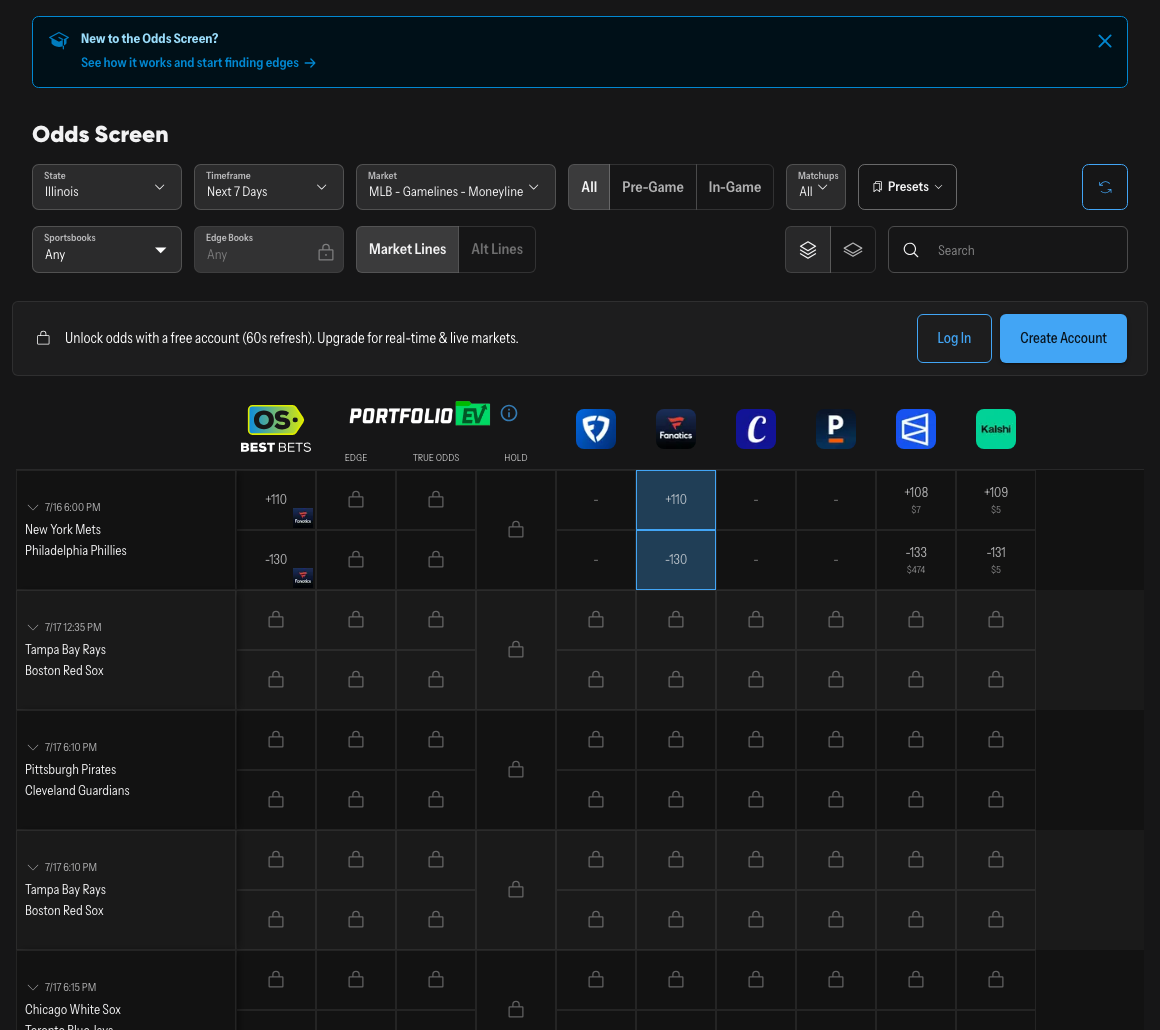
The OddsShopper Odds Screen.
- A Minus Sign (-) Marks The Favorite, the side the book gives the better chance to win. The bigger the minus number, the heavier the favorite.
- A Plus Sign (+) Marks The Underdog, the side less likely to win. The bigger the plus number, the longer the shot.
So on a moneyline priced Kansas City Chiefs -160 vs. an opponent at +140, the Chiefs are the favorite and the underdog pays out more per dollar. (On point spreads and totals it works differently: both sides are usually priced around -110, so there it is the number next to the team, like Chiefs -3.5, that marks the favorite, not the sign on the price.) That covers the entire concept behind "plus minus odds." Everything else is just reading the number itself, which is what the next two sections cover.
What Does A Minus Number Mean? (-110, -160)
A minus number is how much you have to stake to win $100 in profit. The book is charging you more up front because the favorite is more likely to cash.
- -110 means you stake $110 to win $100 (a $210 total return). This is the standard price on most point spreads and totals, and that built-in -110 tax is the sportsbook's cut, called the vig or juice (here is how to remove the vig to see a book's true price).
- -160 means you stake $160 to win $100. A heavier favorite, so you risk more for the same $100 of profit.
- -250 means $250 to win $100, a strong favorite where the payout shrinks fast.
You do not have to bet in $100 units. The ratio just scales. On a -160 line, a $20 bet risks $20 to win $12.50 in profit; a $50 bet wins about $31.25. The OddsShopper Odds Calculator does this math for any stake in a second, so you never have to reach for a napkin.
What Does A Plus Number Mean? (+150, +220)
A plus number is how much profit you win on a $100 stake. On a moneyline the plus side is the underdog, so because it is less likely to win, the book pays you more when it does.
- +150 means a $100 bet wins $150 in profit (a $250 total return).
- +220 means a $100 bet wins $220 in profit ($320 back).
- +400 means $100 wins $400, a bigger longshot for a bigger reward.
Same scaling rule: on +150, a $20 bet wins $30 profit; a $50 bet wins $75. The higher the plus number, the less likely the book thinks that outcome is, and the more it pays if you are right.
Worked Examples: Reading +150, -110, And -160
Say you are looking at four real-shaped prices across the board. Here is what each one costs and returns on a $100 bet:
| Price | Sign | Meaning | Stake | Profit if it wins | Total return |
|---|---|---|---|---|---|
| -110 | Standard price (vig) | Risk $110 per $100 profit | $110 | $100 | $210 |
| -160 | Favorite (bigger) | Risk $160 per $100 profit | $160 | $100 | $260 |
| +150 | Underdog | Win $150 per $100 staked | $100 | $150 | $250 |
| +220 | Underdog (longer) | Win $220 per $100 staked | $100 | $220 | $320 |
Notice the same game can be priced differently at different books. The Lakers might be -155 at DraftKings but -145 at FanDuel: same bet, but at FanDuel you risk $10 less to win the same $100 (stake $145 instead of $155). Pull up the OddsShopper live odds screen for any game and you will see all the books stacked side by side, so grabbing the better number takes seconds.
New to OddsShopper?It scans 100+ sportsbooks and instantly shows you which one is offering the best price on the bet you want, plus what that price is really worth. You can try it free for 7 days, and code ODDS20 takes 20% off your first payment of OS Pro or OS Core if you subscribe: Start your free trial.
Turning The Number Into Implied Probability
Here is the part that separates people who read odds from people who use them. Every American-odds price is really a probability in disguise, the chance the book is giving that outcome. This is called implied probability, and it is the single most useful thing a beginner can learn.
The quick formulas:
- Minus (Favorites): drop the sign, then implied % = odds ÷ (odds + 100). A -160 favorite is 160 ÷ 260 = 61.5%.
- Plus (Underdogs): implied % = 100 ÷ (odds + 100). A +150 underdog is 100 ÷ 250 = 40%; a +220 dog is 100 ÷ 320 = 31.3%.
Run those same prices through the formula and you get:
| Price | Implied probability | Break-even win rate |
|---|---|---|
| -160 | 61.5% | 61.5% |
| -110 | 52.4% | 52.4% |
| +150 | 40.0% | 40.0% |
| +220 | 31.3% | 31.3% |
The key beginner takeawaya +220 underdog only has to win about 31% of the time to break even, versus 40% for a +150. So if you think a team wins closer to 40% of the time, +220 is the better price on the same team. The higher plus number rewards you when your own read of the true chance beats what the price implies.
Here is the subtle part sharp bettors lean on. Those implied percentages are slightly inflated, because the book bakes its cut into every price. Add up both sides of a standard -110/-110 spread and you get 52.4% + 52.4% = 104.8%, not 100%. That extra 4.8% is the hold (the vig expressed as a percentage). Strip it back out and you get the no-vig, or de-vigged, fair price: the book's honest estimate of each side's true chance. As we broke down in our Sports Betting 101: Betting Odds Explained video, a -196 favorite is really the book telling you that side wins about 66% of the time; the odds are a probability quote wearing a payout costume.
You do not have to run any of that by hand: the tool surfaces the payout, the implied probability, and the no-vig fair price for any number you type, and the OddsShopper Portfolio EV screen flags the prices whose implied probability sits below the no-vig fair price it builds from the wider market, which is the makings of a positive-EV bet.
Why does this matter? Reading the payout is step one; reading the implied probability is how you decide whether a number is worth betting at all. When your own read of the true chance is higher than the price implies, that is a value bet. (For all three odds formats and how to convert between them, see how to read betting odds.)
Why The Best Number Matters: Line Shopping
Because books disagree, the same bet can be +150 at one and +160 at another. That gap adds up fast: an extra $10 of profit per $100, every time you take the better side. I never place a bet without checking a few books first, and the Odds Calculator plus the live odds screen make it a two-second habit rather than a chore. Over a season, taking +160 instead of +150 on the bets you were going to make anyway is a real, low-effort edge.
How I Read A Price Fast
When I glance at a board, I run the same three-step check on every price. Take an NBA underdog sitting at +200:
- Sign first. The plus tells me it is the underdog before I read anything else. The market does not expect this team to win.
- Size second. +200 is a real longshot, not a coin flip. For scale, -110 is a near coin-flip with vig baked in, -300 is heavy chalk, and +400 is a real dart throw.
- Value last. I convert: +200 implies 100 ÷ 300 = 33.3%. Then I ask the only question that matters: do I think this team wins more than a third of the time? If my honest read is 40%, the price is underpaying the risk and I bet it. If I have them at 30%, I pass or shop for a longer number. It is the same logic that made +220 a better price than +150 on the same team back in the implied-probability table: the payout only rewards you when it clears your own estimate of the true chance.
That workflow holds on any sport: an NFL spread at -110, an MLB moneyline at +135, an NBA dog at +200. The signs and the math never change.
FAQ
What does +150 mean in betting? A +150 price means the outcome is an underdog and a $100 bet wins $150 in profit ($250 total back). It also implies about a 40% chance of winning.
What does -110 mean in betting? -110 means you stake $110 to win $100 in profit. It is the standard price on most spreads and totals, and the extra $10 is the sportsbook's vig (its built-in fee).
What does the minus sign mean on betting odds? The minus sign marks the favorite and tells you how much you must stake to win $100. A bigger minus number is a heavier favorite that pays less.
Is it better to bet plus or minus odds? Neither is automatically better. Minus odds usually imply a higher chance with smaller payouts; plus odds imply a lower chance with bigger payouts. The best bet is whichever price is higher than the true probability of the outcome, which is where the value is.
How do I calculate my payout from American odds? For a minus price, profit = stake × (100 ÷ minus number). For a plus price, profit = stake × (plus number ÷ 100). The OddsShopper Odds Calculator does it instantly for any stake.
How much does taking the wrong number actually cost me? More than most beginners expect. If your team is +150 at one book and +160 at another, the same $100 bet wins $150 at the first and $160 at the second, which is $10 of extra profit per $100 on every bet, just for shopping the price. Over a full season of wagers, that gap is one of the biggest edges a casual bettor leaves on the table.
What do betting odds mean overall? Betting odds show two things at once: which side is favored (the sign) and the stake-to-payout ratio (the number). Convert the number to an implied probability and you also see the chance the book is giving each outcome.
The Bottom Line
Plus and minus betting odds are just a two-part code: the sign tells you favorite or underdog, and the number tells you the stake-to-payout math (minus = risk to win $100, plus = win on $100). Convert either one to an implied probability and you can tell whether a price is actually worth betting. Learn that once and every board on every app reads clearly.
New to OddsShopper? It scans 100+ sportsbooks so you always take the best available number, and the Odds Calculator turns any +/- price into a payout and an implied probability in one click. Try it free for 7 days, and code ODDS20 takes 20% off OS Pro or OS Core if you subscribe.
More on this: NFL Preseason Event Contracts, Explained In 60 Seconds · Golf Betting Odds Explained: Outrights, Top-10S And Matchups · Golf Matchup Betting Explained: 2-Ball And 3-Ball Strategy · Teaser Bets Explained: Points, Payouts & When They're +EV · Point Spread Betting Explained: Read The Spread
Watch The Video
Want to see plus/minus prices read off a live board? We walk through exactly this in our Sports Betting 101 explainer: Watch on YouTube.