Almost everyone who bets sports has thought about it: what would it take to actually do this for a living, or at least turn a real profit on the side? The honest answer is that the pros are not smarter about who wins on Sunday. They are more disciplined about where they bet, why they have an edge, and what price they pay for it. In a video on the OddsShopper channel, host Chris Ryan laid out five tips to point you in the right direction, and they map to how sharp bettors actually operate. Here is how to put them to work.
TL;DR: How To Bet Like A Pro In 5 Steps
If you only read one thing, read this. The sports betting strategy that separates pros from the crowd is not a magic pick — it is five habits we see winning bettors stack together:
- Find a market where you have a real edge — and know why the price is wrong, because a thin edge disappears the moment the market notices it.
- Go part-time before full-time — prove you can profit on the side before betting becomes your income.
- Avoid the biggest, most efficient markets — the NFL and English Premier League are priced by thousands of sharp eyes; hunt softer markets like lower-league soccer, Challenger Tour tennis, and college sports.
- Learn the math, or use a tool that runs it — a model answers two questions: what is the fair price, and where is the market paying you more than fair. OddsShopper's Positive EV finder surfaces exactly that across every major sportsbook.
- Come in with capital, book access, patience, and curiosity — even a real edge comes with long, painful downswings.
The single fastest edge, and the one we keep coming back to, is buried inside tip four: shop the best price on every bet. You do not need to code a model to do it. Below we walk through all five, then show what that price-shopping habit is worth on a single wager.
Watch: 5 Tips To Bet Like A Pro
Chris Ryan walks through his five-tip starting point for anyone who wants to go semi-pro or just get more profitable. It runs a few minutes and pairs well with the breakdown below.
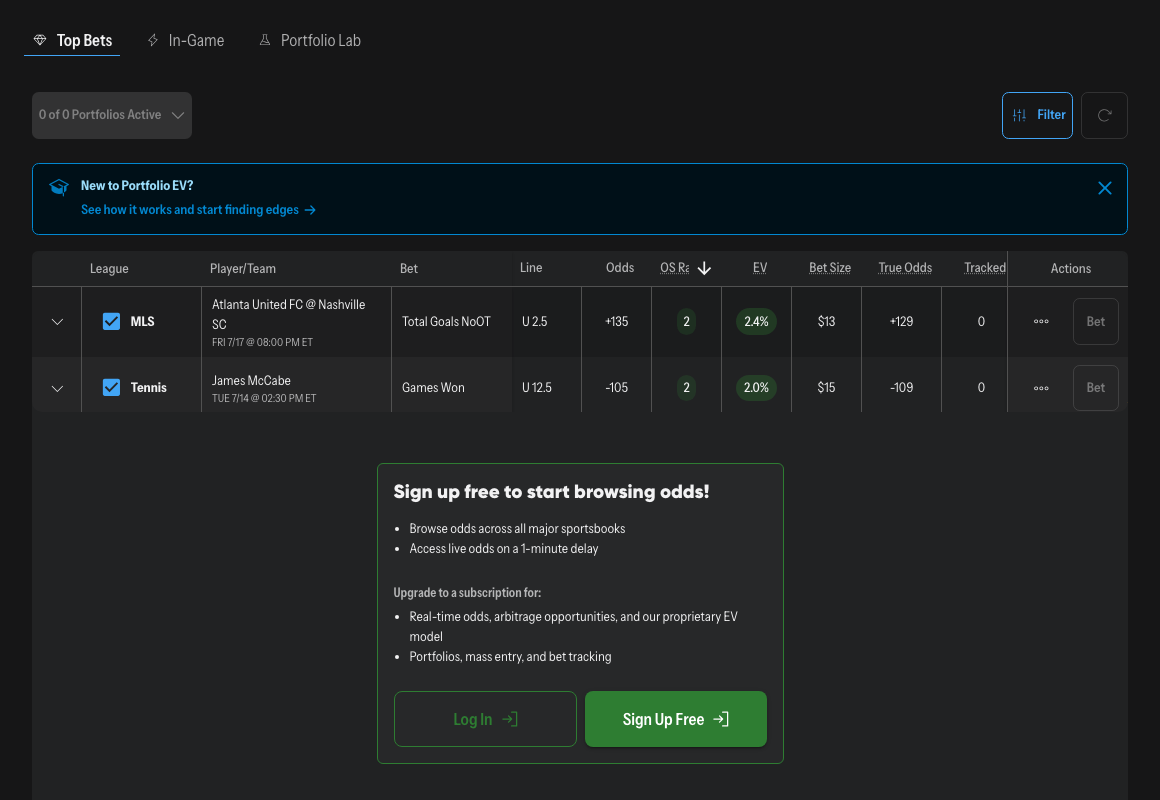
The OddsShopper +EV Screen.
Find A Market Where You Have A Real Edge
The first tip is the foundation for everything else: find a market you can beat, and understand why you can beat it. Feeling like you know a sport is not enough. You need a concrete reason the price is wrong more often than the market thinks.
That edge can come from almost anywhere. Maybe you are unusually good at reading young, up-and-coming tennis players before the market catches up. Maybe you can assess NBA third-quarter totals live, in-running, better than the book can react. Maybe you have built a model that beats closing lines. Any of those can be a real edge, and the point is the same in each case: know what it is and why it exists.
Why the "why" matters so much: the stronger and more durable your reason, the more you can lean into it. A thin edge is fragile. The moment the market notices the same inefficiency you found, it corrects, and your edge is gone. Understanding why you win tells you how hard to press and how long the window is likely to stay open.
Go Part-Time Before You Go Full-Time
The second tip is a discipline check, and it saves people from disaster. Do not quit your job to bet full-time unless you are already making money on the side while holding that job. Walk before you run.
There is no prize for going all-in fast. If you can turn a profit part-time as a side hustle, that is a genuine win on its own, and there is nothing wrong with staying right there. And "proof" here means a real sample, not a hot weekend: a few hundred tracked bets that clear the vig is a signal, while a lucky Sunday is noise. Treat that kind of consistent part-time profit as the evidence you need before you ever consider making betting your income. If the money is not there part-time, going full-time only raises the stakes on a process that is not working yet.
Avoid The Biggest, Most Efficient Markets
Here is the trap that catches most new bettors: assuming they can walk in and beat the NFL or the English Premier League. Those are two of the biggest, most heavily scrutinized markets in the world. Reporters cover every practice, every injury tweak, every lineup note, and thousands of sharp eyes price every game. All of that attention makes the lines extremely efficient and very hard to beat.
The pro move is to hunt where the market is thinner. The higher the level of competition, the more scrutiny it draws, and the harder it is to find a mispriced number. Lower-visibility markets are where edges actually live.
| Market Type | Examples (from the video) | Why the edge is there |
|---|---|---|
| Efficient, Hard To Beat | NFL, English Premier League (the biggest, most-watched leagues) | Enormous attention, deep reporting, sharp money everywhere. Prices are tight. |
| Softer, Easier To Attack | Lower-league soccer, Challenger Tour tennis, European golf, college sports | Fewer eyes, thinner information, more room for a mispriced number. |
This does not mean nobody makes money on the huge markets. People do, but they usually have far greater resources than you, and some of the biggest betting syndicates in the world struggle to beat those markets. When those syndicates do win on the majors, they are often the ones shaping the line, not you. Do not fool yourself into thinking you know an NFL moneyline better than a market that massive. Pick your battles where the field is softer.
Learn To Build A Model, Or Use The Tools That Already Do The Math
The fourth tip is the big one for this era: learn how the math works, and ideally learn to build your own sports betting model. The book itself is running computer-based models, because these days a model beats the eye test. There are still two camps in betting: the qualitative side that grinds tape and trusts years of watching, and the much larger quantitative side building models, machine-learning systems, and algorithms. The industry is clearly heading toward the quants, so learning to code and understanding statistics is a real long-term advantage.
That is intimidating advice if you do not write code, so here is the practical translation. A model exists to answer two questions: what is the fair price of this bet, and where is the market offering me something better than fair. You can learn to build that from scratch, and if you want to go pro, you should understand the math behind it. You can also let a tool do the heavy lifting while you learn.
That is exactly what OddsShopper is built for. Its Sharp Sportsbook Algorithm removes the vig from the market's prices to estimate a fair, no-vig line, then the Positive EV tool flags the bets priced better than that fair number across the books. In other words, it runs the market-efficiency math a pro would build a model to run, and hands you the output. It is not a shortcut around understanding the concepts, but it is a head start on applying them. (If you are curious how far a model alone can take you, our breakdown of whether AI can beat sports betting covers where the real edge actually comes from.)
Here is where that fits a real daily workflow. Instead of eyeballing one book's board, we open the Positive EV screen and let it do the model's job: the tool surfaces the bets offered at a better number than their no-vig fair value and ranks them by edge, so the mispriced bets come to you across every mainstream sport it covers instead of the other way around. Two habits fall straight out of that:
- Take The Best Number, Every Time. For the bet you actually want, it compares supported sportsbooks side by side and shows the top available price, so you are shopping the whole market rather than the one app you happened to open.
- Trust The Math Over The Eye Test. The screen answers the same "is this price better than fair?" question a model would — the exact discipline tip four is pushing you toward, minus the code.
That is a model's daily output without the model, which is why we treat it as the practical on-ramp to tip four rather than a replacement for understanding the math.
There is one application of this "use the tools" tip that needs no code at all, and it is the fastest edge to start with: shop the best price. It is not a sixth tip so much as the simplest way to act on the fourth, and it is exactly the kind of betting tool the video tells you to get your hands on. The section below shows how much that one habit is worth.
A Worked Example: Shop The Same Bet At Two Books
You do not need a model to capture the most reliable edge in betting. Say you like an underdog and you are ready to bet $100 on the moneyline. One book posts the price at +150; another has the same team at +175. It is the identical bet on the identical outcome, so the only question is which number you take.
- $100 At +150 returns $150 in profit if it hits.
- $100 At +175 returns $175 in profit if it hits.
That is an extra $25 on a single bet for doing nothing but clicking the better price. Do it across every wager you place, and the difference compounds all season into real money. This is why serious bettors keep accounts at many sportsbooks: you cannot take the best number if you can only see one book's.
OddsShopper compares every major sportsbook including DraftKings 🎁, FanDuel 🎁, BetMGM 🎁, and Caesars, so the best available number is already surfaced for you on the odds screen before you fire, instead of leaving money on the table at whatever book you happened to open.
Bet like a pro without building the model yourself.New to OddsShopper? It scans every major sportsbook and flags the bets priced in your favor, using de-vig and best-price math similar to what serious bettors build models to run. Try it with a free trial, and code BETLIKEPRO20 takes 20% off OS Pro if you subscribe.
Come In With Capital, Patience, And A Desire To Learn
The last tip is the practical reality check, and it has a few parts. You cannot go in under-resourced. Betting for a living means turning over a lot of money, so you need a decent bankroll behind you and, just as important, smart bankroll management so a cold stretch does not end your run. A common bankroll-management approach is to think in units rather than dollars: sizing each bet as a small, fixed slice of the bankroll (say 1-2%) so no single result can gut you. Even a genuine, provable edge can run cold for weeks at a time, and a bankroll built to survive a bad month is what lets that edge actually play out instead of busting first.
Access to a lot of sportsbooks matters too, and not only for line shopping. Winning bettors get limited or shut down, so having accounts across many books keeps you in action and keeps your options open when one book cuts you off.
Then there is the part nobody likes to hear: this is hard, and even a real edge comes with long, painful downswings. Betting has serious peaks and troughs, and you will go through sustained stretches where you lose money. If that stress gets to you, it becomes far harder to stick with the process long enough for your edge to play out. A patient outlook is a real advantage. (If you or someone you know has a gambling problem, call or text 1-800-GAMBLER.)
Finally, keep the desire to learn. The markets, the sports, and the betting industry all keep evolving. What worked ten years ago does not work now, so the process has to keep changing with it. Study the models, test the tools, and stay curious. Following where sharp money moves is part of that ongoing education; our guide to how to follow sharp money is a good next step.
The Bottom Line
Betting like a pro is not one secret. It comes down to five habits stacked together: find a market where you have a reason to win, prove it part-time first, hunt softer markets instead of the efficient giants, understand the math (or lean on tools that run it), and come in with the capital, book access, patience, and curiosity to survive the swings. Nothing here promises a profit, and the pros will be the first to tell you it is tough to win. But get those five right and you are pointed in the right direction, with far more edge than the bettor firing blind at NFL moneylines.
The fastest way to apply most of it starts with the price you pay on every bet.
Stop leaving the better number on the table.OddsShopper compares every major sportsbook in real time and shows you which bets are actually +EV, so you bet the best price instead of guessing. Try it with a free trial, then 20% off OS Pro with code BETLIKEPRO20.
FAQ
Can you really make a living betting sports? Some people do, but it is hard, and it is realistic only after you are consistently profitable part-time. The smart path is to make money on the side first, keep a patient outlook through the inevitable downswings, and only consider going full-time once the results are already there.
What is the best market for a beginner to find an edge? Softer, less-scrutinized markets, rather than the biggest ones. The NFL and the English Premier League are priced by enormous attention and sharp money, so they are extremely efficient. Lower-league soccer, Challenger Tour tennis, European golf, and college sports draw fewer eyes and leave more room for a mispriced number.
Do you need to build your own model to bet like a pro? Understanding the math behind a fair price helps a lot, and if you want to go pro you should learn it. But you do not have to code a model from scratch to apply it. Tools like OddsShopper's Sharp Sportsbook Algorithm and Positive EV finder run the de-vig and best-price math for you, so you can act on the output while you learn the concepts.
Why do sportsbooks limit winning bettors? Books restrict or limit accounts they believe are beating them long term, which is why pros keep accounts at many sportsbooks. Spreading your action protects your ability to line-shop and keeps you in the game when one book cuts your limits.
More on this: How To Use OddsShopper Pro: Your First 10 Minutes · OddsShopper Review: The Pro Owner's Manual · Best +EV Bet Tracker: What To Look For (And What Most Skip) · Closing Line Value Vs. Variance: Your P&L Is Lying To You · Devig Calculator: Find Fair No-Vig Odds From -110 Prices