How To Bet NFL On Polymarket: The 2026 Step-by-Step Guide
The first time I pulled up an NFL market on Polymarket, the thing that threw me wasn't the crypto or the app. It was that there were no odds. No -110, no +240, just a number in cents: a team to win the Super Bowl sitting at 14¢. That number is the whole game here, because on Polymarket the price is the probability, and once that clicks, betting NFL on it stops being intimidating and starts being a skill. The skill is telling a good contract price from a bad one, and that's the one workflow I'll walk you through, because it's the difference between clicking a number because it's in front of you and clicking it because it's actually cheap. Here's how NFL betting works on Polymarket, which markets are worth your time, and how I check every contract against the sportsbooks before I buy.
In Summary (TL;DR)
- Polymarket Is A CFTC-regulated Event-Contract Exchange, Not A Sportsbook. You buy "Yes" or "No" contracts on an NFL outcome, and each one settles at $1 if you're right and $0 if you're wrong.
- The Price In Cents Is The Implied Probability. A contract at 14¢ is the market pricing that outcome at roughly a 14% chance, with no odds-to-percentage math required.
- Its NFL Depth Lives In The Season-Long Markets: Super Bowl, conference and division winners, MVP, team win totals. Week-to-week game props are thinner, so treat Polymarket as a futures venue.
- The Edge Is The Comparison. A contract price is only worth taking if it beats the sportsbooks' honest number, so you strip the vig out of the book line and hold it next to the contract.
- Legality Is State-Specific, Dated, And Moving. Availability is described here as of July 2026. Confirm your own state on Polymarket before you fund anything, and note Minnesota's felony provision below.
Signing up for Polymarket? Our link carries offer code OS3 — a $50 trading bonus after a $20 deposit for new users: claim it here. Full walkthrough in our Polymarket sign-up bonus guide.
What Polymarket Is (And Isn't) For NFL
Start with the category, because everything downstream depends on it. Polymarket is not a sportsbook. It's a prediction market, an exchange where you trade contracts on whether a real-world event happens, and in the United States it operates as a CFTC-regulated event-contract platform. That's the same federal-commodities family that oversees futures trading, not a state-licensed sportsbook. The classification comes from the platform and its regulator, not from a legal opinion of mine, and it matters for one very practical reason: it's why Polymarket can be available in some states with no legal sportsbook, and blocked in some states that have one. (For the full breakdown of why these are legally different animals, our guide on prediction markets vs. sports betting lays out the two maps side by side.)
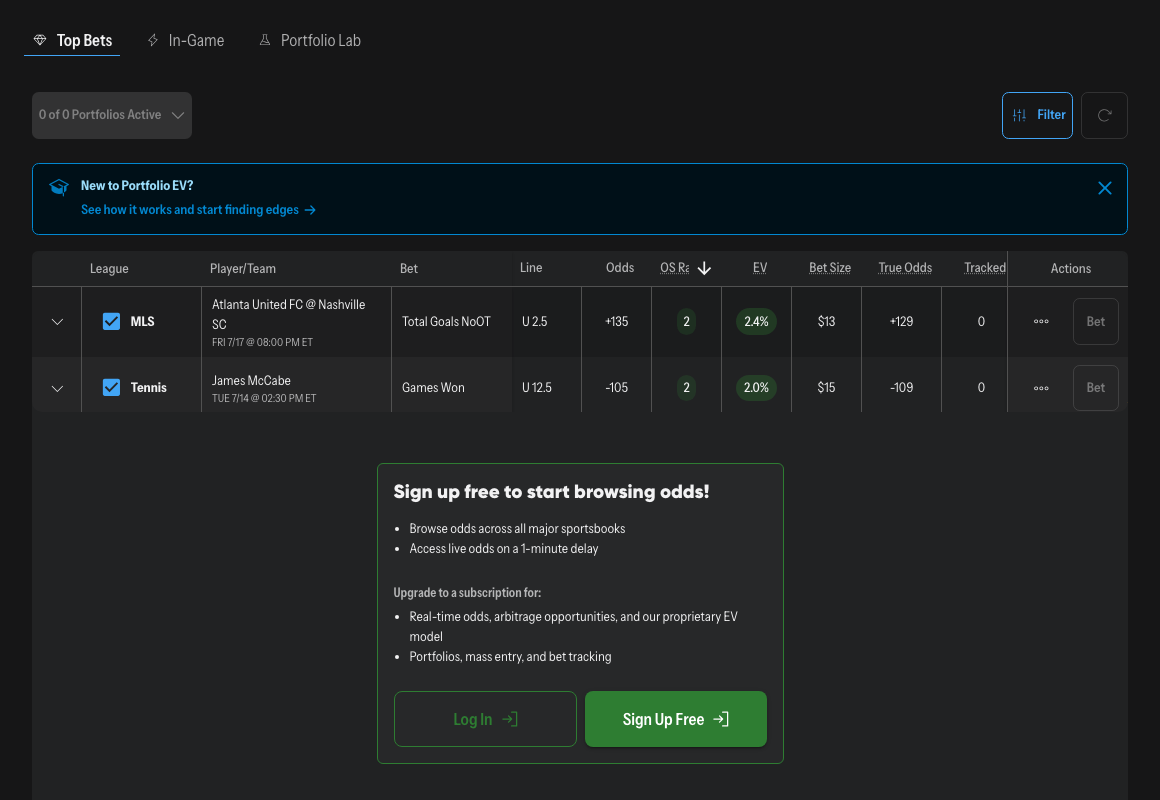
The OddsShopper +EV Screen.
Mechanically, every NFL contract is a Yes/No question. "Will the Chiefs win Super Bowl LXI?" You buy Yes if you think it happens, No if you don't, and at the end the contract is worth exactly $1 or exactly $0. Because of that binary settlement, the price it trades at in between, say 14¢, carries information a moneyline hides: it's the market's read on the probability, stated plainly. Hold that idea, because it's the hinge the whole workflow turns on later.
Funding And The USDC Question, Explained Plainly
NFL bettors coming from a normal sportsbook tend to get tripped up right here. The platform runs on USDC, a dollar-pegged stablecoin, so under the hood a contract is denominated in dollar units rather than settled straight to your bank. In practice, the U.S.-regulated Polymarket that relaunched after its late-2025 CFTC order is designed to feel like dollars. You fund an account, your buying power shows in dollars, and one winning contract pays a dollar. The crypto layer is mostly plumbing.
Two honest caveats, though. The U.S. platform and the older international crypto-native platform are separate products, and the funding options (which may include card, bank transfer, or a direct USDC deposit) differ between them and keep changing as the U.S. version matures. So the one move I'd insist on: check Polymarket's own current funding and eligibility pages before you deposit, rather than trusting any single number, including this one, that could be a version behind. This is a new, fast-moving product, and the mechanics are exactly the kind of thing that shifts month to month.
Which NFL Markets Actually Have Liquidity
Whether Polymarket is useful to you for football comes down to this, and the answer is the opposite of a sportsbook's. A book's deepest, sharpest markets are the weekly ones: this Sunday's spread, a star receiver's yardage prop, a same-game parlay. Polymarket's depth runs the other direction. It concentrates on the big, season-long questions where thousands of people want a position and the money pools up.
| NFL Market On Polymarket | Typical depth | Best use |
|---|
| Super Bowl Winner | Deepest | Season-long position, tight spread |
| Conference / Division Winner | Deep | Futures with real two-way volume |
| Regular-Season MVP | Moderate to deep on favorites | Player-narrative futures |
| Team Season Win Total (Over/Under) | Moderate | Preseason and early-season value |
| Single-Game Moneyline | Thin, in-season | Usable, but shop the spread carefully |
| Player Props / Weekly Specials | Thin or absent | A sportsbook does this better |
The row I keep coming back to is the last one. If you're chasing a specific NFL player prop, a quarterback's passing yards or an anytime touchdown, Polymarket is the wrong tool. That's a sportsbook's home turf, and it isn't close. But the Super Bowl row at the top is genuinely strong: on a marquee futures question, the spread between Yes and No is tight enough that you can get in and out near the quoted price, which is exactly what you can't count on in a thin market. Liquidity, not the platform's logo, is what makes a price trustworthy, a lesson we dug into for the exchange next door in how to attack Kalshi's best sports markets, and it holds identically here.
The NFL framing that matters: treat Polymarket as a futures venue. Its edge is the season-long marquee market, not Week 11's game script. Match the market you want to the platform that actually pools money on it.
How To Bet An NFL Market On Polymarket, Step By Step
Once you know what you're buying, the mechanics are quick:
- Fund your account. Add funds per Polymarket's current U.S. deposit options, and confirm your state is eligible before you do (more on that below).
- Find the market. Search the NFL question you want: a Super Bowl or conference winner, a team's win total, a game moneyline.
- Pick Yes or No. Buying "No" on the Chiefs to win the title is just betting they won't, at its own price. Every question has two sides you can take.
- Read the price as a probability. A 14¢ contract implies about a 14% chance and pays $1 if it hits. That's your cost-to-payout in one number.
- Set your size, then choose your order. Take the price that's posted, or set your own with a limit order. On a deep Super Bowl market a limit order a cent under the ask usually fills; on a thin single-game NFL contract it can sit unfilled for hours or never fill at all, and that non-fill is itself a signal the market's too illiquid to bother with.
- Confirm. Review the contracts and cost, then place it. Because it's an exchange, you can often sell out of the position before the season resolves rather than sweating it to Week 18, though selling early usually means handing back some expected value for certainty.
That's the full loop. But placing the bet was never the hard part. Knowing whether that 14¢ was a good 14¢ is, and that's the promise from up top.
Don't take a contract price on faith, check it against the whole market. OddsShopper strips the vig out of every sportsbook's NFL line so you can read it as a true probability and hold it right next to a Polymarket contract. Start with OddsShopper's free tools, then use code POLYNFL20 for 20% off OddsShopper Pro.
The Edge: Comparing A Contract Price To The Book
This next workflow is the reason a value bettor should care about Polymarket at all. A contract price is already an implied probability, which is the good part, but is it a good probability? The only way to know is to compare it to the rest of the market, and the rest of the market is the sportsbooks.
The catch is that you can't compare them straight. A sportsbook's NFL futures price at DraftKings 🎁, FanDuel 🎁, or BetMGM 🎁 has the book's margin, the vig, baked into it, and futures markets carry some of the heaviest hold on the board, often a 30% margin or more once you add up every team on a Super Bowl board, so the probability you'd read straight off a +400 looks far fatter than the book's real opinion. The fix is to de-vig the book line. Strip the margin out and you're left with the book's honest implied probability, in the exact same 1-to-99-cent unit a Polymarket contract trades in. That de-vig step is the one people skip, and it's the whole ballgame. (New to it? Our prediction markets vs. sports betting guide walks the de-vig math in full.)
That's the job OddsShopper's tools do so you're not doing it by hand:
- No-Vig Fair Odds: the tool scans any sportsbook's NFL line and converts it into a true implied probability, the same cents unit the contract trades in.
- The +EV Screen flags the prices sitting in your favor against that fair number, so you're weighing edges, not hunches.
- Line Shopping Across DraftKings, FanDuel, BetMGM, And Every Other Major Book gives you a market consensus to judge a single contract price against, instead of one book's take.
- The Sharp Action Tool shows where the sharp money is moving, a second signal to weigh a contract against rather than reading it in isolation.
None of those require a Polymarket account. They're what turn "14¢ feels cheap" into "14¢ is two points under the de-vigged book number, so it's a buy."
A Worked Example: One Super Bowl Future, Two Prices
Say you want to back a contender to win the Super Bowl, and you're deciding whether Polymarket or your sportsbook has the better number. Using round, illustrative figures rather than any live price:
| Venue | Price shown | Implied probability |
|---|
| Polymarket (Yes Contract) | 16¢ | ~16% |
| FanDuel Futures (Raw) | +400 | ~20% |
| FanDuel Futures (No-Vig) | margin stripped out | ~17% |
The sportsbook's raw +400 looks like a 20% shot, but futures carry a heavy margin, so once you de-vig it — normalizing across every team on the board rather than reading that one price in isolation — the book's honest read on that team lands lower, illustratively around 17% once that heavy futures hold is stripped out. Now the comparison is clean: Polymarket's 16¢ contract is priced below the book's true 17% number, which means for once the exchange is the cheaper buy. You're paying 16 for something the sharpest read says is worth about 17. That's a small, real edge, and it's only visible because you converted both venues to the same unit first.
The discipline is that it cuts both ways just as often. Plenty of teams will have a de-vigged book number that comes in under the contract price, and in those spots the book is the better buy and Polymarket is the trap. The move is never "always bet Polymarket." It's "convert both to a true probability, then take whichever side is cheaper than it should be," the same +EV habit whether the price is on an exchange or a sportsbook.
The one-line rule to carry into every NFL market: the venue with the cheaper true price wins the bet, not the venue with the shinier interface. A Polymarket contract and a de-vigged sportsbook number live in the same 1-to-99-cent world once you convert them, so let the number pick the side.
Costs, Liquidity, And Risk
Nothing here is free, even without a visible vig. On Polymarket the cost reaches you through some mix of fees and the bid-ask spread, the gap between what buyers will pay and sellers will accept, and that spread is where thin markets bite. On a deep Super Bowl contract the spread is tight; on an obscure market it can be wide enough to eat the edge you thought you had, and you may not be able to exit at a fair price when you want to. Fee structures differ and change, so read Polymarket's current fee page rather than a number you saw quoted months ago.
And the obvious one: a contract can settle against you. A "Yes" you bought at 60¢ is worth $0 if the event doesn't happen, and any futures position can lose everything you put in. Size for the market you're actually in: on a thin single-game moneyline where the bid-ask is wide, a good chunk of your apparent edge can be spread rather than signal, so size down there and save the real money for the deep markets where the price is trustworthy. And only risk what you can afford to lose. If it stops feeling like reading a market and starts feeling like chasing one, that's the signal to step back, and every regulated platform posts responsible-gaming resources for exactly that.
Is It Legal To Bet NFL On Polymarket?
This is the part that matters most to get right, so here's the dated, honest version, and none of it is legal advice. Polymarket returned to U.S. users through a CFTC-regulated exchange, with its U.S. platform live since December 2025, and it operates under CFTC oversight as an event-contract market rather than a state-licensed sportsbook. As of July 2026, and per current reporting, its U.S. availability is uneven and actively contested. A number of states have moved against prediction-market platforms with cease-and-desist orders or enforcement actions, at least one (Nevada) has reportedly had a court-ordered ban take effect, and the platforms and the CFTC are litigating several of those actions right now. Which specific states are on or off that list has shifted repeatedly and can change month to month, so treat any snapshot as temporary and check your own state directly rather than trusting a named list on any page, including this one.
One line worth flagging: Minnesota passed a law, effective August 1, 2026, that makes it a felony to operate, host, or advertise a prediction-market platform in the state. As it's been reported, that provision targets the companies running these platforms rather than individual traders, and the law is being challenged in federal court with no ruling yet as of this writing, so the picture in Minnesota is genuinely unsettled. The cautious move if you're there: don't assume anything on this page is settled law, and check current guidance before you trade. Everywhere else, treat every availability claim here as a July 2026 snapshot, because this map has been redrawn repeatedly and courts and state regulators are still actively contesting how sports event contracts are treated. The clearest source of truth is Polymarket's own eligibility check for your state on the day you sign up, not this page, and not any blog post. For a fuller look at how Polymarket's map compares to the other big exchange, see our Kalshi vs. Polymarket breakdown.
How To Bet NFL On Polymarket — FAQ
How does Polymarket work for NFL betting?
You buy Yes/No contracts on an NFL outcome, such as a team to win the Super Bowl, a division, or a game. Each settles at $1 if it hits and $0 if it doesn't, and the price in cents is the market's implied probability for that outcome.
What NFL markets are on Polymarket?
Its depth is in season-long markets: Super Bowl, conference and division winners, MVP, and team win totals. Single-game moneylines exist in season but are thinner, and weekly player props are largely a sportsbook's domain.
Do I need crypto to bet NFL on Polymarket?
It runs on USDC, a dollar-pegged stablecoin, but the U.S. platform is designed to feel dollar-denominated and offers standard funding options that keep evolving. Check Polymarket's current deposit page for what's supported where you are.
Is betting NFL on Polymarket legal?
Polymarket operates as a CFTC-regulated event-contract exchange, not a state-licensed sportsbook, which is a classification rather than a blanket statement that it's legal everywhere. Availability is state-specific and changing (blocked in several states as of July 2026, and Minnesota has a law effective August 1, 2026 that makes operating or advertising these platforms a felony, currently under a federal-court challenge), so confirm your own state on Polymarket before funding. This isn't legal advice.
Is Polymarket better than a sportsbook for NFL?
Neither wins outright. Polymarket is strong on season-long futures with transparent, probability-first prices and the ability to trade out early; a sportsbook is far deeper on weekly games and props. The sharp move is to compare a contract price to the de-vigged book number and take whichever is cheaper.
The Bottom Line
Betting NFL on Polymarket only looks exotic until you accept the one idea it's built on: the price is the probability. Once you read a 14¢ Super Bowl contract as "about 14%," the platform stops being a crypto novelty and becomes what it actually is, a futures venue with real depth on the season's biggest questions and a genuine edge waiting in the gap between its prices and the sportsbooks'. Play the markets where the money pools, skip the thin ones a book does better, and never take a contract on faith. Convert both venues to a true number first, then buy the cheaper one. That habit is the entire difference between trading a price because it's in front of you and trading it because it's a good one.
Turn any NFL line into a true probability. OddsShopper de-vigs every sportsbook price so you can read it in the same units a Polymarket contract trades in, and the Sharp Action tool shows where the sharp money is going. Start with the free tools; code POLYNFL20 takes 20% off OddsShopper Pro. New to the exchanges? Start with our Kalshi step-by-step guide and the Polymarket sign-up walkthrough.