Kalshi Fees Explained: Trading Costs, Minimums, Deposits, And Withdrawals
Most people searching for Kalshi fees expect to find a number. A commission, a percentage, some flat cut the exchange takes off the top. That number does not exist, and the reason it does not exist is the most useful thing to understand about trading sports events on Kalshi.
Kalshi's trading fee is a curve. It rises and falls with the price of the contract you are buying, which means an identical 100-contract order can cost you $1.75 in fees or 7 cents depending on nothing more than whether the market thinks the outcome is a coin flip or a near certainty. Learn the shape of that curve and you can answer the question that actually matters: for the specific event in front of you, is the exchange cheaper than the sportsbook, or not?
One note before the math, because it changes how the rest of this reads. Kalshi operates as a CFTC-regulated designated contract market, the same regulatory category as a futures exchange, and it characterizes these products as event contracts rather than sportsbook wagers. That distinction drives everything below, including why the cost shows up as a trading fee instead of as vig baked into a price. It is also not settled: several states and courts dispute whether sports contracts are functionally sportsbook wagers, which is why availability is a moving target worth checking before you fund anything. Nothing here is a promise of profit. Fees, spreads, and thin order books are real costs that can turn a good read into a losing trade.
Two things to watch for as the math unfolds: the most expensive contract on Kalshi is not the longshot or the heavy favorite but the coin flip, and there is one way to place an order that can drop your trading fee to zero.
In Summary
- The Fee Is A Formula, Not A Flat Rate. Kalshi's published schedule prices a standard trade at
round up(0.07 × C × P × (1-P)), where C is your contract count and P is the price in dollars. The fee peaks at a 50-cent contract and decays toward both ends of the board.
- The Ceiling Is $1.75 Per 100 Contracts, which the formula reaches at a 50-cent contract. At 90 cents the same 100 contracts cost 63 cents.
- Resting Orders Are The Discount. Fees are charged when you take liquidity off the order book. Leave an order sitting and you often pay nothing, or a reduced maker rate on the markets that carry one.
- There Is No Settlement Fee And No Membership Fee. You pay to trade, not to hold or to get paid.
- Deposits And Withdrawals Are Free By Bank Transfer. The minimum deposit is $10. Card deposits carry a fee of up to 2%.
- Withdrawals Take A Few Business Days By Bank, and recent deposits can sit under a short security hold before they can leave.
- Where OddsShopper Fits: OddsShopper's no-vig fair-odds pricing tells you what a sportsbook's margin really is on the same event, which is the only honest way to judge whether a Kalshi fee is the cheaper cost of doing business.
Verify before you trade. Kalshi revises its fee schedule periodically, so here is exactly how current these numbers are. The 0.07 and 0.0175 coefficients are confirmed against Kalshi's July 2026 fee schedule. The fee table below reflects the schedule effective February 5, 2026, which is the most recent version we could retrieve in full. Deposit and withdrawal details were checked against Kalshi's help center in July 2026. Kalshi publishes the current schedule as a PDF linked from kalshi.com/fee-schedule. Treat any fee number you read anywhere, including here, as a snapshot and check it before you trade.
How Kalshi's Trading Fee Actually Works
Every Kalshi contract settles at either $1.00 or $0.00. It trades somewhere between 1 cent and 99 cents in between, and that price reads directly as a probability. A contract at 30 cents means the market thinks the event is roughly 30% likely.
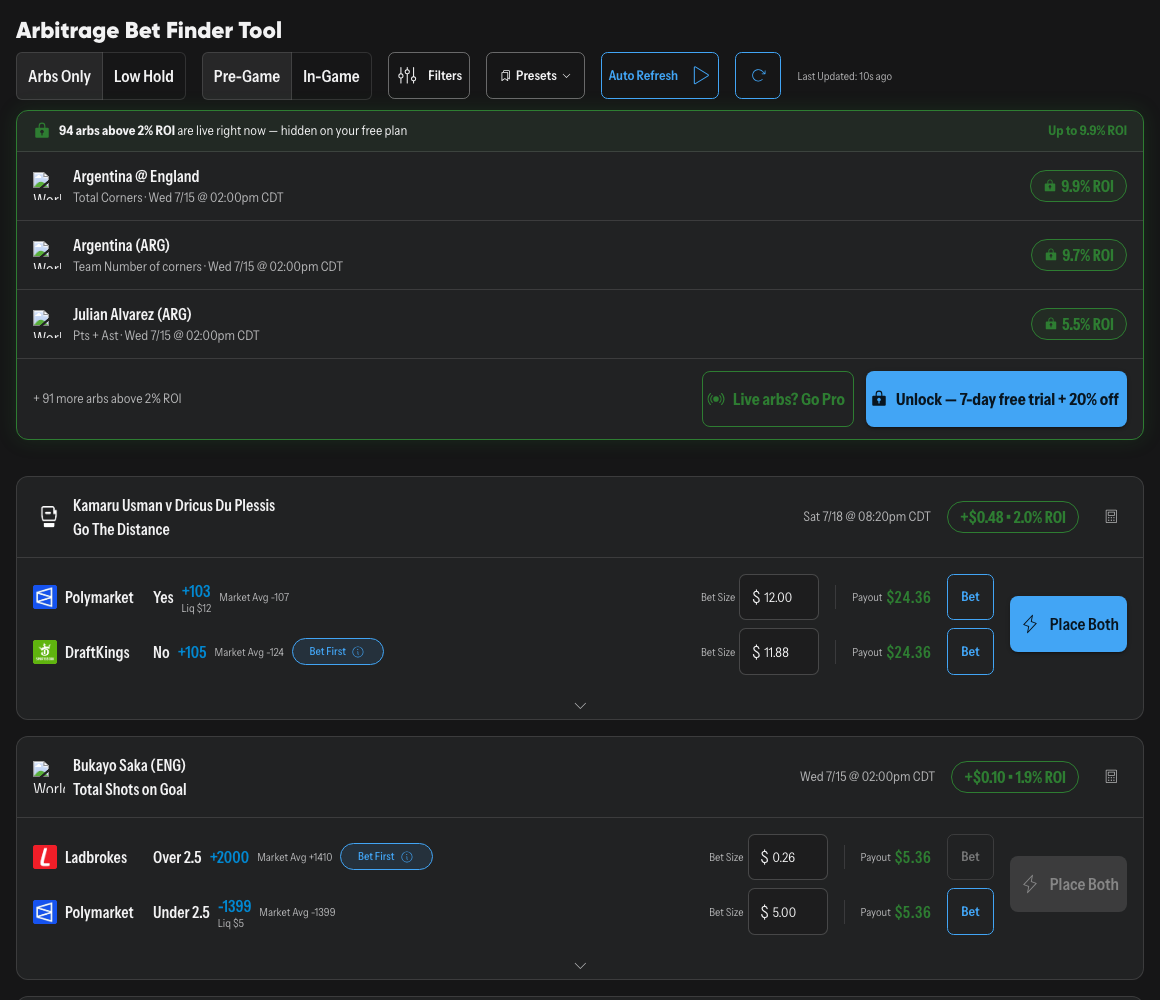
The OddsShopper Arbitrage Tool.
Kalshi charges its trading fee as a percentage of the expected earnings on the contract rather than as a percentage of your stake. That sounds like accounting trivia. It is actually the whole design, and it explains the curve. Per Kalshi's published fee schedule, a standard trade costs:
fee = round up(0.07 × C × P × (1 - P))
Where C is the number of contracts and P is the price in dollars, so 50 cents is 0.50. The round up is to the next cent.
That is the formula exactly as printed in the schedule effective February 5, 2026, the most recent version we were able to read in full. Kalshi's July 2026 revision keeps the same 0.07 coefficient and adds a per-contract multiplier that defaults to 1, so the arithmetic below is unchanged for a standard market. Some products sit outside this schedule entirely and are priced on their own, lower table. If you are trading anything other than a standard sports contract, check the current schedule rather than trusting the general formula.
The engine of that formula is the P × (1 - P) term, which is uncertainty itself. It is largest when P is 0.50, where it equals 0.25, and it shrinks toward zero as the price approaches either 1 cent or 99 cents. Kalshi charges you the most when the market is least sure, and it charges you almost nothing when the market has essentially made up its mind.
So the maximum possible fee on 100 contracts is 0.07 × 100 × 0.25, which is $1.75. Hold onto that number. It is the single most useful figure on the exchange, and it comes back when we compare it to a sportsbook.
The Fee Curve: Why The Coin Flip Costs The Most
Here is what that formula produces across the board, using Kalshi's own published fee table.
| Contract Price | Fee on 1 contract | Cost of 100 contracts | Fee on 100 contracts |
|---|
| $0.01 | $0.01 | $1.00 | $0.07 |
| $0.10 | $0.01 | $10.00 | $0.63 |
| $0.25 | $0.02 | $25.00 | $1.32 |
| $0.40 | $0.02 | $40.00 | $1.68 |
| $0.50 | $0.02 | $50.00 | $1.75 |
| $0.60 | $0.02 | $60.00 | $1.68 |
| $0.75 | $0.02 | $75.00 | $1.32 |
| $0.90 | $0.01 | $90.00 | $0.63 |
| $0.99 | $0.01 | $99.00 | $0.07 |
The 50-cent row is the ceiling, and it is the one everybody quotes. The row worth staring at is the very first one. A 1-cent contract costs 1 cent, and the fee on that single contract is also 1 cent. The fee alone equals 100% of the contract's price, which doubles your outlay before the event has even started. The round up to the next cent, invisible and harmless on a 100-lot, turns brutal on tiny orders at longshot prices.
That is the practical lesson buried in the rounding rule, and it is the opposite of what most people assume. Traders think the longshot corner of the board is cheap because the contracts are cheap. On a per-contract basis the fee there genuinely is small. But if you buy one or two contracts at a time, the round up eats a share of your position that no sportsbook would ever dare charge you. Size matters more than price. If you are trading the cheap end of the board, trade it in blocks, not singles.
Maker Vs. Taker: The Order Type That Cuts The Fee
The formula above applies only to orders that fill immediately against something already sitting on the order book. In market terms, you are the taker. You are removing liquidity, and you pay for the privilege.
Rest an order instead, at a price nobody is hitting yet, and you become the maker. Kalshi does not charge its standard trading fee on orders that sit unmatched on the book. On the markets that do carry a maker fee, the published rate runs at one quarter of the taker formula:
maker fee = round up(0.0175 × C × P × (1 - P))
Which markets carry maker fees changes, and Kalshi keeps the current list on its fee schedule page rather than in the PDF, so check it rather than assuming. There are no fees for cancelling a resting order, and maker fees are only charged if the resting order actually executes.
One detail in Kalshi's favor that rarely gets mentioned: because that maker formula rounds up to the next cent like everything else, small orders overpay in rounding. Kalshi reimburses the excess in the first week of the following month, provided your accumulated overpayment for the month clears $10. Below that threshold, the rounding stays in Kalshi's pocket.
Patience is the discount, with one important asterisk: check whether the specific sports market you are trading carries a maker fee, because you cannot assume it does not. On a coin-flip market, taking liquidity for 100 contracts costs $1.75. Resting that same order costs 44 cents on a market that carries a maker fee, and nothing at all on one that does not. Either way you are paying less than the taker.
The trade-off is real and worth naming honestly: a resting order might never fill, and in a thin market that means sitting and watching the price move away from you. That is a genuine cost, just not one that shows up on a statement. Our guide to Kalshi liquidity and the best sports markets covers where the order books are deep enough for patience to actually pay.
There is also no settlement fee and no membership fee. You are not charged to hold a contract to expiry or to collect on a winner.
Worked Example: Kalshi Fees Vs. Sportsbook Vig
The numbers below are illustrative, chosen to show the mechanics on a clean coin-flip market. Real prices move.
This is the comparison our readers actually want, and almost nobody runs it honestly. A sportsbook does not charge a visible fee. It charges you inside the price, which is exactly why it feels cheaper and often is not.
The sportsbook side. Take a standard game priced at -110 on both sides. That -110 implies a 52.38% break-even. Both sides together add to 104.76%, and that extra 4.76 points is the book's margin. Strip it out, which is what de-vigging means, and the fair price on each side is 50%. So the book is asking you to win 52.38% of the time on a proposition that is truly 50/50. Your cost is those 2.38 percentage points.
The Kalshi side. The same game, with the YES contract trading at 50 cents. Buy 100 contracts and you pay $50.00, plus the maximum fee of $1.75 that we met earlier. Total outlay: $51.75, against a $100 payout if you are right. Your break-even is 51.75 / 100, or 51.75%.
| Sportsbook at -110 | Kalshi taker at 50¢ | Kalshi maker, market with a maker fee | Kalshi maker, market with none |
|---|
| Cost Per $100 Of Payout | $52.38 | $51.75 | $50.44 | $50.00 |
| Break-Even Win Rate | 52.38% | 51.75% | 50.44% | 50.00% |
| Effective Cost Vs. Fair | 2.38 pts | 1.75 pts | 0.44 pts | ~0 pts |
The taker column is the honest headline. On a coin flip, the exchange's worst case fee still requires a lower break-even than a standard -110 sportsbook price, by about 0.63 percentage points. The two maker columns are where the gap gets uncomfortable for the book, though note which one applies to you: only a market that carries no maker fee prices the position at true fair value, and that is a per-market fact you have to check rather than assume.
Now the honest counterweights, because this table flatters Kalshi in three ways. First, it compares Kalshi against the sportsbook's standard price, and -110 is not the only price on the board. Line shopping across an odds screen for the best available number is still the highest-value habit in betting, and we will put an exact figure on how much of this edge a better number erases in a moment. Second, the Kalshi fee is charged per trade, so exiting before settlement means paying again on the way out. Two coin-flip trades cost 3.5 points against a fair price, which is worse than the -110 you were trying to beat. The edge belongs to holding to settlement, not to trading in and out. Third, none of this means anything if the order book is too thin to fill your size at the price you want.
That last point is why the fee is only ever half the question. A cheap fee on a bad price is still a bad trade, which is exactly where a second opinion earns its keep. If you want the mechanics of exploiting gaps between an exchange and a book, we cover them in prediction market arbitrage, and the arbitrage finder surfaces those two-sided gaps as they appear.
See the margin before you pick a venue. OddsShopper Pro prices every sports market at no-vig fair odds, so you can see what a book's real margin is on the same event and compare it against a Kalshi contract price with the fee included. Use code KALSHIFEES20 for 20% off your first payment.
Kalshi Minimum Bet: What You Can Actually Trade
Search "Kalshi minimum bet" and you are asking a sportsbook question about something that is not a sportsbook. There is no bet slip and no minimum wager. There are contracts, and you can buy as little as one.
That means the practical floor is whatever a single contract costs. At the cheap end of the board that is 1 cent, though as the fee table showed, a 1-cent contract carries a 1-cent fee, so the true all-in cost of the smallest possible position on Kalshi is 2 cents. At a coin-flip price, one contract runs 50 cents plus a 2-cent fee.
The real floor is not the trade size. It is the deposit.
Kalshi Deposits: Methods, Minimums, And Fees
Per Kalshi's help center as of July 2026, the minimum deposit is $10, and bank transfers carry no fee.
| Method | Fee | Notes |
|---|
| Bank Transfer (ACH) | No Kalshi fee | $10 minimum. US users only. Settles typically within 5 business days |
| Debit Card | Up to 2% | Typically credits instantly |
| Wire | No Kalshi fee | $1,000 minimum. Your bank may charge its own. Include your Kalshi memo code, and send from an account matching your name, or the wire can be delayed or returned |
| Crypto | Third-party processor fees, disclosed before you transact | Used by international traders |
The line worth pausing on is the debit card row. Deposit $500 by card and you have paid up to $10 before you have placed a single order, which is more than five full coin-flip trades' worth of the $1.75 maximum. Fund the same $500 by bank transfer and that cost is zero. For anyone depositing in size, the funding method is a bigger lever than the order type, and it is the one nobody talks about.
Bank deposits do not always land instantly. Kalshi may credit part of a deposit right away so you can trade while the transfer settles, with the amount depending on your account history and deposit size, and it shows you what will be credited before you confirm. Accounts with a track record of clean, non-reversed deposits tend to see immediate funding more often.
Kalshi Withdrawal Time: How Long Payouts Take
Bank withdrawals are free and, per Kalshi's help center, funds "typically arrive in your bank account within a few business days." Debit card withdrawals are also free and typically arrive back on the card within a few hours, though that is the happy path: if your account or card is under a compliance review by the payment processor, debit withdrawals can be temporarily unavailable, and those reviews normally take three to five business days. Bank withdrawals are available to US users only; international traders route through debit or crypto.
The wrinkle that catches people is the security hold. If you recently deposited, that money can sit under a temporary hold before it is eligible to leave, and the hold period varies by deposit method. It is a standard anti-fraud measure rather than anything unusual, but it means the answer to "how fast can I get my money out" depends on how recently you put it in. Money that has been sitting in your balance and money you wired in this morning do not behave the same way.
The payout cheat sheet. Bank transfer: free, a few business days, US only. Debit card: normally instant. Recent deposits: expect a short hold first. If you need speed, the method you deposited with matters as much as the one you withdraw with.
Where Kalshi's Fee Structure Leaves You
So here is the number the fee schedule never prints, and it is the one that actually decides where a bet belongs.
Kalshi's worst case is a 51.75% break-even. Work backwards to the American price that matches it and the crossover sits at about -107.25. On a contract that fills at 50 cents and is held to settlement, a sportsbook at -108 or worse loses to Kalshi's taker fee, even at the coin flip where that fee is at its maximum. A sportsbook at -107 or better wins, and the reduced-juice books that post -105 beat the exchange outright at 51.22%. The $1.75 ceiling that looked so cheap next to -110 gets erased by a number barely two and a half cents better on the same game.
That figure reframes the argument. The exchange is not structurally cheaper than a sportsbook. It is cheaper than a lazy sportsbook price, and the gap is thin enough that where you shop matters more than which venue you pick. Kalshi's cleanest fee edge is narrower than it first looks: a resting order on a market that carries no maker fee, filled at the price you actually wanted. That is three conditions, not one.
None of which is a full decision rule on its own. Before the fee even matters, the price has to fill, the spread has to be tight enough to survive, the market has to carry the maker terms you think it does, your funding method has to not have eaten 2% on the way in, and your state has to allow the trade at all.
None of which tells you whether the price is right, and that is the part no fee schedule can answer. The fee is a floor on your cost, not a verdict on your trade. Price the event honestly at both venues before you commit: strip the vig out of the book's number, then compare it against the contract with the fee included. If the math here made the case for the exchange, the next question is which markets are worth trading at all. Start with our Kalshi sports guide, and if you are weighing platforms, Kalshi vs. Polymarket runs the same comparison across the two exchanges.
Before You Trade: Eligibility And State Rules
Availability is volatile, contested, and changes by state, so treat any list you read as a snapshot rather than a map. As of our July 2026 check, Kalshi's sports contracts were restricted, paused, or limited in states including Arizona, Massachusetts, Maryland, Michigan, Montana, Nevada, and Ohio, with New York enforcement and several other states in active dispute. That roster moves on court rulings, sometimes within a single week. Kalshi's own eligibility check is the only authority worth trusting on the day you fund an account.
Minnesota: confirm current legality before you do anything. A Minnesota law effective August 1, 2026 makes it a felony to create, operate, host, or advertise a prediction-market platform in the state. It targets platforms rather than individual users, and it is under active federal litigation, so the practical picture may change. The realistic outcome for a Minnesota resident is that these markets stop being available, not that trading itself is prosecuted. Get current local guidance rather than relying on this paragraph.
Prediction market legality is not sportsbook legality, and the two are genuinely different maps. Event contracts are available in some states where sportsbooks are not, and blocked in some states where sportsbooks are live. Check Kalshi's own eligibility tool before you fund an account, and see are prediction markets legal for the state-by-state picture. This is intended for a legal-age audience, and none of it is financial, tax, or legal advice.
Kalshi Fees FAQ
Does Kalshi charge fees?
Yes, on trading. A standard trade costs round up(0.07 × C × P × (1-P)), which works out to a maximum of $1.75 per 100 contracts at a 50-cent price. There is no settlement fee, no membership fee, and no fee on bank deposits or withdrawals.
What is the Kalshi minimum bet?
There is no minimum bet, because Kalshi trades contracts rather than accepting wagers. The smallest position is one contract, which can cost as little as 1 cent plus a 1-cent fee. The minimum deposit, however, is $10.
How long does a Kalshi withdrawal take?
Bank withdrawals typically arrive within a few business days and are free. Debit card withdrawals are free and usually arrive within a few hours, unless your card is under a processor compliance review, which normally takes three to five business days. Recent deposits may sit under a short security hold before they can be withdrawn.
Is Kalshi cheaper than a sportsbook?
Only against a standard price. A 50-cent contract with the maximum fee implies a 51.75% break-even, against 52.38% at -110. But a book at -107 or better beats that, and -105 beats it comfortably at 51.22%, so the honest answer is that Kalshi beats a lazy number rather than beating sportsbooks as a category. The edge also disappears if you exit before settlement, fund by card, or trade a market too thin to fill at your price. Run both prices through an EV calculator rather than trusting the venue, and see our guide to reading betting odds for the conversion by hand.
Are Kalshi fees higher on longshots?
No, they are lower per contract, because the fee shrinks as the price moves toward either extreme. But the round up to the next cent makes very small orders at longshot prices expensive in percentage terms. A single 1-cent contract carries a 1-cent fee.
Compare the true price before you commit. Get OddsShopper Pro with code KALSHIFEES20 for 20% off your first payment and see the no-vig fair odds behind every sports market, or start with our free expert picks today.