Eric "Lindy" Lindquist opened this Sunday MLB research show with a number that framed the entire day: on Saturday's 15-game slate, only 14 home runs cleared the fence all afternoon. Cooler air, deader bats, and a market that already knows it. His takeaway was not to force swings into that. He only bet two home runs Saturday and felt good about not reaching. So the thread running through this whole card is discipline about price: with home runs harder to come by league-wide, the edge is not in the short, sexy slugger number everyone is on. It sits in the two or three spots where the price is fat enough, the one ballpark still baking hitters, and the low-hold strikeout and total markets the books guard loosely. Value is price versus true probability, and closing-line value, not any single result, is the scoreboard.
One vocabulary note before the plays, because it changes how you tail this. A lean is a game he likes but did not bet. An official play is one he actually fired. We do not promote a lean to a bet that never got made. The A's-side home run lottery he stared at for ten minutes and passed on stays a lean.
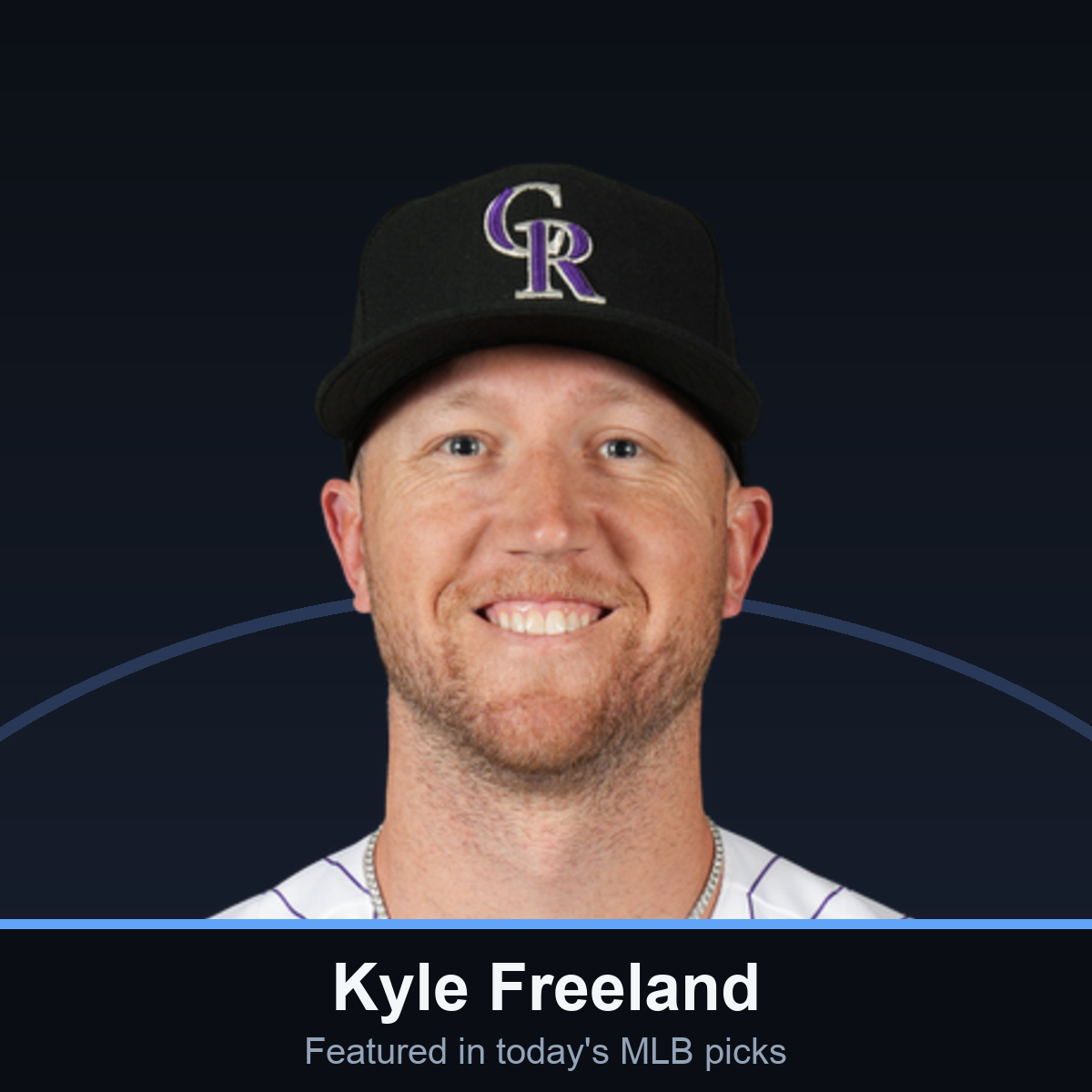
Kyle Freeland, one of the featured players on today's slate.
In Summary
- The Anchors He Carried In: Kyle Freeland (COL) under 4.5 strikeouts against Milwaukee, Braxton Ashcraft (PIT) over his pitching-outs number versus the Cubs, and Salvador Perez (KC) over 1.5 total bases against Framber Valdez (HOU).
- The Plus-Money Home Runs He Actually Fired: Dylan Crews (WSH) in Arizona, Jeremy Pena (HOU) in the Astros game, and a small Tim Tawa (ARI) ticket, all longshots bought because the projection beat the fat price, not despite it.
- The One Ballpark Worth Attacking: 94 degrees with the wind blowing out, so Colby Thomas (ATH) to go deep, a small pick'em play with pinch-hit risk built in.
- Boston Lefties Against Gausman: Masataka Yoshida (BOS) and Wilyer Abreu (BOS) to homer off Kevin Gausman (TOR), a half-unit split his model liked.
- What The Tool Flagged Instead: OddsShopper's de-vigged +EV screen loved the under on a cluster of hit, total-base, and pitcher-strikeout props across several quiet lineups, the market echo of a cold-bat Sunday.
Watch The Video
Lindy built this card live with the OddsShopper board open, upgrading prices as lines moved and reacting to lineups in real time, worth watching for how he talks himself out of bets as much as into them. Watch on YouTube.
Why "Don't Force It" Was The Whole Show
The Saturday home run count was not a throwaway stat. It was the argument. Fourteen homers across 15 games is a cold, low-probability environment, and Lindy's point was that the books have already priced the cool weather in. So chasing a slugger at a short number is paying full freight for a longer shot than the price admits. In effect that is negative expected value with extra steps. His discipline was the tell: he wanted a home run on the A's side badly enough to circle two of them, then fired neither because the numbers were breakevens dressed up as bargains. If you only remember one thing from the show, remember that the willingness to want a bet and still not make it is the skill (see positive expected value for why the price, not the pick, decides).
That framing is why the plays he did fire cluster around pitching and a couple of fat home run prices.
Pitching First: The Anchors He Carried In
With the bats quiet, Lindy leaned on arms and contact he had already locked overnight. Kyle Freeland (COL) under 4.5 strikeouts against Milwaukee got sharper mid-show when the Brewers lineup dropped without Garrett Mitchell, subtracting a strikeout bat from a soft-contact order, and Freeland's number then ticked to 4 elsewhere, a push-hunting middle he weighed aloud but left as the single Under 4.5 he came in with. Braxton Ashcraft (PIT) over his pitching-outs total versus the Cubs was the length play; he spent a live inning sweating Ashcraft's velocity (97 out of the gate) and that elite curveball, exactly the traits that keep a young starter in the game deep enough to clear the number.
The contact bet was Salvador Perez (KC) over 1.5 total bases against Framber Valdez (HOU), a spot Lindy liked in the Astros game. These are not lottery tickets; they are the safe, repeatable base the riskier swings get funded from.
The Plus-Money Home Runs He Actually Fired
Here is the value lesson in one bet. Dylan Crews (WSH) was the home run Lindy kept coming back to, a big plus-money longshot in Arizona. The read was pure lineup mechanics: Crews landed in the three-hole while most projection sources still had him fifth, so the market was pricing a middle-of-the-order bat as if he were hitting lower, and Lindy's number had him far likelier to go deep than the fat price implied. That gap, not the odds, is the reason to bet it.
He paired it with Jeremy Pena (HOU) to homer in the Astros game and a small Tim Tawa (ARI) ticket he flat-staked and moved on from. Both are the same logic as Crews, a projection that clears the plus-money number, sized to the risk. And the callback to his own thesis is the point: these got bet because the price was fat, while the A's-side homers he loved on talent got passed because their prices were not.
The one exception to "avoid the cold parks" was the desert-hot A's yard: 94 degrees, wind out, the single best hitting environment on the board three days running. There he took Colby Thomas (ATH) to go deep on a pick'em board, and only there, above a long price, because if Thomas gets pinch-hit for before he sees three at-bats the ticket voids rather than losing. It is not a hedge; it is buying the outcome with the downside capped.
Boston's Lefties Off A Fading Gausman
The cleanest bat matchup was Masataka Yoshida (BOS) and Wilyer Abreu (BOS) to homer against Toronto's Kevin Gausman (TOR). Lindy's rationale was straightforward: the Boston lefties were popping against Gausman in his model, so he split roughly a half-unit across the two rather than force one bigger ticket.
Featured Fired Plays (7/26)
| Play | Market | The read |
|---|---|---|
| Dylan Crews (WSH) | To Hit A Home Run | Batting third but priced like a five-hole bat; plus-money misprice |
| Jeremy Pena (HOU) | To Hit A Home Run | Projection clears the fat number in the Astros game |
| Tim Tawa (ARI) | To Hit A Home Run | Small flat-stake longshot |
| Colby Thomas (ATH) | To Hit A Home Run | 94°, wind out; voids on early pinch-hit, so risk is capped |
| Masataka Yoshida (BOS) | To Hit A Home Run | Boston lefty bat popping vs Gausman in his model |
| Wilyer Abreu (BOS) | To Hit A Home Run | Second half of the half-unit Gausman split |
| Kyle Freeland (COL) | Under 4.5 Strikeouts | Brewers minus Garrett Mitchell; contact lineup |
| Braxton Ashcraft (PIT) | Over Pitching Outs | 97 velo, elite curveball, length vs the Cubs |
| Salvador Perez (KC) | Over 1.5 Total Bases | Contact play in the Astros game vs Valdez |
The row that matters most is the Crews home run, because it is the whole thesis in one ticket: a lineup card the projections had wrong handed Lindy a plus-money number that was fatter than the true odds, and he took it before the rest of the market caught the batting-order move. Betting the price instead of the player is the entire edge.
What The OddsShopper +EV Screen Flagged
This is the "low hold" refrain Lindy repeats all show, turned into a list. The same de-vigged prop board he works on stream put its best under value on Heliot Ramos, whose fair no-hit price of +168 was takeable at +182 on Bet365. The rest of the board tells the same cold-bat story, across hit, total-base, and one pitcher-strikeout prop spread over several unrelated games; what ties them together is not a matchup but a fair price sitting well below the best takeable number.
| Player | Market | Fair | Best takeable | Edge |
|---|---|---|---|---|
| Heliot Ramos (SF) | Under 0.5 Hits | +168 | +182 (Bet365) | +5.2% |
| Amed Rosario | Under 0.5 Hits | +154 | +165 (BetMGM) | +4.3% |
| Jasson Dominguez (NYY) | Under 0.5 Hits | +160 | +170 (Fanatics) | +3.9% |
| Max Schuemann (ATH) | Under 0.5 Hits | +103 | +110 (BetMGM) | +3.5% |
| Justin Crawford (PHI) | Under 0.5 Total Bases | +132 | +140 (BetMGM) | +3.5% |
| Carson Whisenhunt (SF) | Under 4.5 Strikeouts | -117 | -110 (Bet365) | +2.9% |
| Nolan Schanuel (LAA) | Under 0.5 Hits | +158 | +165 (Fanatics) | +2.7% |
| Mike Trout (LAA) | Under 0.5 Hits | +178 | +185 (Bet365) | +2.5% |
| Bryce Eldridge (SF) | Under 0.5 Hits | +144 | +150 (Bet365) | +2.5% |
| Rafael Devers (SF) | Under 0.5 Hits | +144 | +150 (Bet365) | +2.5% |
The one that breaks the pattern is Carson Whisenhunt Under 4.5 strikeouts, the lone pitcher prop on the board: fair at -117 but takeable at -110 on Bet365, a 2.9% edge on exactly the low-hold strikeout market Lindy hunts. If you are shopping a book like BetMGM for one of these prices and do not have an account yet, check BetMGM's current sign-up offer and how to claim it before you leave a bonus on the table, and run any bonus bet through the free bet converter so you do not waste it on a chalk favorite.
The Bottom Line
Sunday was a cold-bat, don't-force-it kind of day, and Lindy played it the honest way: pitching anchors, a couple of fat home run prices, and the one ballpark still baking hitters. The reads that stick are the ones a projection sheet alone could not hand you: Crews's batting-order bump turning a longshot into value, and Colby Thomas bought only where the pinch-hit downside voids instead of loses. Every one of them comes back to the same test the odds screen is built to run, and closing-line value is how you grade it after the fact: is the number you are getting better than the true odds? Price your own card on the OddsShopper MLB odds screen, cross-check the strikeout board and the day's home run picks, and follow Lindy's full card on Tails before you fire a single ticket.
Get 25% off your first week or month of OddsShopper Pro with code LINDY25 →