Most bettors have no idea whether they're actually winning. They remember the big hits, forget the slow leaks, and guess at their real number somewhere north of break-even. A good bet tracking app ends the guessing: it syncs every wager, grades it automatically, and shows you the truth. But here's the catch nobody puts on the box, and it's the thread that runs through every app below: a tracker only tells you what you already did. The money was made or lost the moment you clicked "place bet." So the best tracker in 2026 isn't just the one with the prettiest dashboard, it's the one that pushes you back toward better prices before your next bet. Keep that in mind, because it's how we ranked all four.
Quick Summary: The Best Bet Tracking Apps
Four apps are what most US bettors are choosing between right now. Here's the short version before we get into each one.
New to OddsShopper?It scans 100+ sportsbooks in real time and flags the exact bets priced in your favor, the +EV prices your tracker only shows you after they close. That's the front half of the loop these apps grade. You can try OddsShopper Pro free for 7 days, and code BETTRACK20 takes 20% off OS Pro or OS Core if you subscribe.
| App | Best for | Cost | Standout | The catch |
|---|---|---|---|---|
| Pikkit | Recreational bettors who want verified stats | Free (Pro tier for advanced analytics) | BookSync auto-imports from 30+ books, no manual entry | No manual bets, so unsupported books go untracked |
| Juice Reel | Widest coverage + anyone selling picks | Free | 300+ books and DFS sites synced, picks marketplace built in | Feature-dense; verification-only, no manual logging |
| Betstamp | The odds-screen bettor | Free tracking; PRO odds screen paid | Tracking wired to a deep odds screen (200+ books on PRO) | Less "hands-off" than the auto-sync apps |
| Action Network | Bettors who want content and tracking together | Free + paid content tiers | Media, picks, and tracking under one roof | Tracker is secondary to the content product |
The most interesting row in that table is Betstamp. Juice Reel folds in an odds-comparison view too, but Betstamp is the one that builds its entire identity around tracking and a serious odds screen living in the same place. Hold onto that idea, because it's exactly where this whole category is heading.
What A Bet Tracker Actually Does (And Why CLV Is The Number That Matters)
You already know the basics: connect your sportsbooks, and the app pulls in your bets, tallies your profit and loss, and breaks down ROI by sport, market, and book. That's table stakes in 2026. The metric that separates a scoreboard from a coaching tool is closing line value (CLV), the gap between the price you got and the price the market settled on at kickoff.
CLV matters because it's the closest thing to a leading indicator that exists in betting. Win-loss is noisy over any sample a normal bettor will ever have; you can bet well for a month and lose, or bet badly and win. But if you consistently beat the closing number, the math says you're getting the better of the market, and results tend to follow the price over a large enough sample. The three tracking-first apps here put CLV front and center, though the depth varies (Pikkit, for one, gates its full CLV analysis behind its Pro tier); Action Network surfaces it too, but tracking is a side feature there rather than the main event. The question worth asking, and the one we come back to at the end, is what any of them actually do to help you get good CLV in the first place.
Pikkit: Best For Verified, Hands-Off Tracking
Pikkit launched in 2021 and grew up fast, largely by refusing to let anyone fudge their numbers. Its BookSync feature automatically pulls every win, loss, push, and pending bet from 30+ sportsbooks and DFS sites straight into your dashboard, with no manual entry. You see profit, loss, ROI, CLV, and win rate by sport, all synced without you touching a spreadsheet.
That "no manual entry" decision is Pikkit's whole personality. Because you can't hand-type a bet, every stat on the platform is verified, which is why its community leaderboards of profitable, tracked bettors carry weight in a space full of screenshot-cropped "records."
The trade-off is the mirror image of the strength. If you bet on a book Pikkit doesn't support, that action simply doesn't exist in your numbers, and full CLV plus advanced analytics live behind Pikkit Pro. For anyone playing mainstream US books who wants a verified, zero-effort record, Pikkit is the easiest yes here.
Juice Reel: Best For Coverage And Pick Sellers
Juice Reel takes Pikkit's auto-sync idea and pushes the coverage as wide as it goes. Its core tracking is free, and it connects to 300+ sportsbooks and DFS platforms (DraftKings, FanDuel, BetMGM, Caesars, Bet365, Underdog, PrizePicks, Sleeper), plus prediction markets. Like Pikkit, it verifies bets and tracks CLV and EV, so the numbers are trustworthy.
Where Juice Reel separates itself is that it isn't only a tracker. It folds an odds-comparison view, an expert-picks marketplace, and player-prop tools into the same app, and it has real extras for people who sell picks, since a verified record is the credibility currency of the picks business. Bettors who spread their action across a long tail of books, or who monetize their bets, will value the breadth most. The flip side is that all those features make it the busiest app on the list, and, like Pikkit, it's verification-only with no manual logging.
Betstamp: Best For The Odds-Screen Bettor
Betstamp tracks your bets and grades them automatically like the others, but its identity is the odds screen sitting right next to the tracker. Its free odds tools cover a wide set of books, and Betstamp PRO opens up the deep grid, a 200+ book screen with Edge sorting, a True Line fair-price read, and deep prop coverage that prices essentially any market a book posts.
That integration is the point. A top-down bettor who lives on an odds screen, shopping every number and hunting the outlier price, gets to do the finding and the tracking in one loop instead of two apps. The knock in most head-to-heads is that Betstamp doesn't save you quite as much time as the pure auto-sync apps; it rewards a bettor who's actively working the screen, not one who just wants a passive ledger. For the reader who already thinks in terms of fair odds and line shopping, that's a feature, not a bug.
Action Network: Best For Content Plus Tracking
Action Network is the odd one out because tracking isn't its main product; content is. It blends betting news, analysis, and expert picks with a bet tracker, all under a brand with serious media reach. Anyone who already reads Action for picks and wants a competent tracker attached to the thing they're using anyway will find the convenience real.
Just go in clear-eyed on the trade-off. The tracker is a supporting feature, not the flagship, so it's lighter on the verified-leaderboard depth and granular CLV breakdowns that Pikkit, Juice Reel, and Betstamp compete on head-to-head. The reader Action actually fits is the one already paying for its picks and content: for them, having a competent tracker built into the app they open every morning beats bolting on a fourth login. If you're coming purely for the tracking analytics, one of the other three is the sharper tool.
A Worked Example: Turning A Tracked Bet Into Your Next +EV Play
Here's why the "what does it do for my next bet" question isn't academic. Say your tracker shows you bet the Yankees moneyline at -130 last Tuesday. Nice. But it also shows the line closed at -150. You beat the close by 20 cents, positive CLV, and over a season that gap is the whole ballgame.
Now flip it forward. The tracker taught you that you're capable of catching a number before the market moves. The obvious next move is to systematize it: instead of stumbling onto -130 before it becomes -150, find the books already hanging the outlier price tonight, and take it on purpose. That's the exact handoff a tracker can't make for you. It grades the shot after the whistle; it can't line up the next one. It's something our betting team harps on constantly: the best plays come from layering signals (a fair-odds read, your own handicap, and the market all pointing the same way), not from any single number in isolation.
Where A Tracker Ends And Your Odds Tools Begin
Line up the four apps and a pattern falls out: they are all, fundamentally, rear-view mirrors. They tell you the truth about bets you've already made, and the good ones (Pikkit, Juice Reel, Betstamp) grade your CLV so you can see whether you're beating the market. What none of them are built to do is manufacture that CLV. Betstamp gets closest by bolting an odds screen onto its tracker, which is exactly why it's the sharpest pick for a hands-on bettor.
That front half of the loop is what OddsShopper's tools exist to do. The live odds screen — shop the number across every major book does the line shopping a tracker only measures after the fact; the +EV screen ranks bets by expected ROI and win probability using no-vig fair odds; the Sharp Action tool surfaces where sharp exchange and prediction-market money is moving the line, the same sharp money you can learn to follow. The honest read for 2026 is that a tracker and an odds tool are two halves of one workflow: use a tracker to keep yourself accountable, and use an odds screen to make the tracked number a good one before you ever place the bet.
If that's the loop you want, it's worth seeing how the finding half stacks up on its own. We break OddsShopper down against the other major odds platform in OddsShopper vs OddsJam, the arbitrage-specific tools in the best arbitrage betting tools, and the difference between the two edges worth chasing in arbitrage vs +EV betting. And if you'd rather someone hand you the number, our free expert picks today are a fine place to start.
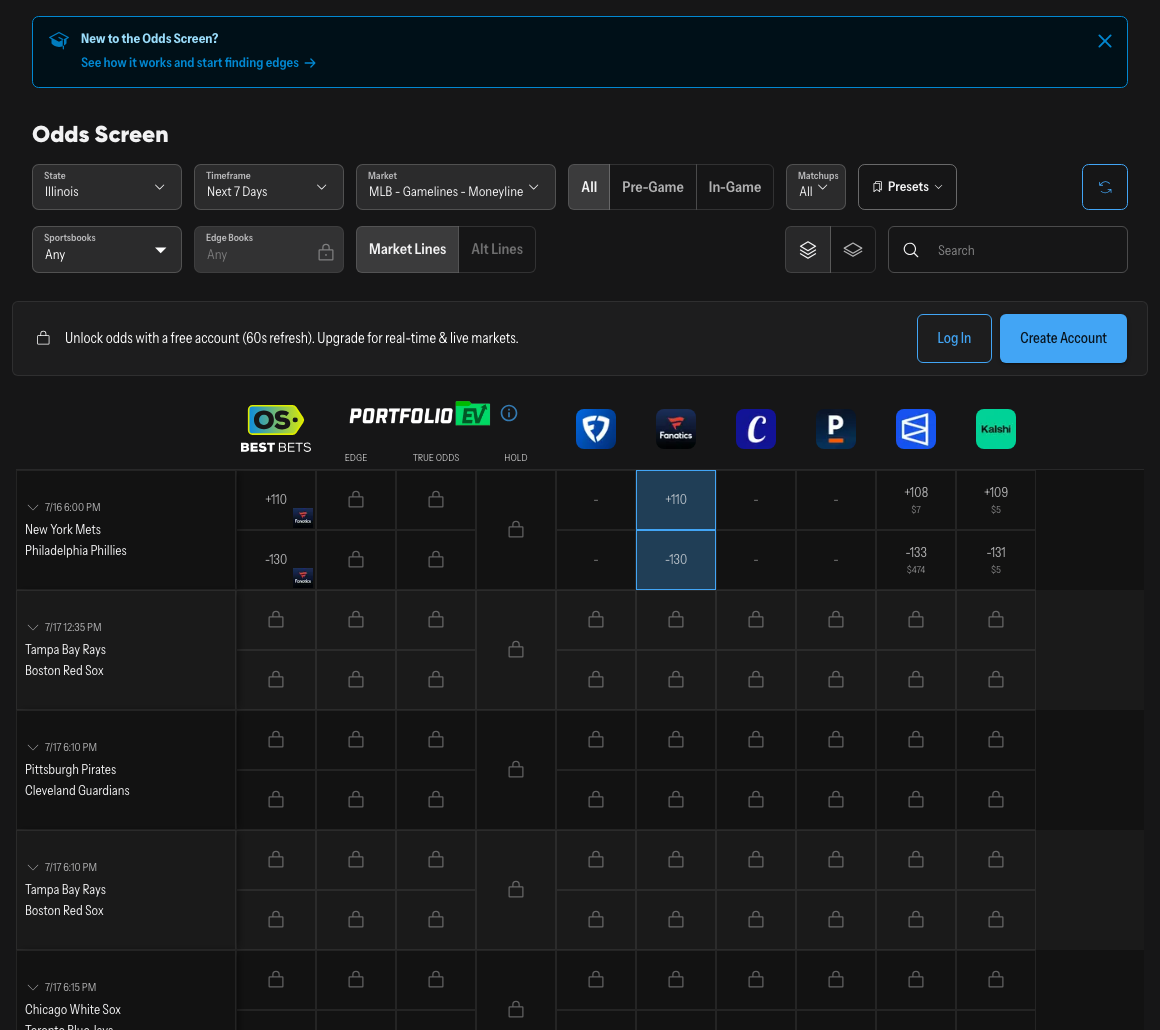 The OddsShopper live odds screen — every book's price on one board, refreshed in real time. Open the live board.
FAQ
What is the best bet tracking app in 2026? There's no single winner, because it depends on how you bet. Pikkit is the easiest hands-off, verified tracker for mainstream US books; Juice Reel wins on sheer coverage and pick-seller tools; Betstamp is best if you want an odds screen wired into your tracking; and Action Network fits bettors who want content and tracking in one place.
Are bet tracking apps free? The core tracking on Pikkit, Juice Reel, and Betstamp is free. Advanced analytics and full CLV on Pikkit sit behind Pikkit Pro, and Betstamp's premium odds screen (Betstamp PRO) is paid. Action Network's tracker is free with paid content tiers on top.
What is CLV and why does it matter? CLV, or closing line value, is the difference between the odds you bet and the odds at kickoff. Consistently beating the closing line is the strongest sign you're getting the better of the market, and it's a more reliable long-term read than win-loss over a small sample.
Can a bet tracker help me find good bets? Only indirectly. A tracker grades bets you've already placed and shows whether you beat the close. To find the +EV prices in the first place you need an odds tool like OddsShopper's +EV screen, which is why pairing a tracker with an odds screen is the complete workflow.
The Bottom Line
Pick your tracker by how you actually bet: Pikkit for hands-off verified stats, Juice Reel for coverage and selling picks, Betstamp for the odds-screen loop, Action Network for content plus tracking. But remember what the whole category can and can't do. A tracker is a truth-teller, not a money-maker; it settles the argument about whether you're winning, and it points at CLV as the number that matters. Getting good CLV, night after night, happens before the bet, on the odds screen, not in the ledger. Track everything, then go get the next one at a better price.
More on this: Kalshi Profit And Loss Tracking: Your Real P&L, Fees Included · Best NFL Betting Apps 2026: Top Sportsbooks Compared · MLB Division Odds On Kalshi Vs Sportsbooks: 3 Tightest Races · How To Play Sleeper Picks: Review + Promo Code · Sleeper Promo Code Vs Betr Promo Code (2026)